Why turnkey AAC plant delivery timelines often extend beyond quoted 6–8 months — and where delays most commonly occur
Why “6–8 Months” Is Rarely the Real Timeline for a Turnkey AAC Plant
If you’re evaluating turnkey AAC plant proposals—and especially if you’ve already received a firm quote citing “delivery in 6–8 months”—pause before signing. That number is almost always a baseline, not a commitment. It reflects ideal conditions: no design revisions, no customs hold-ups, no civil work delays, and seamless coordination across time zones and disciplines. In practice, procurement professionals at mid- to large-scale building materials producers consistently report timelines stretching to 10–14 months, sometimes longer. The cost impact isn’t just about waiting: extended schedules inflate financing costs, delay ROI, trigger penalty clauses in off-take agreements, and force costly stopgap production solutions.
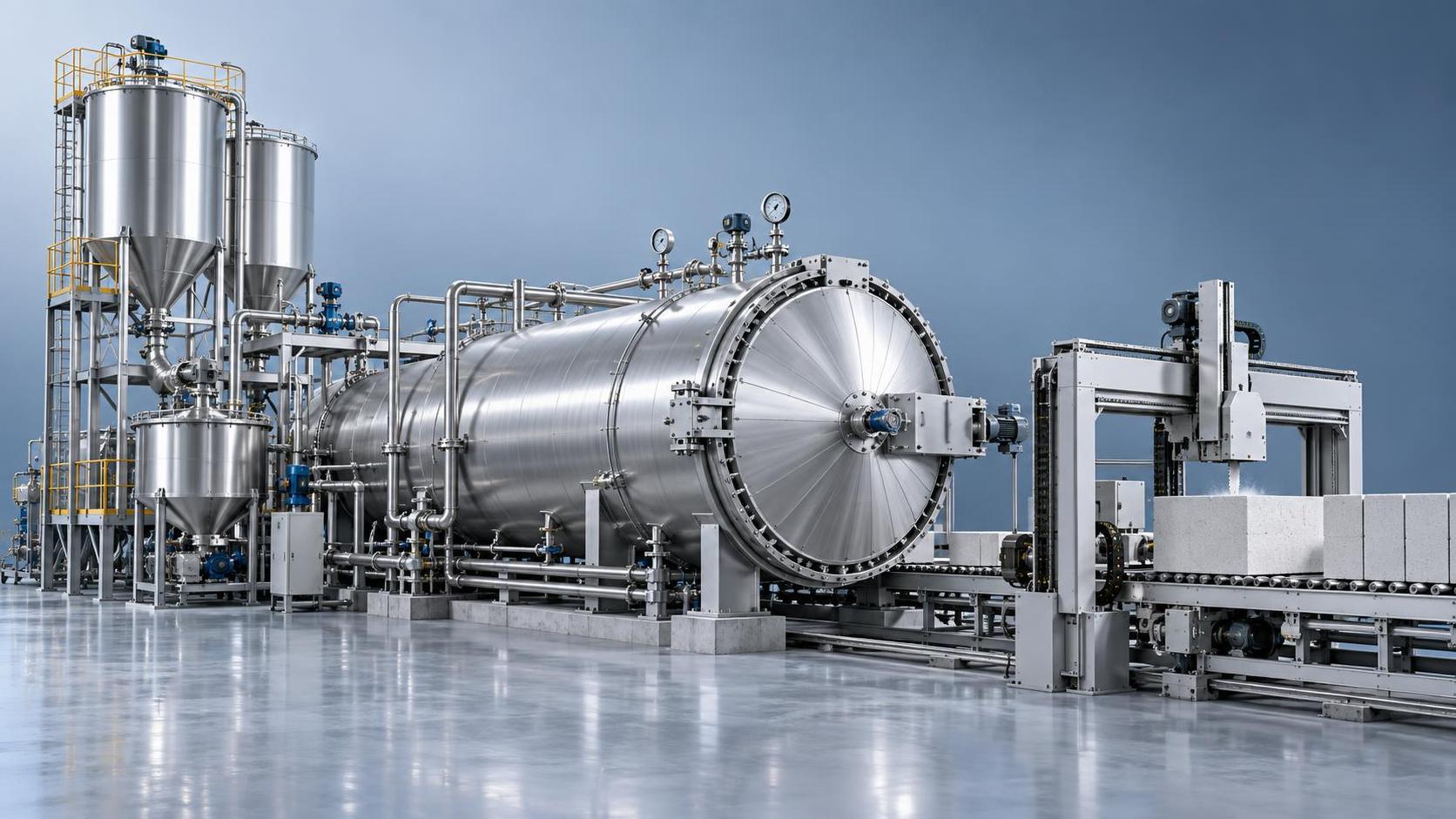
This isn’t a sign of poor vendor performance—it’s how complex industrial integration actually works. A turnkey AAC plant isn’t assembled from pre-fabricated modules like a prefabricated office. It’s a tightly interlocked system: structural steel, autoclaves, slurry preparation units, cutting machines, steam generation, PLC control architecture, and site-specific utilities—all engineered, sourced, fabricated, tested, shipped, installed, and commissioned as one functional unit. When any one link stretches, the entire chain does.
The Four Most Predictable Delay Points—And Why They’re Not Just “Vendor Issues”
Based on decades of execution across hundreds of aerated concrete block production lines—including those supplied by ISO-certified manufacturers with integrated R&D and multi-base production capacity—the most frequent timeline slippage occurs in four interconnected areas. None are avoidable—but all are manageable, provided procurement teams understand where leverage exists.
1. Engineering Finalization & Local Regulatory Alignment
“Design approval” sounds like a formality. In reality, it’s often the first major bottleneck. AAC plants must comply with local pressure vessel codes (e.g., ASME, PED, or GB/T standards), electrical safety regulations, emissions limits, and seismic requirements—none of which are universal. A vendor’s standard layout may require re-engineering for your country’s foundation soil data, monsoon rainfall intensity, or grid voltage stability. Even minor changes—like relocating the steam condensate return line to accommodate existing drainage gradients—trigger revised P&IDs, updated stress calculations, and re-submission to local authorities.
Procurement teams often underestimate how long this takes—not because engineers are slow, but because iterative feedback loops dominate. One revision cycle can take 3–5 weeks. Two or three cycles are common. And if the vendor lacks in-country engineering support or certified local reviewers, that cycle extends further.
2. Third-Party Critical Component Sourcing
No single manufacturer builds every component of a turnkey AAC plant. Autoclaves, high-precision cutting saws, and specialized slurry pumps are typically sourced from specialist suppliers—some with lead times exceeding 20 weeks. These aren’t off-the-shelf items; they’re custom-built to exact pressure ratings, material specs, and interface dimensions.
Delays here rarely stem from the main vendor’s planning. They come from external factors: port congestion delaying imported gear motors; semiconductor shortages impacting PLC cabinet deliveries; or quality rejection during factory acceptance testing (FAT) of an autoclave shell. When that happens, the entire assembly sequence stalls—because downstream equipment (e.g., conveyors, curing stacks) can’t be installed until the autoclave is positioned and anchored.
Smart procurement doesn’t assume “vendor-managed sourcing” means zero risk. It means verifying which components are truly proprietary vs. outsourced—and demanding visibility into supplier lead times and FAT schedules *before* contract signature.
3. Site Civil Work Readiness—The Silent Schedule Killer
Vendors quote “6–8 months from order.” They rarely quote “6–8 months from *your* completed foundations, leveled slab, utility tie-ins, and crane access.” Yet without these, no major equipment can be set. Civil work is almost always owner-responsible—and routinely underestimated in scope and duration.
A typical AAC plant requires reinforced concrete foundations rated for dynamic loads (cutting machines vibrate intensely), steam condensate pits with chemical-resistant linings, and underground cable trenches meeting fire-rating codes. If site surveys reveal unexpected groundwater or poor bearing capacity, redesign and dewatering add months. Worse: if civil work starts *after* equipment fabrication begins, the vendor’s workshop space fills up with unassembled modules—triggering storage fees, demobilization/re-mobilization costs, and potential damage during extended laydown.
The fix isn’t faster construction—it’s parallel execution. Civil drawings should be finalized and approved *before* final engineering sign-off. Procurement contracts should explicitly tie milestone payments to verified civil completion—not just equipment shipment.
4. Commissioning Coordination Across Borders and Disciplines
Commissioning isn’t flipping a switch. It’s a staged, documented process: mechanical completion checks → electrical loop testing → dry run of each subsystem → integrated wet commissioning → performance validation over 72+ hours. Each step requires qualified personnel from multiple disciplines—mechanical fitters, control system engineers, autoclave safety inspectors—and often, simultaneous presence of vendor staff and client operations teams.
When teams operate across three time zones, with visas, travel approvals, and language support required, aligning availability becomes its own project. A two-week commissioning window can slip by six weeks simply because the autoclave specialist was booked on another continent—or because the client’s shift schedule didn’t allow for 24/7 supervision during the critical 72-hour test.
This phase is where “turnkey” most visibly breaks down. Vendors may deliver hardware on time—but without synchronized readiness on both sides, the plant remains non-operational.
What Procurement Can Control—Not Just Monitor
Timeline risk isn’t passive. It’s contractual, procedural, and relational. Here’s what moves the needle:
- Require a detailed, stage-gated master schedule—signed and updated monthly. Not just “equipment delivery Q3,” but “autoclave FAT completed by [date], foundation pour completed by [date], PLC software load by [date].” Hold weekly alignment calls—not just with the vendor, but jointly with your civil contractor and utility provider.
- Define “ready for commissioning” in writing—and verify it 90 days in advance. This includes calibrated instruments, trained operators, spare parts inventory, and documented SOPs. Don’t wait until the commissioning team arrives to discover the water treatment system isn’t online.
- Pre-qualify third-party component suppliers—and build buffer into the contract. Ask for letters of intent from autoclave and pump suppliers. Negotiate liquidated damages not just for late delivery, but for late FAT or late submission of compliance documentation.
- Align commercial terms with physical dependencies. Avoid front-loaded payments. Tie 30% to mechanical completion, 40% to successful 72-hour performance test, and only 30% to final handover—including as-built documentation and training certification.
Manufacturers with deep technical integration—like those operating national-level research institutes, holding dozens of patents in AAC process control, and managing end-to-end production across multiple bases—don’t eliminate these delays. But they reduce their frequency and severity through tighter engineering control, in-house fabrication of critical subassemblies, and proven protocols for cross-border commissioning. That reliability translates directly into schedule predictability—and ultimately, lower total cost of ownership.
For procurement professionals, the real question isn’t “Can we get it in 6 months?” It’s “What evidence do we have—beyond a brochure—that this vendor has delivered a plant like ours, on time, under conditions like ours?” That evidence—not the quoted timeline—is the only reliable input for a sound purchasing decision.
Previous:International Projects
Next:No more content
Recommend
 Sep 17, 2026
Why turnkey AAC plant delivery timelines often extend beyond quoted 6–8 months — and where delays most commonly occur
Discover why turnkey AAC plant timelines often exceed 6–8 months—and where delays really happen. Get actionable insights to protect your schedule & ROI.
 Aug 19, 2026
International Projects
 Aug 19, 2026
International Projects