Do You Need a Ball Mill for Sand-Based AAC Production?
A ball mill is not automatically required for sand-based autoclaved aerated concrete (AAC) production. It is needed when the available sand cannot consistently meet the fineness and slurry requirements of the chosen process without grinding. If a suitable fine silica material is available at a dependable cost and can be incorporated into the mix reliably, a production line may operate without an on-site ball mill.
The decision is more consequential than simply asking whether sand looks fine. Particle-size distribution, mineral composition, supply consistency and the AAC recipe all affect how the silica source behaves. Removing the mill also removes a way to adjust incoming material, so the alternative must be evaluated as a complete material-handling and quality-control arrangement.
Why is sand ground for AAC production?
Sand supplies much of the silica in a sand-based AAC mixture. During autoclaving, reactive silica participates in the formation of calcium silicate hydrates in the presence of lime, water, heat and pressure. These reactions contribute to the strength and structure of the hardened product.
Grinding increases the surface area available for reaction. Coarse particles generally react less readily than finer particles under the same curing conditions, and material that remains insufficiently reactive can affect the relationship between mix design, autoclaving and final properties. Fineness is therefore a process variable, not merely a purchasing specification.
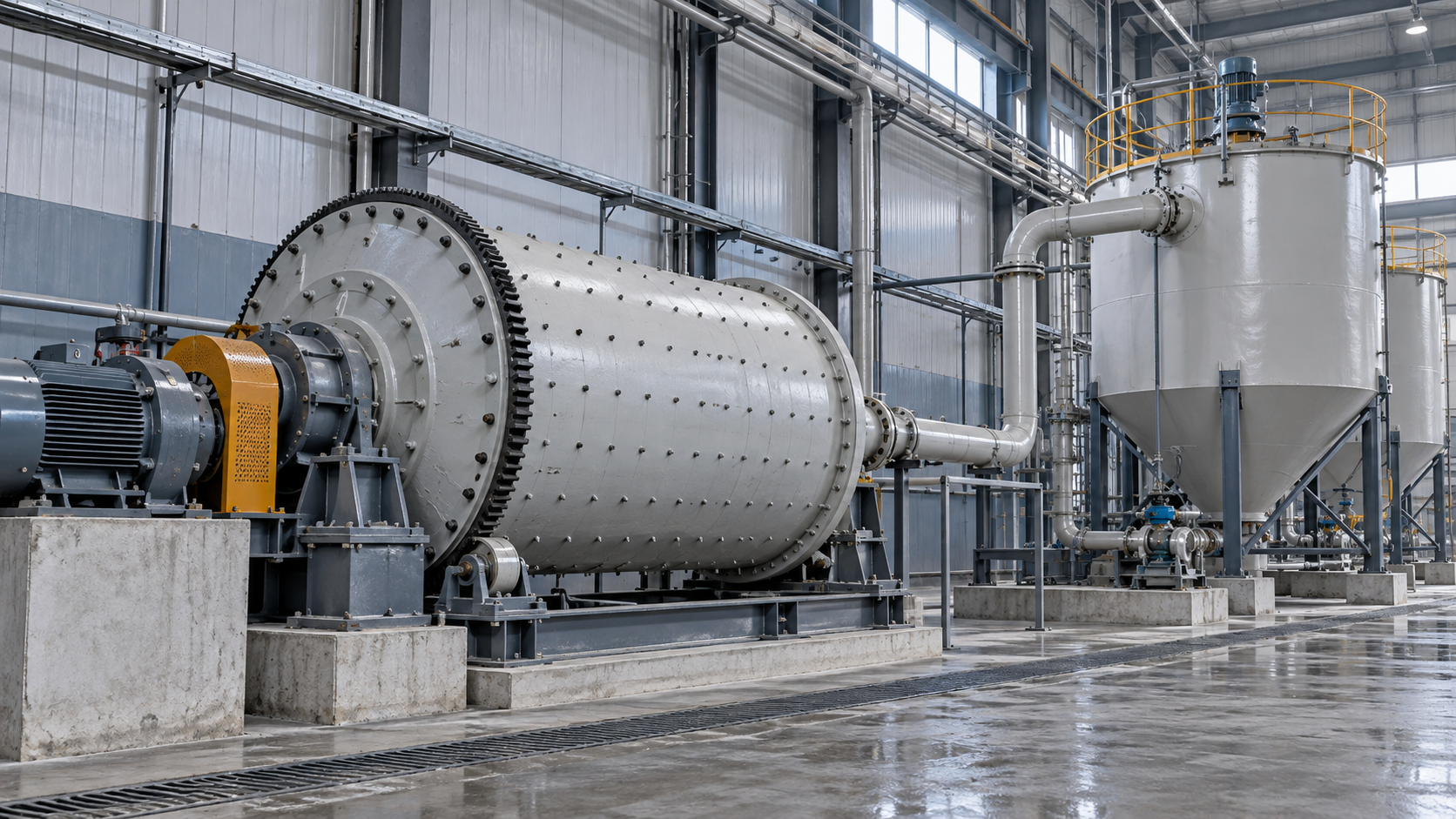
A wet ball mill is one way to prepare the silica source. Sand and water are fed into a rotating mill containing grinding media. The resulting slurry is transferred to downstream storage and batching equipment, subject to the plant’s process design. Grinding and slurry preparation are connected functions, but they are not identical: a plant using pre-ground material still needs a dependable way to store, meter and incorporate it.
When is a ball mill likely to be necessary?
An on-site mill is a strong candidate when the intended raw material is ordinary construction sand or another silica source whose particle size is too coarse for the proposed AAC process. It may also be justified when several available sand sources vary enough that a fixed recipe cannot reliably accommodate them without preparation.
The need should be established against the requirements of the specific production line, not against a generic description such as “fine sand.” A sample can contain a substantial fine fraction and still have a coarse tail that changes its behaviour. Conversely, a material does not need to be ground more finely than the process requires simply because finer material is technically achievable.
Grinding capacity should also match production demand. A mill that can produce the required fineness in a laboratory test does not automatically have adequate throughput under continuous operating conditions. Sand hardness, feed size, target fineness and slurry concentration all influence the equipment and operating conditions needed.
When can a sand-based AAC plant operate without one?
A mill may be unnecessary when the plant has access to a pre-ground silica material that is suitable for the recipe and can be supplied consistently. Depending on the material and line design, it may arrive as a dry powder or as a prepared slurry. Natural material with a sufficiently fine particle-size distribution may also be considered, but its suitability must be demonstrated rather than inferred from appearance.
Skipping grinding is credible only if the alternative satisfies both the production process and the commercial supply arrangement. A material that works in a trial but has no dependable source may not support a continuous plant. Equally, a material that is available in volume but varies substantially between deliveries can create batching and product-quality difficulties.
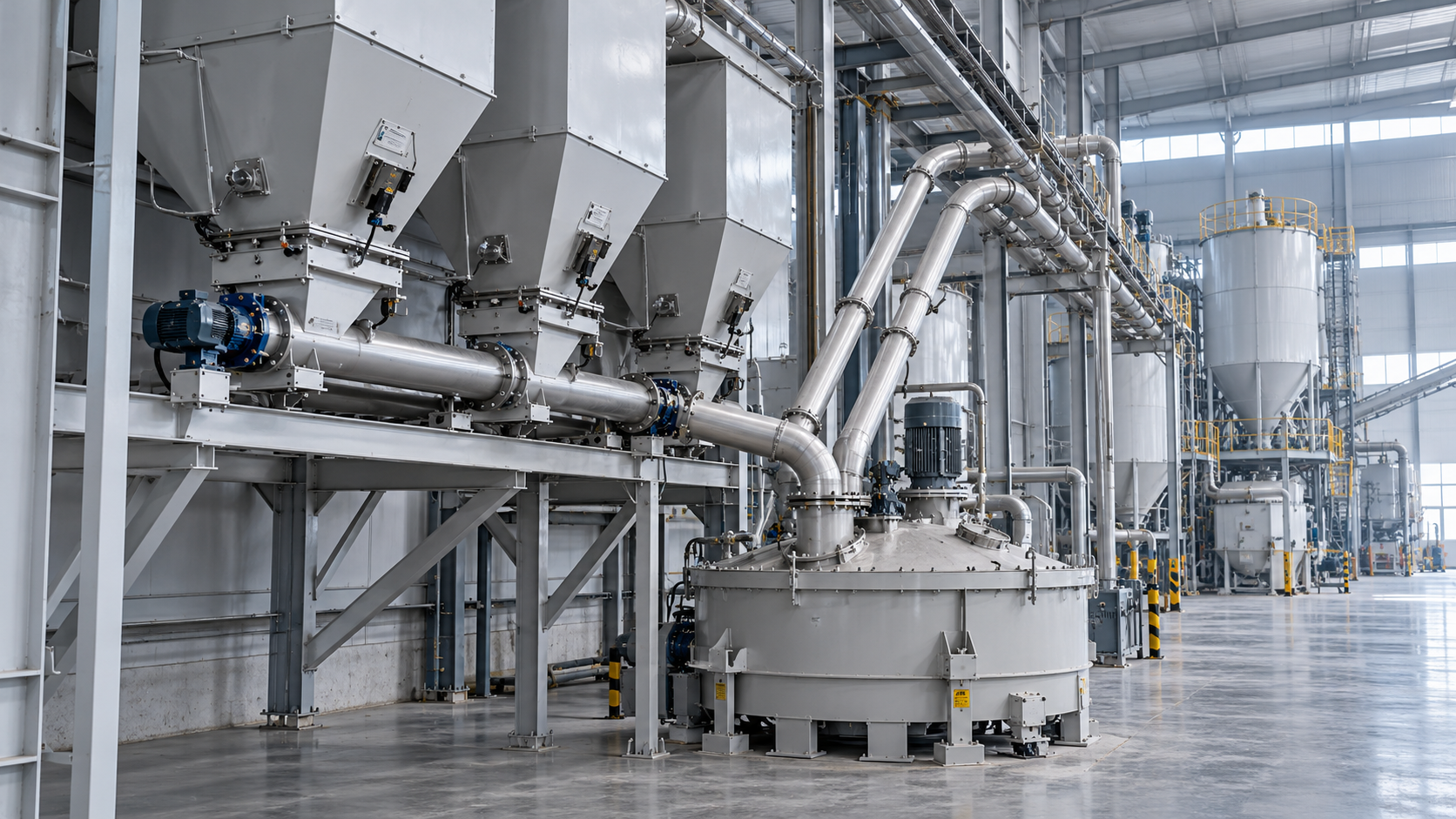
Before removing the mill from the design, establish how the material will be received, stored and dosed. Dry powder may require enclosed transfer, dust control and mixing equipment. Purchased slurry requires suitable tanks, agitation and pumping, along with controls for solids content and settling. Avoiding the mill does not eliminate these requirements.
Is particle size the only test that matters?
No. Particle-size distribution is central, but it does not describe everything that affects AAC performance. The silica content and mineralogy of the material matter, as do impurities and variations in moisture. Clay, organic matter or other unwanted constituents can interfere with handling or mix behaviour, depending on their nature and concentration.
The particle-size distribution should be assessed across the material, not only by a single average figure. Two sands with similar average sizes can contain different proportions of coarse or very fine particles. Those differences can influence reaction behaviour, water demand and slurry handling.
Sampling is equally important. A result from one bag or one delivery cannot establish long-term consistency. Obtain representative samples from the intended source and discuss how the supplier controls changes in its deposit, processing and delivery. The proposed acceptance criteria should be linked to the AAC formulation and agreed with the process designer rather than copied from an unrelated plant.
Does a fine silica material guarantee acceptable AAC blocks?
No. Fineness can make a silica source more suitable, but finished block properties depend on the complete process. Lime and cement characteristics, water content, aluminium dosing, mixing, rising conditions and the autoclave cycle all interact with the silica material.
A meaningful qualification therefore goes beyond checking a laboratory particle-size report. The material should be assessed in the intended formulation and curing conditions. Trial batches should be evaluated for relevant fresh-mix behaviour and finished-product properties, such as density and compressive strength, against the project’s specifications and applicable local requirements.
If the trial result is unsatisfactory, the cause should not automatically be assigned to the absence of a mill. The formulation or curing cycle may need adjustment, but changes should be assessed together: compensating for unsuitable raw material can create added cost or reduce the operating margin elsewhere in the process.
Can another type of mill replace a ball mill?
Potentially. Other grinding technologies can produce fine silica material, but the choice depends on feed characteristics, required particle-size distribution, whether the process uses wet or dry material, and the capacity required. A substitute should be evaluated on the material it delivers to batching, not solely on its nameplate capacity.
Wet and dry grinding lead to different downstream arrangements. Wet grinding produces a slurry that must be monitored and kept sufficiently uniform in storage. Dry grinding produces powder that must be conveyed and metered, with appropriate dust containment, before it is mixed with water or other ingredients. Either route must fit the AAC line’s dosing system and formulation.
Where an equipment proposal specifies an alternative mill, ask how its output will be measured, how coarse material is controlled and what operating assumptions support the stated capacity. The same questions apply to a ball mill: the equipment is only useful if it delivers the required output under the expected feed conditions.
What changes in the plant design if the ball mill is omitted?
Removing the mill can reduce the amount of grinding equipment, associated wear parts and maintenance work on site. It also transfers more responsibility for particle size to the incoming material supplier or to a separate processing facility. The practical question is whether that transfer improves the project as a whole.
The plant still needs enough storage to manage delivery interruptions and enough control to keep the silica feed consistent. For slurry, this includes measuring solids concentration and providing agitation or recirculation suitable for the material. Settling can make the material drawn from a tank differ from the material initially delivered, even when the delivery itself met specification.
For dry fine material, the design must address flow from silos or other storage, accurate dosing and dust control at transfer points. Additional mixing may be needed to incorporate the powder uniformly. These provisions should be included in the comparison rather than treating a no-mill line as a line with no silica-preparation equipment.
Changes in raw-material moisture also affect batching. If wet material is supplied with variable water content, the process must account for that water to maintain the intended mix proportions. A weight-based delivery figure alone may not indicate how much dry silica has entered the recipe.
How should the costs be compared?
Compare the cost of producing an acceptable quantity of AAC, not just the purchase price of the mill or the price per tonne of sand. An on-site grinding option includes equipment, installation, electrical demand, grinding media, wear parts, maintenance, water and the personnel needed to operate and monitor it. The cost of managing downtime and spare parts also belongs in the assessment.
A no-mill option may require a higher-value processed silica feed, different storage and handling equipment, and transport for material prepared elsewhere. For purchased slurry, the delivered price includes the movement and handling of water as well as solids. Comparing prices on a dry-solids basis makes the alternatives easier to assess.
Supply risk has a financial effect even when it is difficult to express as a single figure. Consider the available sources, the cost of holding inventory, delivery reliability and the consequences of changing material. A plant with on-site grinding has more control over feed preparation, but it remains dependent on a suitable raw sand supply and on mill availability.
What should be confirmed before the equipment order is finalized?
The decision should be tied to a defined raw-material source and a documented process basis. A useful equipment discussion includes representative material samples, the planned production rate, the proposed AAC formulation and the desired finished-product specifications. Without these inputs, a supplier cannot reliably establish whether grinding is unnecessary or size a mill for the duty.
Ask the process designer to identify the required silica-feed characteristics, how they will be measured and where responsibility lies if the incoming material falls outside those limits. If pre-ground material is proposed, confirm whether the agreed specification covers particle-size distribution, composition, moisture or slurry solids, and how variation between deliveries will be handled.
If a ball mill is proposed, request the basis for its capacity and output fineness using the actual feed material or a clearly defined equivalent. The proposal should also explain the associated slurry storage, pumping, controls and maintenance provisions. A mill sized around a different sand or an undisclosed target fineness may not deliver the expected result.
The practical answer is conditional: retain a ball mill when the plant needs on-site grinding to turn its available sand into a consistent AAC feed. Omit it only when an alternative material and handling system have been qualified for the intended recipe, production rate and supply conditions. The decisive evidence is the performance and reliability of the complete process, not whether a particular piece of equipment appears on the layout.
Next:No more content
Recommend
 Nov 03, 2026
Do You Need a Ball Mill for Sand-Based AAC Production?
Do I need a ball mill for sand-based AAC production? Discover when grinding is essential, when you can skip it, and how to make a cost-effective choice.
- Nov 03, 2026
How Accurate Should AAC Ingredient Dosing Be?
How accurate should AAC ingredient dosing be? Discover ingredient-specific tolerances, practical checks and batching tips to improve consistency and reduce waste.
 Oct 26, 2026
AAC Plant Technical Training: Operator Skills to Verify Before Startup
AAC plant technical training: Discover essential operator checks for dosing, cutting, and autoclave safety. Reduce startup waste and verify team readiness with practical competency assessments.