How Do You Assess a Color Roof Tile Machine for Export Markets?
A roof tile production line can look convincing in a factory demonstration and still disappoint after installation overseas. The sample tiles may be attractive, but the buyer needs to know whether the equipment will maintain that finish with local raw materials, available labor, and the destination country’s power supply. A machine that runs well for ten minutes is not necessarily a line that can supply a roofing business consistently.
Choosing a color tile making machine for export market applications therefore requires more than comparing purchase prices. Equipment importers and roofing manufacturers should assess the finished tile, the complete production process, operating costs, destination-market requirements, and the supplier’s ability to support the installation. Drawing on Shandong Hongfa’s construction machinery background, the following checks help turn a promising quotation into a purchase decision supported by evidence.
Start with the roof tile you intend to sell
“Color roof tile machine” is not a precise equipment category. It can describe machinery for concrete roof tiles, coated metal roofing products, or other colored roofing materials. These systems use different forming methods, raw materials, finishing processes, and quality controls. Before evaluating a supplier, establish exactly which product and manufacturing route the quotation covers.
For concrete roof tiles, the assessment typically includes batching, mixing, forming, curing, and coloring or coating. For coated metal products, forming accuracy, substrate specifications, surface preparation, and coating performance become central. Comparing quotations without resolving this distinction can lead to purchasing equipment that does not match the intended market.
Prepare a short product brief with the tile profile, dimensions, target weight, color range, and intended roof application. Include requirements for overlap, interlocking features, fastening holes, and compatible ridge or accessory tiles. Local roofing contractors can be valuable here: a tile that looks appealing on a display rack may be difficult to install on the roof systems they actually use.
Work backward from destination-market requirements
Two separate questions need answers: can the machinery be imported and operated legally, and can the tiles it produces be sold for their intended use? Machine conformity does not establish finished-product compliance.
Before placing an order, consult the relevant authorities, a qualified conformity specialist, or an accredited testing laboratory. Depending on the jurisdiction and product, checks may involve machinery safety, electrical requirements, guarding, documentation, or construction-product testing. Roof tile assessments may address dimensions, strength, water resistance, weathering, or other locally applicable properties.
Ask the supplier to connect each compliance claim to a specific document and equipment configuration. A generic certificate, a certificate for another model, or a photograph of a compliance mark is not sufficient evidence. Where third-party testing is required, agree on who supplies samples, who pays for testing, and what happens if the results do not meet the agreed specification.
Resolve compliance responsibilities before the deposit, rather than leaving them for the shipment stage.
Evaluate production quality through a meaningful trial
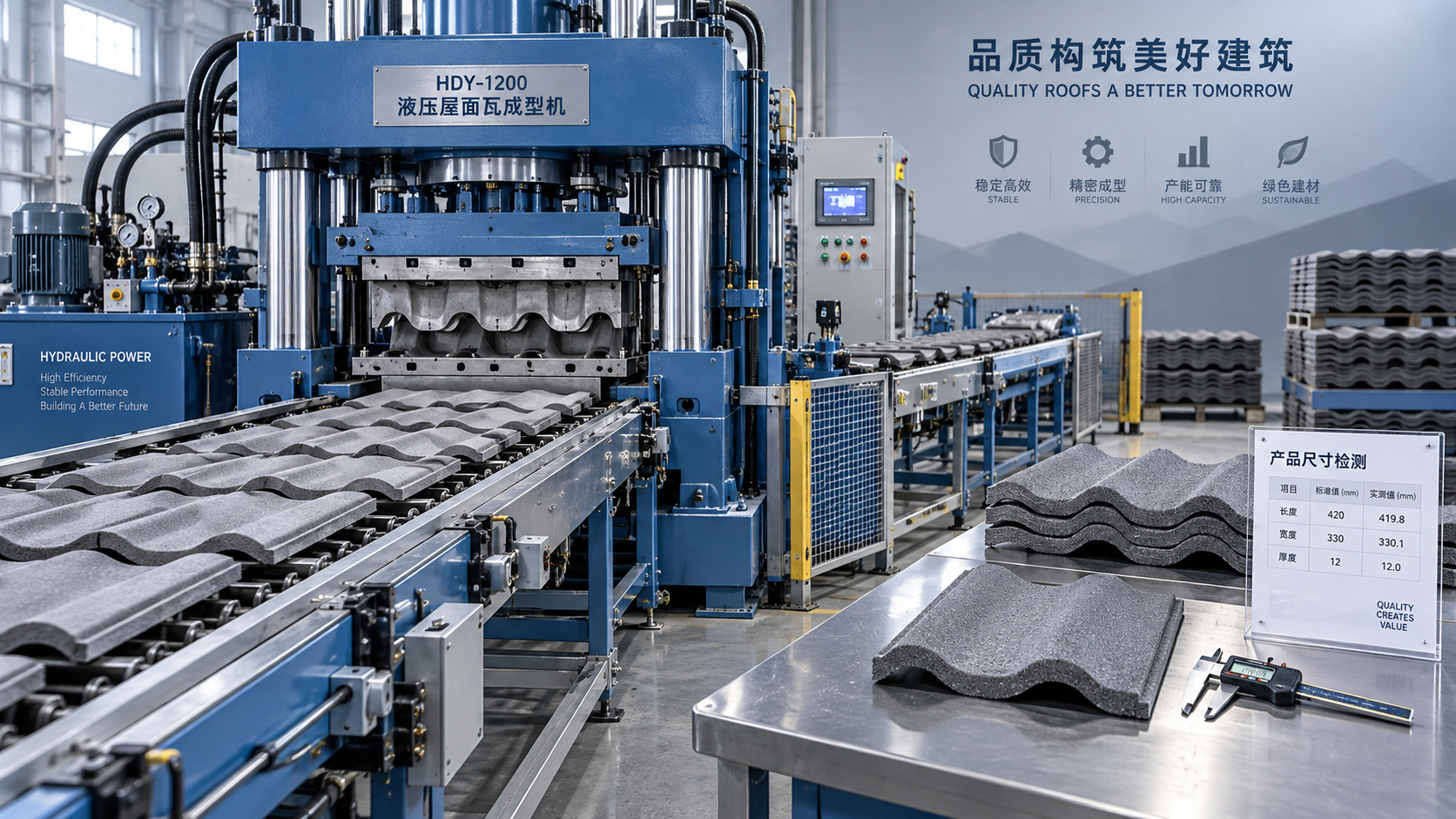
A useful factory trial should resemble normal production closely enough to expose variation. Request a continuous run using the proposed configuration, a documented material recipe, and representative molds. Whenever practical, test with destination-market raw materials or materials with comparable properties.
For concrete tiles, aggregate grading, moisture, cement characteristics, pigments, and additives can influence forming behavior and appearance. A supplier should explain the acceptable material range and the adjustments needed when inputs change. A machine should not be expected to compensate for unsuitable materials without process development.
Agree on sampling intervals and inspect tiles from the beginning, middle, and end of the run. Check:
- Dimensions and profile: length, width, thickness, curvature, and the fit of overlapping or interlocking sections.
- Weight consistency: variation that may indicate unstable feeding, moisture control, or forming conditions.
- Surface condition: cracks, chipped edges, pinholes, incomplete forming, or uneven coating.
- Color repeatability: differences within a batch and between batches under consistent lighting.
- Finished performance: relevant tests after the required curing or finishing period.
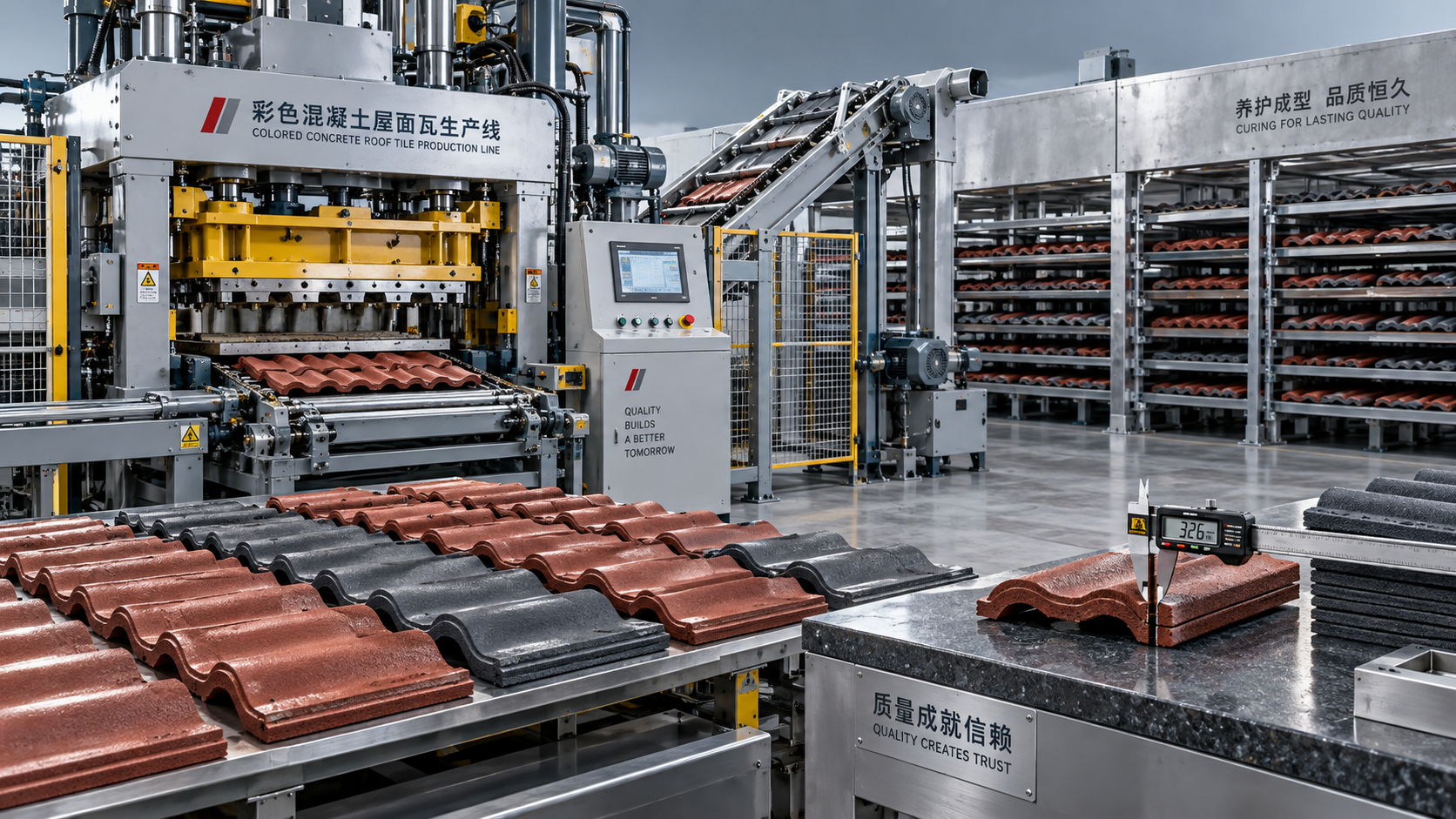
Color deserves particular attention because roofing is viewed as a large surface, not as isolated samples. Small shade differences can become obvious after installation. Ask whether color is introduced through the material, applied as a surface coating, or produced through a combination of methods. Then examine pigment dosing, mixing consistency, coating application, drying conditions, and the procedure for changing colors.
A freshly formed tile cannot demonstrate long-term color retention or durability. Separate what the factory trial proves from what requires finished-product testing and longer-term evidence.
Translate advertised capacity into saleable output
A quoted figure in tiles per minute usually describes a particular operating condition. It may exclude setup, mold changes, cleaning, maintenance, rejected pieces, and downstream delays. For an overseas buyer, the more useful measure is accepted finished tiles per shift.
Use a simple planning relationship:
Saleable output = nominal production rate × scheduled operating time × operating availability × acceptance rate.
For illustration, a nominal rate of 1,000 tiles per hour over an eight-hour shift gives 8,000 tiles before losses. At 80% operating availability and a 95% acceptance rate, the result is approximately 6,080 accepted tiles. These are hypothetical planning assumptions, not specifications for any particular machine.
Also inspect the equipment around the forming machine. Mixing capacity, material feeding, pallet or mold circulation, curing space, coating, handling, and packing can constrain the entire line. Ask the supplier to explain how these stages are balanced and how much floor space, labor, and work-in-process inventory the quoted output requires.
A practical comparison sheet for export buyers
Instead of ranking suppliers by brochure features alone, compare their answers to the same operating questions.
Check whether the machine fits your factory—not just your budget
Confirm the destination voltage, frequency, phase arrangement, and available electrical capacity. Check the specifications of motors, drives, control cabinets, and any auxiliary equipment. Do not assume that adapting the incoming power automatically makes every component suitable.
Request requirements for compressed air, water, drainage, ventilation, ambient conditions, and foundations. Depending on the process, dust control, wash-water management, coating ventilation, or temperature control may also be necessary. These provisions should appear in the project budget rather than emerge during installation.
Maintenance access matters as much as the footprint. Operators need room to clean the machine, remove molds, replace wear parts, and work safely around moving equipment. Ask for a layout showing maintenance clearances and material movement, not merely the dimensions of the main machine.
For controls, clarify the interface language, alarm descriptions, electrical drawings, backup procedures, and access arrangements for troubleshooting. Remote assistance can be useful, but it should complement clear documentation and locally serviceable components.
Calculate cost per accepted tile
The lowest machine price does not necessarily produce the lowest manufacturing cost. Build the comparison around the complete installed project and its expected operating expenses.
Include equipment, molds, auxiliary systems, freight, insurance, import charges, inland delivery, foundations, utilities, commissioning, and training. Operating estimates should cover raw materials, pigments or coatings, energy, labor, consumables, maintenance, rejects, and packing.
Ask for consumption figures with their measurement basis. Was energy measured during loaded production or estimated from installed motor ratings? Does the staffing figure include mixing, coating, inspection, and packing? What material yield was assumed? Figures without these details are difficult to compare fairly.
Model a cautious utilization scenario as well as the supplier’s intended operating case. A new roofing business may need time to develop demand, qualify products, and train its team. An oversized line can tie up capital in equipment, molds, and inventory before sales justify that capacity.
Assess the supplier’s depth and the limits of its promises
Shandong Hongfa Scientific Industrial & Trading Co., Ltd. was established in 1990 and has a construction machinery background spanning block-making equipment, concrete batching plants, aerated concrete production lines, and quartz stone machinery. The company describes manufacturing bases in Shandong and Guangxi, together with engineering and technical resources supporting its equipment business.
That broader manufacturing background is relevant when evaluating material handling, batching, automation, and production-line integration. However, it does not replace verification of the specific roof tile machine offered. Request the proposed model’s technical documents, manufacturing scope, trial arrangements, and evidence of experience with the relevant tile-making process.
Apply the same discipline to certifications. Historical quality-management credentials should not be treated as proof of current certification or destination-market conformity. Verify validity, scope, and applicability to the supplying entity.
After-sales support should be contractual rather than implied. Clarify installation responsibilities, training duration, travel expenses, warranty exclusions, technical response arrangements, and spare-parts delivery conditions. Request a recommended startup stock of critical parts, with identification codes and current quotations.
Make acceptance and shipment part of the purchase contract
Before payment milestones are agreed, define what constitutes successful factory acceptance and successful site commissioning. The contract should identify the equipment supplied, tile specifications, trial conditions, measurement methods, and procedure for correcting nonconformities. Where appropriate, use an independent inspector.
Shipping preparation deserves similar detail. Confirm dismantling and reassembly requirements, corrosion protection, moisture protection for electrical components, lifting points, packing lists, package dimensions, and unloading arrangements. Check any destination requirements for wood packaging and confirm customs documentation with a broker.
Specify the agreed Incoterms rule, named place, and version, alongside insurance and unloading responsibilities. These details determine which costs and risks remain with the supplier and which transfer to the buyer.
The strongest purchase decision is not the one supported by the most impressive brochure. It is the one with the fewest unresolved operating questions. When assessing a color roof tile machine for export markets, insist on evidence that connects the machine to your intended tile, local inputs, factory conditions, and service needs. That is how an attractive equipment offer becomes a workable production investment.
Recommend
 Oct 22, 2026
How Can Buyers Verify a Hydraulic Roof Tile Machine's Output Capacity?
Verify hydraulic roof tile machine production capacity with witnessed trials, downtime logs, and cured-tile quality checks. Learn how to confirm reliable output before you buy.
- Oct 22, 2026
How Do You Assess a Color Roof Tile Machine for Export Markets?
Assess a color tile making machine for export market success. Discover key checks for tile quality, compliance, costs, and supplier support to make a smarter investment.
- Oct 21, 2026
How Do AAC Plant Installation Requirements Differ by Country?
Compare AAC plant installation requirements different countries impose, from pressure-vessel approvals to site permits. Discover key checks to avoid costly delays and plan with confidence.