How Long Should Commissioning an Overseas AAC Plant Take?
How Long Should Commissioning an Overseas AAC Plant Take?
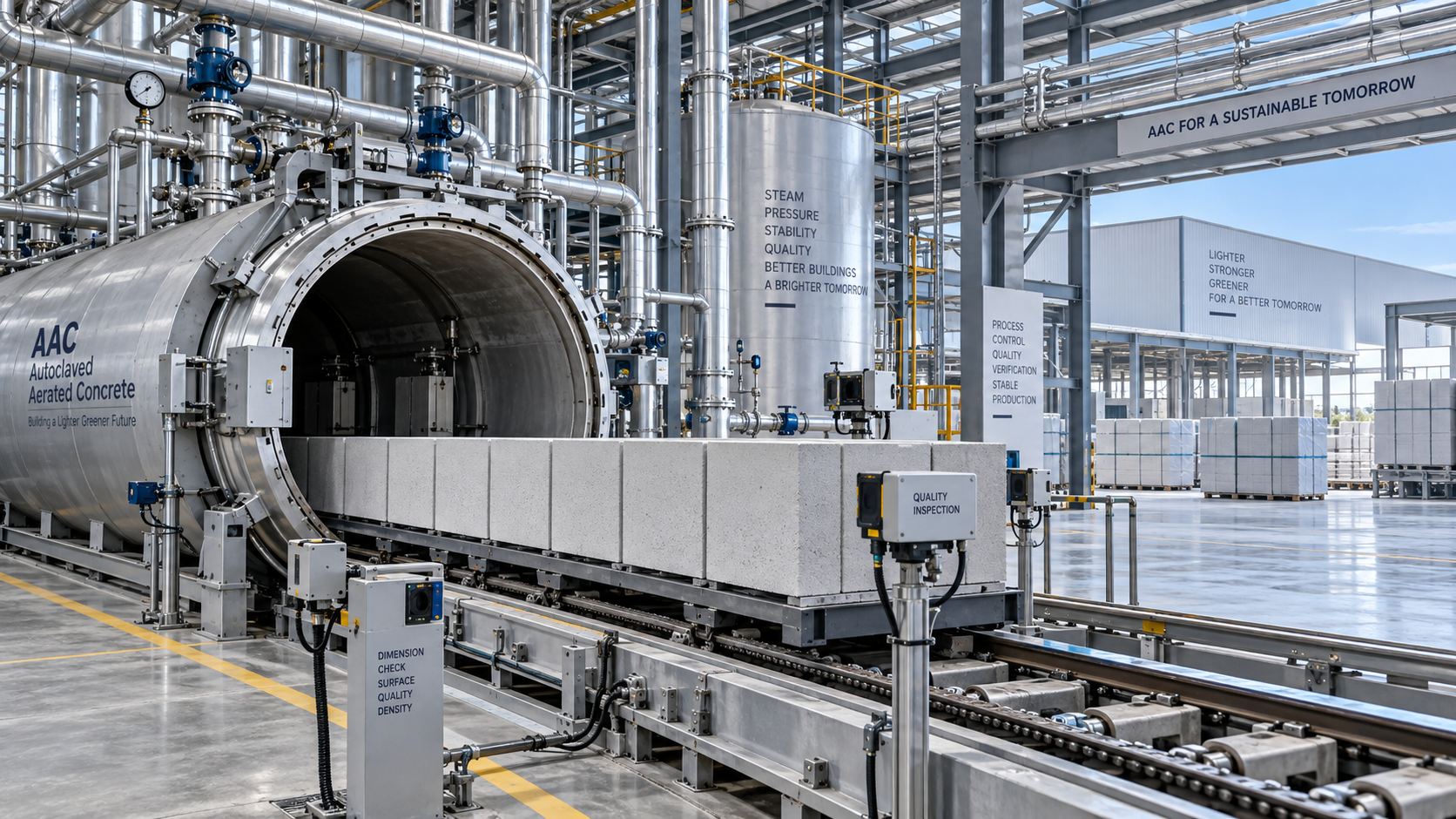
For an overseas autoclaved aerated concrete (AAC) plant, commissioning should be planned in weeks, not treated as a few days between installation and commercial production. If a project needs an initial budgeting assumption, a six-to-twelve-week allowance after verified installation completion can be a starting point for discussion. It is not an industry guarantee or a Hongfa delivery commitment: the actual schedule must be checked against the equipment scope, raw materials, utility readiness, local approvals, and acceptance requirements.
The distinction matters because making the first blocks is not the same as producing market-ready blocks consistently. A line may complete a trial batch while still needing recipe adjustment, cutting corrections, operator training, or reliable steam supply. A useful AAC plant commissioning timeline for an overseas project therefore has several finish lines—not just one startup date.
The practical question is: what must be demonstrated before the plant is considered ready, and which of those conditions are outside the machinery supplier’s control?
Start the clock at a verified readiness milestone
“Installation complete” is often too loose a phrase for scheduling. Machines may be positioned and anchored while cable termination, pipe flushing, instrument calibration, guarding, or control-system integration remains unfinished. Bringing commissioning engineers to site at that point can turn a technical assignment into an expensive waiting period.
A better starting point is a joint readiness review. The supplier and owner should confirm that the line can be tested safely, that utilities are available under the required operating conditions, and that remaining work is recorded in a punch list. Items that prevent safe operation must be closed before the affected tests begin; minor finishing work can sometimes continue separately.
For overseas projects, this review should also cover the less visible dependencies: technician access and travel documents, interpreters where needed, approved raw-material stocks, laboratory equipment, maintenance tools, and responsibility for boiler and pressure-equipment approvals. The applicable requirements depend on the destination country and should be confirmed locally.
Do not start the commissioning clock simply because the last container has arrived. Delivery, installation, commissioning, and production acceptance are different milestones.
Build the schedule around release gates, not optimistic dates
The most useful commissioning programme shows what releases each stage. Some tasks can overlap, but others cannot be compressed without losing the evidence needed to move forward.
Avoid assigning identical durations to these stages. A straightforward mechanical check may close quickly, while material trials need several iterations. Conversely, a sound recipe cannot compensate for a control fault that repeatedly stops cake transfer. The critical path can move as testing reveals the plant’s actual constraints.
Why the first good batch does not settle the schedule
AAC production links several sensitive operations. Slurry preparation and dosing affect the mix; aeration and pre-curing determine whether the cake is ready for cutting; cutting quality influences dimensions and handling losses; autoclaving develops the required product properties. A correction in one area can change conditions downstream.
Consider a trial cake that cuts poorly. Adjusting the cutting equipment may be appropriate, but the underlying issue could be inconsistent cake condition at the cutting point. If the team changes wire settings, mix proportions, and pre-curing conditions at once, the next result becomes difficult to interpret. Controlled trials may feel slower, yet they usually provide a clearer route to repeatability than making several undocumented changes together.
The schedule must allow time for the complete production cycle and subsequent testing. Operators cannot judge final block performance from the appearance of a fresh cake. Sampling, conditioning where required, and laboratory procedures should follow the agreed product standard and test method.
A successful batch demonstrates possibility. Repeated acceptable production demonstrates control. Commercial planning should be based on the latter.
The delays worth investigating before engineers travel
Utilities that exist on paper but fail under load
A connected power supply is not proof that the plant can operate reliably. Likewise, a boiler being installed does not establish that sufficient steam is available when the autoclaves require it. Commissioning needs evidence of utility performance under relevant operating conditions, not just equipment nameplates.
Check utility interfaces against the supplier’s requirements, including water quality, compressed-air condition, electrical protection, condensate arrangements, and steam-system readiness. Pressure equipment must only be tested and operated through approved procedures by qualified personnel. A deadline is not a reason to bypass an interlock or local inspection requirement.
Local raw materials that differ from the design assumptions
An AAC recipe should not be treated as universally transferable. Depending on the process route, changes in sand or fly ash characteristics, lime reactivity, cement, gypsum, or aluminium dosing behaviour can affect production. Laboratory review and, where practical, preliminary trials reduce uncertainty before full-line startup.
Use representative materials from the intended supply chain. A carefully selected trial sample is of limited value if commissioning later relies on a different source. Keep enough consistent stock for comparative trials; otherwise, each delivery may introduce another variable just as the process begins to stabilise.
Small missing items with large consequences
A failed sensor, unsuitable seal, or damaged cutting component can interrupt testing despite being a minor part of the purchase value. Overseas replacement lead times deserve attention before mobilisation. The initial spare-parts package should reflect commissioning risks and local availability, not merely a generic list of consumables.
Clarify who supplies and services equipment outside the main line. Boilers, compressors, transformers, and laboratory instruments may come from separate vendors. If nobody owns the interfaces, the commissioning team inherits a coordination problem it cannot solve through machine adjustment.
Training should run through commissioning, not follow it
Waiting until the line runs well before training operators wastes the best learning opportunity. Local staff should participate in checks, observe controlled recipe changes, record batch data, and learn how deviations are diagnosed. Maintenance personnel need exposure to lubrication, alignment, inspection points, alarms, and safe isolation procedures.
There is also a shift issue. A plant operated successfully by the supplier’s engineers and one experienced local crew has not necessarily demonstrated readiness for independent multi-shift production. Include the intended operating teams in the training plan, with clear handover records and accessible instructions.
Shandong Hongfa Scientific Industrial & Trading Co., Ltd., established in 1990, manufactures AAC production lines alongside other construction machinery, including block machines and concrete batching plants. For an overseas AAC project, that manufacturing background is relevant, but buyers should still request the project-specific commissioning scope. The useful deliverables are the staffing plan, readiness checklist, training arrangements, trial responsibilities, and acceptance procedure—not company history alone.
Define “finished” before the first trial
Acceptance disagreements often begin with undefined expectations. The owner may expect saleable output at contracted capacity, while the supplier expects completion of functional tests. Both parties can believe the schedule is on track while measuring different outcomes.
The contract and commissioning plan should distinguish equipment functionality, product quality, production performance, and independent operation. Agree on the block sizes and grades to be tested, applicable standards, sampling arrangements, laboratory responsibility, test duration, and permitted exclusions. If capacity is part of acceptance, define whether it refers to gross output or accepted product, and specify the operating conditions.
Also decide how interruptions will be recorded. A stoppage caused by unavailable site power should not be silently grouped with an equipment failure. Accurate cause records protect both parties and make corrective action much faster.
Market readiness may involve obligations beyond machinery acceptance, including local product testing or conformity requirements. Confirm these before promising customer deliveries.
Turn a provisional allowance into a credible production date
A six-to-twelve-week working allowance is useful only if it is replaced by a reviewed, project-specific programme. Ask the machinery supplier to identify assumptions, stage-release conditions, owner responsibilities, and the activities most likely to extend the schedule. Keep unresolved installation work separate from process optimisation so that delays remain visible.
Report readiness, first complete trial, first conforming production, and sustained acceptance separately. This gives investors a more honest picture than a single “commissioning percentage.” It also helps sales teams avoid committing stock that has not yet passed the required checks.
Before confirming the overseas team’s travel date, close the readiness review and agree on what successful handover will look like. That is the point where a commissioning estimate becomes a schedule the project can actually manage.
Recommend
 Oct 21, 2026
How Do AAC Plant Installation Requirements Differ by Country?
Compare AAC plant installation requirements different countries impose, from pressure-vessel approvals to site permits. Discover key checks to avoid costly delays and plan with confidence.
- Oct 21, 2026
How Long Should Commissioning an Overseas AAC Plant Take?
Plan your AAC plant commissioning timeline for an overseas project. Discover readiness checks, trial stages and acceptance criteria to reduce delays and set realistic production dates.
- Oct 20, 2026
What Operator Training Should an Overseas AAC Plant Supplier Provide?
AAC plant technical training for overseas operators: discover essential safety, process control, maintenance, and assessment skills to compare suppliers and secure a confident plant handover.