How Much Does a Quartz Stone Production Line Cost?
A quartz stone production line can require a substantial investment, but there is no single price that reliably describes what a buyer will spend. A quotation for a basic machinery package may cover only part of the equipment needed to produce saleable slabs. Freight, factory preparation, utilities, installation, raw materials and working capital can materially increase the amount required before the first shipment to a customer.
The most useful starting point is to price the project in layers: the equipment needed for the intended slab and output, the cost of bringing that equipment into operation, and the cost of producing and selling finished material. Without a defined capacity, product specification and site, a precise figure would be misleading. A comparable, itemized quotation will give a stronger basis for an investment decision than an isolated headline price.
What is included in the price of a production line?
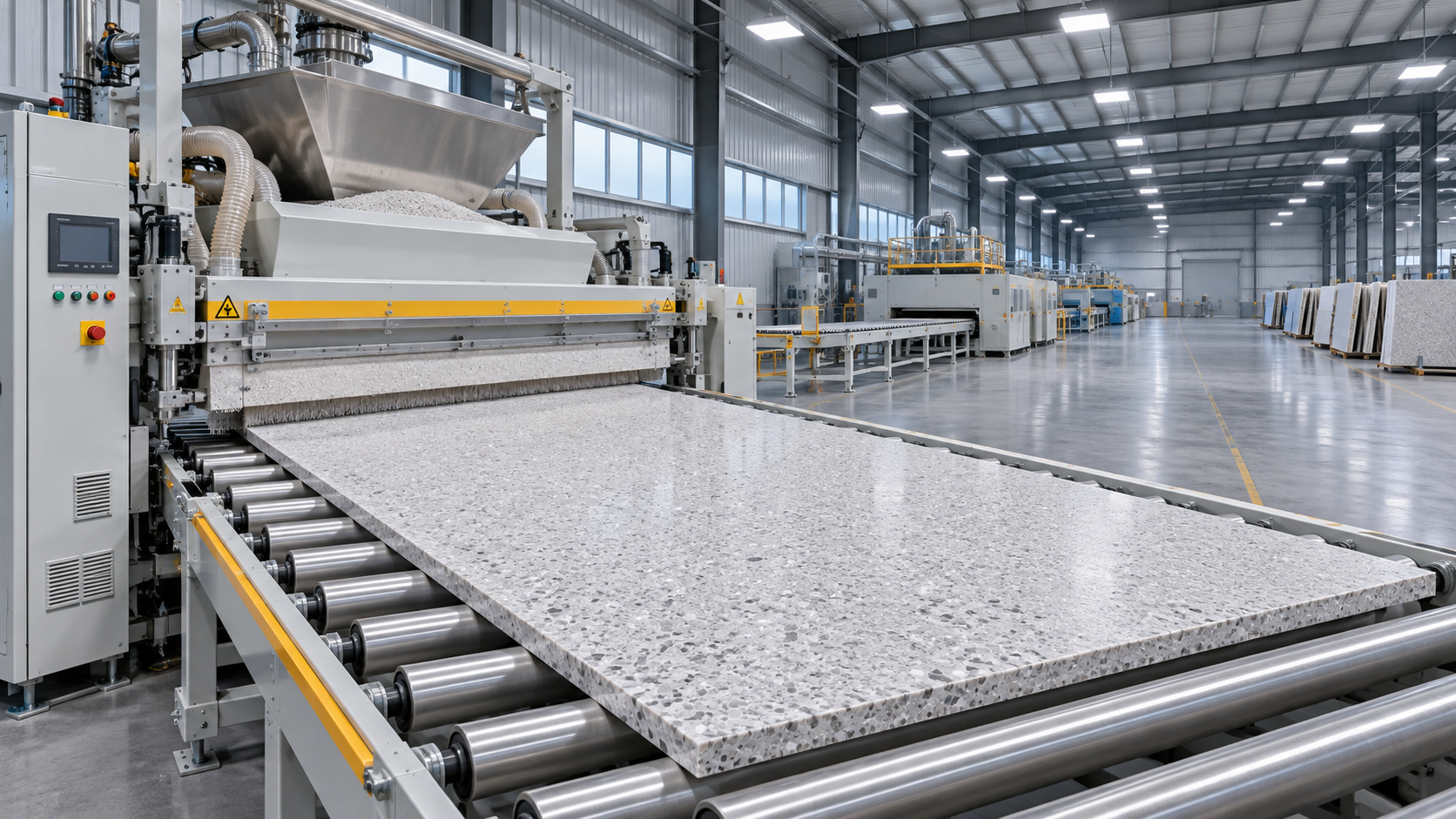
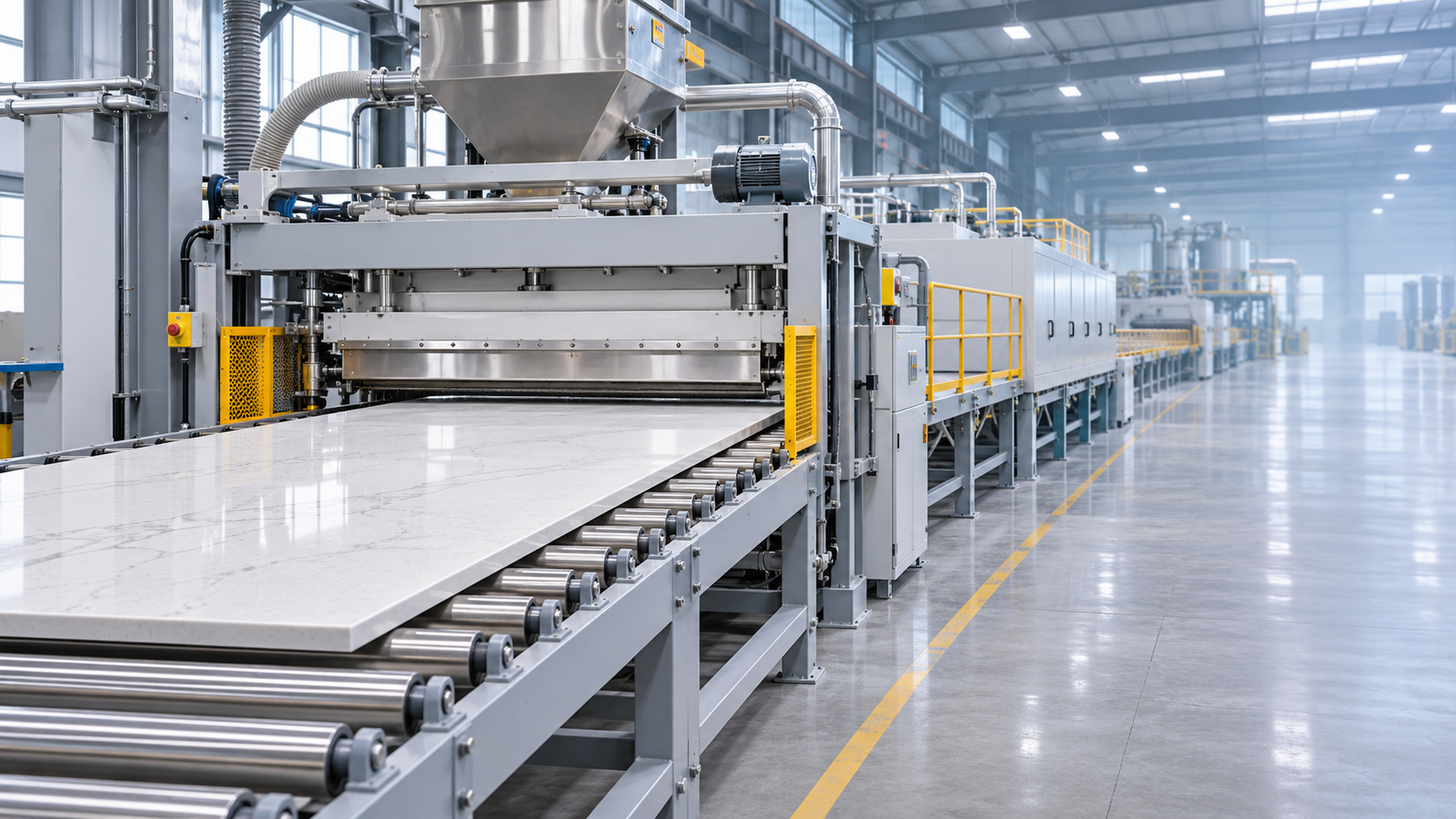
Engineered quartz slabs are made by combining mineral aggregates with a binder and other formulation ingredients, forming and compacting the mixture, curing the slab, and finishing its surfaces. The machinery required depends on the chosen process and the condition in which the product will leave the factory.
A quotation may include some or all of the following stages:
- Material handling and preparation: Storage, conveying, weighing and mixing equipment for aggregates, resin and other ingredients.
- Slab forming: Equipment to distribute the mixture, form slabs and compact them to the required dimensions and consistency.
- Curing and handling: Equipment and space for curing, moving and temporarily storing slabs between operations.
- Finishing: Grinding, calibration, polishing, cutting and inspection equipment, depending on the required finished product.
- Supporting systems: Controls, dust collection, compressed air, water handling and other services associated with the proposed configuration.
Two suppliers can both describe their offer as a “complete line” while including different finishing equipment, utility systems or levels of material handling. One offer may end at a cured slab; another may include polishing and cutting. Those differences make a direct price comparison unreliable until each stage is mapped against the intended final product.
Ask for a list of individual machines, their functions and their interfaces. The list should identify equipment supplied by the vendor, equipment to be purchased separately and work that falls to the factory contractor. This is particularly useful at the boundaries between the production line and site services, where responsibility for cables, pipes, extraction connections or foundations can otherwise remain unclear.
Which decisions have the greatest effect on equipment cost?
Capacity and the product you intend to sell
Higher output generally requires more equipment capacity, faster handling or additional machines. The relationship is not always proportional: increasing the speed of one stage may require changes elsewhere to prevent a backlog. A high-capacity forming section, for example, offers limited value if curing, polishing or internal handling cannot support the same production plan.
Capacity figures also need context. Ask suppliers to state the slab size, thickness, operating schedule and product conditions behind their output figures. A figure expressed as slabs per day is difficult to compare with another quote if the proposed slab dimensions or operating hours differ. Output in finished surface area can help, provided both offers use the same assumptions about thickness and operating time.
The target finish matters as well. A buyer selling unfinished slabs to a separate processor may need a different equipment package from a buyer supplying polished and cut material. The latter takes on more finishing investment, handling and quality-control work, but also has more control over the condition of the delivered product. Price both options against the actual customer requirement before deciding where the line should end.
Automation and labor
Automation can add to the initial machinery price through controls, conveyors, handling systems and integration. It can also reduce repetitive manual handling and make production flow less dependent on operators. Whether the extra investment pays for itself depends on labor costs, expected utilization, maintenance capability and the consistency required from the line.
A partially automated configuration may suit a buyer testing demand or producing a varied mix of slabs. A more automated line may make sense when a stable production schedule and sufficient sales volume justify the added capital. Either way, examine the manual work that remains: loading materials, moving slabs, cleaning, changing formulations, inspection and packing can still require substantial labor.
Do not evaluate automation by machine count alone. Ask the supplier to identify operator positions for the proposed layout and explain what happens during product changes, routine stoppages and equipment faults. A system that is difficult for the local maintenance team to support may lose some of its expected operating benefit.
Slab requirements and finishing quality
Slab dimensions, thickness tolerances, surface finish and design range influence equipment selection. Larger or heavier slabs can affect handling, storage and building layout. A demanding finish may require additional processing or more careful control of earlier stages, while a broad product range can introduce changeover and cleaning time.
Provide suppliers with the specifications customers actually require, including acceptable variation and the form in which the slabs will be delivered. Over-specifying every stage can raise the investment unnecessarily; leaving specifications vague can result in a line that produces material requiring additional processing before sale.
Costs beyond the machinery quotation
The purchase price is only one part of the cash needed to start production. Some expenses arise before the equipment arrives, while others continue after commissioning. Build the budget around the following categories and assign each one to a responsible party.
- Site and building work: Floor loading, foundations, access for unloading, internal movement, storage areas and any building modifications required by the layout.
- Utilities and environmental systems: Electrical supply and distribution, compressed air, water, drainage, ventilation and dust control appropriate to the equipment and local requirements.
- Delivery and import: Packing, freight, insurance, unloading, inland transport, customs charges and any applicable duties or taxes.
- Installation and commissioning: Mechanical and electrical assembly, travel and accommodation for technical personnel, local labor, lifting equipment and trial-production materials.
- Startup and operating funds: Initial raw material inventory, packaging, staffing, maintenance supplies and cash to cover production while sales and collections develop.
These items should be calculated for the proposed location rather than added as an arbitrary percentage of the machinery price. Freight depends on the delivery route and shipment terms; site costs depend on the condition of the building and available services. The supplier can provide equipment loads, connection requirements and a preliminary layout, but local contractors and logistics providers may be needed to price their portions of the work.
Separate one-time spending from recurring costs. A lower equipment quote can be offset over time by higher material consumption, labor, energy, maintenance or finishing losses. Conversely, a more expensive configuration needs enough production and sales to justify its additional fixed cost.
How to assess overseas installation costs
International buyers should establish the installation scope before comparing final offers. The cost depends on who supplies the installation team, how long technicians are expected on site, what local labor and lifting equipment are available, and whether the factory is ready when the machinery arrives.
For a quotation from Shandong Hongfa Scientific Industrial & Trading Co., Ltd., overseas installation should be discussed as a defined part of the project scope. Ask which services are included in the equipment price and which are charged separately. The same questions apply to any international supplier.
The agreement should identify who pays for travel, accommodation, visas where applicable, interpretation, insurance, local transport and any additional site days. It should also define the buyer’s responsibilities for unloading, foundations, utilities, electrical connections and assistance from local workers. Delays in any of these areas can extend the period for which technical personnel are needed.
Commissioning deserves its own description. Mechanical assembly, first startup, process adjustment, operator instruction and production acceptance are distinct activities. Specify the product and operating conditions used for acceptance, the measurements to be taken, and the responsibilities for raw materials and testing. An agreement on training should also say who will be trained and what documentation will be supplied.
Turn the quotation into a cost per saleable slab
The capital budget tells a buyer how much funding is needed to launch. The cost per saleable slab helps determine whether the line can support the intended selling price. Calculate it using the planned output that can meet customer specifications, rather than the maximum output stated in a brochure.
Start with the expected cost of aggregates, resin and other ingredients, then add labor, energy, consumables, maintenance, packaging and relevant factory overhead. Include the cost of rejected or downgraded slabs and allow for production time lost to cleaning, maintenance and changeovers. Financing and depreciation can be shown separately so that cash operating cost and the broader investment return remain visible.
For planning purposes, use more than one utilization scenario. A line may have a technical capacity that exceeds initial sales demand; running below that capacity spreads fixed expenses across fewer saleable slabs. A higher-capacity line can reduce unit costs when it is well utilized, but its financing and operating commitments may be difficult to carry if orders develop slowly.
It is also useful to test the effect of changes in resin cost, selling price, yield and output. These variables can affect the result more than a modest difference between two machinery quotes. Use figures from prospective material suppliers, utility providers and customers wherever available, and make the assumptions visible to everyone reviewing the investment.
What to request before committing to a supplier
Send each shortlisted supplier the same project brief: intended slab dimensions and finish, product mix, target saleable output, available site information and the preferred delivery location. Ask for an itemized scope, equipment layout, utility requirements, installation responsibilities and a proposed commissioning and acceptance process.
Then compare the offers on a common basis. Add separately purchased equipment, freight, site work and startup services to the quoted machinery price. Check how spare parts, technical support and training are offered, and whether the proposed payment schedule fits the project’s funding plan.
The best-supported budget is the one that connects a defined finished product to a defined line and a prepared site. Once those elements are clear, the equipment quotations become easier to compare, and the buyer can judge how much production and sales are needed to make the investment workable.
Next:No more content
Recommend
 Nov 14, 2026
How Much Does a Quartz Stone Production Line Cost?
Ltd. overseas installation is one factor in quartz stone production line costs. Explore equipment, startup expenses and quotation tips before investing.
- Nov 14, 2026
How to Check Shandong Hongfa's Block Machine Export Experience
Ltd. quartz line reviews offer context, but block machine buyers need more. Learn how to verify Shandong Hongfa’s export records and customer references.
- Nov 13, 2026
How to Evaluate Shandong Hongfa Quartz Line Reviews
Ltd. AAC plant price searches can mix unrelated results. Learn how to evaluate Shandong Hongfa quartz line reviews, costs, performance, and support before you buy.