How Much Does a Quartz Stone Production Line Cost?
How much does a quartz stone production line cost? The answer depends on production capacity, automation level, equipment configuration, and installation requirements. Beyond the initial machinery price, buyers should also consider shipping, plant preparation, labor, and ongoing operating costs. Shandong Hongfa Scientific Industrial & Trading Co., Ltd. offers quartz stone machinery solutions for manufacturers evaluating their production needs. Understanding the scope of overseas installation support can also help buyers plan a realistic project budget and compare quotations with confidence.
There is no dependable single price for a complete line without a defined product and production plan. A quotation for forming uncured slabs is not directly comparable with one that includes curing, polishing, dust control, and commissioning. Even when two offers list similar machines, differences in output assumptions and delivery responsibilities can change the economics considerably.
What are you actually buying?
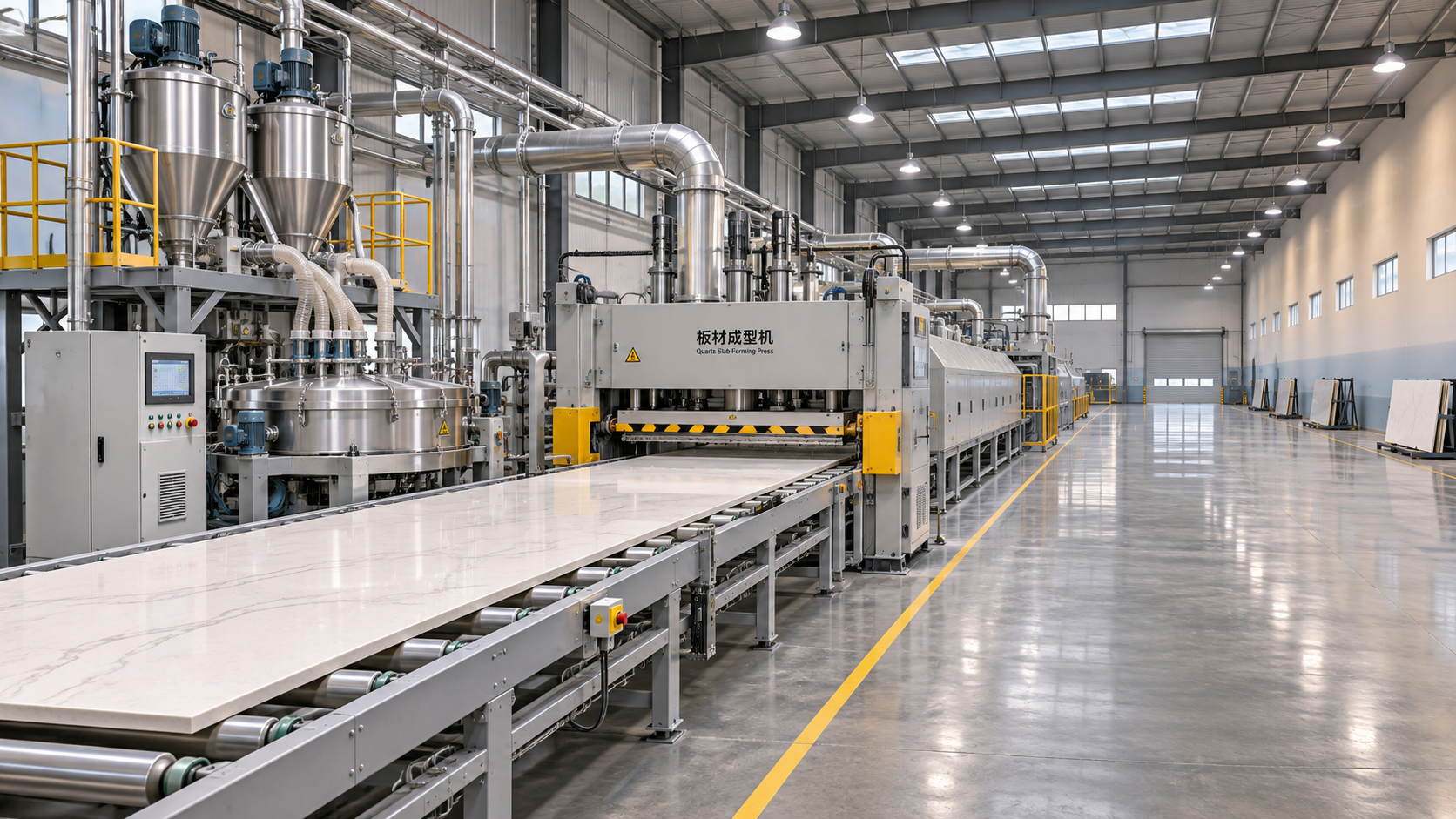
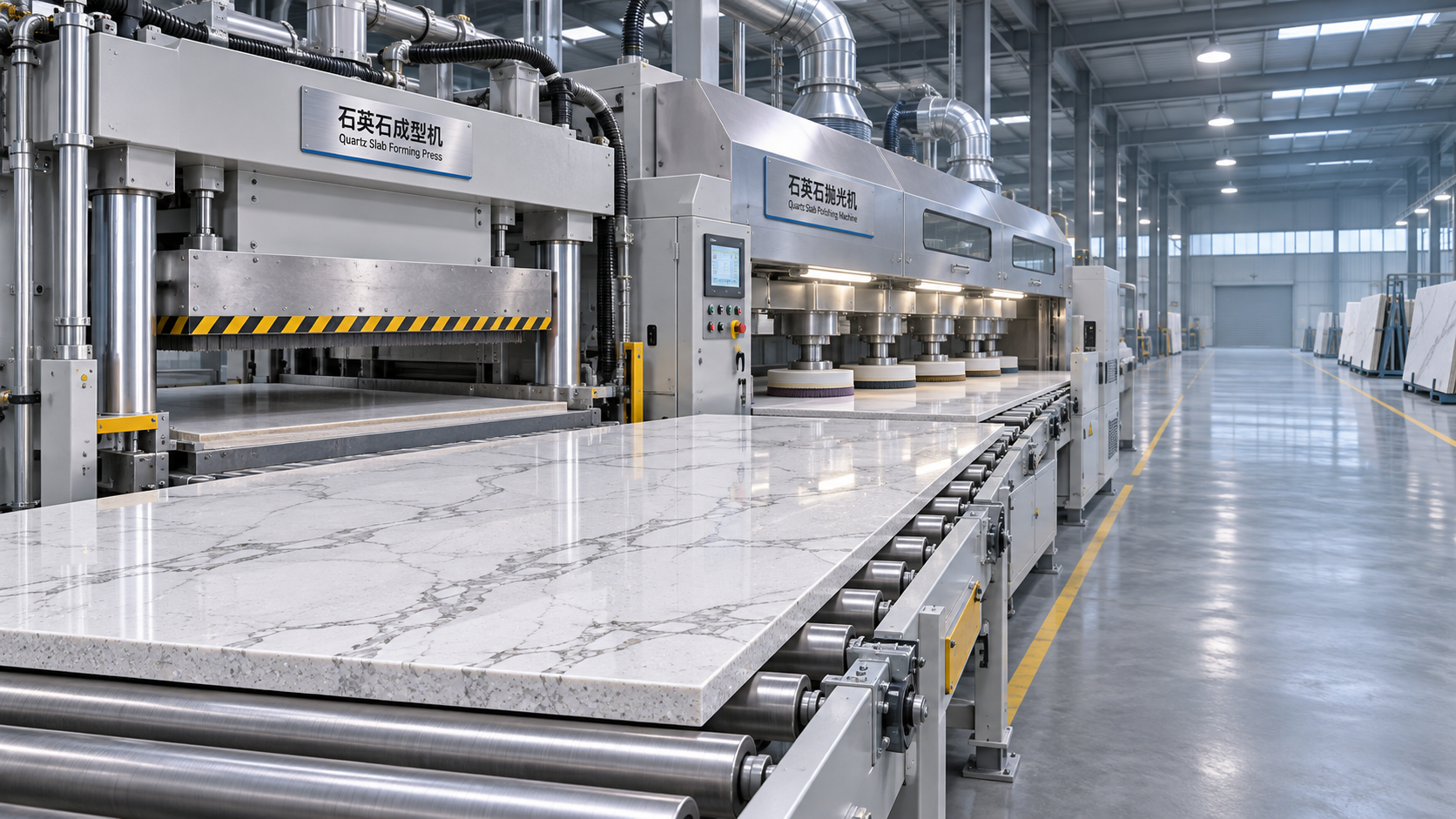
A quartz stone production line generally makes engineered slabs by combining graded mineral material with a binder and additives, forming the mixture, curing it, and finishing the surface. The exact process and equipment depend on the intended product. A buyer planning basic slabs may not need the same finishing configuration as one supplying decorative surfaces with demanding appearance requirements.
A complete project may involve raw-material handling and dosing, mixing, distribution, forming equipment, curing arrangements, cooling and conveying, calibration, polishing, cutting, inspection, and packing. Dust collection, electrical controls, air supply, and wastewater treatment may also be necessary, depending on the process and local requirements. Some of these items may be supplied separately rather than included in the machinery package.
Start by asking each supplier to mark the boundary of its offer on a process flow diagram. If the offer stops at cured slabs, the buyer still needs a plan and budget for turning those slabs into a saleable finish. If polishing is included, check how many finishing stages are specified and whether handling equipment between stages is part of the price.
The specifications that move the price
Capacity and operating assumptions
Higher planned output generally calls for greater equipment capacity, more handling capability, and potentially more space and utilities. But a headline output figure is useful only when its basis is clear. Ask whether it refers to slabs per shift, production area per day, or another measure, and whether the calculation assumes a particular slab size, thickness, operating schedule, and product mix.
The slowest stage can limit the entire line. A forming machine with ample theoretical capacity will not deliver its rated output if curing, cooling, or polishing cannot keep pace. Product changes, cleaning, planned maintenance, and rejected slabs also affect saleable output. Compare offers using the same assumptions rather than treating the fastest quoted machine as the most productive line.
Slab format and product range
Slab dimensions, thickness range, color changes, and decorative effects influence molds, distribution systems, handling equipment, and finishing requirements. Larger or heavier slabs can affect the design of conveyors, lifting devices, storage, and packing. A wide product range may require additional tooling and more time between batches.
Avoid paying for flexibility that has no credible sales plan, but do not ignore a likely future format simply to reduce the initial quote. Ask what can be added later, which components would need replacement, and whether the proposed building layout leaves room for expansion.
Automation and labor
Automation can be applied selectively to dosing, conveying, slab transfer, polishing, inspection, and packing. A more automated line usually costs more upfront, but it may reduce repetitive handling and make production less dependent on manual coordination. Its value depends on local labor costs, production volume, operator skills, maintenance capability, and the consistency required by customers.
The relevant question is not whether a line is described as automatic. It is which tasks still require people, how many operators are assumed for each shift, and what happens when a sensor, drive, or control component fails. Request a staffing estimate by work area and a list of critical control components before comparing automation premiums.
Build a project budget, not just an equipment budget
The machinery quotation is a starting point. A realistic capital budget also accounts for the cost of getting the line into a suitable building and making acceptable slabs. The items below often sit outside the base equipment price or require separate confirmation:
- Freight and import: packing, inland transport, ocean freight, insurance, unloading, customs charges, and applicable taxes. The agreed delivery terms determine which party pays and carries risk at each stage.
- Plant preparation: foundations, floor loading, access routes, equipment clearances, storage, drainage, and any required building modifications.
- Utilities: electrical distribution, compressed air, water, ventilation, and related infrastructure sized for the proposed equipment and site conditions.
- Installation and commissioning: lifting equipment, local labor, electrical connections, technicians, travel, accommodation, testing materials, and operator training.
- Start-up inventory: raw materials, consumables, spare parts, and working capital while operators stabilize production and customers qualify the finished slabs.
Ask for the equipment layout and utility loads early enough for a local engineering team to review them. A low machinery offer can become expensive if the plant needs major electrical work or if the buyer discovers too late that cranes and foundations were excluded. Allow a contingency based on the maturity of the design and the uncertainties at the site; there is no universal percentage that fits every project.
Overseas installation: define the handover
Overseas installation can mean anything from remote guidance to technicians working on site through commissioning. Do not assume that a supplier’s willingness to support installation means every associated cost is included. With Shandong Hongfa Scientific Industrial & Trading Co., Ltd., overseas installation arrangements, availability, and charges should be confirmed for the specific project and written into the contract.
The agreement should identify who positions and anchors machinery, connects power and utilities, supplies lifting equipment, and provides interpreters or local technicians where needed. It should also state the expected sequence: mechanical installation, electrical checks, dry runs, process trials, training, and handover. Travel, visas, accommodation, insurance, and waiting time caused by site delays are worth assigning explicitly.
Acceptance criteria matter just as much. Define the products and materials to be used in the trial, the operating conditions, the tests to be performed, and how deficiencies will be recorded and corrected. If a supplier quotes a capacity, establish whether and how that capacity will be demonstrated. This protects both parties from disagreements over what “commissioned” actually means.
Operating costs can outweigh a cheaper quotation
Raw materials, binder, pigments, labor, electricity, consumables, maintenance, packaging, and waste all contribute to the cost of a finished slab. The mix varies by product and location, so a generic production-cost figure is a poor basis for investment. Instead, prepare a model using local quotations and the intended formulation, then update it after production trials.
Yield deserves particular attention. Material lost during changeovers, damaged slabs, surface defects, and slabs that require rework consume capacity as well as materials. A lower purchase price may not compensate for frequent stoppages or inconsistent finishing. Conversely, expensive automation will not necessarily pay back if the line runs infrequently or produces a narrow range of simple products.
Request a recommended spare-parts list, expected replacement items, and information on how critical components can be sourced. For polishing equipment, clarify consumable specifications and who can supply them locally. Also ask for access to operating manuals, electrical drawings, and fault information: a maintenance team cannot support equipment effectively if essential documentation is missing.
Worker protection belongs in the operating plan as well as the capital budget. Quartz-containing dust, resin handling, and other process hazards require assessment against applicable local rules and the materials used. Confirm which extraction, guarding, ventilation, and waste-handling measures are included in the line and which remain the factory owner’s responsibility.
How to compare quotations on the same basis
Send each supplier the same brief: target slab sizes and thicknesses, intended products, required saleable output, shifts, available space, local power supply, destination, and desired degree of automation. Include any customer specifications or local conformity requirements that must be met. Ask suppliers to identify assumptions rather than silently filling gaps in the brief.
Then compare the equipment list line by line. Check quantities, machine functions, control-system scope, tooling, spare parts, documentation, delivery terms, payment milestones, warranty conditions, and exclusions. Separate one-time equipment costs from site costs and recurring operating expenses. Where prices differ, ask what has changed in the process or scope before deciding that one offer is cheaper.
Shandong Hongfa Scientific Industrial & Trading Co., Ltd., established in 1990, manufactures construction machinery and includes quartz stone machinery among its product lines. A useful next step when evaluating its proposal, as with any supplier’s, is to review a project-specific process layout and written scope rather than rely on a general equipment list. Confirm the finishing requirements, site responsibilities, installation support, and acceptance method before using the quotation as the basis for an investment decision.
Next:No more content
Recommend
 Nov 20, 2026
How Much Does a Quartz Stone Production Line Cost?
Ltd. overseas installation is one factor in quartz stone production line costs. Explore equipment, operating expenses, and quotation tips to plan your investment.
- Nov 20, 2026
How to Assess Hongfa's Block Machine Export Experience
Ltd. quartz line reviews offer limited insight into block machines. Learn how to verify Hongfa’s export projects, commissioning records and after-sales support before buying.
- Nov 19, 2026
How to Evaluate Reviews of Hongfa Quartz Stone Lines
Comparing Ltd. AAC plant price results with quartz line reviews? Learn how to verify Hongfa equipment claims, service quality, and costs before you invest.