How Much Does a Quartz Stone Production Line Cost?
How Much Does a Quartz Stone Production Line Cost?
How much does a quartz stone production line cost? The answer depends on production capacity, automation level, equipment configuration, and installation requirements. Beyond the purchase price, buyers should also consider factory preparation, operating costs, and technical support when planning their investment. Shandong Hongfa Scientific Industrial & Trading Co., Ltd. overseas installation requirements can be discussed as part of the project planning process. This guide explores the main factors affecting production line costs and helps you identify the right equipment configuration for your business.
There is no dependable single price for a line without a defined equipment list and production target. A quotation for forming slabs may exclude polishing, dust extraction, utilities, freight, or commissioning. Another may include much of that work. Comparing the two figures without checking their boundaries can make the cheaper offer look more attractive than it really is.
What Are You Actually Buying?
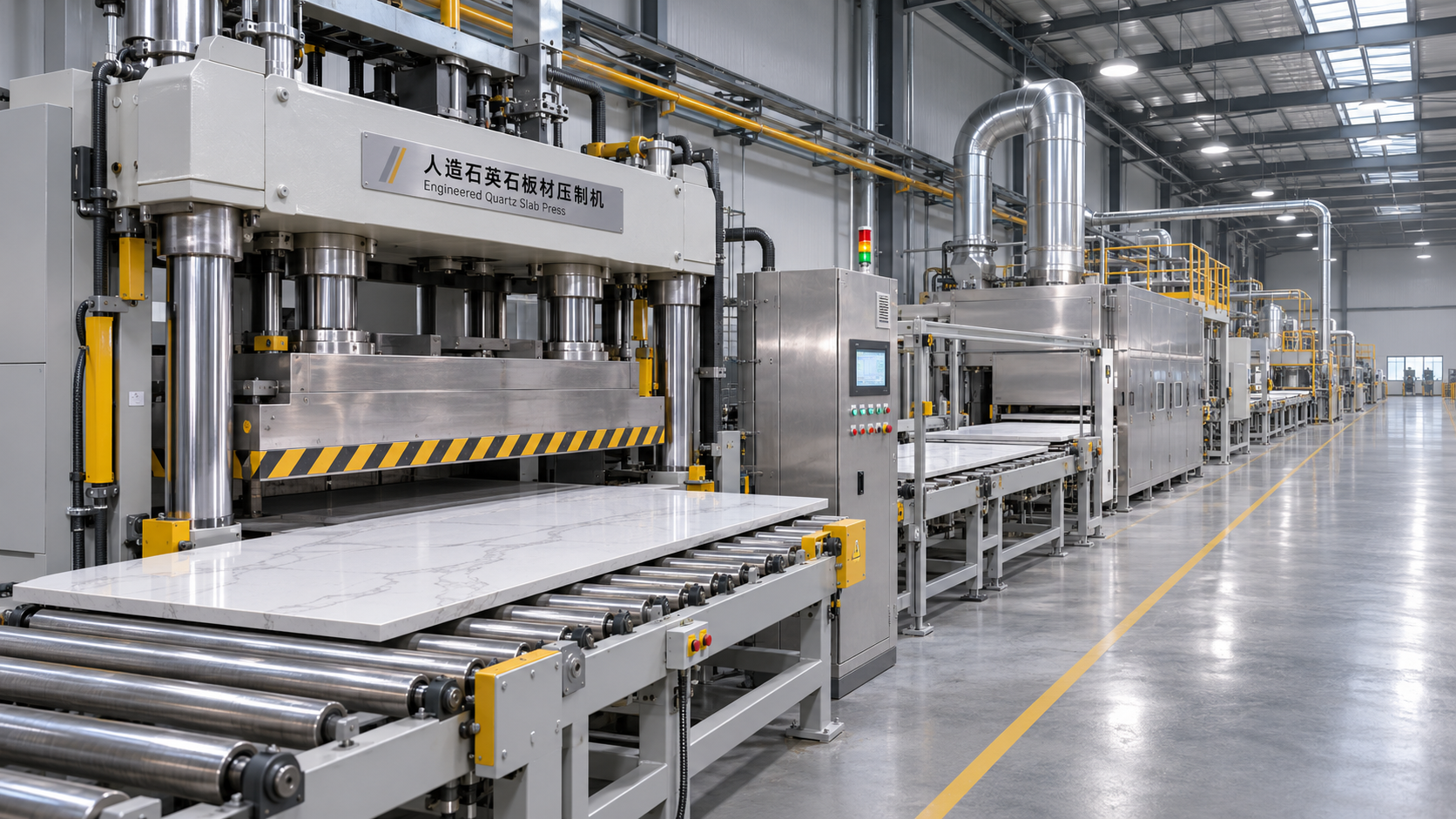
An engineered quartz slab line typically combines mineral aggregates and fillers with a binder and pigments, then forms, cures, and finishes the slabs. The exact process and equipment depend on the intended product, formulation, and degree of automation. Buyers should distinguish this type of plant from a natural stone cutting and polishing workshop: the raw materials, forming equipment, and production economics are different.
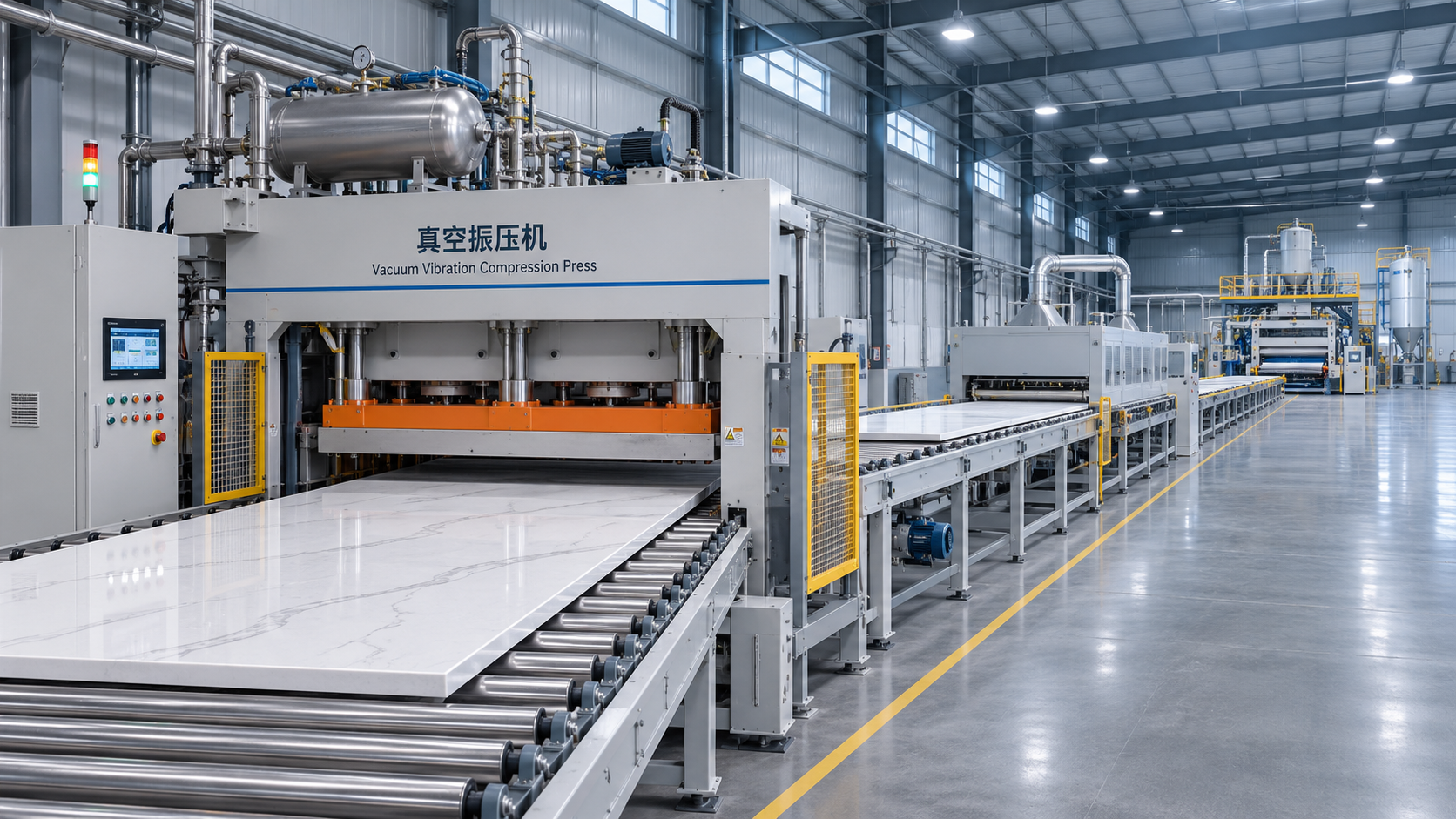
Depending on the project, the equipment scope may cover raw material handling, weighing and mixing, slab forming and pressing, curing, calibration, polishing, and handling between stations. Some buyers also need water treatment, dust collection, inspection equipment, or packaging systems. These are not necessarily included in a machinery supplier’s base offer.
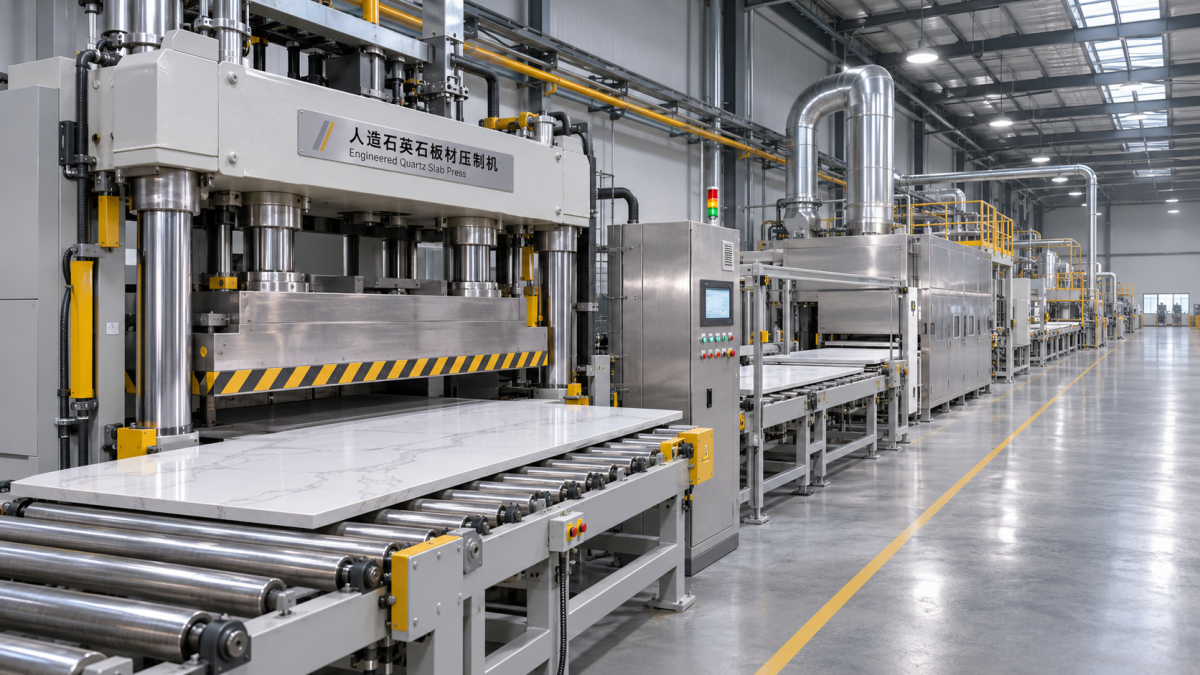
Ask for a process flow diagram alongside the quotation. It should show where materials enter, how unfinished slabs move between operations, and where the supplier’s responsibility ends. A missing connection between two machines may mean an additional conveyor, forklift handling, floor space, or labor that was not obvious from the equipment list.
The Main Factors Behind the Equipment Price
Capacity and the definition behind it
A higher-capacity line generally requires more equipment, faster handling, or a different configuration. But a capacity figure is useful only when its assumptions are clear. Ask whether output is stated as slabs per shift, square meters per day, or another measure, and confirm slab dimensions, thickness, operating hours, and product mix.
Theoretical machine throughput is not the same as saleable finished output. Cleaning, color changes, maintenance, startup adjustments, and rejected slabs all affect production. A line sized around optimistic continuous operation may leave a new factory short of its actual sales target.
Look for the bottleneck rather than focusing only on the press. If curing space or polishing capacity cannot keep up with forming, the nominal output of the forming section will not translate into finished slabs. The supplier should explain how the capacities of the major stations are matched.
Automation and product flexibility
Automated weighing, feeding, transfer, and controls can raise the initial equipment cost. They may also reduce repetitive handling and improve consistency when the system is properly configured and maintained. The business case depends on local labor costs, production volume, operator skills, and the availability of maintenance support.
More automation is not automatically the better purchase. A plant expecting frequent changes in color or pattern should ask how recipes are changed, how the mixer is cleaned, and how much material is left in the system between batches. A highly automated line designed for long, repeatable runs may be less convenient for frequent small orders.
Slab size and thickness matter too. Confirm the full range the proposed line can produce, not just its maximum dimensions. Larger slabs can affect molds, handling equipment, curing arrangements, polishing width, packaging, and factory layout. Retrofitting those items later can be more disruptive than specifying the right range at the outset.
Budget for the Factory, Not Just the Machines
The equipment quotation is only one part of the investment. Before approving a project, separate the supplier’s price from costs the buyer must arrange locally. The following categories are worth checking even when a proposal is described as a complete line:
- Site and civil works: building space, foundations, equipment access, storage, drainage, and any structural work required by the layout.
- Utilities: electrical supply and distribution, compressed air, water, process cooling or heating, and connections to individual machines as specified.
- Environmental and safety systems: dust extraction, ventilation, water treatment, fire protection, and waste handling appropriate to the process and local requirements.
- Logistics: export packing, freight, insurance, unloading, customs charges, inland transport, and lifting equipment at the site.
- Startup resources: raw materials for trials, operators, technicians, spare parts, consumables, and working capital while production stabilizes.
These items should not be treated as identical across countries or sites. For example, a factory with suitable power and lifting access may need less preparation than an empty building. Have the equipment supplier provide utility loads, foundation drawings, and installation requirements early enough for local contractors to price their work.
Delivery terms also change the apparent price. Confirm the agreed Incoterms rule and named place, then identify who pays for each transport leg, insurance, customs clearance, and unloading. Do not assume that a delivered price includes duties or placing equipment on its foundations.
How Overseas Installation Affects the Project Budget
Installation is more than sending a technician to the factory. It may involve mechanical assembly, electrical checks, alignment, commissioning, trial production, and operator training. The cost and duration depend on the equipment scope, site readiness, travel arrangements, and the division of work between the supplier and local contractors.
For a project involving Shandong Hongfa Scientific Industrial & Trading Co., Ltd., overseas installation terms should be defined in the proposal rather than assumed from the equipment price. Hongfa, established in 1990, manufactures construction machinery and quartz stone production line equipment. The practical question for an overseas buyer is which services are available for the specific destination and configuration, and how those services will be charged.
A useful installation scope should answer these questions:
- Which tasks will the supplier’s engineers perform, and which require local electricians, riggers, welders, or other contractors?
- Are travel, accommodation, insurance, visas, interpretation, and working days included? Who pays if site delays extend the visit?
- Must power, water, compressed air, foundations, and lifting equipment be ready before the engineers arrive?
- What training is included, in what language, and does it cover routine maintenance as well as operation?
- What constitutes commissioning or acceptance, and what materials, operators, and utilities must the buyer provide for the trial?
A low installation allowance can become expensive if the factory is not ready when the team arrives. Agree on a site-readiness checklist and a process for handling delays before shipment. Also confirm what remote assistance is available after the team leaves and how urgent spare parts will be supplied.
Estimate the Cost per Saleable Slab
The lowest purchase price does not necessarily produce the lowest manufacturing cost. To test a proposal, build a simple operating model using your own expected production volume and local prices. Include aggregates and fillers, binder, pigments, packaging, electricity, water, labor, maintenance, abrasives, and other consumables. Add the cost of financing and the planned recovery of the capital investment where appropriate.
Divide the relevant costs by expected saleable output, not just the number of slabs formed. Edge damage, surface defects, inconsistent color, and polishing problems can turn nominal production into rework or scrap. Since actual yield depends on materials, recipes, equipment settings, and operator skill, use a cautious assumption and test how the result changes if yield is lower than planned.
Raw material selection deserves particular attention. Local aggregate availability and consistency can affect formulation, appearance, wear, and process settings. Before committing to a production plan, discuss whether representative materials can be evaluated and what information the equipment supplier needs. Do not assume that a recipe used elsewhere will transfer unchanged to a different supply chain.
Maintenance is another cost that is easy to underestimate. Ask which parts are consumables, which components have long procurement lead times, and whether commonly replaced electrical and pneumatic parts are available locally. A modest initial spare-parts package may be more useful than waiting until a failed component stops the entire line.
How to Compare Quotations on Equal Terms
Send each prospective supplier the same project brief: target saleable output, slab dimensions and thicknesses, intended colors or patterns, available factory space, utility conditions, destination, and desired automation level. Identify any downstream cutting or fabrication processes that sit outside the slab line. The more consistent the brief, the easier it is to understand genuine differences between offers.
Then compare scope line by line. Check machine quantities, controls, molds, conveyors, finishing equipment, dust and water systems, spare parts, drawings, and services. Mark every exclusion and obtain a separate estimate for it. If a supplier proposes an alternative process or configuration, ask what it changes in output, labor, utilities, floor space, and finished-slab quality.
The contract should also describe the acceptance procedure. Agree on the product specification, test conditions, measurement method, trial duration, and how issues will be corrected. A capacity promise without agreed raw materials, slab dimensions, operating conditions, and an acceptance method is difficult for either party to evaluate fairly.
Before selecting a line, request a consolidated project budget that separates equipment, site works, freight, installation, startup materials, and operating cash needs. That breakdown gives decision-makers a more useful answer than a standalone machine price—and makes it easier to see which assumptions still need to be verified.
Next:No more content
Recommend
 Nov 26, 2026
How Much Does a Quartz Stone Production Line Cost?
Explore Ltd. overseas installation considerations and the key factors affecting quartz stone production line costs. Compare budgets and plan with confidence.
- Nov 26, 2026
How Can Buyers Assess Hongfa's Block Machine Export Experience?
Ltd. quartz line reviews offer a starting point. Learn how to assess Hongfa’s block machine exports through project references, delivery records, and service plans.
- Nov 25, 2026
How Can Buyers Verify Reviews of Hongfa Quartz Lines?
Compare Ltd. AAC plant price and learn how to verify Hongfa quartz line reviews, customer references, performance claims and after-sales support before investing.