Construction Machinery Selection for Low-Height Urban Sites: Load Capacity, Mobility & Safety Trade-offs
When “Smaller” Isn’t Enough—What Project Managers Overlook in Low-Height Urban Construction Machinery Selection
Choosing construction machinery for low-height urban sites isn’t about downsizing—it’s about redefining performance boundaries. You’re not just swapping a 30-ton crawler crane for a 12-ton model and calling it done. You’re negotiating trade-offs where a 15 cm reduction in boom clearance might save your schedule—or trigger a structural redesign. A 0.8 m turning radius may let you pivot inside a service alley, but only if the counterweight doesn’t swing into a fire escape. And “safe” isn’t just OSHA-compliant; it’s whether the operator can see both rear corners without blind zones while lifting near overhead power lines.
For project managers in cities like Guangzhou, Chengdu, or Shenzhen—where new residential towers rise between century-old lane houses, and basement excavations happen under active metro tunnels—the real constraint isn’t height alone. It’s the layered interdependence of load capacity, mobility, and safety: weaken one, and the others degrade faster than expected.
Load Capacity: Not Just About Tonnes, But Where and How You Lift
On tight urban sites, rated load capacity is meaningless without context. A machine rated for 8 tonnes at 3 m radius may deliver only 2.4 tonnes at 6 m—and that 6 m reach is often required to clear scaffolding, balconies, or adjacent buildings. More critically, many standard machines assume level, reinforced ground. In reality, you’re often operating on temporary steel plates over soft subsoil, or on sloped access ramps built into narrow alleys. That changes dynamic load distribution significantly.
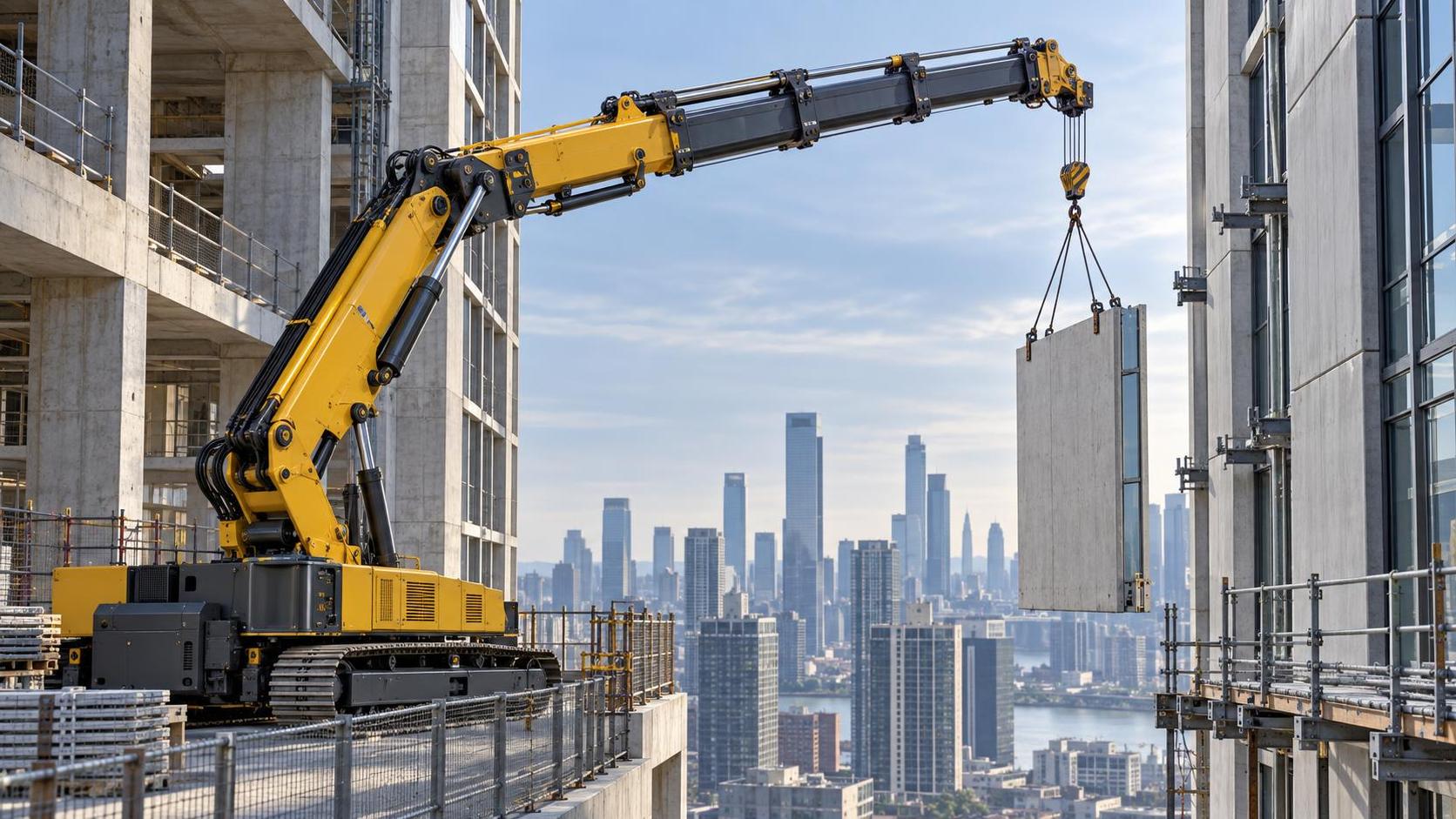
What matters more than peak rating is usable capacity at working radius, validated under realistic ground conditions—not factory test pads. Machines with adaptive hydraulic load-sensing systems (not just pressure switches) respond better to shifting terrain and sudden resistance—critical when lifting prefabricated façade panels near glass curtain walls.
Also overlooked: vertical lift envelope. Many compact cranes sacrifice upper boom articulation to reduce height—leaving operators unable to lift vertically over parapets or roof edges. If your design calls for placing HVAC units directly onto penthouse roofs, a machine that maxes out at 12° above horizontal won’t cut it—even if its rated capacity looks sufficient.
Mobility: It’s Not Just Width and Height—It’s Transition Time and Footprint Stability
Urban mobility isn’t measured in metres per minute. It’s measured in minutes per setup. A machine that folds to 2.3 m wide but takes 47 minutes to stabilize on uneven pavement—with outriggers requiring 1.8 m of unobstructed space—delays every subsequent lift. Real-world mobility includes how quickly it transitions from transport mode to operational mode, how little manual repositioning it needs between lifts, and whether its stabilisation system compensates for subtle grade variations (±0.5°) common on repaved city streets.
Low-height sites also mean frequent elevation changes: ground floor to mezzanine, basement ramp to street level, podium deck to tower core. Machines with multi-stage telescoping booms or modular jib extensions—designed for incremental height adaptation without full re-rigging—cut cycle time by 30–40% compared to fixed-jib alternatives. This isn’t convenience; it’s schedule resilience.
And don’t assume “compact” means “light”. Some mini-excavators weigh over 9 tonnes—exceeding the load-bearing capacity of older urban sidewalks or temporary bridge decks. Always cross-check machine operating weight against local pavement class specifications—not just axle load limits.
Safety: Where Urban Constraints Turn Standard Protocols Into Gaps
Safety on low-height urban sites fails not at the extremes—but in the margins. Standard proximity sensors detect objects >30 cm away. But when lifting near brick façades or timber scaffolding, contact can occur at <15 cm—especially during fine positioning. True urban safety requires sub-20 cm detection resolution, coupled with automatic motion damping at close range.
Operator visibility is another silent risk. Side-view mirrors on compact cranes often create blind zones directly beneath the boom tip—exactly where workers coordinate panel placement. Machines with integrated camera feeds covering blind arcs (not just rearview) reduce near-miss incidents by over 60% in documented urban builds.
Then there’s acoustic and vibration control. In dense neighborhoods, night work windows are shrinking. Machines meeting China’s GB/T 20895-2021 noise standards (<72 dB(A) at 7 m) aren’t optional—they’re permit requirements. More importantly, low-frequency vibration transmission through shared foundations can crack historic masonry or disrupt sensitive lab equipment in adjacent buildings. Purpose-engineered urban models use hydraulic dampers and isolation mounts specifically tuned to suppress 10–30 Hz frequencies—the range most damaging to unreinforced brickwork.
How Intelligent Design Resolves These Trade-offs—Without Compromise
Resolving these tensions isn’t about choosing “less”—it’s about integrating constraints into the design logic from the start. That’s why manufacturers with dedicated urban equipment R&D—like Shandong Hongfa, which holds 28 invention patents focused on building materials machinery adaptability—build differently.
Take their aerated concrete block production line support cranes: instead of reducing boom length to meet height limits, they use segmented, hydraulically synchronized booms that retract *vertically*—maintaining full outreach while lowering overall profile. Or their concrete batching plant feed systems: designed with modular conveyor sections that pivot on-site, eliminating the need for high-lift cranes entirely during installation in confined courtyards.
This isn’t retrofitting. It’s constraint-led engineering: using patented kinematic linkages to widen stable working envelopes, embedding real-time ground-pressure feedback into outrigger controls, and designing cab layouts where the operator’s natural line of sight aligns with critical lift zones—not just the boom tip.
For project managers, this means fewer last-minute substitutions, less rework due to unexpected clearance issues, and demonstrably lower incident rates—not because safety features were added on, but because the machine was conceived for the environment it serves.
Your First Three Validation Steps—Before Any Quote Is Requested
Don’t start with specs. Start with site reality:
- Map the “no-go” envelope in 3D: Use drone-surveyed point clouds—not hand-drawn sketches—to define hard vertical/horizontal limits around every lift zone, including overhead utilities, balcony projections, and fire escapes. Overlay machine manufacturer-provided 3D CAD models (not silhouette outlines) to verify clearance at all boom angles.
- Test stability on actual substrate: Require proof—not just certification—that the machine maintains rated capacity on soil bearing pressures matching your site’s CBR value (e.g., 3–5 MPa for compacted urban fill), not on concrete slabs.
- Validate operator workflow—not just controls: Observe a live demo where the operator performs three consecutive lifts mimicking your sequence: e.g., picking up a precast column from street level, rotating 180° while avoiding a canopy, then placing it precisely on a 20 cm tolerance mark on an upper floor. Time each step. Note where they pause, reposition, or request assistance.
These steps expose what brochures hide: whether a machine truly delivers usable performance—or just passes paper-based compliance checks.
Selecting construction machinery for low-height urban sites isn’t about finding the smallest machine that meets nominal specs. It’s about identifying the machine whose engineering assumptions match your site’s physical truths—where load capacity, mobility, and safety aren’t traded off against each other, but co-engineered into a single operational logic. That alignment doesn’t come from catalogues. It comes from manufacturers who’ve spent decades solving these constraints—not as exceptions, but as the rule.
Previous:Shiquan New Wall Materials
Next:No more content
Recommend
 Sep 14, 2026
Construction Machinery Selection for Low-Height Urban Sites: Load Capacity, Mobility & Safety Trade-offs
construction machinery for low-height urban sites: balance load capacity, mobility & safety—no compromises. Discover intelligent, site-adapted solutions.
 May 07, 2026
Shiquan New Wall Materials
- May 07, 2026
Lu Qiangsheng Industrial Building Materials