Can construction machinery certified to ISO 14001 be operated safely in high-humidity coastal sites without corrosion risk?
ISO 14001 certification addresses environmental management systems—not material performance. It verifies that an organization has established processes to identify, monitor, and reduce its environmental impacts, including waste generation, energy use, emissions, and chemical handling. Crucially, it does not specify or guarantee corrosion resistance, material selection, coating durability, or operational suitability in saline, high-humidity coastal environments. A construction machinery unit certified to ISO 14001 may be manufactured with standard carbon steel components, untreated fasteners, and non-sealed electrical enclosures—materials highly vulnerable to chloride-induced pitting and crevice corrosion when exposed continuously to marine aerosols.
Corrosion failure in coastal sites follows predictable electrochemical pathways: chloride ions penetrate surface oxides, disrupt passive layers on stainless steels (e.g., AISI 304), accelerate galvanic coupling between dissimilar metals (such as aluminum housings bolted to steel frames), and promote under-deposit corrosion beneath dust, salt crusts, or accumulated moisture in recessed joints. Unlike inland operation where humidity fluctuates diurnally, coastal conditions sustain relative humidity above 85% for extended periods, suppress natural drying cycles, and deposit hygroscopic salts that remain active even at ambient temperatures. These factors render conventional paint systems—especially single-layer alkyd or epoxy ester coatings—ineffective without rigorous surface preparation, multi-stage application, and periodic re-coating.
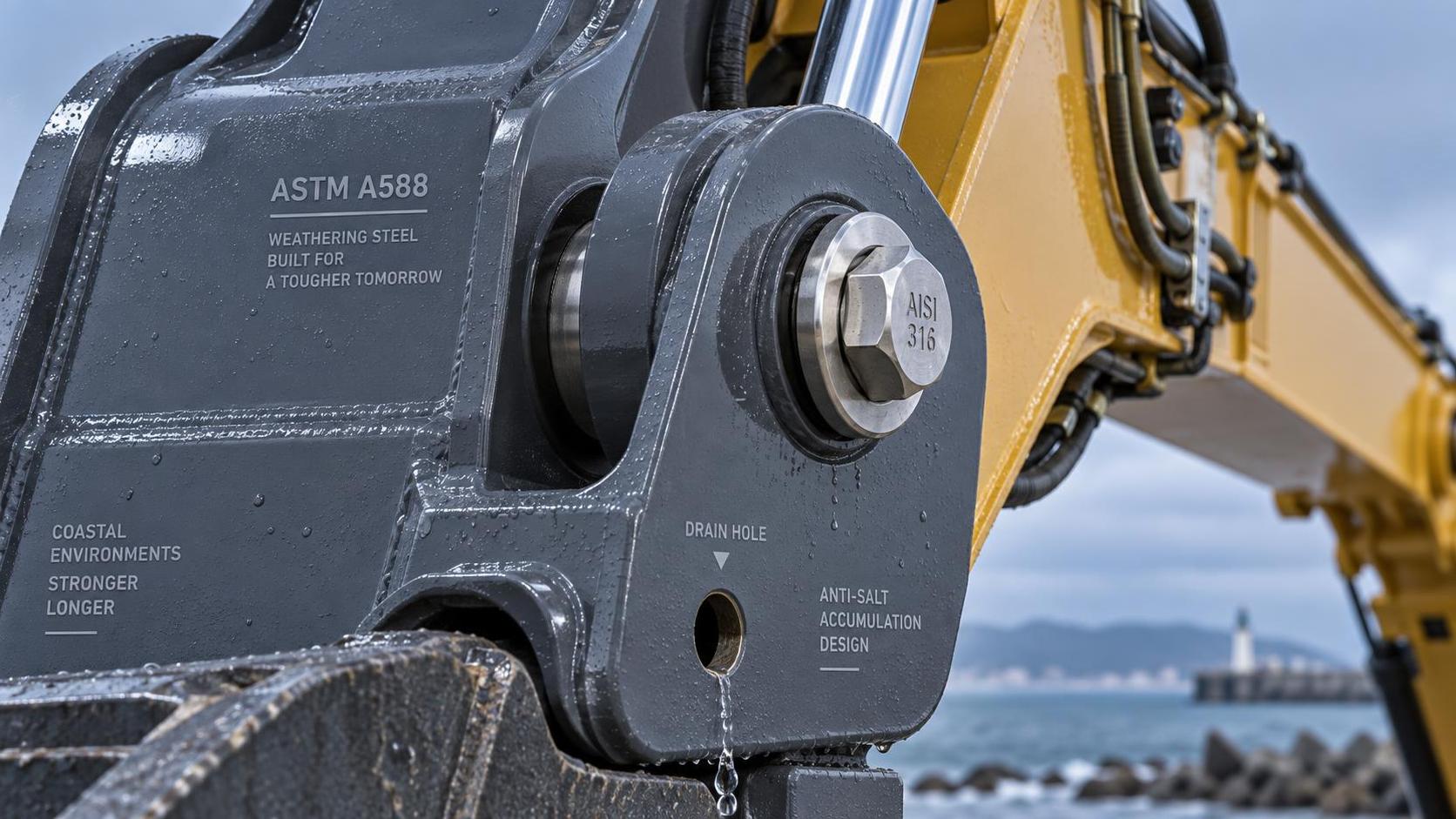
Material specification is the primary determinant of coastal survivability—not environmental certification status. For structural frames and load-bearing components, ASTM A588 Grade K weathering steel offers proven resistance through stable rust patina formation, but only when exposed to alternating wet-dry cycles; continuous immersion or stagnant salt film inhibits passivation and accelerates localized attack. Austenitic stainless steels like AISI 316 provide superior chloride resistance due to molybdenum content (2–3%), yet they remain susceptible to stress corrosion cracking under tensile load in warm, chloride-rich atmospheres—a risk amplified in welded assemblies subjected to thermal cycling during operation. Duplex stainless steels (e.g., UNS S32205) mitigate this by balancing austenite and ferrite phases, but require precise heat treatment control during fabrication to avoid sigma phase embrittlement—a failure mode undetectable by visual inspection but catastrophic under dynamic loading.
Coating integrity depends not only on chemistry but on application fidelity. Zinc-rich primers must achieve a minimum dry film thickness of 75–80 µm to ensure cathodic protection longevity; thinner applications deplete sacrificial zinc before substrate exposure. Epoxy intermediate coats require strict adherence to recoat windows—exceeding the maximum interval causes intercoat adhesion loss, while premature overcoating traps solvents that later blister the topcoat. Polyurethane topcoats, though UV-stable, degrade rapidly if applied over contaminated surfaces or without proper dew point monitoring during spraying: surface temperature must exceed dew point by at least 3°C to prevent micro-condensation beneath the film, which initiates delamination from the first day.
Design-level mitigation carries equal weight. Drainage holes in structural cavities must be sized ≥6 mm and positioned to prevent salt accumulation—smaller apertures clog with sand or biofilm, turning enclosed sections into corrosion incubators. Fastener selection demands compatibility: stainless steel bolts paired with galvanized nuts create galvanic couples unless insulated washers are used. Electrical enclosures rated IP66 provide ingress protection against water jets but do not address internal condensation; desiccant breathers or active humidity control are required for long-term reliability in sealed cabinets housing sensitive PLCs or servo drives.
Maintenance protocols must align with coastal reality—not generic schedules. Visual inspections every 90 days are insufficient; chloride deposits form invisible conductive films that initiate corrosion beneath paint edges or gasket interfaces. Surface resistivity measurements using portable conductivity meters (measuring µS/cm on wiped surfaces) provide objective quantification of contamination levels. Salt concentration exceeding 50 µg/cm² warrants immediate cleaning with pH-neutral, chloride-free rinse water—not high-pressure seawater, which compounds residue. Grease points require lithium complex thickeners with corrosion inhibitors, not standard mineral oils, which emulsify and wash away under salt-laden rain.
Manufacturing process controls directly influence field performance. Weld seams on hydraulic cylinder mounts must undergo post-weld heat treatment to relieve residual stresses that drive stress corrosion cracking in aggressive environments. Shot blasting before coating must achieve Sa 2.5 cleanliness with angular abrasive to anchor primer mechanically—sandblasting alone leaves embedded contaminants that undermine adhesion. Even minor deviations—such as grinding weld spatter instead of grinding flush, or masking threaded holes with tape that leaves adhesive residue—create initiation sites for filiform corrosion that propagates invisibly beneath intact coatings.
Environmental compliance and corrosion resilience operate on separate technical axes. An ISO 14001-certified manufacturer may excel at solvent recovery, wastewater treatment, or noise reduction—but those capabilities do not transfer to material science, metallurgical processing, or protective coating engineering. Conversely, a non-certified builder might employ marine-grade alloys, duplex fasteners, and multi-coat epoxy-polyurethane systems validated per ISO 12944-2 C5-M corrosion category, delivering demonstrably higher service life in coastal infrastructure projects. The critical distinction lies in specification traceability: each material grade, coating system, and design detail must be verifiably documented—not assumed from certification status.
For construction machinery operating in high-humidity coastal sites, safety and structural integrity depend on explicit, test-validated corrosion countermeasures—not environmental management credentials. ISO 14001 confirms procedural rigor in environmental stewardship; it neither substitutes for nor implies compliance with ISO 12944 (corrosion protection of steel structures), ISO 9223 (corrosivity classification), or ASTM G44 (cyclic salt spray testing). Reliability emerges from deliberate material selection, precision fabrication, verified coating application, and condition-based maintenance—not from the presence or absence of an environmental certificate.
Next:No more content
Recommend
 Sep 17, 2026
Can construction machinery certified to ISO 14001 be operated safely in high-humidity coastal sites without corrosion risk?
Construction machinery safety in coastal sites depends on corrosion-resistant materials—not ISO 14001 certification. Discover why environmental compliance ≠ operational resilience.
- Sep 16, 2026
Which AAC block manufacturing equipment certifications are mandatory for export to EU and ASEAN markets?
AAC block manufacturing equipment certification standards vary by region: CE marking is mandatory for EU export, while ASEAN requires country-specific approvals — learn how to comply efficiently.
 May 07, 2026
Honors and Qualifications