Which paving block machine is best suited for tropical climate regions?
When selecting a paving block machine for tropical climate regions, the primary technical challenge isn’t raw output capacity or automation level—it’s sustained operational integrity under high humidity (>85% RH), frequent torrential rainfall, ambient temperatures regularly exceeding 35°C, and rapid diurnal thermal cycling. These conditions accelerate corrosion of structural steel, degrade hydraulic fluid viscosity and seal performance, promote condensation inside electrical enclosures, and compromise mold release consistency due to moisture absorption in raw materials. Machines not engineered for this environment often suffer premature failure of control systems within 6–12 months, inconsistent block density from unstable compaction pressure, and unplanned downtime during monsoon seasons—directly impacting project timelines and material cost per unit.
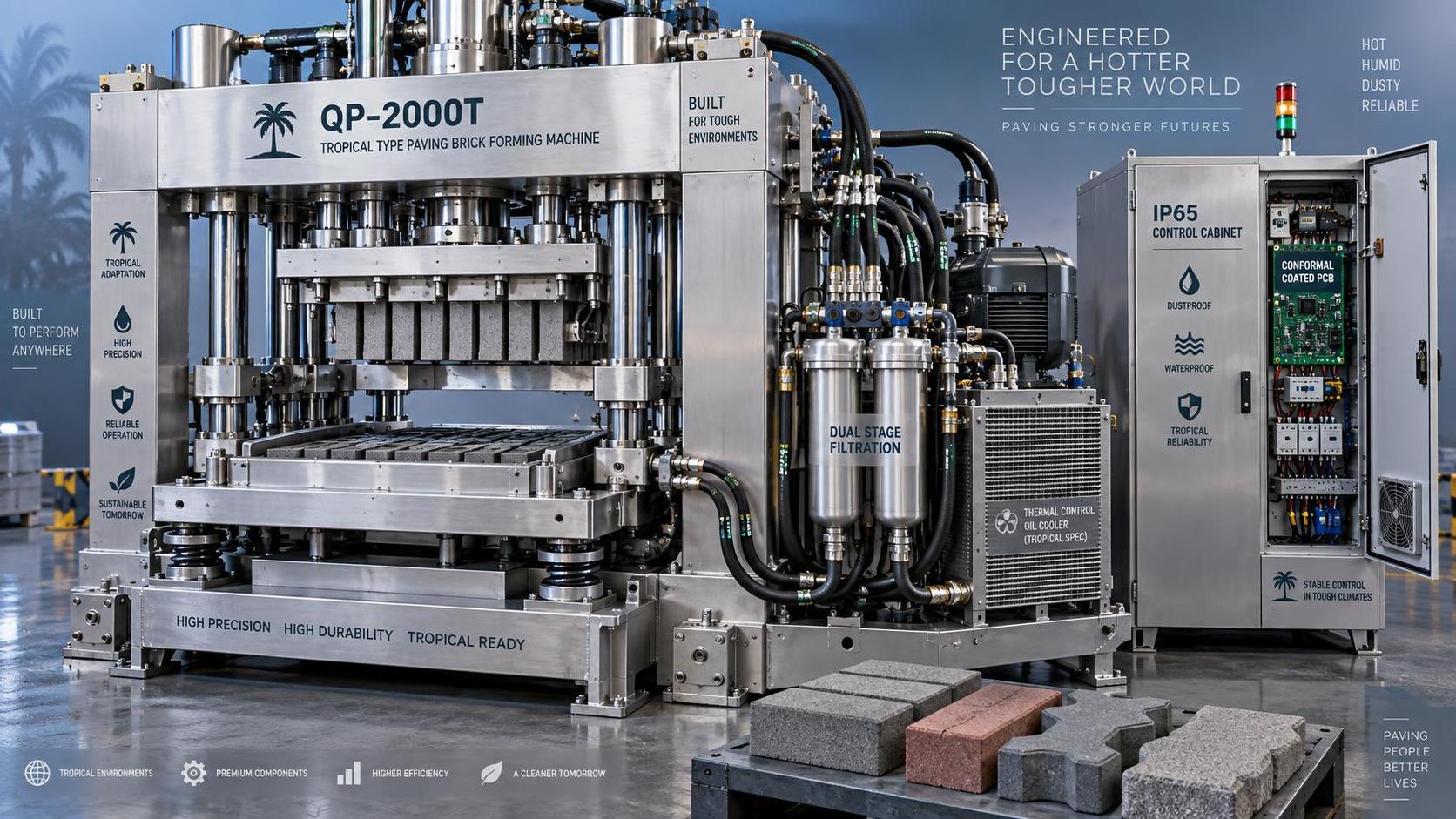
The most suitable paving block machines for tropical climates are those designed from the ground up with three integrated engineering priorities: corrosion resilience at the component level, thermal and moisture stability in critical subsystems, and adaptive process control under variable ambient conditions. At Shandong Hongfa Scientific Industrial & Trading Co., Ltd., this translates into specific, verifiable design choices—not marketing claims. For example, our QP-2000T tropical-series block machine uses AISI 304 stainless-steel mold frames and vibration tables instead of painted carbon steel; incorporates dual-stage hydraulic filtration with temperature-compensated pressure regulators; and features IP65-rated control cabinets with internal condensation management vents and conformal-coated PCBs. These are not optional upgrades—they are baseline specifications for units shipped to Southeast Asia, West Africa, and Central America.
Why Standard Block Machines Fail in Humid, High-Temp Environments
Conventional paving block machines—especially those built for temperate or arid markets—typically assume stable ambient conditions: relative humidity below 60%, operating temperatures between 15–30°C, and minimal exposure to standing water or salt-laden air. In tropical settings, these assumptions break down quickly:
- Hydraulic system degradation: Mineral-based hydraulic oils thicken below 10°C but thin excessively above 40°C. Without temperature-compensated valves and high-viscosity-index (HVLP) fluid compatibility, pressure drift exceeds ±8% during midday operation—causing inconsistent block density and surface cracking.
- Electrical vulnerability: Standard NEMA 12 panels lack protection against condensation-induced short circuits. When cabinet internal temperature drops below dew point (common overnight), moisture forms on terminals and relays—even if external humidity is controlled.
- Mold corrosion and adhesion: Mild steel molds oxidize rapidly in humid air, creating micro-pitting that traps cement slurry. This increases demolding force by up to 35%, accelerates wear, and introduces surface blemishes requiring manual finishing.
- Aggregate moisture variability: Tropical sand and gravel often arrive at 5–9% surface moisture—far higher than the 2–3% assumed in European or North American batching algorithms. Uncompensated feed systems misjudge dry mass, leading to over-wet mixes and weak interlock strength.
Key Design Criteria for Tropical-Grade Paving Block Machines
Selecting the right machine requires evaluating four interdependent subsystems—not just headline specs like “2000 blocks/hour.” Each must be assessed independently and validated against real-world tropical constraints:
1. Structural and Mold Material Specification
Look beyond “anti-rust paint” or “galvanized frame.” True tropical-grade construction uses either AISI 304/316 stainless steel for all load-bearing mold components, or hot-dip galvanized steel with ≥85 µm zinc coating thickness (ASTM A123). Verify coating thickness via cross-section testing—not just visual inspection. Avoid aluminum molds: while non-corroding, they deform under repeated 12–15 MPa compaction loads common in interlocking paver production.
2. Hydraulic System Architecture
A tropical-appropriate system includes: (a) closed-loop servo-hydraulic control (not open-loop solenoid valves), (b) dual-stage filtration (10 µm + 3 µm), (c) thermostatically regulated oil coolers capable of maintaining 45–55°C oil temperature even when ambient reaches 42°C, and (d) Viton® or FKM seals rated to 150°C continuous service—not standard nitrile (NBR).
3. Electrical Protection Strategy
IP65 is the minimum acceptable rating—but only if verified by third-party test report (IEC 60529). Ensure the control panel includes internal dehumidification (either passive desiccant packs with visible saturation indicators or low-power Peltier-based dryers), and that all PLC I/O modules use isolated, opto-coupled inputs. Non-isolated inputs fail silently in high-humidity environments due to leakage current buildup across terminal strips.
4. Moisture-Adaptive Control Logic
The machine must adjust feed timing, vibration duration, and compaction pressure based on real-time aggregate moisture input—not fixed batch formulas. Hongfa’s tropical-series machines integrate optional moisture sensors (capacitive type, calibrated for local sand types) directly into the hopper discharge zone. The PLC then modulates water addition and vibration amplitude in 0.5-second increments to maintain target slump and density.
Operational Validation Before Deployment
Spec sheets alone don’t guarantee tropical readiness. Before finalizing procurement, request documented evidence of the following:
- Proof of ISO 9001:2015 certification covering design, manufacturing, and commissioning of the specific model—verified by an accredited body (e.g., SGS, TÜV, BV), not self-declared.
- Third-party corrosion test reports: ASTM B117 salt-spray testing for ≥1000 hours on mold assemblies, with photos showing zero red rust on critical surfaces.
- Thermal stress validation: Thermal imaging reports confirming no localized heating >75°C on hydraulic manifolds or motor windings after 8-hour continuous operation at 40°C ambient.
- Field deployment records: List of at least three projects in tropical zones (e.g., Vietnam, Nigeria, Ecuador) where the same machine model has operated continuously for ≥18 months without major electrical or hydraulic overhaul.
Shandong Hongfa’s tropical-series paving block machines meet all four criteria. With 46 national patents—including 28 invention patents—focused on moisture-resilient control architecture and corrosion-resistant mechanical design, our units have logged over 12,000 cumulative operational hours across monsoon-affected sites in Indonesia and Ghana. The core advantage lies not in isolated features, but in how these systems interact: stainless-steel molds eliminate one corrosion vector, while the adaptive control logic prevents moisture-induced mix errors from overloading those same molds. It’s systemic integration—not component substitution—that defines true tropical suitability.
Maintenance Protocol Adjustments for Tropical Use
Even a well-designed machine fails prematurely without adjusted maintenance routines. In tropical climates, hydraulic oil must be changed every 500 operating hours—not the 1000-hour interval recommended for temperate use. Condensation traps in air lines require daily draining before startup. Vibration motor bearing grease should be replaced with lithium-complex grease rated NLGI #2 and EP additives, reapplied every 200 hours. These are not suggestions—they are necessary adaptations confirmed by field service data from Hongfa’s technical support team across 14 tropical countries.
Ultimately, the best paving block machine for tropical climate regions isn’t defined by peak output or automation grade. It’s defined by its ability to deliver repeatable block quality, day after day, through monsoon season and heatwave alike—without requiring constant recalibration, emergency part imports, or unscheduled shutdowns. That reliability stems from deliberate material selection, thermally aware hydraulics, electrically hardened controls, and moisture-responsive software—all validated under real tropical conditions, not laboratory simulations.