How Much Does AAC Block Packaging Equipment Cost?
How much does AAC block packaging equipment cost? The answer depends on production capacity, automation level, packaging materials, and integration requirements. Buyers should also consider how upstream processes, including AAC batching system accuracy, affect block consistency and downstream handling. This guide examines the main factors behind equipment pricing and the additional costs to consider when planning an AAC production line, helping you compare options and make a more informed investment.
What should you expect to pay?
There is no dependable single price for an AAC block packaging line without a defined equipment scope. A manually loaded wrapping machine, a strapping station with powered conveyors, and a fully integrated line with automatic stacking and hooding do not perform the same job. Comparing their quoted prices as if they did is one of the quickest ways to underestimate a project.
For an initial budget, request separate prices for the core packaging machines, conveying and handling equipment, controls, installation, and commissioning. Ask suppliers to identify exclusions rather than offering only a headline figure. Freight, local taxes, foundations, utilities, and consumables may sit outside the machinery quotation.
A credible price range needs more information than a nominal plant capacity. Suppliers will need the block sizes, pack dimensions, required output per shift, existing line layout, and the intended method of transport. Until those details are agreed, treat any online price as an indication of a particular machine, not the installed cost of a working packaging system.
The equipment scope makes the biggest difference
AAC packaging generally starts after the blocks have been cured and separated, but the exact boundary varies by plant. One quotation may begin at a prepared pack on a conveyor; another may include transferring, grouping, stacking, protecting, and discharging the finished pack. That difference can outweigh a modest difference in machine specifications.
A basic arrangement might rely on operators to position packs and apply straps or film with stand-alone equipment. It can suit a plant with limited output, available labor, and several product formats. The trade-off is that labor requirements and output consistency depend heavily on how packs reach the station and how quickly finished loads are removed.
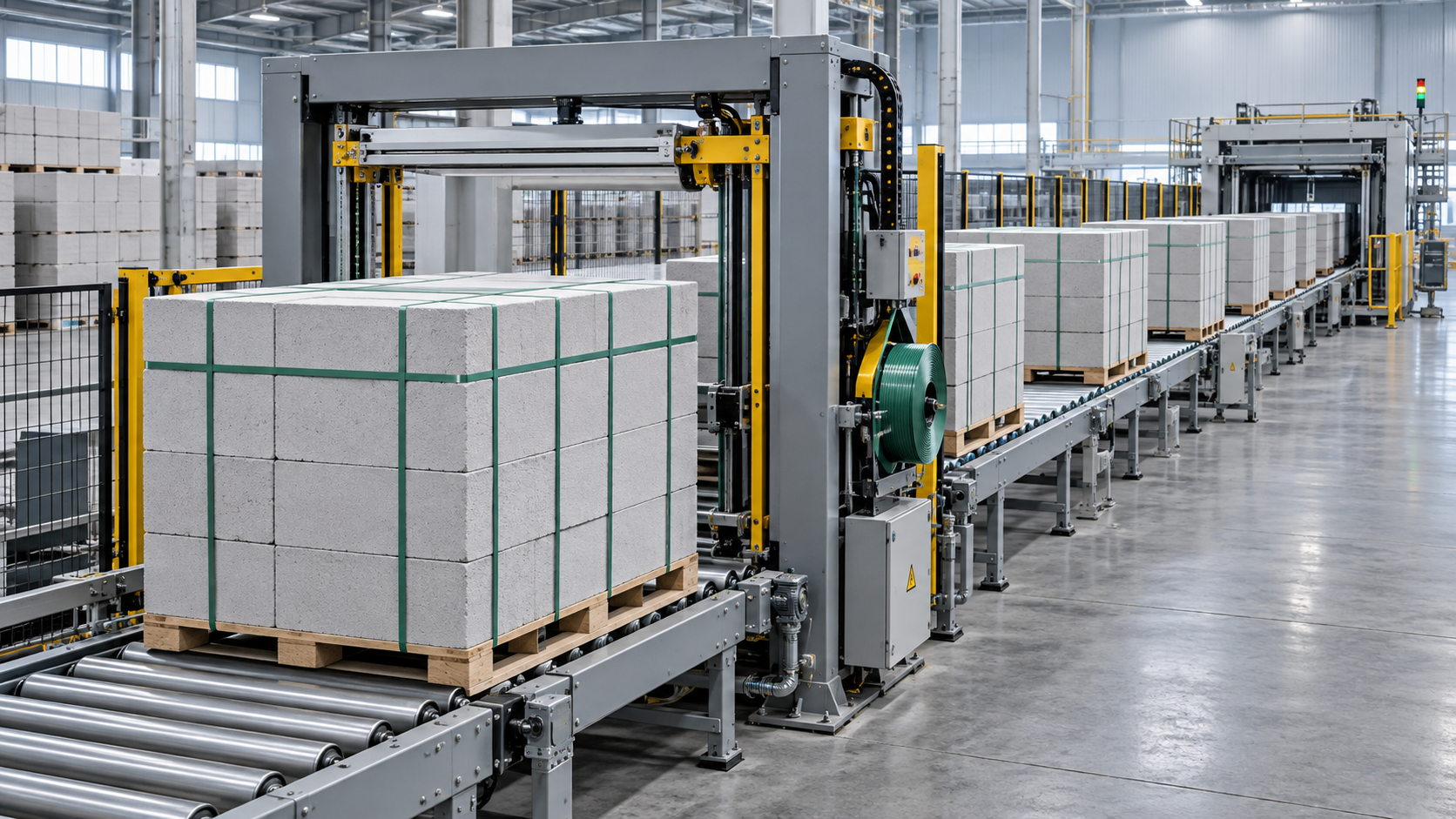
A more automated arrangement can include pack transfer, alignment, strapping, stretch wrapping or hood application, and controlled discharge. Automation reduces the need for repeated manual handling, but it also brings more sensors, controls, guarding, maintenance requirements, and interfaces to resolve. It is worth paying for when the rest of the line can feed it reliably and the expected operating schedule justifies it.
Be precise about what “automatic” means. A supplier may describe wrapping as automatic even though an operator must position each pack, fit protective material, or remove the finished load. Ask for a step-by-step operating sequence and the number of people needed in normal production, during changeovers, and when a fault occurs.
Capacity is more than the machine’s rated speed
Packaging equipment is often quoted in packs per hour, while AAC plants may plan production in cubic meters per day. Those figures cannot be compared directly without knowing the volume of each finished pack, the product mix, operating hours, and expected interruptions. A line that looks fast enough on paper can become a bottleneck when small blocks require more handling or when pack sizes change frequently.
Give each supplier the same production assumptions: normal and peak output, block dimensions, pack configuration, and the proportion of different products. Ask whether the stated cycle includes pack entry, alignment, strap or film application, sealing, and discharge. Some advertised cycle times cover only the wrapping or strapping operation itself.
It is also sensible to plan for a small buffer between processes where the layout allows it. A downstream delay should not immediately stop upstream handling, and a brief gap in block supply should not necessarily idle the packaging operator. The right buffer depends on available space, pack stability, and the way the existing line is controlled; it should not be added as an afterthought.
Strapping, wrapping, or both?
The packaging method affects both the equipment price and the cost of every pack. Strapping helps hold a load together, while film or a hood can provide additional protection against weather and contamination. Neither choice automatically solves every transport problem. A stable pack still depends on its geometry, handling method, support underneath, and the condition of the blocks.
For short storage periods under cover, a buyer may decide that a simpler protection arrangement is adequate. Blocks stored outdoors or transported over rough routes may need a different specification. Test the proposed pack against the actual loading, storage, and delivery conditions before committing to a material format or machine configuration.
Ask suppliers to state the compatible strap and film types, pack-size limits, sealing method, and whether corner protection or top sheets are included. A machine designed around one material size may be less flexible than expected if local supply changes. Check availability of consumables near the plant as well as the purchase price of the machine.
Why block consistency affects packaging cost
Packaging equipment cannot correct inconsistent blocks. Chipped edges, unstable layers, or dimensional variation can cause misalignment, interruption at guides, and damaged packs. Operators may compensate by slowing the line or adjusting strap tension, but those adjustments can conceal an upstream problem rather than solve it.
AAC batching system accuracy is one part of the wider production picture. Consistent ingredient dosing supports control of the mix, but finished block quality also depends on raw materials, mixing, casting, cutting, curing, and handling. It would be misleading to attribute packaging performance to batching accuracy alone.
When evaluating a packaging upgrade, examine where damage occurs. If blocks arrive at the packer with broken corners, a more sophisticated wrapper may do little to reduce the loss. If damage appears after strapping, investigate pack alignment, contact points, strap tension, and support during transfer. A supplier should be given representative product dimensions and information about existing defects, not only ideal samples.
Costs that are easy to leave out
The purchase order is only one part of the budget. Depending on the site and contract, the following items may need separate provision:
- Site preparation: foundations, floor loading, access routes, drainage where relevant, and space for maintenance and consumable storage.
- Utilities: electrical supply, compressed air, cabling, and connections from the plant’s existing distribution points.
- Integration: conveyor modifications, mechanical guarding, control interfaces, and agreement over which supplier handles interlocks and fault signals.
- Delivery and installation: transport, unloading, lifting equipment, assembly, travel, and accommodation for site personnel where applicable.
- Operating support: initial consumables, recommended spare parts, operator training, documentation, and ongoing maintenance.
Responsibility gaps are often more expensive than the individual items suggest. For example, a packaging supplier may provide a connection point for compressed air but not the site pipework. The plant owner may assume the opposite. Mark each boundary on the layout and assign it to a named party before comparing final prices.
For an existing plant, installation downtime deserves its own discussion. Establish what can be assembled while production continues, when the old equipment must be disconnected, and who is responsible for restarting the combined line. The lowest equipment price is less attractive if its installation requires an unplanned interruption at a busy point in the production schedule.
How to compare quotations on equal terms
Start with a common scope document rather than asking several suppliers for their “best price.” Include a layout, the point where each supplier takes over the product, the point where a finished pack is handed back, pack weights and dimensions, and the production conditions used for the capacity calculation. Note any forklift, crane, or downstream conveyor restrictions.
Then compare the practical details: which product sizes are covered without modification, how long a format change takes under agreed conditions, what happens when a strap breaks, and whether operators can safely clear a fault without dismantling equipment. Ask which wear parts are proprietary and how replacement parts and technical support are supplied.
Acceptance conditions should be agreed before purchase. A useful test defines the product and packaging materials to be used, the operating sequence, the required output, and how interruptions and rejected packs will be recorded. Avoid accepting a speed demonstration on empty conveyors as proof that the complete line can handle saleable AAC packs at the required rate.
Shandong Hongfa Scientific Industrial & Trading Co., Ltd., founded in 1990, produces AAC production lines alongside other construction machinery. When packaging is being planned as part of a broader plant project, a discussion with an equipment manufacturer familiar with upstream and downstream processes can help clarify layout and interface requirements. Confirm the exact packaging equipment, integration work, and after-sales support included in any proposal rather than assuming they form part of a standard line.
Before choosing a supplier, take one representative finished pack through the whole proposed route: from block transfer to storage and vehicle loading. If the quotation does not explain who handles each movement, what protects the blocks, and how the line reaches its stated output, the price is not yet ready for a fair comparison.
Recommend
 Nov 09, 2026
What Are the Import Requirements for Construction Machinery?
Understand building machinery import requirements, from customs documents and duties to safety compliance and installation, before you ship.
- Nov 09, 2026
How Accurate Is an AAC Batching System?
Compare AAC sand grinding equipment cost and learn what affects batching accuracy, from slurry control to calibration, before investing in your production line.
- Nov 08, 2026
How Much Does AAC Block Packaging Equipment Cost?
AAC batching system accuracy can affect downstream packaging. Explore AAC block packaging equipment costs, key price factors, and tips for comparing quotes.