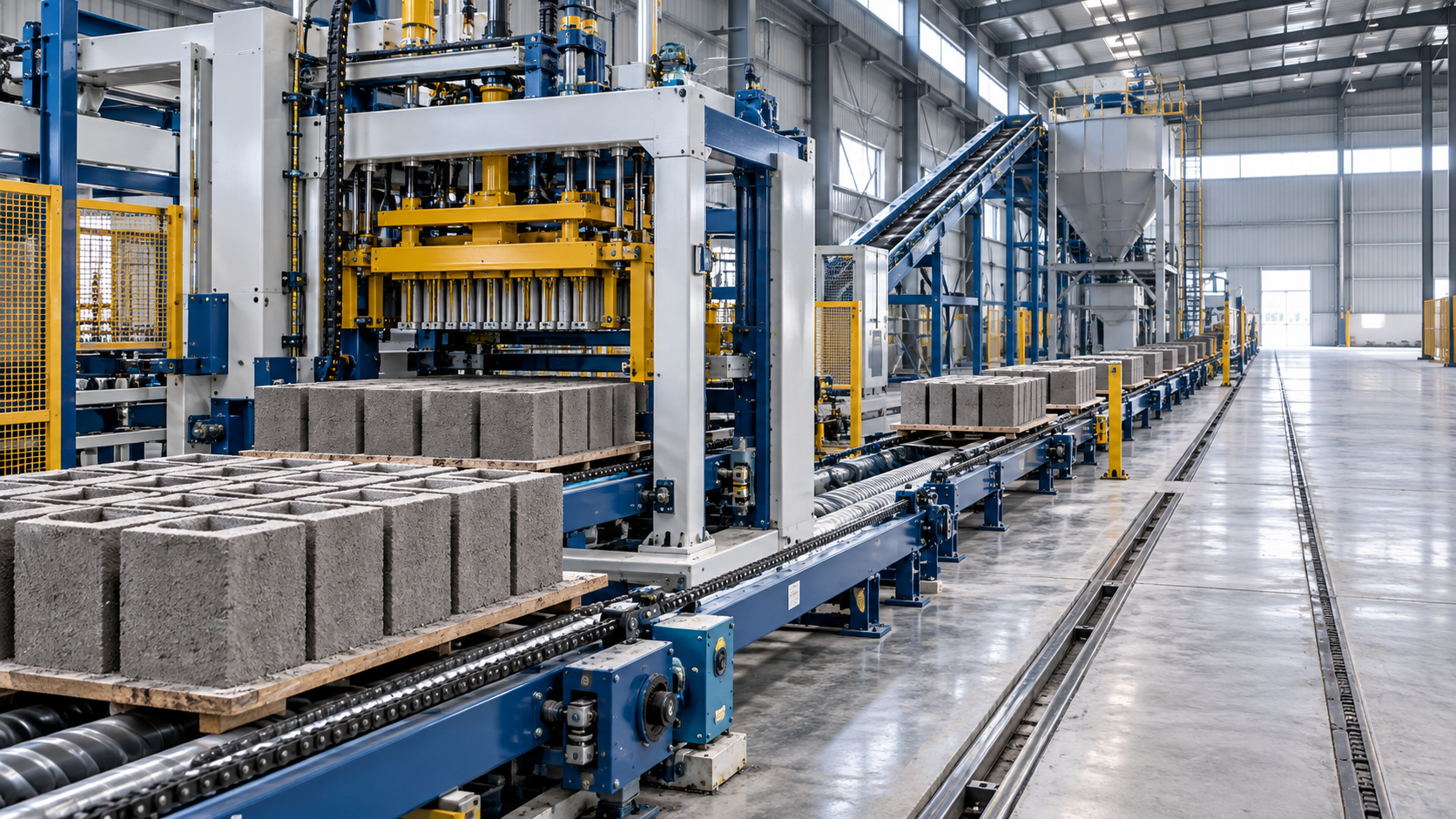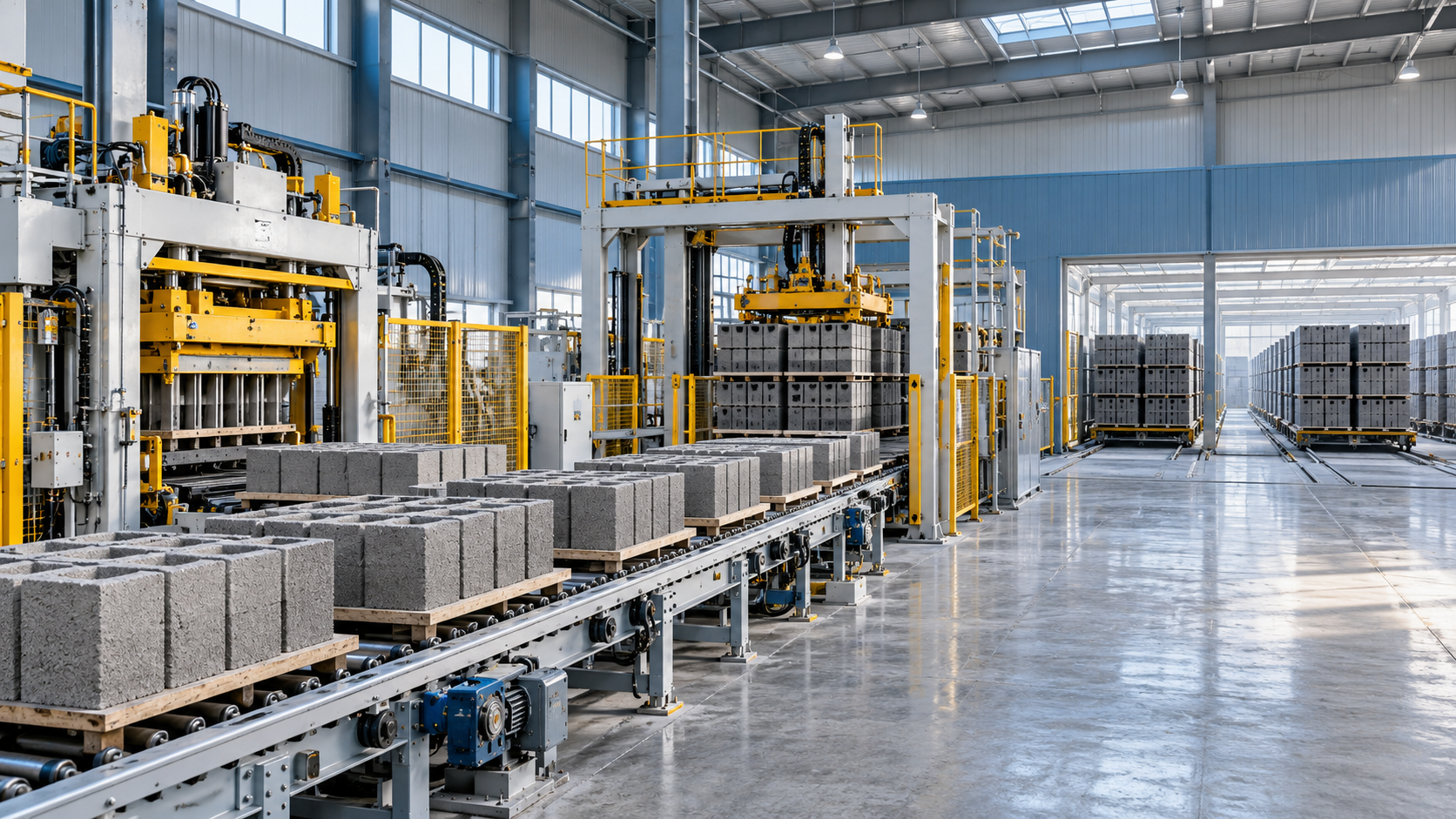
How to Choose AAC Plant Capacity for Your Market
How do I choose the right AAC plant capacity for my market? Start with a realistic assessment of local demand, construction activity, distribution reach and investment budget. A plant that is too small can restrict growth, but excess capacity can leave you paying for equipment, utilities and financing that sales cannot support. The decision is not simply how many cubic metres an autoclaved aerated concrete plant can produce. It is how much saleable product you can consistently make, deliver and get paid for.
How much AAC can your market realistically absorb?
Begin with customers you can reach, not the total volume of construction in a country or region. AAC competes with other walling materials, and not every project is designed to use it. Developers may like its thermal or handling characteristics, while contractors may hesitate if they lack experience with the blocks, compatible mortar or installation methods.
Build a demand estimate from the bottom up. Speak with distributors, contractors and developers about the products they buy, the dimensions they prefer, expected project schedules and their willingness to switch suppliers. Separate confirmed orders from expressions of interest. A distributor who agrees that AAC has potential is not necessarily committing warehouse space or a purchase volume.
Also examine the competition you would actually encounter. An established producer may already serve the largest cities; a gap on the map may reflect transport costs or weak demand rather than an obvious opportunity. Check competing materials as well as competing AAC plants, including how customers compare delivered prices and installation costs.
Where AAC is unfamiliar, allow for a slower sales ramp. Product demonstrations, contractor training and distributor development take time. That may favour a smaller initial line or a phased investment, even when a long-term market study suggests substantial potential.
What does the supplier’s capacity figure actually mean?
AAC production capacity is commonly quoted in cubic metres per year, but annual figures are only comparable when their assumptions match. Ask each equipment supplier to state the planned operating days, shifts, hours, product mix and the definition of output. In particular, check whether the figure describes theoretical line output, finished output or saleable output after losses.
An annual nameplate number can conceal a demanding schedule. If a proposal assumes more operating days or shifts than you can staff, its annual capacity is not a reliable basis for your business plan. Maintenance, changeovers, quality checks, training and unplanned stoppages all need time in the schedule.
For a simple sizing exercise, divide expected annual sales by the proportion of rated capacity you realistically expect to turn into saleable product. For example, if your planning scenario calls for 60,000 m³ of annual sales and assumes a 60% conversion from rated annual capacity to saleable output, the indicative rated capacity is 100,000 m³ per year. Those figures are illustrative, not industry benchmarks. The 60% assumption must cover the difference between the supplier’s rating and your planned shifts, downtime and losses; do not subtract those same factors again.
Run the calculation with a conservative case as well as a stronger sales case. If the project only works when production and sales both approach the supplier’s maximum, there is little room for startup problems or delayed orders.
Which part of an AAC line determines real output?
The plant’s practical capacity is constrained by its bottleneck, not by the fastest individual machine. Raw-material preparation, dosing and mixing, mould circulation, pre-curing, cutting, autoclaving, demoulding and packing must operate as a coordinated system.
Autoclave capacity deserves particular attention. The number and usable loading arrangement of autoclaves, the curing cycle, steam availability and turnaround time all affect how much material can pass through the plant. A faster cutter will not solve a curing bottleneck. Likewise, additional autoclaves will not deliver their expected benefit if moulds, handling equipment or the boiler cannot support the increased flow.
Ask for a production balance showing output at each major stage under the proposed operating schedule. Review how many moulds and handling movements are needed, where material waits between stages and what happens during maintenance. If the line is expected to make several block sizes or densities, discuss how changes affect cutting, packing and inventory rather than assuming every product runs at the same rate.
The same scrutiny applies to utilities. Steam, electricity and water must be available at the required quantity and quality. A quoted production line capacity is of limited use if the site’s power supply is unreliable or the boiler has been selected without enough allowance for the intended operating pattern.
How should transport and sales territory affect plant size?
AAC is relatively light compared with many masonry materials, but finished blocks still occupy substantial truck space and require careful handling. Delivered cost depends on distance, road conditions, vehicle loading, packaging, breakage and return trips. A larger plant may offer a lower production cost per cubic metre at high utilization, yet lose that advantage when it must ship farther to find enough buyers.
Map likely customers around the proposed site and estimate delivered cost by destination. Include the practical limits of distributors: storage space, unloading equipment, payment terms and their ability to sell through stock. A plant near raw materials but far from customers may look attractive on the factory budget while creating a difficult sales problem.
Demand timing matters too. A large project order can temporarily fill the production schedule, but a plant should not be sized solely around one contract unless there is a credible plan for the period after delivery. Conversely, a diversified customer base may support steadier production even if no single buyer takes a large volume.
Can raw materials and quality requirements support the target?
Capacity planning starts before the mixer. AAC formulations depend on the available raw materials and the required product properties. Depending on the process, suppliers may propose sand or fly ash alongside cement, lime, gypsum and other inputs. Their consistency, availability, transport cost and suitability for the proposed recipe need to be assessed for the specific site.
Request raw-material testing and process trials where appropriate. A low-cost source is not an advantage if variation leads to unstable mixes, cutting problems or finished blocks that cannot meet customer requirements. Confirm who will conduct the tests, which properties will be measured and what happens if the material changes after the line is commissioned.
Local product standards and approval requirements should be checked before finalizing the business case. Required block strength, density, dimensional tolerances or other properties depend on the market and intended application. These requirements can influence the recipe, curing regime, testing arrangements and saleable yield. Do not treat compliance as a task to solve after the equipment is ordered.
Should you buy for current demand or future growth?
Usually, neither extreme is ideal. Buying only for immediate orders can force an early relocation or expensive rebuild. Buying for an optimistic long-term forecast can put too much capital into a plant that operates below its economic capacity. The better question is which parts of the investment are difficult to change later.
Land, building layout, vehicle access, foundations and utility corridors are worth considering early. Leave room for future equipment and finished-goods storage if expansion is plausible. At the same time, ask the supplier to identify what an upgrade would actually involve: another autoclave, more moulds, a larger boiler, changes to cutting or packing, additional staff, or a complete line modification. “Expandable” is not a useful promise without a scope and interfaces.
A phased approach is attractive when demand is uncertain, but it is not automatically cheaper. Installing infrastructure in two stages can add construction costs or interrupt production. Compare the initial investment, the cost of expansion and the disruption against the risk of carrying unused equipment from day one.
What should be included in the financial comparison?
Compare alternatives using the cost per saleable cubic metre at several sales volumes, not just the equipment purchase price or the cost at full capacity. Include raw materials, fuel and electricity, labour, maintenance, consumables, packaging, internal handling and delivery. Financing costs, insurance and working capital also matter, particularly while customers are paying on credit and finished goods are accumulating in the yard.
Separate fixed costs from costs that change with output. If sales fall short, a larger plant may still carry substantial labour, financing and facility costs. On the other hand, a very small line may struggle to cover its costs if it cannot produce enough volume for its established sales commitments. Ask the finance team to identify the sales level at which each option covers its operating and financing obligations, using locally verified prices.
Cash flow during ramp-up deserves its own review. Commissioning, operator training, product testing and customer approval can delay stable sales. Budget for spare parts and technical support as well as inventory; a modest component failure can stop an entire line if a replacement is unavailable.
What should you ask an equipment supplier before deciding?
Give suppliers the same written basis for their proposals: target products, raw-material information, intended shifts, site conditions and expected annual sales. Then ask them to clarify the boundaries of their offers. A lower quoted price may exclude the boiler, water treatment, installation, civil works, packing or other items needed to reach the stated output.
Request a process flow, equipment list, utility requirements, layout, production assumptions and a proposed acceptance procedure. Establish how capacity and product quality will be tested, what operating conditions apply, and which party supplies materials, labour and utilities during the test. Discuss commissioning support, operator training, spare parts and response arrangements in the contract rather than relying on general assurances.
Shandong Hongfa Scientific Industrial & Trading Co., Ltd. produces AAC production lines alongside other building-material machinery. When discussing a project with Hongfa or another supplier, the useful conversation is not simply about the largest available line. It is about matching a complete process configuration to your raw materials, operating plan and distribution area.
Before committing, put three documents side by side: a customer-based sales forecast, a supplier’s capacity calculation with stated assumptions, and a cash-flow model for slower-than-expected sales. If their assumptions do not agree, resolve the differences before selecting the plant. The right capacity is the one your market can absorb and your operation can support—not merely the number printed on a quotation.
Next:No more content
Recommend
 Nov 06, 2026
How to Choose AAC Plant Capacity for Your Market
How do I choose the right AAC plant capacity for my market? Explore demand, production bottlenecks and costs to make a confident investment decision.
- Nov 06, 2026
Is a Fully Automated Block Plant Worth the Extra Investment?
Is a fully automated block plant worth the extra investment? Compare payback, labor savings, production capacity, and maintenance costs before you decide.
- Nov 05, 2026
How Much Labor Can an Automated Block Production Line Save?
How much labor can an automated block production line save? Explore practical staffing examples, calculate savings and make a more confident investment decision.