How to Choose a Wall Panel Production Machine for Export Quality?
Export quality is not determined by the rated output of a wall panel production machine. A line can run at a high speed and still produce panels with inconsistent thickness, poor edge geometry, weak bonding, or traceability gaps that create rejection risk after shipment. The right machine is the one that can repeatedly manufacture a panel meeting the destination market’s technical requirements under the actual raw-material, labor, utility, and maintenance conditions of the factory.
The first decision is therefore not “Which machine has the highest capacity?” It is “Which panel specification must remain stable from batch to batch, and what production controls are needed to protect that specification?” For export-oriented production, equipment selection should connect panel design, forming method, curing or bonding process, quality inspection, packaging, documentation, and supplier support into one operating system.
What does “export quality” mean for a wall panel line?
Export quality has at least four dimensions. The first is product conformity: dimensions, density, strength, surface condition, thermal or acoustic performance, fire-related properties, and other declared characteristics must match the contract, drawings, and applicable local requirements. The second is consistency: an acceptable sample panel is not enough if later batches vary because of moisture changes, dosing drift, mold wear, or unstable curing.
The third is shipment readiness. Panels must be stacked, protected, labeled, and loaded in a way that minimizes damage during inland transport, container handling, sea freight, and unloading. The fourth is evidence. Buyers, inspectors, distributors, and project owners may require batch records, test reports, installation guidance, material declarations, spare-parts lists, and equipment documentation. A machine line that produces good panels but cannot support disciplined records creates avoidable commercial risk.
These requirements differ substantially by panel category. A machine for lightweight cement-based partition panels, for example, has different control points from a line producing insulated metal-faced sandwich panels, precast concrete wall elements, fiber-cement boards, or AAC-related wall products. “Wall panel machine” is therefore too broad a description to support a sound purchase decision.
Start with the panel specification, not the equipment brochure
Before comparing manufacturers, define the product in production terms. This should include panel length, width, thickness range, core structure, facing materials, joint profile, embedded reinforcement, openings or conduits, target dry density, permitted dimensional tolerances, curing regime, and expected surface finish. If the panel is intended for a particular building system, the machine must also preserve the geometry required for joints, installation accessories, and edge sealing.
A basic question is whether the line is designed around a fixed product or a flexible product family. A fixed mold arrangement may offer better repeatability for one size, while a configurable line may accommodate different thicknesses and lengths but require more changeover time and more careful calibration. Flexibility has value only when the business genuinely needs multiple specifications. Buying a highly adjustable line for a stable, single-SKU product can add complexity without improving export performance.
Material behavior must be assessed with equal care. Cement, gypsum, fly ash, silica sand, foam, fibers, additives, EPS granules, perlite, and reinforcing mesh do not behave identically across suppliers or climates. A line should be evaluated against the feedstocks actually available to the plant, including their moisture range, particle distribution, contamination risk, and storage conditions. Equipment calibrated around ideal laboratory inputs may be difficult to stabilize with variable commercial materials.
Which machine functions have the greatest effect on panel consistency?
For most wall panel processes, stable dosing and mixing are more important than headline forming speed. Inconsistent water addition, inaccurate weighing, poor mixing sequence, or uncontrolled foaming can change density, workability, bond quality, and final strength. The machine should provide a clear, maintainable method for measuring critical ingredients rather than relying excessively on operator judgment.
Where slurry, mortar, or foam-based material is used, the mixer must suit the formulation and batch size. A mismatch can lead to unmixed material, excessive entrained air, fiber clumping, segregation, or premature setting. The purchaser should ask how the supplier validates mixing uniformity and how the system handles cleaning between shifts or between formulations. Cleaning is not a minor operational matter: residual material can affect subsequent batches and cause unplanned downtime.
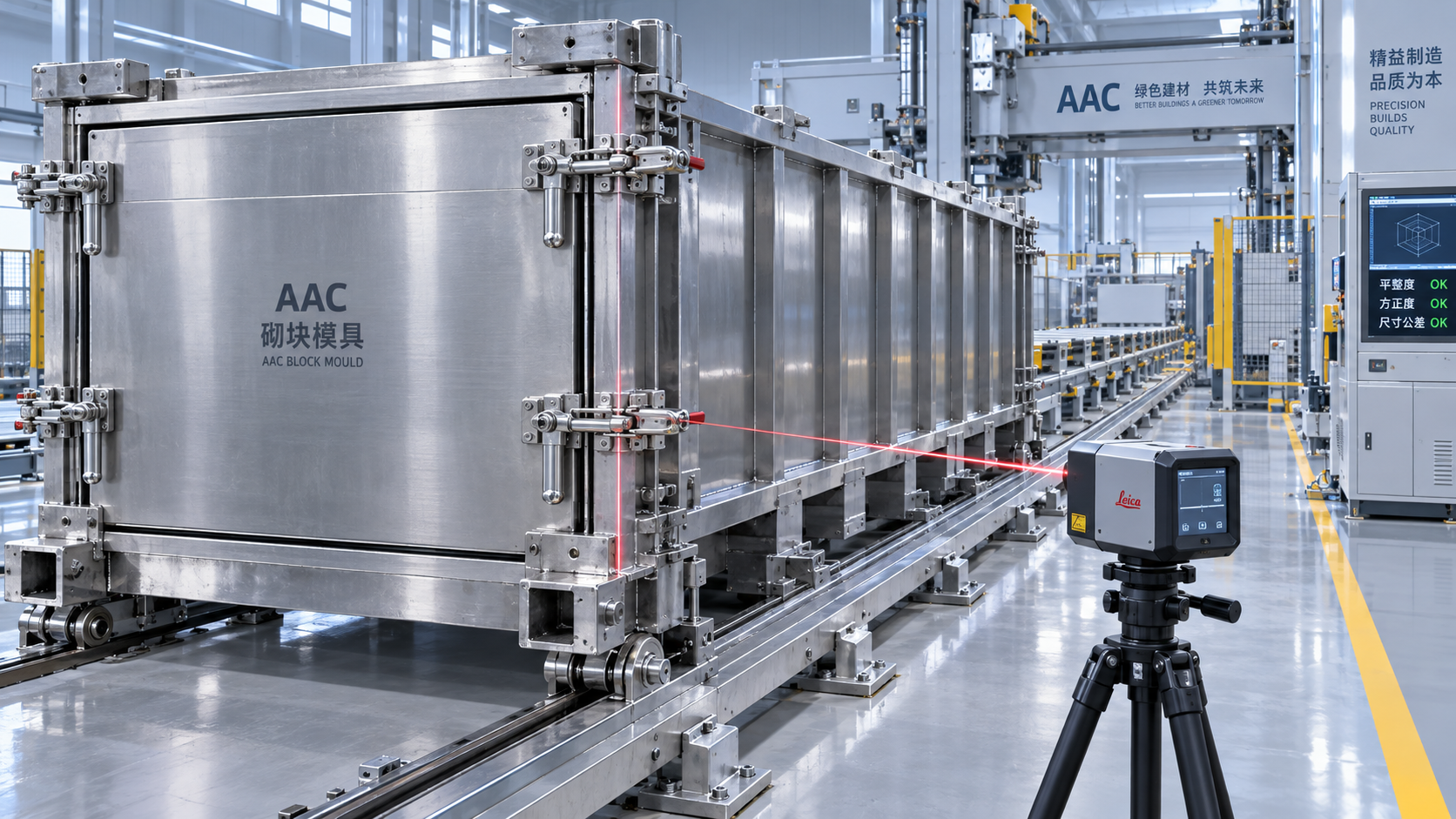
Forming accuracy is the next major control point. Mold rigidity, platen flatness, guide alignment, vibration behavior, extrusion stability, and release mechanisms all affect panel dimensions and surface quality. Long panels make small alignment errors more consequential. A machine should be assessed not only by its nominal dimensional capability, but also by how it maintains alignment after repeated cycles, how wear parts are adjusted, and how easily operators can verify settings.
For panels incorporating mesh, wire, board facings, or other reinforcement, placement control is critical. Reinforcement that shifts during filling or pressing can reduce cover, distort edges, or interfere with cutting. The line should keep material feed, reinforcement placement, and panel forming synchronized. Manual insertion may be workable for low-volume production, but it increases dependence on training and process discipline when repeatability is a central export requirement.
Cutting and edge profiling deserve particular attention because they affect installation as well as appearance. Clean cuts, square ends, and stable tongue-and-groove or other joint features reduce site modification and complaints from installers. Ask whether cutting occurs at green strength or after curing, what tool wear indicators are used, and how dust or slurry residue is managed. A good forming process can still lose value if the finishing stage damages corners or creates inconsistent joints.
Why curing and handling capacity can be more important than machine speed
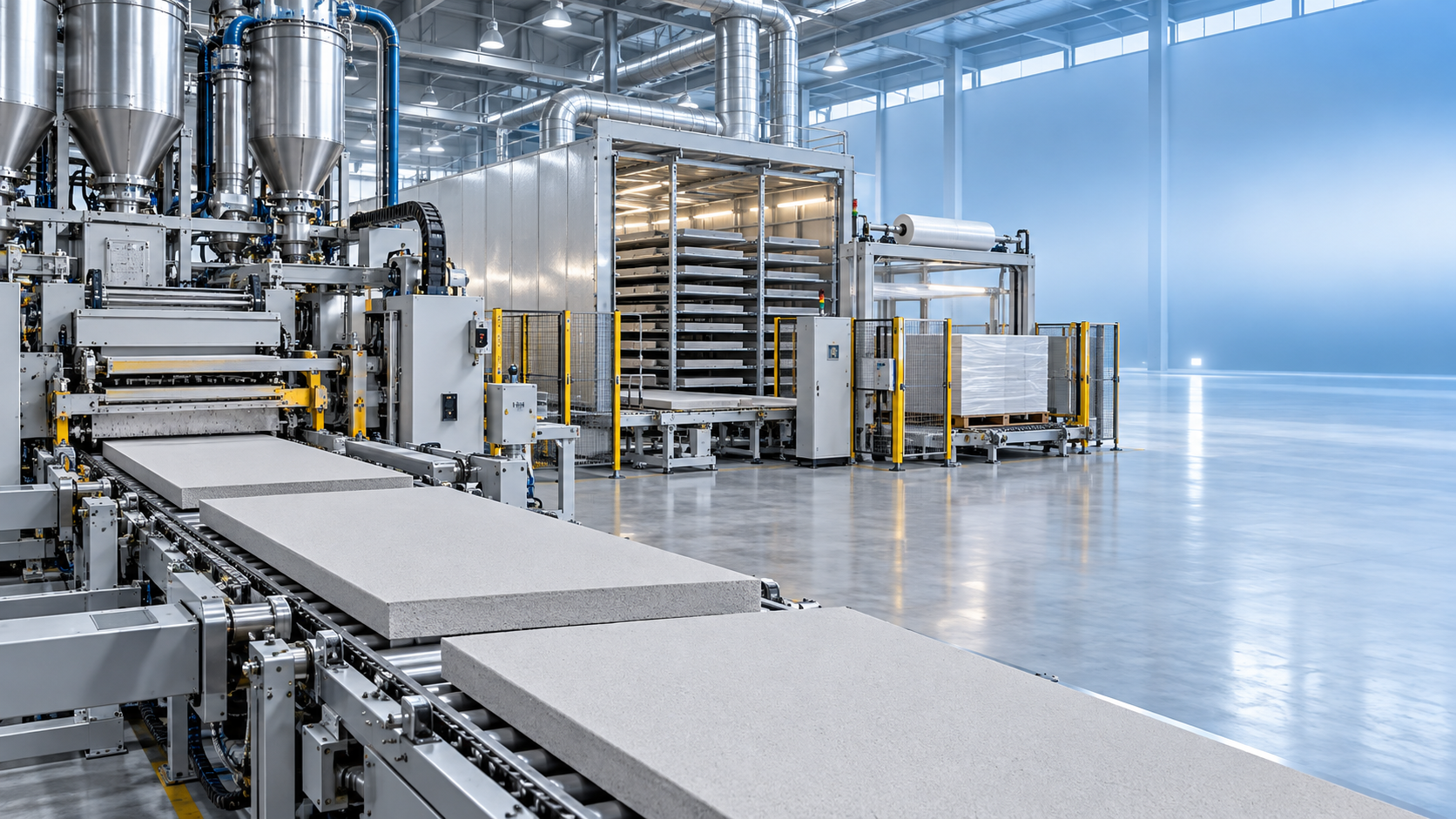
A production line should be evaluated as a flow system, not as a single forming machine. If the forming section produces panels faster than the curing area can accept them, the factory may accumulate semi-finished product, shorten curing time, or create handling damage. None of these outcomes supports reliable export quality.
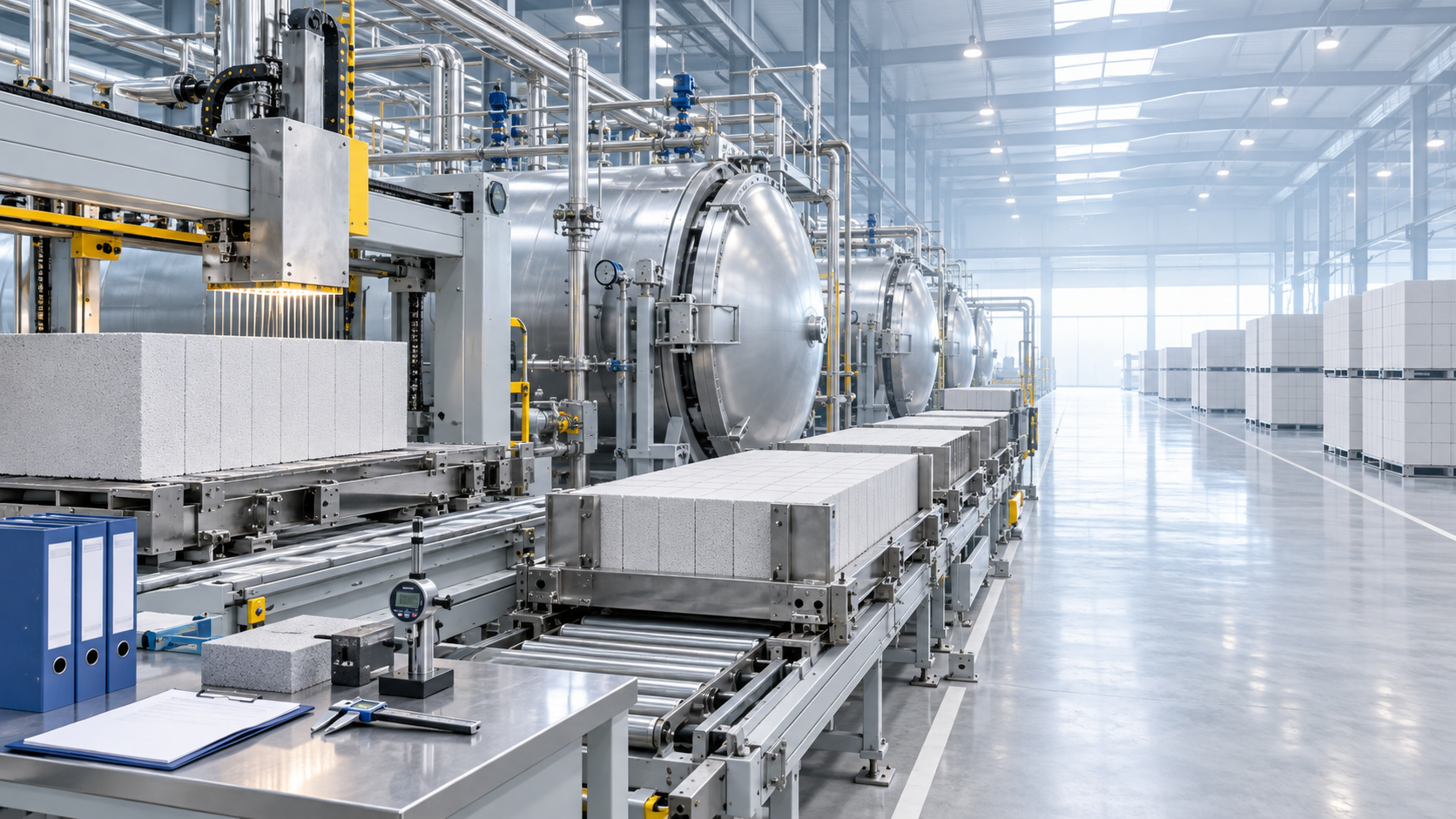
The appropriate curing method depends on the panel composition. Ambient curing, controlled-temperature rooms, racks, kilns, autoclaves, and other methods have different space, energy, time, and process-control implications. The equipment proposal should state the assumptions behind its claimed output: cycle time, number of molds, curing duration, shift pattern, material preparation time, and allowance for cleaning and maintenance. A daily capacity claim is not comparable unless these assumptions are visible.
Material transfer is another frequent source of defects. Fresh or partially cured panels can crack, warp, chip, or deform if lifting points, support spacing, or conveyor transitions are poorly designed. Long-format products need handling systems that prevent sagging. It is useful to review the entire path from demolding through curing, trimming, inspection, stacking, and loading rather than treating those steps as secondary accessories.
For export shipments, the packing system should match the panel’s fragility and the expected logistics route. Edge protectors, separators, strapping, moisture protection, pallet design, and lifting instructions should be considered early. Packaging cannot correct a weak panel, but poor packaging can damage a compliant panel before it reaches the buyer.
How much automation is actually necessary?
Automation should be selected according to the stability it creates, not because it appears advanced. Automated batching, recipe management, mold movement, cutting, and stacking can reduce variation where manual work is a major source of inconsistency. They can also improve batch identification and production records. However, automation adds sensors, drives, software, pneumatic components, electrical cabinets, and troubleshooting requirements that must be supportable at the operating location.
A practical line separates tasks that need precision from tasks that benefit from human judgment. Critical dosage and repeated positioning are strong candidates for automation. Visual inspection of surface defects, assessment of abnormal material behavior, and corrective action may still require trained personnel. The most suitable design is often one with automated control of critical parameters and manual access for cleaning, adjustment, and verification.
Control software should allow authorized users to manage recipes, display alarms, retain relevant production records, and identify deviations. It should not force the plant into a closed system where ordinary adjustments require remote intervention from the supplier. At the same time, unrestricted parameter changes can undermine consistency. Role-based access, backup procedures, and clear documentation are more valuable than a visually complex interface.
What technical evidence should be requested from the machine supplier?
A quotation should be supported by engineering information detailed enough to evaluate the line, not merely a list of major equipment. Useful documents include a process flow diagram, general layout, utility schedule, foundation loads, electrical load information, compressed-air and water requirements, equipment list, control-system description, and scope boundaries between supplier and buyer.
The supplier should explain which performance figures are guaranteed and under what conditions. Capacity may depend on panel size, formulation, curing time, mold quantity, operator count, and the proportion of time allocated to changeovers. Dimensional tolerance claims should identify the measurement basis and the point in the process at which they apply. A panel measured immediately after demolding may not have the same dimensions after drying or curing.
Factory acceptance testing is especially valuable when the buyer has a defined panel design. The test plan should identify the materials to be used, panel dimensions, sampling method, acceptance criteria, measurement tools, equipment settings, and records to be handed over. If testing with the buyer’s exact raw materials is impractical, that limitation should be explicit. Substituting a different cement, additive, facing, or reinforcement can materially change production behavior.
Equipment certification should be interpreted accurately. ISO 9001 certification indicates that a manufacturer operates a quality management system within its certified scope; it does not by itself prove that a specific machine will produce panels meeting a particular national product standard. Likewise, CE marking is relevant to machinery placed on the European Economic Area market and concerns applicable legal conformity obligations; it is not a universal certificate of manufacturing excellence or a substitute for buyer-defined acceptance criteria.
Where a panel is intended for a regulated construction market, the buyer should identify the applicable product rules before purchasing the line. The relevant test methods and declarations depend on the panel type, its intended use, and the destination. For example, a standard applicable to metal-faced insulated sandwich panels should not be assumed to apply to cement-based interior partition panels. The machinery supplier can provide technical input, but responsibility for confirming market-specific product compliance should not rest on generic equipment claims.
How should energy use be evaluated?
Energy efficiency should be measured at the process level. A low-power forming machine does not necessarily create a low-energy factory if curing, compressed air, dust collection, wastewater handling, or material drying consumes heavily. The relevant calculation is energy per saleable panel or per square meter of conforming product, including foreseeable scrap and rework.
Examine motor efficiency, variable-frequency drives where load changes justify them, insulation of heated curing spaces, heat recovery possibilities, compressed-air leakage control, and idle-time power consumption. The analysis should also consider local energy reliability. A line that relies on continuous heating or tightly timed automated cycles may require backup power or additional process safeguards in areas with unstable supply.
Water and waste handling should not be ignored. Wet-process equipment may need settling, recycling, or controlled disposal arrangements. Dust-generating cutting and dry-material handling stages require appropriate collection systems. These systems protect product quality as well as working conditions: dust contamination, contaminated process water, and uncontrolled residues can affect consistency and increase maintenance requirements.
What makes after-sales support an export-quality issue?
For imported machinery, service capability is part of the technical specification. Installation quality affects alignment, calibration, safety interlocks, and the accuracy of the initial production baseline. Commissioning should include more than starting the motors. It should cover recipe setup, trial production, adjustment procedures, operator instruction, maintenance schedules, and a defined handover of drawings and software backups.
Spare-parts planning should focus on failure consequences rather than simply buying a large assortment. Identify parts that stop production or affect quality: sensors, cutting tools, seals, bearings, hydraulic or pneumatic components, drive parts, mold liners, and control hardware. Confirm part numbers, recommended stock quantities, lead times, alternatives, and whether internationally available components are used where appropriate.
Technical documents should be available in a language usable by the operating team and should include electrical diagrams, hydraulic or pneumatic diagrams where relevant, preventive-maintenance instructions, wear-part schedules, safety instructions, troubleshooting guidance, and calibration procedures. Remote support can be useful, but it should complement—not replace—clear local documentation and competent commissioning.
Where do buyers most often make the wrong comparison?
The common mistake is comparing quotations only by capacity, price, and automation level. This tends to obscure differences in molds, curing provisions, material preparation, inspection equipment, installation scope, packing systems, commissioning support, and spare parts. Two quotations with similar output claims may represent fundamentally different levels of process completeness.
Another mistake is treating optional equipment as nonessential before understanding its role. An automated batching system, curing racks, dust collection unit, dimensional inspection fixture, or protective packing station may appear to increase the initial budget, yet removing it can transfer cost and quality risk into daily operations. The correct question is whether an item protects a requirement included in the product specification or export contract.
A sound selection decision ties the machine configuration to a written production and quality plan. The plan should define the panel, raw materials, process controls, acceptance tests, utilities, staffing, maintenance responsibilities, packing method, and supplier deliverables. When these elements are clear, the choice of wall panel production machine becomes less about promotional claims and more about whether the proposed line can reliably deliver saleable panels throughout its operating life.
Next:No more content
Recommend
 Oct 13, 2026
How to Choose a Wall Panel Production Machine for Export Quality?
How to choose a wall panel production machine for export quality? Explore essential factors for consistent output, curing, automation, quality control, and supplier support.
- Oct 12, 2026
Is ISO Certification Mandatory for AAC Block Manufacturing Equipment?
Are AAC block manufacturing equipment ISO certified mandatory? Discover legal requirements, supplier risks, and smart compliance checks before investing.
- Oct 11, 2026
How Often Should AAC Molds Be Inspected and Replaced?
How often should AAC molds be inspected and replaced? Discover practical inspection schedules, warning signs, and maintenance tips to reduce defects and downtime.