Is ISO Certification Mandatory for AAC Block Manufacturing Equipment?
Are AAC block manufacturing equipment ISO certified mandatory? The short answer is: not always. In most markets, there is no universal law stating that every autoclaved aerated concrete (AAC) production machine must carry an ISO certificate before it can be purchased or operated. However, this simple answer can be misleading if it stops there.
For an AAC plant investor, plant manager, or procurement team, ISO certification is often one of the clearest signals that a machinery supplier has documented quality controls, repeatable manufacturing processes, and a system for handling nonconformities. Those factors matter greatly when a production line includes raw-material dosing, slurry mixing, mold handling, cutting, pre-curing, autoclaving, finished-product handling, and automation controls.
In other words, ISO certification may not be a universal legal gatekeeper for AAC block manufacturing equipment, but it is a practical benchmark that can influence equipment reliability, project risk, maintenance planning, and long-term confidence in the supplier.
First, clarify what “ISO certified equipment” actually means
Buyers often use the phrase “ISO-certified machine,” but ISO certification can refer to several different things. This distinction is important during technical discussions and contract review.
The most common reference is ISO 9001, a quality management system standard. It usually certifies the supplier’s management system rather than declaring that every individual AAC block machine or every completed production line is independently certified by ISO. A manufacturer with an ISO 9001 quality system should have defined procedures for design control, purchasing, production, inspection, corrective action, document management, and customer feedback.
That is valuable, but it is not the same as a local safety approval, electrical compliance declaration, pressure-vessel inspection, or acceptance test for a specific line. A reliable supplier should be able to explain the difference clearly instead of using “ISO” as a broad and vague sales term.
When evaluating AAC equipment, purchasers should normally separate four questions:
- Does the machinery manufacturer operate under a recognized quality management system?
- Does the proposed equipment meet the mandatory legal and safety requirements in the destination country?
- Are high-risk components, such as autoclaves, electrical panels, lifting systems, and pressure-related parts, supported by the required documentation?
- Can the supplier demonstrate that the actual line will perform according to the agreed technical specification?
A “yes” to only the first question is not enough. But ignoring that first question entirely can make supplier selection much harder.
When ISO certification is not legally mandatory
In many jurisdictions, ISO 9001 certification is voluntary. A machinery builder may legally manufacture and sell AAC block production equipment without holding ISO 9001 certification, provided that it complies with applicable local laws and contractual requirements. A buyer may also choose a non-certified supplier if the supplier can still demonstrate adequate engineering capability, quality control, safety compliance, and after-sales support.
This is why the answer to “Are AAC block manufacturing equipment ISO certified mandatory?” depends partly on where the line will be installed. The relevant legal obligations may come from national machinery regulations, workplace safety rules, electrical codes, import rules, boiler and pressure-equipment regulations, or environmental permits—not from ISO itself.
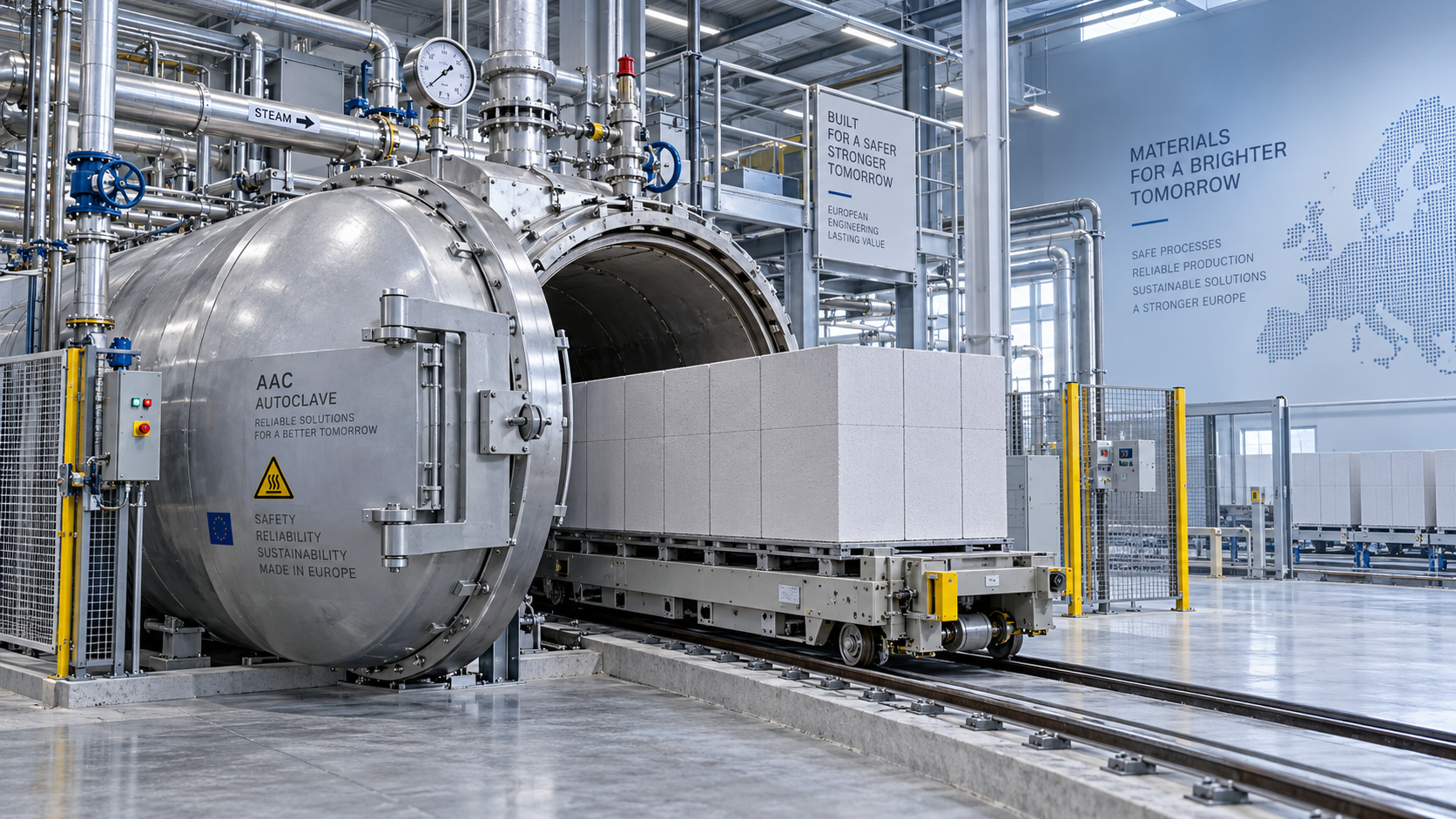
For example, an AAC project involving steam curing must pay close attention to autoclave-related compliance. The autoclave is not just another production component: it operates under pressure and requires appropriate engineering, inspections, operating procedures, and maintenance discipline. The exact requirements vary by country, but the buyer should never assume that a supplier’s ISO certificate replaces pressure-equipment documentation or local authority approval.
Similarly, if equipment is exported to a market with specific machinery conformity requirements, the relevant declarations and technical files may be mandatory even when ISO 9001 remains voluntary. Certification expectations should therefore be checked before the purchase order is finalized, not after equipment has arrived at the site.
Why many serious AAC producers still prefer an ISO-certified supplier
AAC blocks are sensitive to process consistency. Variations in slurry density, material dosing, mixing time, mold filling, cutting accuracy, curing conditions, or autoclave cycles can affect block dimensions, density, strength, appearance, and yield. The production line is not simply a collection of machines; it is a connected process in which weak control at one stage can create waste further downstream.
That is where a documented quality management system becomes meaningful. An ISO-oriented supplier is more likely to maintain controlled drawings, inspection records, procurement standards, assembly procedures, calibration routines, and traceability for key components. It does not guarantee that every installation will be trouble-free, but it reduces the chance that critical work depends only on informal experience or verbal promises.
For buyers, the benefit is often felt during the less glamorous stages of a project: confirming motor and gearbox specifications, resolving a control-system issue, ordering replacement parts years later, comparing a delivered machine with approved drawings, or identifying the source of a recurring defect. Good records make those moments far easier to manage.
The value is also commercial. Banks, project partners, government procurement teams, and larger construction-material groups may ask for evidence that a machinery supplier follows a recognized quality system. Even where ISO certification is not a statutory requirement, it can make supplier qualification smoother and reduce questions during due diligence.
ISO 9001 is useful, but it should never be the only buying criterion
Some buyers make the opposite mistake: they see an ISO certificate and stop asking technical questions. That approach can be expensive. ISO 9001 indicates that a quality management system has been assessed, but it does not automatically prove that a specific AAC line has the right capacity, automation level, energy profile, layout, or material compatibility for a particular project.
A well-chosen AAC equipment supplier should be evaluated through both documentation and practical engineering evidence. Consider the following areas alongside ISO status:
1. Process design for your raw materials
Fly ash, sand, lime, cement, gypsum, aluminum powder or paste, and water can vary significantly by region. The line should be designed around the actual characteristics of the available materials, not only a generic recipe. Ask how the supplier addresses grinding, slurry preparation, batching accuracy, and formula adjustment when material quality changes.
2. Capacity stated in real operating terms
Production capacity should be discussed with clear assumptions: product size, density grade, shift arrangement, autoclave configuration, curing cycle, annual operating days, and expected reject rate. A headline capacity figure without these details can create unrealistic expectations.
3. Mechanical construction and component selection
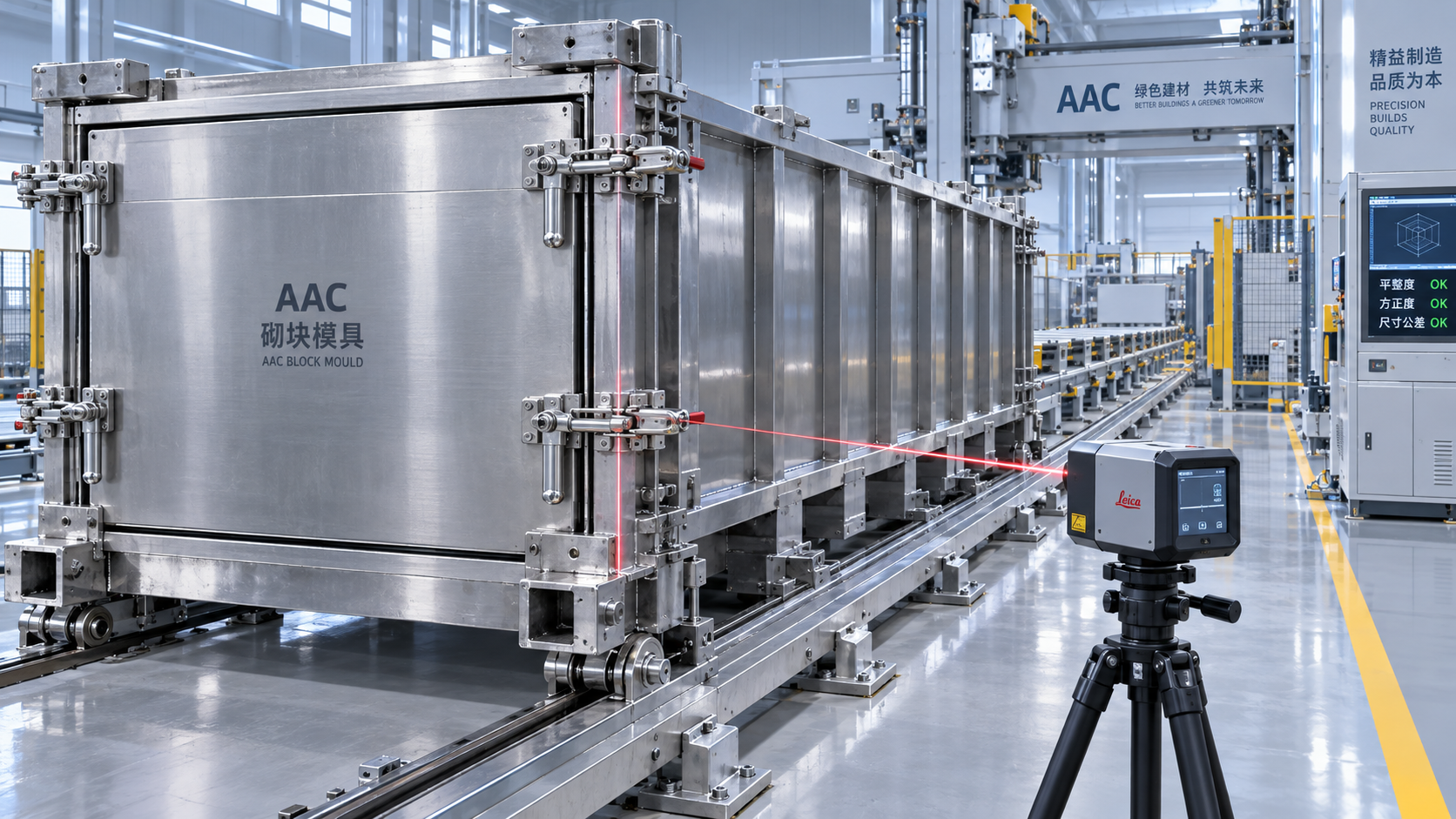
Review the construction of molds, cutting systems, transfer equipment, racks, conveyors, and handling mechanisms. Ask which components are manufactured in-house, which are sourced externally, and how wear parts are supported. In AAC production, small alignment problems can become repeated cutting defects or handling interruptions.
4. Automation and serviceability
An advanced control system is useful only if local operators can understand and maintain it. The best solution balances automation with clear interfaces, accessible electrical cabinets, sensible fault diagnostics, backup procedures, and training. Buyers should also confirm language requirements for manuals, operator screens, and electrical documentation.
5. Factory acceptance and commissioning support
A detailed factory acceptance test, followed by structured site commissioning, provides stronger evidence than a certificate alone. The contract should define what will be tested, which materials will be used, how performance is measured, what documents will be delivered, and how deficiencies will be corrected.
A practical compliance checklist before ordering an AAC block line
Instead of asking only, “Do you have ISO?”, a more productive conversation is: “Which documents apply to this line, this destination, and these operating conditions?” The following checklist can guide procurement discussions.
- Quality system certificate: Request a copy of the supplier’s ISO 9001 certificate, confirm the issuing body, validity period, and certified scope.
- Company capability: Review manufacturing facilities, engineering resources, quality inspection methods, and relevant experience in building-material machinery.
- Equipment specification: Ensure the quotation identifies capacity assumptions, product range, line boundaries, utilities, automation scope, and exclusions.
- Safety documents: Ask for risk assessments, operating instructions, emergency-stop arrangements, guarding details, and lockout or maintenance procedures where applicable.
- Electrical documentation: Confirm voltage, frequency, control standards, panel drawings, cable schedules, and destination-market requirements.
- Pressure-related documentation: Clarify responsibilities for the autoclave, valves, piping interfaces, inspections, and any local registrations required before operation.
- Quality inspection plan: Request information on incoming-material inspection, fabrication controls, assembly inspection, test records, and final inspection.
- Acceptance criteria: Put performance targets, trial-run conditions, and remedies for nonconformance in writing.
- After-sales coverage: Define installation guidance, commissioning scope, operator training, spare-parts recommendations, remote support, and response procedures.
This checklist is particularly useful for first-time AAC investors, who may focus naturally on the visible equipment while underestimating documentation, utilities, safety interfaces, and commissioning responsibilities.
What certification means for international sourcing
International sourcing adds another layer to the decision. Equipment may be engineered in one country, shipped through another, and installed under a third country’s industrial regulations. In that situation, the buyer needs more than a general assurance that the supplier “meets international standards.” The project team should identify the applicable standards and required certificates at the beginning of the design phase.
It is wise to involve local consultants, inspection bodies, or relevant authorities early when the project includes autoclaves, steam systems, high-voltage electrical work, or a new industrial building. Late compliance changes can affect equipment layout, piping design, foundation work, control panels, and delivery schedules.
Importantly, ISO certification should be verified rather than accepted at face value. Check the certificate number, the legal name of the certified entity, the scope of certification, the issue and expiry dates, and the accreditation of the certification body. A certificate covering a trading entity, for example, may not demonstrate the same level of manufacturing-process control as one covering the actual equipment factory.
How Hongfa approaches the quality question
For buyers looking at Chinese AAC block manufacturing equipment, Hongfa is a building-material machinery manufacturer with production bases in Shandong and Guangxi and a long history in construction machinery. Its product range includes aerated concrete block production lines, block machines, concrete batching plants, quartz stone machinery, and related equipment.
Hongfa states that its “Hongfa” brand building machinery has been produced under an ISO9001-2008 international quality system certification framework. The company also describes a point-based quality tracking approach and maintains building-material equipment research capabilities supported by engineering personnel and patented technologies. For a buyer, these points are relevant because they suggest an emphasis on process management and technical development rather than equipment supply as a one-time transaction.
Still, every project should be reviewed individually. Prospective customers should request the current certification documents, confirm their applicability, and match the proposed AAC production line with local compliance obligations and plant-specific requirements. The right purchasing decision comes from verified documentation, transparent technical communication, and a realistic commissioning plan.
The bottom line
ISO certification is generally not universally mandatory for AAC block manufacturing equipment. Legal requirements depend on the country of installation and may focus more directly on machine safety, electrical systems, pressure equipment, environmental controls, and workplace regulations.
Yet ISO certification—especially ISO 9001 at the supplier level—remains an important decision factor. It gives buyers a structured way to assess whether an equipment manufacturer has repeatable quality controls behind its promises. In a capital-intensive AAC project, where downtime, inconsistent blocks, and delayed commissioning can affect the entire business plan, that reassurance has real value.
The most sensible approach is not to treat ISO as either a legal formality or a complete guarantee. Treat it as one piece of a larger verification process: examine the supplier’s quality system, confirm destination-market compliance, inspect the technical proposal, define acceptance testing, and make after-sales responsibilities clear. That is how AAC producers can choose equipment with greater confidence—and operate with fewer unwelcome surprises after installation.
Next:No more content
Recommend
 Oct 12, 2026
Is ISO Certification Mandatory for AAC Block Manufacturing Equipment?
Are AAC block manufacturing equipment ISO certified mandatory? Discover legal requirements, supplier risks, and smart compliance checks before investing.
- Oct 11, 2026
How Often Should AAC Molds Be Inspected and Replaced?
How often should AAC molds be inspected and replaced? Discover practical inspection schedules, warning signs, and maintenance tips to reduce defects and downtime.
- Oct 10, 2026
What Safety Standards Apply to AAC Autoclave Systems in Europe?
What safety standards apply to AAC autoclave systems in Europe? Explore PED, EN standards, machinery safety, CE marking, inspections, and supplier compliance essentials.