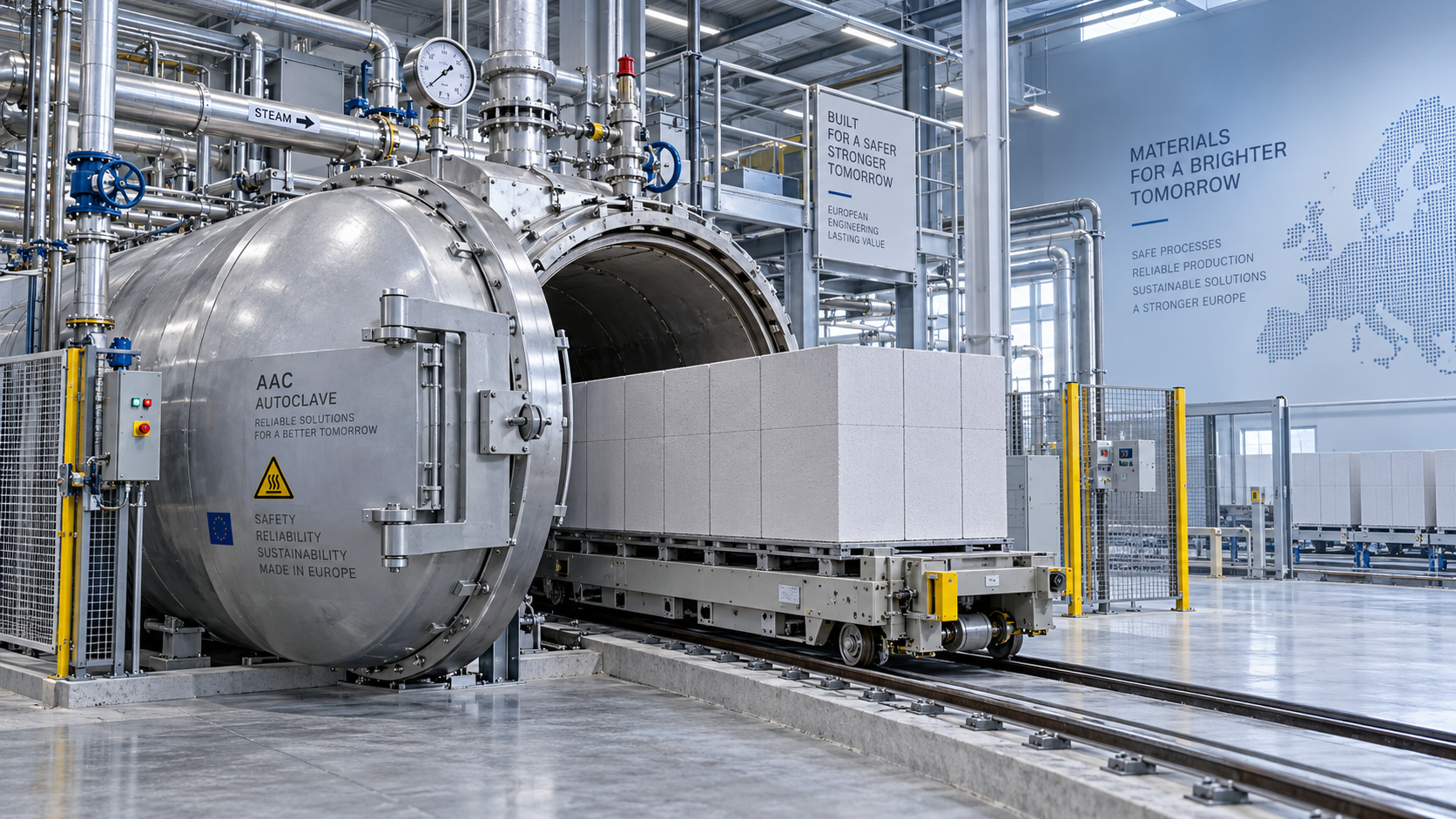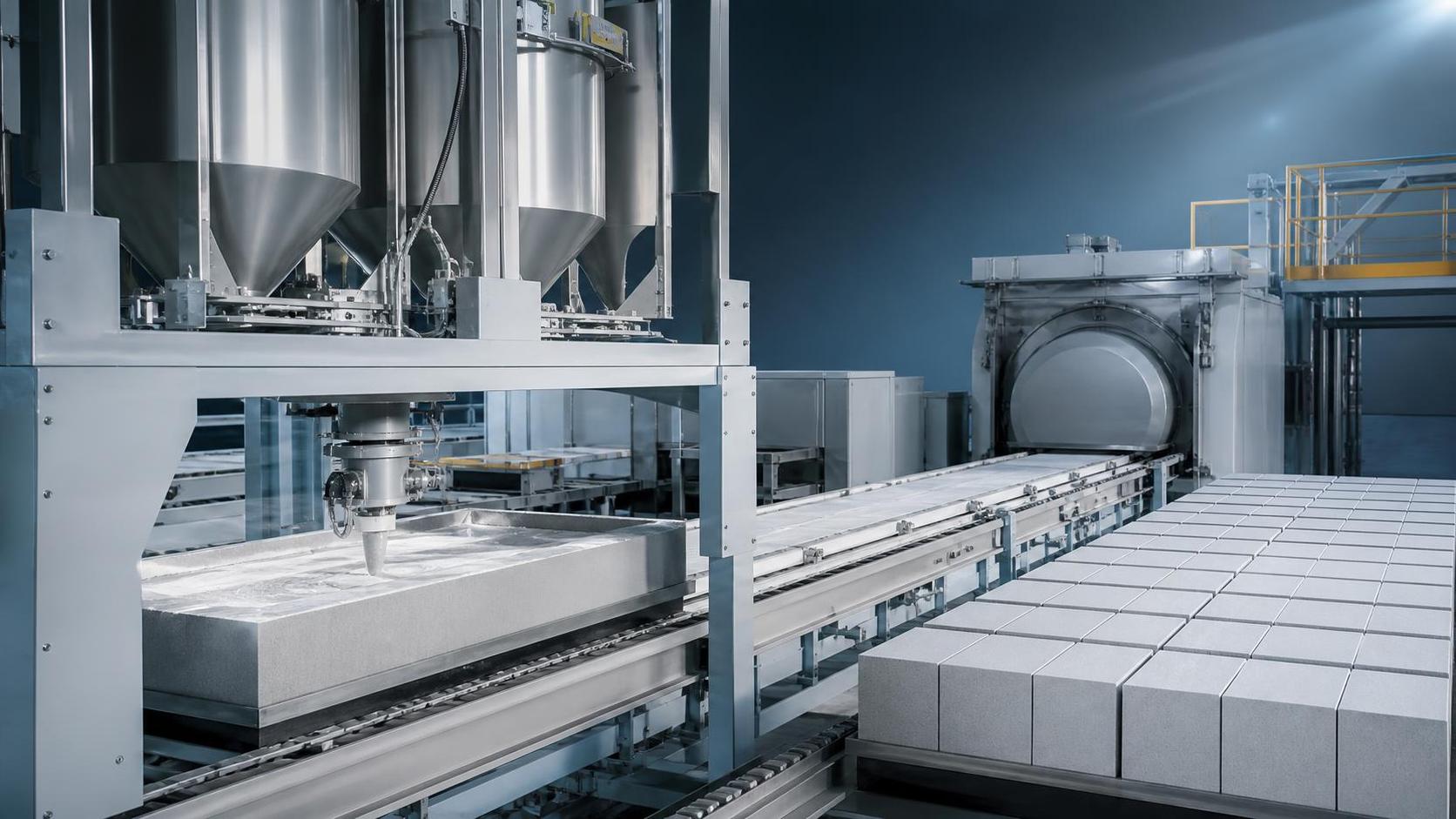




What safety standards apply to AAC autoclave systems in Europe? Compliance begins with the Pressure Equipment Directive, but safe market access also requires machinery, electrical, workplace, and inspection obligations.
For manufacturers, investors, and plant operators, the key issue is not simply obtaining a CE mark. It is proving that the complete autoclave system is designed, documented, installed, operated, and maintained safely.
AAC autoclaves operate with high-pressure saturated steam, elevated temperatures, heavy doors, complex piping, and automated material handling. These conditions create risks requiring coordinated engineering controls rather than isolated component certificates.
This guide explains the standards and practical decisions that matter most when selecting or operating an AAC autoclave system for a European aerated concrete production line.
Start with the Pressure Equipment Directive
The central European legal framework is the Pressure Equipment Directive, commonly called the PED. The current directive is 2014/68/EU, governing stationary pressure equipment placed on the EU market.
An AAC autoclave is normally classified as pressure equipment because it contains steam under pressure. Its pressure shell, heads, nozzles, safety valves, piping, and pressure accessories require assessment.
The PED applies when maximum allowable pressure exceeds 0.5 bar. Since AAC autoclaves commonly operate well above that threshold, their compliance assessment is usually substantial and formally documented.
Under the PED, the manufacturer must identify the equipment category using pressure, volume, fluid group, vessel type, and maximum allowable pressure. Higher categories require more stringent conformity assessment procedures.
Steam is generally treated as a Group 2 fluid under PED classification rules. However, this does not eliminate risk, because autoclaves often have large volumes and significant stored energy.
For many industrial AAC autoclaves, a notified body participates in design review, manufacturing surveillance, final assessment, or quality-system approval. The exact role depends on the final PED category.
What PED Compliance Must Cover in Practice
PED compliance covers more than vessel wall thickness. The equipment must meet essential safety requirements addressing design strength, materials, fabrication, permanent joining, inspection, testing, marking, and operating instructions.
Design calculations must consider internal pressure, temperature, cyclic loading, corrosion allowance, supports, nozzles, external loads, and foreseeable upset conditions. Door openings require particularly careful engineering evaluation.
Manufacturers must use suitable materials with documented properties and traceability. Material certificates, heat numbers, and verification procedures are important because pressure-vessel performance depends on consistent material quality.
Welding is a critical safety process. The PED requires qualified welding procedures and qualified personnel where applicable, supported by appropriate non-destructive testing and inspection records.
The completed autoclave normally undergoes a pressure test, frequently a hydrostatic test, unless a justified alternative procedure is permitted. Test pressure and acceptance criteria must follow the approved design basis.
Every compliant unit needs permanent marking, including allowable pressure, design temperature, volume, serial number, manufacturer identity, CE marking, and notified-body number when that involvement is required.
Use Harmonized EN Standards to Demonstrate Conformity
Harmonized European standards are not the only route to compliance, but they provide a practical presumption of conformity with relevant legal requirements when correctly applied and documented.
For welded, unfired pressure vessels, EN 13445 is often the most relevant standard family. It addresses materials, design, fabrication, inspection, and testing for pressure vessel construction.
EN 13445 helps translate PED requirements into engineering actions. It supports calculation methods, material selection, weld design, examination scope, proof testing, and technical documentation for autoclave pressure shells.
EN 764 series standards provide additional terminology and technical principles for pressure equipment. They can help project teams define pressure boundaries, protection devices, operating limits, and documentation consistently.
Pressure-relief devices should be selected and sized using applicable principles from EN ISO 4126. Their discharge capacity must protect the autoclave during credible overpressure conditions.
Do not assume a supplier’s statement that equipment is “built to EN standards” is sufficient. Buyers should request the precise standard editions, design scope, exclusions, calculations, and conformity evidence.
Why Machinery Safety Also Applies to AAC Autoclaves
An AAC autoclave is usually part of a larger automated production system. Therefore, pressure compliance alone does not address moving doors, rail cars, transfer mechanisms, conveyors, valves, and controls.
Currently, machinery placed on the EU market is generally assessed under the Machinery Directive 2006/42/EC. Machinery Regulation 2023/1230 will replace it, with broad application beginning in January 2027.
The machinery framework requires a risk assessment covering reasonably foreseeable use, misuse, maintenance, cleaning, failures, and human interaction. The resulting safeguards must reduce risk to an acceptable level.
EN ISO 12100 is the principal standard for machinery risk assessment and risk reduction. It guides teams through hazard identification, risk estimation, inherently safe design, protective measures, and user information.
For an autoclave line, typical machinery hazards include crushing at the door, derailment of curing cars, unexpected movement, release of steam, hot surfaces, confined-space entry, and accidental restart.
A complete plant supplier should define system boundaries clearly. Buyers need to know whether CE documentation covers only the pressure vessel or the integrated autoclave package and associated handling equipment.
Control Systems Must Prevent Dangerous Conditions
Control-system design is central to autoclave safety because many severe incidents result from incorrect sequencing, failed interlocks, bypassed sensors, or unexpected operation during loading and unloading activities.
EN ISO 13849-1 is widely used to design and validate safety-related parts of control systems. IEC 62061 may also be applicable for functional safety of machinery control systems.
Safety functions should include prevention of door opening while pressure remains above the defined safe limit. They should also prevent pressurization when doors are not fully locked.
Door locking mechanisms need independent confirmation of their safe position. A single ordinary limit switch should not be treated as adequate protection for a large pressure-retaining autoclave door.
Emergency stops are necessary, but they are not a substitute for properly designed safety functions. An emergency stop cannot safely resolve every pressurized condition or steam-release hazard.
EN 60204-1 covers electrical equipment of machines and is commonly relevant to panels, wiring, protective bonding, isolation, labeling, emergency controls, and electrical documentation for autoclave systems.
Safety Valves, Instrumentation, and Interlocks Need Independent Review
Pressure protection should rely on a layered approach. This normally includes control functions, pressure indication, alarms, high-pressure trips, safety relief devices, operating procedures, and maintenance controls.
Safety valves must be correctly sized for the credible pressure-rise scenario. The design should account for steam supply capacity, blocked outlets, valve failures, abnormal heating, and isolation arrangements.
Relief discharge routing deserves attention. Releasing steam into an occupied area, enclosed space, or unsuitable drainage zone can create serious burn, visibility, noise, and structural hazards.
Pressure gauges, transmitters, temperature instruments, and switches must be suitable for their operating range and environment. Their calibration and verification intervals should be defined in the maintenance plan.
Interlocks should be designed so that a failed sensor, cable, actuator, or controller does not permit an unsafe action. Diagnostic coverage and fault response should match the assessed risk.
Operators must not be able to defeat safety protections casually. Where bypassing is necessary for controlled maintenance, access should be restricted, logged, time-limited, and governed by formal procedures.
National Inspection Rules Continue After CE Marking
CE marking permits lawful placing on the European market, but it does not end the operator’s legal responsibilities. Each country applies national rules for in-service pressure equipment and workplace safety.
National requirements may cover installation approval, periodic inspection, inspection by competent persons, repair authorization, operator training, and records. These obligations vary across member states and should be checked early.
For example, German installations may be subject to the Betriebssicherheitsverordnung, or Ordinance on Industrial Safety and Health. Local authorities and approved inspection bodies can influence the inspection plan.
Plant owners should establish responsibilities before commissioning. They need clarity on who maintains pressure records, schedules inspections, calibrates instruments, manages repairs, and approves operational changes.
Changing a steam source, increasing working pressure, modifying a door, replacing a safety valve, or altering controls can trigger reassessment. Treat modifications as engineering changes, not routine maintenance.
International buyers should also distinguish the EU from the United Kingdom. Great Britain uses separate product-marking arrangements and pressure-equipment legislation, even where technical expectations remain similar.
Documents Buyers Should Request from an AAC Autoclave Supplier
Before signing a purchase contract, request a complete compliance matrix. It should map the autoclave system against PED, machinery, electrical, and applicable national installation requirements.
Ask for the EU Declaration of Conformity or Declaration of Incorporation, depending on supply scope. The document should identify applicable legislation, standards, manufacturer details, and authorized signatory information.
Technical documentation should include general arrangement drawings, pressure boundary drawings, design calculations, material certificates, welding documentation, non-destructive examination reports, and pressure-test records.
Also request safety-valve certificates, instrument lists, calibration specifications, electrical schematics, control narratives, safety-function validation records, and operating instructions in the required local language.
For notified-body involvement, confirm the body’s identity, notified-body number, and scope. A valid certificate for one component does not automatically prove conformity of the finished system.
Contract documents should define site responsibilities for foundations, steam piping, electrical supply, ventilation, drainage, lifting, guarding, commissioning support, and local statutory inspections before production begins.
How to Evaluate an AAC Autoclave Supplier Beyond Certificates
Certificates are necessary, but they are not sufficient evidence of robust engineering. Buyers should evaluate whether the supplier has practical experience designing large, cyclically loaded AAC curing systems.
Review the proposed door design, locking method, gasket arrangement, opening sequence, and maintenance access. These features strongly affect both daily safety and long-term plant availability.
Ask how the supplier controls welding quality and traceability. A credible answer includes qualified procedures, welder qualifications, inspection plans, acceptance criteria, and retained manufacturing records.
Examine the automation philosophy. It should describe normal operating sequences, permissives, alarms, trips, manual-mode restrictions, power-loss behavior, communications failures, and recovery after abnormal shutdowns.
Factory acceptance testing should verify more than basic movement. It should test critical interlocks, door safety logic, pressure alarms, emergency actions, valve positions, and communications with plant-level controls.
Hongfa’s AAC production-line experience can support buyers seeking integrated equipment, but every European project still needs a project-specific compliance review based on final configuration and destination country.
Commissioning and Operation Determine Real-World Safety
Many compliance gaps appear during installation rather than fabrication. Incorrect steam piping supports, poor insulation, missing drainage, inadequate clearances, or altered control wiring can undermine approved equipment design.
Commissioning should include a documented check of every safety device, instrument, guard, interlock, emergency control, relief path, warning sign, and operating procedure before regular production begins.
Operators need training on normal curing cycles, alarm response, depressurization, door operation, isolation, and prohibited actions. Training should be repeated when procedures, personnel, or controls change.
Maintenance teams require lockout and tagout procedures that isolate electrical, pneumatic, hydraulic, steam, and residual-pressure energy. Opening any pressure boundary requires verified zero-energy conditions.
Autoclave entry requires special controls because it may involve heat, restricted access, residual steam, and confined-space hazards. Employers should assess entry requirements under applicable national workplace rules.
Trend data from pressure, temperature, cycle duration, valve response, and alarms can reveal deterioration early. Preventive maintenance improves safety while reducing unplanned downtime and rejected AAC product.
Conclusion: Build Compliance into the Entire AAC System
European AAC autoclave safety depends on a complete compliance strategy, not a single certificate. PED requirements govern pressure integrity, while machinery and electrical rules govern the integrated operating system.
The most relevant technical references commonly include PED 2014/68/EU, EN 13445, EN ISO 4126, EN ISO 12100, EN ISO 13849-1, and EN 60204-1.
Buyers should verify the exact scope of supply, notified-body involvement, safety-function design, documentary evidence, and national inspection obligations before placing an order or commissioning an AAC production line.
When these requirements are addressed early, manufacturers can protect personnel, improve operating reliability, reduce compliance risk, and establish a stronger foundation for sustainable European market access.