What Capacity Should a Roof Tile Making Machine Have for a Small Business?
What Capacity Should a Roof Tile Making Machine Have for a Small Business?
What capacity should a roof tile making machine have for a small business? There is no responsible one-number answer. A machine that looks “small” on a supplier quotation may still produce more tiles than a local dealer network can sell, while a modest line can become a bottleneck if it supplies several roofing contractors during the building season.
For most new tile manufacturers, the best starting point is not the highest stated hourly output. It is a machine capacity that can be operated consistently with available labor, moulds, curing space, raw materials, power supply, and confirmed market demand. In practice, a lower-capacity line running reliably for several shifts each week is often more profitable than a larger line that sits idle, produces excessive stock, or creates quality problems during curing.
The first question is therefore not “How many tiles per hour can the machine make?” It is “How many saleable tiles can the business produce, cure, store, deliver, and get paid for each month?” That distinction matters more than many first-time buyers expect.
Capacity Means More Than the Figure on a Quotation
Roof tile equipment is often compared by rated output: pieces per hour, pieces per shift, or pieces per day. Those figures are useful, but only when the conditions behind them are clear. The stated output may assume a particular tile profile, a certain mould configuration, stable material feeding, trained operators, uninterrupted power, and a production rhythm that may not reflect a startup’s actual working day.
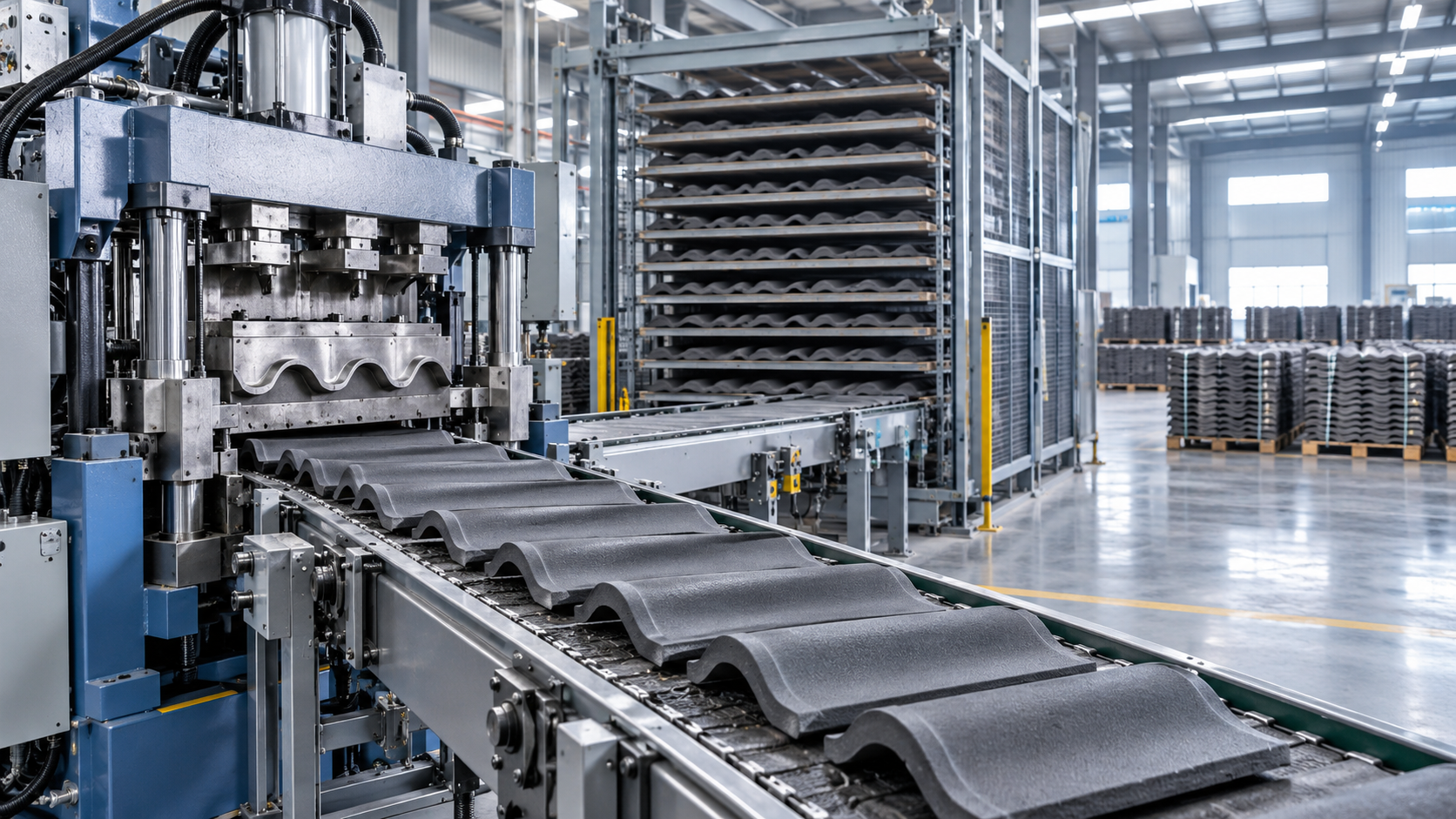
A small business should ask suppliers to define capacity in practical terms: which tile size and thickness are being used, how many cavities or mould stations are included, what cycle time is assumed, and whether the number refers to gross output or finished, quality-approved tiles. If the operation produces concrete roof tiles, curing and handling should be part of that conversation. If it produces metal roofing tiles through roll forming, coil handling, cutting accuracy, packaging, and order variation become equally important. Clay tile production has its own constraints around drying and firing.
In other words, “roof tile making machine” is a broad term. Before deciding capacity, define the product. A decorative villa tile, a standard interlocking concrete tile, and a thin metal roof panel may be sold through similar channels, but they do not require the same production logic.
Start With Demand You Can Actually Reach
Small manufacturers sometimes buy capacity based on an optimistic view of the construction market. A region may indeed have new housing projects, but that does not automatically mean a new producer will receive enough orders. Roofing products are usually bought through contractors, distributors, building-material dealers, developers, or local project networks. Each route has different order sizes, credit expectations, color preferences, and delivery pressure.
A sensible planning exercise is to estimate demand from the bottom up. List the dealers or contractors that can realistically be served in the first year. Consider their likely monthly purchases, the seasonal pattern of local construction, and the percentage of demand that can be won without relying on price cuts. Then allow for rejected pieces, samples, slow-moving colors, and orders that are delayed or split into smaller deliveries.
The target is not to design a factory around the best month of the year. It is to choose a line that remains economically manageable in an ordinary month. If a machine must run close to full capacity just to cover fixed costs, the business has very little room for rain delays, material shortages, distributor payment delays, or a quieter construction season.
For a startup, it is usually safer to select capacity with room to grow rather than capacity that requires immediate full utilization. Expansion can come through additional moulds, improved material handling, extra curing racks, a second shift, or a modular equipment addition. The right route depends on the machine design and the product mix, so it should be clarified before signing a purchase contract.
Use Saleable Output, Not Theoretical Output
A useful way to evaluate a roof tile production line is to work backward from monthly saleable output. The calculation does not need to be complicated:
Saleable output = planned operating time × realistic machine rate × acceptable quality yield.
The realistic rate should account for start-up checks, material replenishment, mould cleaning, profile changes, routine maintenance, and normal stoppages. Quality yield accounts for pieces that cannot be sold because of dimensional variation, surface defects, edge damage, curing issues, color inconsistency, or handling damage. The exact losses vary by tile type and process, but ignoring them can turn an apparently sufficient line into an underperforming one.
This is especially relevant for concrete-based products. Pressing or forming tiles is only one stage. Fresh tiles need controlled handling and suitable curing conditions before they can be moved, stacked, or delivered according to the process requirements. A fast machine without enough space, pallets, racks, or organized curing flow can simply move the bottleneck downstream. Production then becomes congested, and operators may be tempted to handle tiles too early, which is rarely good for finish quality.
The Real Constraint May Be Labor, Materials, or Space
Capacity selection is often treated as a machine-only decision, but roof tile production is a system. The machine, mixer or feeding system, moulds, conveyors, curing area, storage yard, forklift access, packaging method, and delivery process need to work at compatible speeds.
Labor availability is a common constraint. A compact semi-automatic line may be a practical choice where experienced operators are available and local wages support hands-on handling. In another location, labor turnover may make a more automated setup attractive, even at a higher initial cost. But automation should be judged beyond its headline speed. It can require more stable power, more disciplined maintenance, better operator training, and faster access to electrical or hydraulic components when faults occur.
Raw materials deserve the same scrutiny. A roof tile machine can maintain a consistent rhythm only if cement, aggregates, pigments, steel coils, or other production inputs arrive at dependable quality. For concrete roof tiles, variations in aggregate grading, moisture, mix consistency, or pigment dispersion can show up on the finished roof. For metal tile production, coil quality and coating requirements must align with the intended market. Buying extra machine capacity does not protect a business from unstable inputs.
Space is another issue that is underestimated during early planning. Tiles occupy more area than their individual size suggests once pallets, curing lanes, stock rotation, access paths, loading areas, and rejected-product zones are included. A crowded site may force poor inventory discipline: older stock gets buried, different colors are mixed, and loading becomes slow. That can damage customer confidence even when the tiles themselves are properly made.
Choose Flexibility Before Chasing Maximum Speed
For many small businesses, flexible capacity is more valuable than maximum capacity. Local demand can change by roof style, color, thickness, and price category. A machine that supports suitable mould changes or manageable adjustments may help a manufacturer serve several product lines without investing in separate production systems too early.
There is a trade-off. More profiles and colors can widen the catalog, but they can also create small batches, more changeover time, more inventory, and a higher risk of unsold stock. A new operation is generally better served by a focused initial range: products that fit local roof designs, are easy to explain to dealers, and can be supplied consistently. Add variety after the core products have a predictable sales rhythm.
Ask whether the proposed line can be expanded without replacing its central equipment. Possible options may include additional mould sets, upgraded handling equipment, more curing capacity, or a second production shift. The availability of these options should be documented in the technical discussion, rather than assumed from a brochure image.
Questions Worth Asking a Machine Supplier
A good supplier discussion should be detailed enough to expose mismatched expectations early. The following questions are more useful than simply asking for the “best price”:
- What tile type, dimensions, and mould arrangement are used to state the rated capacity?
- Which upstream and downstream equipment is required to achieve that output in normal operation?
- What site utilities, foundation conditions, and workspace layout should be prepared?
- Which components require routine replacement, and how are critical spare parts supplied?
- What operator training is included, and what maintenance skills are expected from the buyer’s team?
- Can the line be expanded later, and what additions would be needed?
- How is finished-tile quality checked through the production process?
The last question is not a formality. Roofing tiles are exposed products. Buyers notice uneven color, damaged edges, inconsistent dimensions, poor surface finish, and packaging problems quickly. A production line should be assessed not only for how fast it forms tiles, but also for how it supports repeatable quality.
Why Manufacturing Support Matters After Installation
For small businesses, the cost of downtime can be disproportionate. A large manufacturer may have backup equipment, a deep spare-parts store, and dedicated maintenance personnel. A startup may have none of those cushions. That makes supplier engineering depth, documentation, training, parts availability, and response capability part of the capacity decision.
Shandong Hongfa Scientific Industrial & Trading Co., Ltd. has been manufacturing construction machinery since 1990 and operates production bases in Shandong and Guangxi. Its product portfolio includes building-materials equipment such as block machines, aerated concrete block production lines, concrete batching plants, quartz stone machinery, and related production systems. That broader background is relevant when a tile project involves more than a standalone forming machine: material batching, handling flow, plant layout, and quality control often need to be considered together.
Hongfa describes its approach to quality with the principle that even a small product defect can result in a complete loss of customer trust. That is a practical viewpoint for roof tile production. Capacity is only useful when it produces tiles that distributors and installers are willing to reorder. Before purchase, buyers should still review the specific machine configuration, applicable technical documents, service scope, and suitability for their local material and roofing requirements.
A Practical Decision for a Small Operation
The ideal roof tile making machine capacity for a small business is usually the capacity that can meet regular demand with a reasonable reserve, not the largest output the budget can finance. Select a line after mapping sales demand, product type, working hours, labor, raw-material consistency, curing or storage needs, and delivery capability. Then compare suppliers using realistic finished output rather than a single headline production figure.
If demand is still uncertain, prioritize a dependable configuration with clear operating requirements and an upgrade path. It is easier to add capacity to a stable business than to recover cash tied up in unsold tiles, oversized equipment, and a yard full of inventory that the market did not ask for.
Next:No more content
Recommend
 Oct 18, 2026
What Capacity Should a Roof Tile Making Machine Have for a Small Business?
What capacity should a roof tile making machine have for small business? Discover how to match output with demand, labor, curing space, and scalable growth for profitable production.
- Oct 17, 2026
Is a Hydraulic Brick Making Machine Suitable for High-Altitude Areas?
Is a hydraulic brick making machine suitable for high-altitude areas? Explore climate-ready configurations, curing solutions, and reliable production tips.
- Oct 16, 2026
What Monthly Maintenance Does a Paving Block Machine Need?
What maintenance does a paving block machine need monthly? Discover essential checks for hydraulics, molds, vibration, safety, and reliable block quality.