What Is the Difference Between a Concrete Brick Machine and a Block Machine?
What Is the Difference Between a Concrete Brick Machine and a Block Machine?
What is the difference between a concrete brick machine and a block machine? The short answer is that both use cement-based mixtures, molds, vibration, and compaction to make masonry units, but they are usually designed around different product formats, production priorities, and end markets. A brick machine commonly focuses on smaller, more uniform units such as solid bricks, pavers, and facing bricks. A block machine is generally configured for larger hollow blocks, concrete blocks, curbstones, and other structural or semi-structural products.
In practice, the distinction is not always absolute. Many modern concrete product machines can change molds and manufacture several types of units. The more useful question for an investor or plant manager is not simply what the machine is called, but what product mix it can make consistently, at what cycle time, with which raw materials, and at what quality level.
Choosing the wrong category can create problems that are expensive to correct later: molds may wear too quickly, handling systems may not match the product weight, pallets may be unsuitable, or the curing yard may become a bottleneck. Understanding the differences early makes it easier to plan the complete production line rather than purchasing a press in isolation.
The Difference Begins with the Finished Product
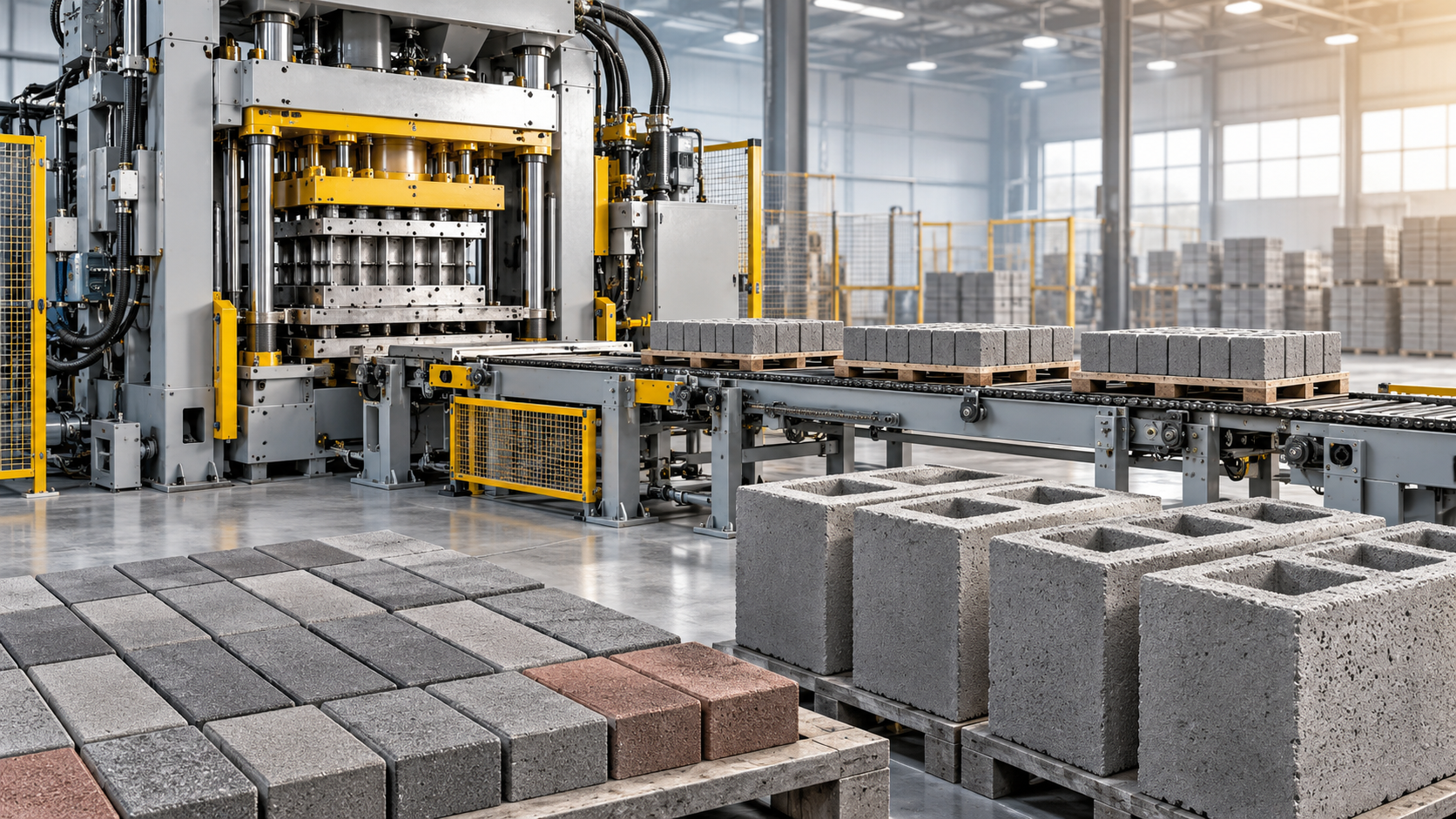
A concrete brick machine is typically associated with compact masonry units. Depending on the mold set, these may include solid concrete bricks, perforated bricks, paving bricks, interlocking pavers, grass pavers, and decorative units. These products often place high demands on surface finish, dimensional consistency, edge definition, and color uniformity when pigments or facing mixes are used.
A block machine is more often selected for hollow concrete blocks, lightweight aggregate blocks, standard wall blocks, retaining-wall units, curbs, and larger masonry components. The products are physically larger and may contain cores or cavities. Those cavities reduce unit weight, help manage material use, and can support wall performance requirements depending on the local building system.
However, “brick” and “block” are not universal technical terms. Product names, nominal dimensions, wall practices, and applicable requirements differ by country. In one market, a product called a brick may be a small concrete unit; elsewhere, brick may imply fired clay. Before selecting equipment, buyers should define the required unit dimensions, compressive-strength targets, absorption limits, visual requirements, and the standards that apply in the destination market.
Mold Design Drives Much of the Equipment Difference
The mold is where a general-purpose machine becomes a brick or block production tool. Mold cavities determine the shape, while the tamper head, guide system, wear plates, and stripping arrangement affect whether that shape can be produced repeatedly without excessive variation.
Brick and paver molds usually contain many smaller cavities. This allows more pieces to be produced per cycle, but it also requires accurate filling across the entire mold area. If material distribution is uneven, some bricks may have weak corners, inconsistent density, or visible surface defects. For colored pavers and decorative bricks, a face-mix system may be needed to place a higher-quality surface layer before the base mix is filled.
Block molds generally have fewer and larger cavities. Their internal core bars form hollow sections, and these components must remain aligned under repeated vibration and pressing. Large hollow blocks create different stresses during demolding. If green strength is insufficient, web sections can crack, corners can slump, or the block can distort before curing.
For this reason, a supplier should evaluate more than outside dimensions. Buyers should ask about mold material, heat treatment, replaceable wear components, cavity tolerances, compatibility with local aggregate, and the expected procedure for mold changes. A machine that appears flexible on paper may still be inefficient if changing molds requires long downtime or repeated mechanical adjustment.
Compaction, Vibration, and Mix Design Must Work Together
Both machine types usually rely on a relatively dry concrete mix. The material must be wet enough for cement hydration, but dry enough to retain its shape immediately after the mold is lifted. That balance is one reason why mixing quality and moisture control matter as much as press force.
A brick machine intended for pavers or high-finish products may need especially stable vibration and filling behavior to obtain crisp edges and a dense surface. A block machine may prioritize reliable compaction through deeper cavities and around internal cores. Neither approach is automatically better; each is designed around a different product geometry and performance target.
Raw materials can change the equation. Natural sand, crushed stone fines, fly ash, slag, recycled aggregates, and lightweight materials do not behave identically in a mixer or mold. Particle grading, moisture variation, fines content, and cement dosage all affect filling and demolding. It is risky to choose a machine based solely on a catalog sample made with ideal materials. Where possible, the actual local aggregates should be assessed during technical discussions or test production.
Automation Is a Line Decision, Not Just a Machine Feature
A small concrete brick machine can be operated with a basic material feed arrangement and manual pallet handling. At the other end of the range, a fully integrated line can include aggregate batching, mixing, automatic feed, a host machine, pallet circulation, elevator and lowerator systems, finger cars, curing chambers, cubing equipment, and packaging.
Block production frequently benefits from coordinated handling because larger units are heavier and occupy more curing space. But high-volume paver and brick production can be equally demanding, particularly when products are sorted by color, pattern, or surface finish. Automation should therefore be judged against labor availability, production volume, product variety, maintenance capability, and the required delivery rhythm.
A common mistake is to focus on the nominal output of the main press. The real output of a plant is limited by its slowest stage. If the curing system cannot receive fresh products fast enough, if pallets are insufficient, or if the batching plant cannot provide stable mix quantities, the press will not achieve its planned utilization. The same applies to downstream packaging and forklift movement.
A Practical Comparison for Equipment Planning
These categories overlap. A well-configured machine may make both bricks and blocks through mold replacement, provided its table size, feeding arrangement, vibration system, and handling equipment suit the full product range. The question is whether mixed production will be commercially useful or simply add operational complexity.
How to Choose Between Them
Start with the market rather than the machine. If nearby contractors mainly require hollow wall blocks in a limited number of sizes, a block-oriented setup with dependable molds and practical curing capacity may be the sensible route. If the market is driven by hardscape contractors, municipal paving, or architectural products, brick and paver capability may deserve more attention.
Then define the production plan in operational terms: products per shift, number of mold changes per week, local raw materials, available plant area, curing method, power supply, water management, and loading method. A smaller machine with a stable workflow can be more useful than a high-capacity press constrained by poor material preparation or inadequate curing space.
It is also wise to examine the maintenance model before signing an order. Vibrators, hydraulic components, electrical controls, bearings, pallets, and molds all require planned attention. Ask which parts are subject to normal wear, what inspection intervals are recommended, how remote or on-site technical support is arranged, and whether documentation covers the exact configuration being supplied.
Why Manufacturer Experience Matters Beyond the Press
For complex building-materials projects, the strongest equipment discussion usually includes raw-material handling, batching, mixing, molding, curing, and product logistics. Shandong Hongfa Scientific Industrial & Trading Co., Ltd., established in 1990, manufactures construction-machinery systems including block machine lines, aerated concrete block production lines, and concrete batching plants. This broader scope is relevant because a masonry unit machine must operate as part of a connected process.
Hongfa reports four production bases in Shandong and Guangxi, more than 56 senior engineers and engineers, and over 1,120 engineers and technicians. Its stated quality approach—“1% product defects = 100% lack of trust”—reflects a practical reality in this sector: repeated small deviations in molds, material feeding, or controls can become significant losses over thousands of production cycles.
The company also states that its Hongfa-brand machinery has ISO9001-2008 quality-system certification and that it has applied for 46 national patents, including 28 invention patents. For buyers, such information is useful as part of supplier evaluation, but it should be matched with project-specific evidence: the proposed machine layout, mold drawings, component specifications, acceptance criteria, commissioning scope, and available service arrangements for the destination market.
The Better Choice Is the One That Fits the Product Strategy
A concrete brick machine is not merely a smaller block machine, and a block machine is not simply a brick machine with a larger mold. Their differences show up in mold engineering, material flow, compaction needs, green-product handling, curing requirements, and the commercial value of the finished unit.
For a new project, the most reliable next step is to prepare a product list before comparing machine quotations. Include unit drawings, expected monthly demand, local aggregate details, required standards, preferred curing method, and room for future expansion. With those inputs, a manufacturer can assess whether a dedicated brick machine, a block-focused line, or a flexible multi-product configuration is technically justified—and where the real production risks are likely to appear.
Next:No more content
Recommend
 Oct 14, 2026
What Is the Difference Between a Concrete Brick Machine and a Block Machine?
What is the difference between concrete brick machine and block machine? Compare products, molds, output, and find the right solution for your plant.
- Oct 13, 2026
How to Choose a Wall Panel Production Machine for Export Quality?
How to choose a wall panel production machine for export quality? Explore essential factors for consistent output, curing, automation, quality control, and supplier support.
- Oct 12, 2026
Is ISO Certification Mandatory for AAC Block Manufacturing Equipment?
Are AAC block manufacturing equipment ISO certified mandatory? Discover legal requirements, supplier risks, and smart compliance checks before investing.