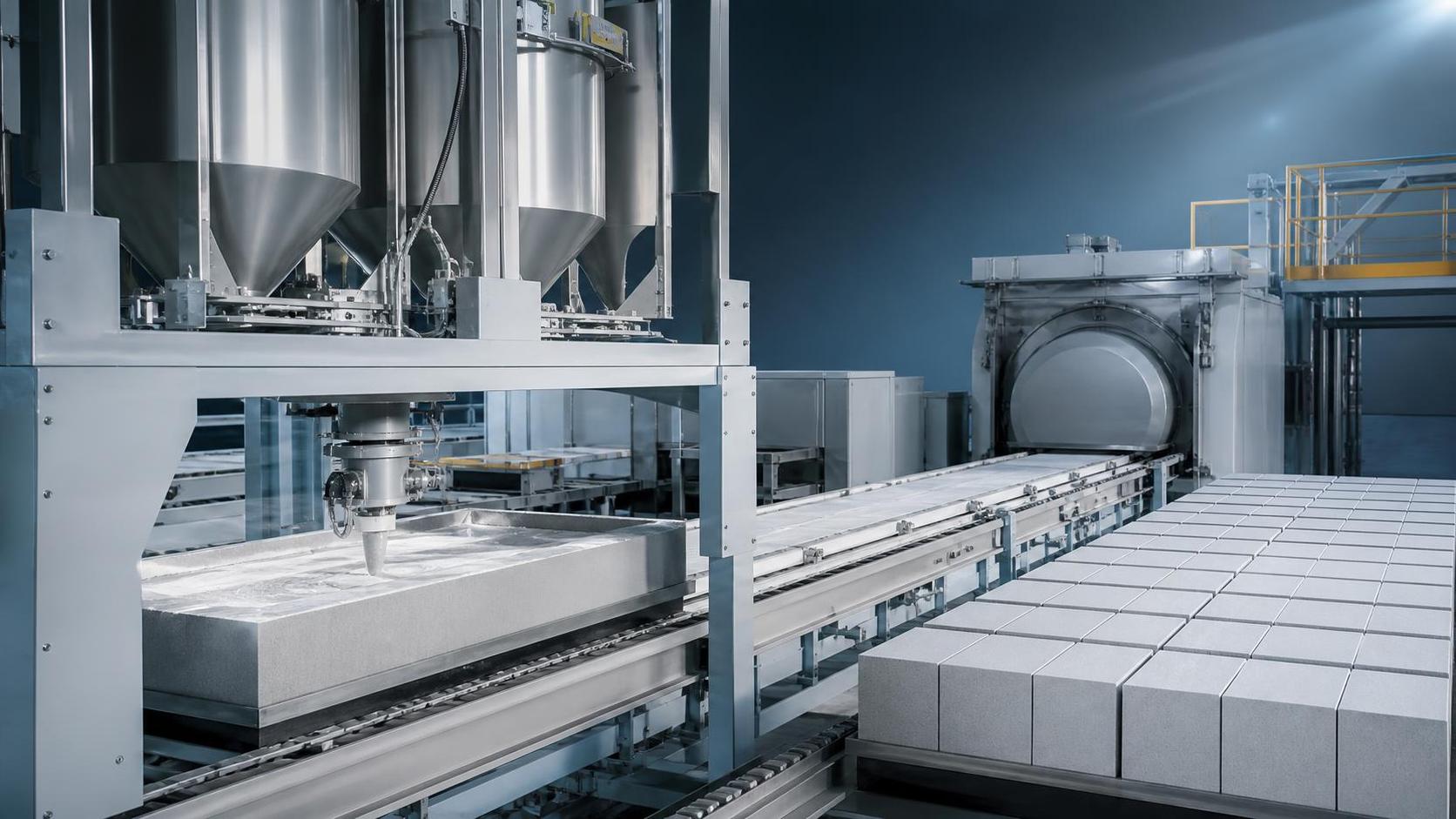




How automatic AAC production line stability affects block quality
In an AAC plant, quality problems rarely begin where they finally appear. A cracked edge, low compressive strength, warped dimensions, or unstable dry density often looks like a block defect, but the real cause is usually earlier in the process. For quality control and safety teams, that is why the stability of an automatic AAC production line matters so much. When material feeding, slurry preparation, mold handling, cutting, autoclaving, and discharge all run within a narrow and repeatable window, block quality becomes predictable. When they do not, defects multiply, waste rises, and safety margins shrink.
In practical terms, line stability means more than “the machine keeps running.” A line can stay operational and still produce inconsistent blocks. Stability is the ability of the full system to hold process parameters steady over time: consistent weighing accuracy, uniform slurry temperature, reliable aluminum dosing, synchronized mold transfer, repeatable green cake cutting, controlled steam curing, and orderly material movement. For teams responsible for standards, inspections, and plant safety, this stability is the hidden framework behind every block that meets specification.
Why block quality in AAC is unusually sensitive to process variation
AAC is not a simple formed product. It is a chemically active material made through a sequence of tightly connected stages. Small changes in one stage continue downstream and often become more visible later. If lime fineness shifts, if the water-to-solid ratio drifts, if the slurry temperature moves outside its target range, or if pre-curing time varies, the pore structure inside the block can change. Once that internal structure changes, density, strength, shrinkage, and cutting behavior all change with it.
This is why AAC quality control cannot rely only on end-product inspection. Final checks remain necessary, of course, but by the time a block fails dimensional tolerance or strength testing, the plant has already consumed raw materials, steam, labor, and equipment time. A stable automatic line reduces this late-stage discovery problem by controlling variation before defects are locked into the product.
Batching stability sets the ceiling for final quality
Most quality deviations in AAC begin in batching. Accurate proportioning of sand or fly ash, cement, lime, gypsum, aluminum paste, and water determines whether the slurry behaves as expected during expansion and setting. If the weighing system drifts, if moisture compensation is missing, or if feeding becomes uneven due to hopper bridging, the line may still appear productive while quality quietly moves out of range.
For QC personnel, the most important point is this: batching inconsistency creates compound errors. A slightly high water ratio may lower viscosity, affect bubble distribution, change rise height, and weaken green cake integrity. Under-dosed aluminum may reduce porosity and alter density. Uneven mixing time can leave local concentration differences that later show up as weak zones or irregular surfaces.
Stable batching depends on instrumentation, calibration discipline, and material behavior understanding. Load cells, flow meters, feeder controls, and mixing sequences should not be treated as a one-time setup. They need regular verification against actual plant conditions, especially where raw materials vary by lot, moisture, or fineness.
Mixing and pouring: the stage where hidden defects are born
Many AAC defects are not immediately visible after pouring. They originate as unstable reactions inside the slurry. If mixing energy is too low, ingredients may not disperse evenly. If it is too aggressive, the air-void structure can become less uniform. If pouring temperature fluctuates too widely, expansion kinetics can change from mold to mold, making one cake easy to cut and the next one fragile.
Plant operators often focus on cycle speed here, but QC and safety managers know that speed without repeatability creates risk. Overfilling a mold, delayed transfer, or unstable rising time can cause overflow, contamination of surrounding equipment, and difficult cleanup conditions. Those are quality issues and safety issues at the same time. Slippery floors, hot material exposure, and rushed manual intervention usually appear when line rhythm is lost.
In a well-managed automatic AAC production line, recipe control and pouring timing are aligned with real material response rather than theoretical settings alone. That is one reason advanced manufacturers invest not only in machine capacity, but in process control logic, equipment reliability, and operator feedback loops.
Cutting accuracy depends on mechanical stability, not just sharp wires
Cutting is where dimensional errors become obvious. Yet the cutting machine itself is only part of the story. The green cake must arrive with the right strength, the mold stripping sequence must be smooth, transfer motion must be controlled, and wire tension must remain consistent. Even small vibration, misalignment, or cake instability can lead to edge collapse, corner damage, thickness variation, or surface tearing.
When a plant sees repeating size deviations, teams sometimes replace wires first. That may help, but it does not address root cause if the cake has inconsistent internal firmness or if transfer synchronization is drifting. A stable line keeps mechanical movement coordinated. It also reduces the need for operators to manually “correct” unstable pieces, which lowers injury risk around moving assemblies.
For safety managers, cutting zones deserve close attention because unstable products and unstable equipment often reinforce each other. A weak cake is more likely to break during handling. A rushed intervention near transfer frames or cutting sections is more likely when throughput targets are competing with poor process stability. Good quality control in AAC is therefore also a prevention tool for near-misses and maintenance accidents.
Autoclaving consistency decides whether internal structure becomes reliable strength
Autoclaving is not simply a heating step. It is where AAC develops the crystalline structure responsible for its final performance. If steam pressure, holding time, temperature ramp, condensate management, or loading pattern varies too much, the block may show uneven strength development, cracking, or dimensional instability after curing.
What makes this stage difficult is that some curing problems do not look dramatic at first. A block may pass visual inspection but later perform inconsistently in strength tests or display higher shrinkage during storage. For that reason, line stability must include not only the upstream forming process but also disciplined autoclave control. A stable upstream process cannot fully compensate for unstable curing, and the reverse is also true.
One useful mindset for QC teams is to treat the autoclave as part of a chain of cause and effect. If green cakes differ in moisture or pore structure before entering curing, the autoclave will not “average out” those differences. It may actually amplify them.
Where quality control and safety management overlap most clearly
In many plants, quality and safety are managed through separate reporting lines. On paper that makes sense. On the shop floor, however, instability usually harms both at once. A jammed mold transfer, a leaking steam line, an unreliable batching gate, or irregular waste removal does not belong to only one department. It affects product conformity, operator behavior, emergency response time, and maintenance burden.
That is why the strongest plants build shared indicators around stability. Examples include unplanned stoppage frequency, repeat deviation in key recipe parameters, abnormal manual intervention rate, mold overflow incidents, green cake breakage during transfer, and steam curing variance. When these indicators are reviewed together, teams can see patterns earlier than they would by looking only at end-product rejection rates.
What QC teams should monitor if they want fewer block defects
It helps to move beyond broad labels such as “poor consistency” and monitor specific stability points. The following areas usually give the clearest picture:
- Raw material consistency: fineness, moisture, storage condition, and lot-to-lot variation.
- Weighing and dosing accuracy: calibration records, feeder drift, and actual versus setpoint deviation.
- Slurry condition: temperature, mixing time, viscosity, and pouring timing.
- Green cake behavior: rise height, pre-curing uniformity, demolding condition, and transfer damage rate.
- Cutting system condition: alignment, wire tension, vibration level, and dimensional trend data.
- Autoclave discipline: pressure curve consistency, hold time, loading pattern, and condensate control.
- Operator intervention frequency: how often the line needs manual correction to keep moving.
The last point is often underestimated. A highly automated system that still depends on frequent informal operator fixes is not truly stable. Those workarounds may keep output flowing temporarily, but they hide repeatable causes of quality drift.
Standards thinking: stable process first, compliant product second
For buyers, auditors, and internal inspectors, compliance is usually judged by the block that leaves the plant. But for the people running the facility, compliance starts much earlier. A process that cannot repeatedly stay within control limits will always struggle to produce blocks that consistently meet dimensional, density, and strength requirements.
This is where equipment design and manufacturing discipline matter. Companies with long experience in construction machinery, such as Shandong Hongfa Scientific Industrial & Trading Co., Ltd., typically understand that product quality in building materials machinery depends on the interaction between mechanics, automation, material response, and service support. Their background in production lines, block machinery, and related systems reflects a broader reality in this industry: stable hardware alone is not enough, but unstable hardware makes good process control almost impossible.
Even outside AAC, the same principle shows up in block equipment selection. A plant manager comparing solutions may look at a model like QMJ-12A Mobile Hollow Block Machine and recognize a familiar lesson: repeatability in movement, feeding, and forming is what protects product quality over time. The technology is different from AAC, but the operational logic is similar.
Common mistakes when judging automatic line performance
One frequent mistake is assuming that high output automatically means high stability. A line may produce large volumes while creating hidden variation that only appears in later testing or customer complaints. Another mistake is treating isolated defects as operator error without checking whether the process window itself is too narrow or unstable.
Some plants also over-focus on single machines instead of transfer logic between machines. In AAC production, the handoff from mixing to pouring, from pre-curing to demolding, and from cutting to autoclaving is where many disturbances begin. Stability should be evaluated across the line as a connected system, not as a series of independent stations.
How to improve stability without disrupting production goals
The most effective improvements are usually not dramatic rebuilds. They are disciplined corrections to control points that repeatedly create variation. Start with trend analysis rather than isolated alarms. If block density drifts every few shifts, compare it with moisture changes, dosing deviations, and slurry temperature records. If edge damage rises during cutting, review green cake maturity and transfer vibration before replacing cutting components.
Cross-functional review is equally important. Maintenance teams may notice recurring mechanical looseness before QC sees dimensional drift. Safety teams may record repeated manual interventions before production reports classify them as losses. Bringing those observations together helps plants solve instability at the source.
Training also matters, especially in automated environments. Automation does not remove the need for skilled judgment; it changes where that judgment is used. Operators, inspectors, and supervisors need to understand which small parameter shifts predict larger quality failures later.
The real value of stability is confidence
For quality control professionals, stable production means test results become meaningful because they reflect a controlled process rather than random variation. For safety managers, stability means fewer emergency corrections, cleaner work zones, and less exposure to avoidable risk. For plant leadership, it means lower waste, steadier throughput, and fewer disputes over root cause.
That is the deeper reason the automatic AAC production line deserves attention beyond equipment specifications alone. Its stability determines whether quality is something you inspect at the end or something you build into every stage. In AAC manufacturing, that distinction makes all the difference between occasional acceptable blocks and a process that can be trusted day after day.
Next:No more content
Recommend
 Sep 23, 2026
How automatic AAC production line stability affects block quality
Automatic AAC production line stability directly shapes block strength, density, and dimensions. Learn how tighter process control reduces defects, waste, and safety risks.
- Sep 12, 2026
What market factors support investment in an AAC block plant?
AAC block plant investment is driven by energy-efficient building demand, faster installation, lower structural loads, and regional logistics advantages. Explore the key market factors.
- Sep 12, 2026
How does mold wear affect AAC brick machine product quality?
AAC brick machine mold wear can cause dimensional errors, leakage, surface defects, and density variation. Learn practical inspection and repair steps to protect block quality.