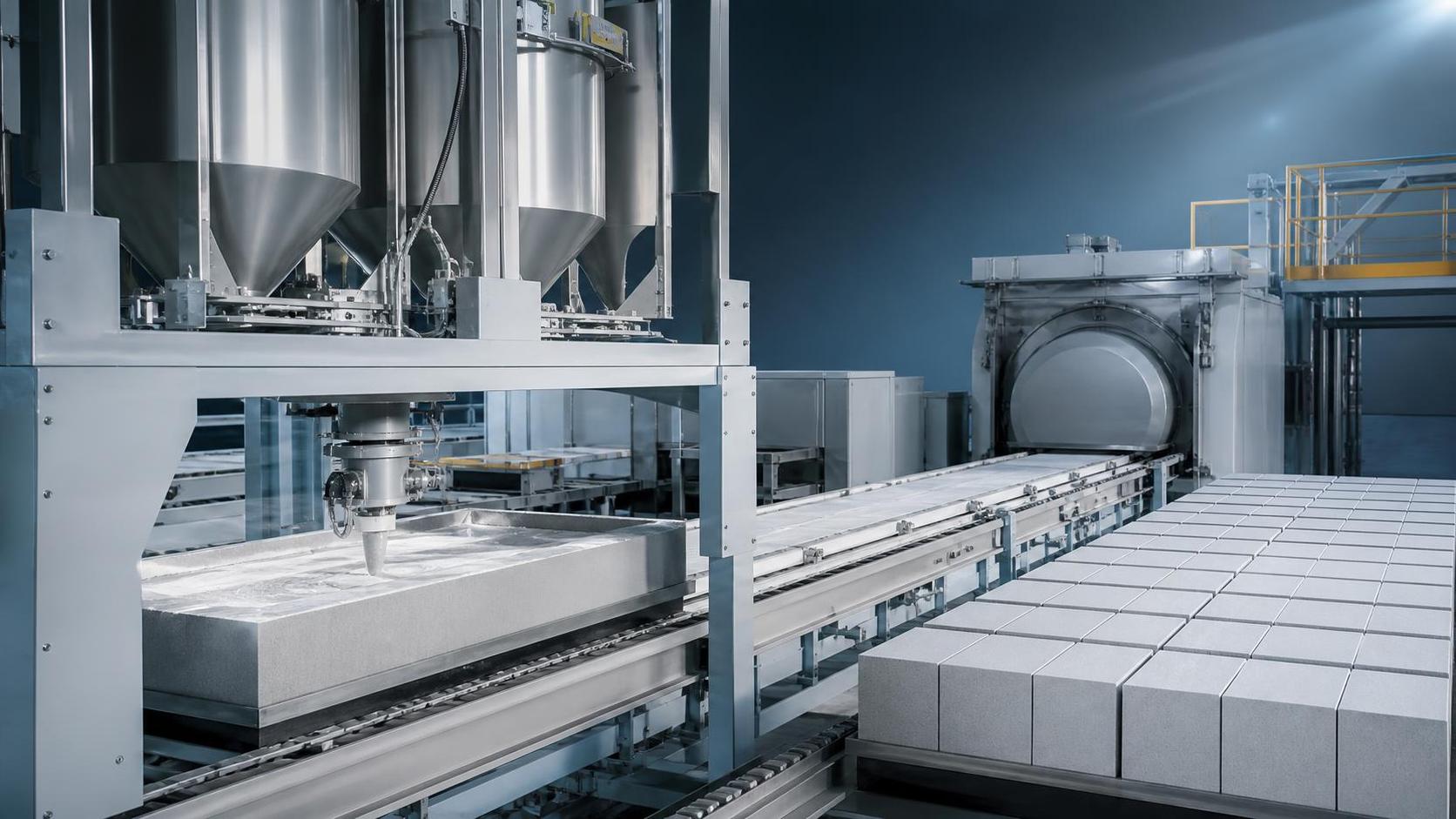




How an AAC batching system affects mix consistency and block quality
How an AAC Batching System Affects Mix Consistency and Block Quality
In an autoclaved aerated concrete plant, the batching area is often treated as a material-handling section. In practice, it is the point where many later quality outcomes are decided. Slurry density, expansion behavior, green-cake stability, cutting performance, dry density, compressive strength, and dimensional consistency can all be traced back to how accurately the raw materials were prepared and dosed.
An AAC Batching System does more than move cement, lime, sand slurry, gypsum, water, and aluminum powder into a mixer. It establishes the initial conditions for the aeration reaction. If those conditions vary from batch to batch, downstream equipment may still run, but stable block quality becomes difficult to maintain. A cutting machine cannot correct an unstable green cake, and an autoclave cannot reliably compensate for an inconsistent chemical or mineral balance created at batching.
For technical evaluation, the central question is not simply whether the system is automated. It is whether the equipment can repeatedly deliver the intended formulation under real operating conditions: changing moisture in solid materials, slurry density drift, recycled slurry returns, material bridging in bins, dosing delays, scale deviations, and interruptions between batches.
Consistency Starts Before the Mixer
AAC is sensitive because its pore structure is generated during a controlled reaction rather than formed by mechanical compaction. Aluminum powder or paste reacts in the alkaline slurry and produces hydrogen gas, creating the cellular structure that gives the material its low density. The rate and uniformity of this process depend on the temperature, alkalinity, viscosity, solids content, and dispersion of the mix.
That makes raw-material condition a batching issue, not merely a laboratory issue. Sand slurry with an altered solids concentration changes the effective water-to-solid relationship. Lime that differs in reactivity may change expansion timing. Moisture fluctuations in stored powder materials can distort mass-based dosing if the material condition is not considered. Recycled slurry can be useful in a controlled process, but its density and chemical contribution must be understood rather than treated as neutral process water.
A well-engineered batching arrangement therefore connects storage, conveying, weighing, slurry preparation, liquid dosing, and recipe control into one process logic. The mixer is important, but it receives only what the upstream system has measured and delivered. When batch inputs are inconsistent, longer mixing time may improve dispersion to a degree, yet it will not restore the original formulation.
The Link Between Dosing Accuracy and Finished Blocks
The relationship between dosing and finished AAC blocks is rarely linear. A minor variation in one material may be tolerated in isolation, while several small deviations occurring together can alter the entire behavior of the slurry. For example, a change in slurry density combined with delayed aluminum addition and cooler process water may affect rise behavior more substantially than any one factor would suggest.
The most visible consequences typically appear in the green cake. Uneven rising, surface cracking, low edge integrity, internal void irregularity, or a cake that is too soft or too brittle for cutting may indicate that the batch was outside its stable operating window. These symptoms are not always caused by batching alone; mold condition, mixing energy, pre-curing environment, and cutting timing also matter. Still, batching records are usually among the first documents worth reviewing when defects recur.
Finished product testing may confirm dry density, compressive strength, dimensional tolerances, moisture-related behavior, or other requirements specified by the target market. However, final testing is a lagging indicator. A batching system with reliable records gives production and quality teams a chance to identify drift before an entire production sequence reaches cutting and autoclaving.
What a Technically Sound AAC Batching System Should Control
The appropriate configuration depends on plant capacity, raw material source, local climate, recipe design, and the level of traceability required. Yet several functions deserve close attention during evaluation.
Separate measurement for materials with different behavior
Bulk powders, prepared sand slurry, process water, additives, and aluminum suspension do not behave in the same way. A practical system recognizes those differences. Powder dosing needs dependable weighing and discharge behavior. Slurry handling requires density control, agitation where necessary, and a clear method for preventing settlement or segregation. Small-quantity materials require dosing equipment that remains stable at low setpoints, not only at nominal production output.
The design of hoppers, screw conveyors, valves, and chutes matters more than it may appear in a layout drawing. Poor flow characteristics can cause material retention, bridging, irregular discharge, or carryover from a previous batch. These faults can create deviations even when the weighing instrument itself is accurate.
Recipe management with controlled changes
A recipe should be more than a list of setpoints on an operator screen. The control system should support defined material sequences, target quantities, allowable deviations, and batch identification. Where process conditions require an adjustment—for example, because sand slurry density or ambient temperature has changed—the adjustment should be authorized, recorded, and understandable during later review.
Uncontrolled manual correction is a common source of quality drift. Operators need practical flexibility, particularly when raw materials change, but flexibility without records makes troubleshooting slow and subjective. The better approach is to establish a validated adjustment procedure linked to laboratory checks and actual green-cake performance.
Timing as well as quantity
Batch accuracy is not only a matter of kilograms or liters. The order and timing of additions affect dispersion and reaction. Aluminum material is especially sensitive to handling, preparation, and addition sequence. If it is introduced too early, too late, or without sufficient dispersion, the resulting pore structure may become uneven even if the nominal dose is correct.
Control logic should therefore coordinate weighing completion, discharge confirmation, mixing time, and transfer to the mold. A system that merely sends start-and-stop signals without verifying whether a material has actually discharged leaves too much uncertainty in the batch history.
Automation Is Valuable Only When It Can Be Verified
Automation reduces dependence on repeated manual measurement, but it should not be confused with automatic quality assurance. Load cells can drift, slurry density instruments can become contaminated, valves can leak, and conveyor performance can change as materials wear the equipment. A technically credible system makes these risks observable.
During acceptance review, it is reasonable to ask how the plant will verify scale performance, how zero values are checked, how batch deviations are displayed, and what happens when a measured value exceeds a configured limit. The answers should address both hardware and procedure. A high-quality controller cannot compensate for a maintenance practice that does not include calibration, cleaning, inspection, and periodic comparison against known references.
Batch reports should be useful rather than decorative. At a minimum, they should help link a particular mold or production run to the recipe version, actual weighed quantities, critical process timestamps, alarms, and operator interventions. This traceability becomes especially valuable when quality claims must be assessed against a project specification or the applicable product standard in the destination market.
Evaluating the System Against Production Reality
A supplier proposal may describe throughput in ideal terms, but plant evaluation should also consider the less ideal moments: material changes, cleaning, short production interruptions, low-bin conditions, recipe switching, and restart after a stoppage. These are the situations in which weak batching design tends to reveal itself.
Useful evaluation questions include whether the system can maintain slurry homogeneity during waiting periods, whether each weighing scale is accessible for inspection, whether material residue can be cleaned without excessive downtime, and whether the control architecture allows plant personnel to diagnose common faults without bypassing safety or quality safeguards. Spare-parts availability and the documentation of instruments, electrical components, and control parameters should be considered early, particularly for projects operating far from the equipment manufacturer.
Capacity should also be matched to the full line rather than viewed in isolation. A batching section that is too slow may starve mold filling. One that is oversized but poorly synchronized may create unnecessary holding time for reactive slurry. The target is a stable rhythm between raw-material preparation, mixing, mold filling, pre-curing, cutting, and autoclaving.
A Manufacturing Perspective on Quality Tracking
For AAC line builders, batching quality is inseparable from the performance of the wider production system. Shandong Hongfa Scientific Industrial & Trading Co., Ltd., established in 1990, manufactures construction machinery including aerated concrete block production lines, block-making equipment, and concrete batching plants. Its manufacturing base spans four production facilities in Shandong and Guangxi, supported by engineering and technical teams working across equipment development, production, and service.
This broader equipment perspective is relevant because an AAC batching system must interface with slurry preparation, mixing, mold handling, cutting, and autoclave-side production planning. Hongfa’s stated quality approach—“1% product defects = 100% lack of trust”—is reflected in its emphasis on point-by-point quality tracking. The company also reports an ISO9001-2008 international quality system certification and has developed building-material equipment technology through its research capabilities, including patented technologies. For an individual project, the more practical question remains how these capabilities are translated into the proposed process layout, control philosophy, commissioning scope, and documentation package.
That distinction matters. Equipment credentials provide context, but batch repeatability is ultimately demonstrated through clear engineering, commissioning discipline, calibration routines, and production records after the line enters service.
The Most Useful Decision Criterion
The best AAC batching system is not necessarily the one with the largest control screen or the longest list of automatic functions. It is the system that gives the plant a repeatable, measurable, and maintainable way to prepare slurry within the operating range required by its recipe and product specification.
Before finalizing a system, technical teams should confirm the actual raw materials, expected density grades, required block dimensions, applicable quality requirements, batch frequency, and the intended approach to laboratory verification. They should also review how recipe adjustments will be governed after commissioning. If those questions are answered clearly, the batching section becomes more than a feeding station: it becomes a practical control point for consistent AAC block quality.
Recommend
 Oct 10, 2026
What Safety Standards Apply to AAC Autoclave Systems in Europe?
What safety standards apply to AAC autoclave systems in Europe? Explore PED, EN standards, machinery safety, CE marking, inspections, and supplier compliance essentials.
 Oct 10, 2026
How an AAC batching system affects mix consistency and block quality
AAC Batching System control improves mix consistency, green-cake stability, density, strength, and block quality. Explore key dosing and automation factors.
- Sep 23, 2026
How automatic AAC production line stability affects block quality
Automatic AAC production line stability directly shapes block strength, density, and dimensions. Learn how tighter process control reduces defects, waste, and safety risks.