Which Certifications Are Required to Import Building Machinery?
Which certifications are required to import building machinery into my country? The answer depends on the destination, equipment type, and applicable safety and customs rules. From conformity assessments and electrical safety documentation to emissions requirements, identifying the right paperwork early can help prevent delays and unexpected costs. This guide explains the key certifications and documents importers should check when sourcing building machinery, including block machines, concrete batching plants, and production lines.
Is there one certificate that every machinery importer needs?
No. There is no universal machinery import certificate accepted in every country. Depending on the destination, the evidence may take the form of a manufacturer’s declaration, third-party certification, test reports, an inspection, or a combination of these. Some documents are checked at the border; others become relevant when the machine is placed on the market, installed, or approved for use.
Start with four facts: the destination country, the precise machine and its intended use, whether it is new or used, and whether it will be sold as a complete machine or supplied as parts of a larger line. A diesel-powered mobile machine and a stationary electric block press may fall under different emissions, electrical, and safety requirements even if both are used in construction.
Also distinguish between a legal requirement and a buyer’s specification. An insurer, factory owner, or local electrical inspector may request evidence beyond what customs requires. Those requests can still affect the project schedule, but they are not automatically import laws.
Does a CE mark allow machinery to enter every European market?
No. CE marking applies where relevant EU legislation requires it; it is not a worldwide approval. For machinery placed on the EU market, the applicable legislation depends on the product and timing. The EU Machinery Directive 2006/42/EC is replaced by the Machinery Regulation (EU) 2023/1230 from 20 January 2027, subject to its provisions. Other legislation may also apply, depending on the equipment.
A CE mark is not simply a certificate purchased from an inspection company. The responsible manufacturer must follow the applicable conformity assessment procedure, prepare the required technical documentation, issue the appropriate declaration, and affix the mark where required. Whether a third party must participate depends on the applicable rules and machine category. Ask who is taking responsibility for the declaration and which model and configuration it covers.
For a production line, the difficult question is often not whether individual components have marks, but whether the assembled machinery works safely as a whole. Conveyors, mixers, presses, and pallet handling equipment may come from different suppliers. Their interfaces, emergency stops, guarding, and control logic need to be considered together. A machine supplied for incorporation into a larger assembly may be treated differently from a complete machine.
Do not assume the EU answer applies unchanged elsewhere in Europe. Great Britain and Northern Ireland have distinct regulatory arrangements, and acceptance of CE marking in Great Britain depends on the product and applicable rules. Check the relevant government guidance for the destination before committing to labels or documentation.
What electrical safety evidence should a buyer request?
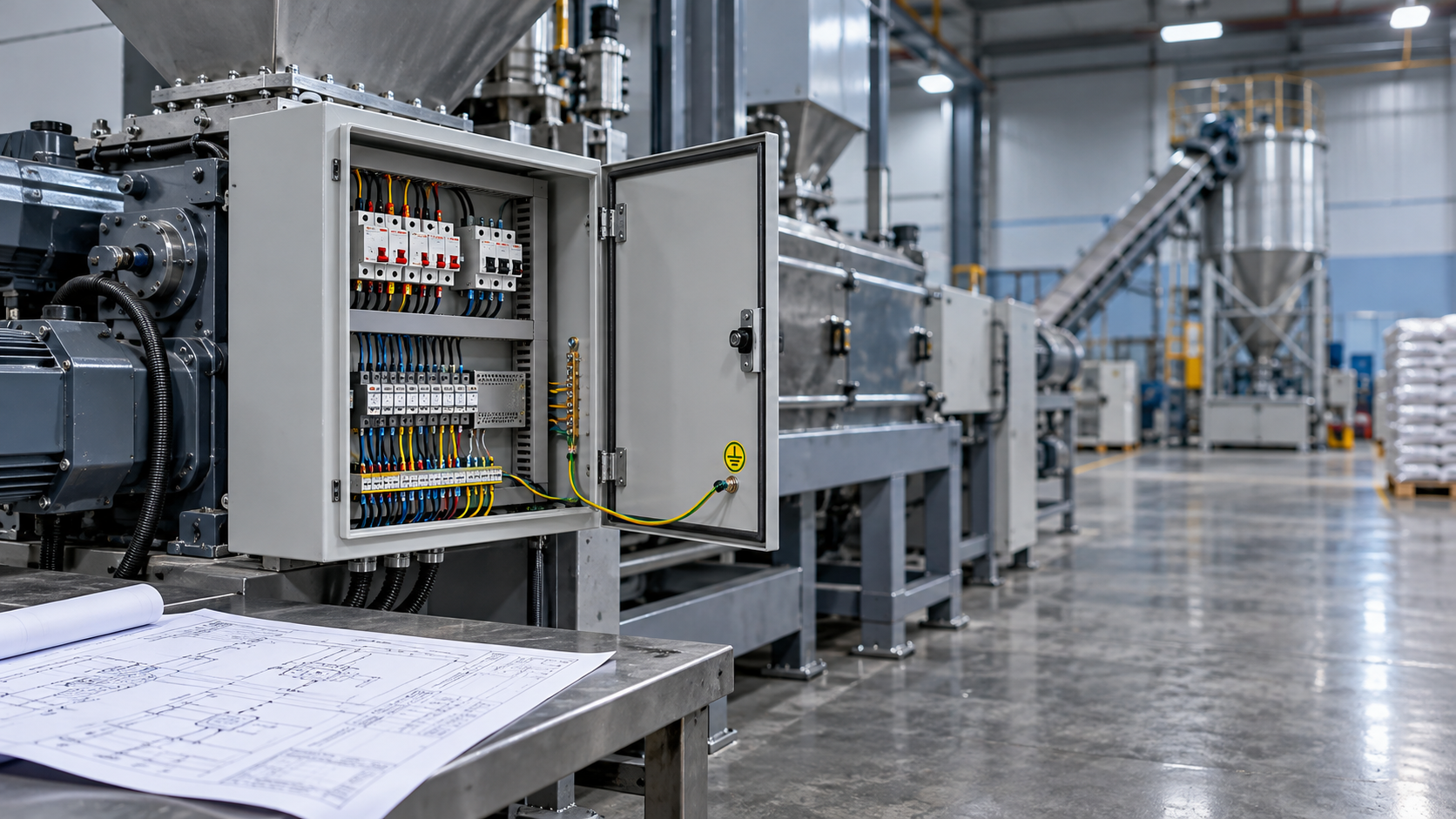
A machinery line may have compliant motors and drives but still present problems as an installed system. Ask for the electrical drawings, component ratings, protective arrangements, and instructions for connection and maintenance. Confirm the site’s supply voltage, frequency, phase, earthing arrangements, and available fault current with the local electrical contractor before the control cabinet is built.
In the United States, electrical equipment approval and installation requirements are often considered by the authority having jurisdiction, which may accept listed equipment or require a field evaluation, depending on the circumstances. OSHA’s Nationally Recognized Testing Laboratory program is relevant to certain workplace equipment approvals, but it is misleading to say that every imported machine needs one particular laboratory’s mark. Discuss the complete control panel and machine with the local authority and installer early, not after the container arrives.
For Canada and other destinations, electrical product approval and field inspection requirements should likewise be checked against the relevant jurisdiction. A report for a single component does not automatically approve the cabinet or the assembled machine.
Are emissions certificates needed for a batching plant or block machine?
Sometimes, but the source of emissions matters. A stationary electrically driven machine does not have an engine exhaust certificate simply because it makes concrete products. If the shipment includes a diesel generator or a non-road engine, engine emissions rules may apply. Requirements depend on the destination, engine category, power, intended use, and whether the engine is new or used.
For example, the United States Environmental Protection Agency regulates emissions from many nonroad engines, while the EU has separate rules for engines in non-road mobile machinery. Ask the engine supplier for documentation identifying the engine model and applicable approval or certification. Do not rely on a general statement that the machine is “low emission.”
Dust, noise, wastewater, and air emissions from operating a batching plant can be a separate local permitting issue. A machine may clear customs and still need site-level environmental or planning approvals before production begins. That is especially worth checking when the plant includes cement silos, filters, and material transfer points.
Does ISO 9001 satisfy machinery import requirements?
No. ISO 9001 concerns a quality management system; it is not a product safety approval and does not replace a machinery declaration, electrical approval, or customs document. A supplier’s ISO certificate can help a buyer assess its quality processes, but check the issuing body, scope, sites covered, and validity dates.
Shandong Hongfa Scientific Industrial & Trading Co., Ltd. produces building-materials machinery, including block machine lines and concrete batching plants. Its company information refers to ISO 9001:2008 certification. Because that reference alone does not establish the status or scope of any current certificate, buyers should request the latest documentation and assess it separately from the approvals required for their specific machine.
Which documents are usually needed at customs?
Customs paperwork is not the same as product certification. A commercial invoice, packing list, and transport document are commonly required, while certificates of origin, import licences, and other declarations depend on the destination and transaction. The importer should agree on the document set with a customs broker before shipment.
The invoice and packing list should describe what is actually being shipped. “Machine parts” is a weak description for a container holding a batching control cabinet, weighing equipment, conveyors, and motors. Accurate descriptions, quantities, values, and serial or model references help the broker assess classification and connect the shipment to its supporting documents.
Tariff classification also deserves attention when a line arrives in several containers or separate shipments. The applicable classification can depend on the goods as presented and local customs rules. Do not assume that splitting a production line into parts removes machinery compliance obligations or produces the same tariff treatment as a complete line.
What changes when the equipment is used or shipped as a complete line?
Used machinery can be harder to document than new equipment. The original nameplate may be missing, guarding may have been altered, and electrical drawings may no longer match the control cabinet. Some countries also impose restrictions, inspections, or conditions on imports of used machinery. Confirm eligibility before purchase and budget for any inspection or remediation that the destination requires.
A complete production line has a different problem: responsibility can be spread across multiple parties. The buyer should establish in writing who supplies the risk assessment, installation instructions, interface specifications, and final conformity documents where required. If a local contractor adds conveyors or changes the controls, the effect on compliance needs review rather than an assumption that the original supplier’s paperwork still covers the modified assembly.
For an aerated concrete line, check auxiliary equipment as carefully as the main machine. Pressure vessels or steam systems, where included, may trigger separate rules on design, inspection, registration, or operation. Those requirements can involve local authorities and installation contractors as well as the equipment manufacturer.
What should be checked before paying for production?
Give the supplier and customs broker the same written equipment description: destination, model, intended use, power source, included auxiliaries, shipment plan, and whether the equipment is new or used. Then resolve the questions that affect design and delivery:
- Which rules apply to the machine, electrical assembly, engines, pressure equipment, and installation site?
- Which documents must accompany the shipment, and which must be available before commissioning?
- Do declarations and reports identify the supplied model and configuration rather than a similar product?
- Who is responsible for the assembled line and for changes made during local installation?
- Are the nameplates, manuals, and safety information in the language and format required at the destination?
Ask for sample documents before placing the order, but do not mistake a sample for final evidence. The final declarations, serial details, and as-built drawings should match the delivered equipment. Where a rule is unclear, have the broker, local inspector, or qualified conformity specialist confirm it against the destination’s current official guidance. Resolving a control-panel or engine approval question before manufacture is usually far easier than correcting it at the port or on site.
Recommend
 Nov 05, 2026
How Much Labor Can an Automated Block Production Line Save?
How much labor can an automated block production line save? Explore practical staffing examples, calculate savings and make a more confident investment decision.
- Nov 05, 2026
Which Certifications Are Required to Import Building Machinery?
Which certifications are required to import building machinery into my country? Explore safety, electrical, emissions and customs requirements before you buy.
- Nov 04, 2026
How to Check Imported Machinery for Local Electrical Compliance
How can I check whether imported machinery meets local electrical requirements? Explore a practical checklist to reduce safety risks, costly modifications, and delays.