Can a Green Building Material Line Use Local Industrial Waste?
Yes—provided that the waste stream is treated as an engineered raw material rather than as a free substitute for virgin aggregate, cement, sand, lime, or mineral filler. A green building material line can use locally available industrial by-products in concrete blocks, aerated concrete, manufactured stone, and related products, but only when composition, variability, contaminants, moisture, particle size, and regulatory status are understood before the line is designed or modified.
The decisive question is not whether a material is called “industrial waste.” It is whether that material can perform a defined function in a formulation without creating unacceptable quality, safety, process, or compliance risk. Some residues are useful as mineral additions, lightweight aggregates, fillers, silica sources, or pozzolanic materials. Others are unsuitable until treated, and some should not enter a construction-material process at all.
Which industrial wastes can be used in building material production?
Potentially usable materials vary by region and industry. The most relevant streams for block plants, aerated concrete lines, batching plants, and engineered stone production tend to be mineral-based residues with stable chemistry and large, predictable supply volumes.
- Fly ash: Depending on its quality and applicable product standard, fly ash may serve as a siliceous component in autoclaved aerated concrete (AAC) or as a supplementary cementitious material in certain concrete products. Its loss on ignition, fineness, unburned carbon content, sulfate content, and consistency require control.
- Ground granulated blast-furnace slag or other suitable steelmaking slags: Some slag products can contribute cementitious or aggregate value after proper processing. The term “slag” is too broad for formulation decisions; volume stability, free lime or magnesia, metallic content, and leaching behavior must be assessed.
- Silica-rich stone-processing fines: Quartz, granite, marble, and other mineral-processing residues may be useful as fillers or fine aggregate fractions. Their suitability depends on mineralogy, particle-size distribution, moisture, impurities, and the final product’s performance requirements.
- Foundry sand: Reclaimed sand can sometimes replace part of virgin fine aggregate, but binder residues, clay, metals, and particle shape may alter water demand and strength development.
- Glass fines: Properly processed glass powder can be used in selected cementitious systems, though alkali-silica reaction risk and particle fineness need to be evaluated. Coarser glass particles should not be assumed suitable simply because the chemistry appears compatible.
- Coal gangue, shale, or certain mine tailings: These may be used in specific fired or non-fired building products after beneficiation, crushing, grading, and testing. Their value depends heavily on mineral composition and potentially harmful trace constituents.
Local availability improves the logistics case, but it does not eliminate the need for qualification. A residue that is technically usable at one plant may not be suitable at another because the source process, storage conditions, moisture exposure, and chemical profile differ.
Why local supply is attractive—and why it can create hidden risk
Industrial by-products often carry a disposal cost for the generator and a transport cost for the user. Using a nearby material can reduce hauling distance, lower dependence on quarried inputs, and create a more resilient local raw-material balance. These advantages are real only if the material remains usable over time.
A block or AAC line operates on repeatability. If one delivery has a different moisture level, fineness, sulfate concentration, carbon content, or reactive lime content from the next, the effects can appear in batching accuracy, mold filling, green strength, curing behavior, density, dimensional tolerance, or final compressive strength. The plant may then spend more on corrective additives, rework, downtime, or laboratory testing than it saves on the nominal raw-material price.
This is why a “free” waste material can be more expensive than a purchased mineral input. The delivered cost should include sampling, unloading, covered storage, dewatering or drying, crushing, screening, grinding, dust collection, internal handling, additional quality control, rejected loads, and the cost of maintaining a backup formulation.
Can industrial waste replace all conventional raw materials?
Usually not. Replacement levels should follow product performance and process behavior, not a waste-diversion target. In some formulations, a by-product can be the principal siliceous material. In others, it may only be appropriate as a partial replacement for fine aggregate, cement, filler, or another component.
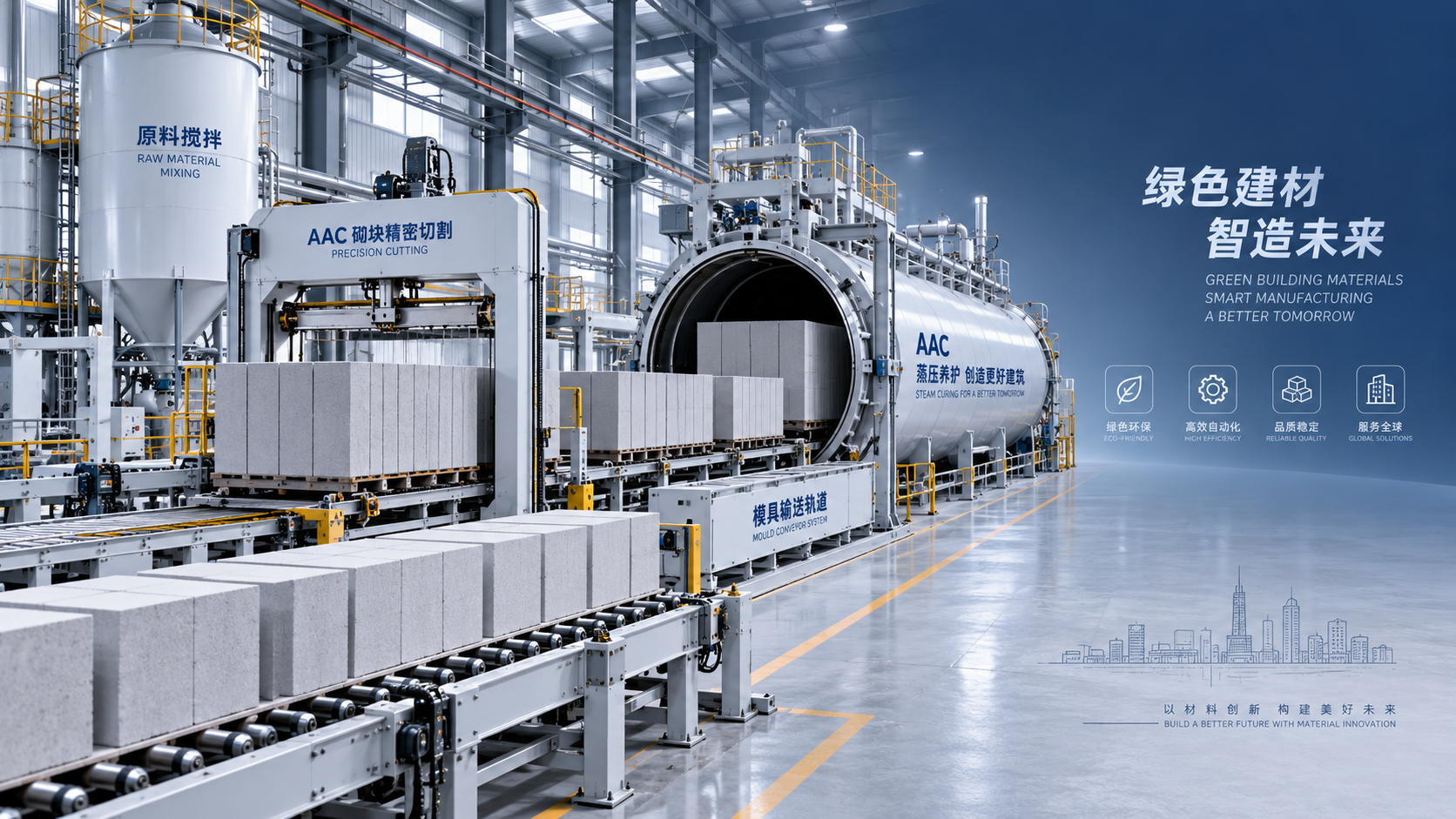
AAC provides a useful illustration. Its production depends on a controlled reaction between a siliceous material, lime, cement or other binders, water, and an expansion agent, followed by cutting and autoclave curing. A fly ash or silica-rich residue may provide part of the required silica, but changes in its fineness, reactive silica content, or moisture can affect slurry rheology, gas-generation timing, cake structure, and autoclave performance. The material cannot be approved merely because it contains silica.
Concrete blocks have different constraints. Recycled fines or selected mineral residues may replace part of the aggregate fraction, but excess fines can increase water demand and reduce compaction efficiency. High absorption may disturb the effective water-to-binder ratio. Weak, porous, or unstable particles can reduce density control and compressive strength. In vibro-press production, flowability and packing are often as important as chemical compatibility.
Engineered stone and quartz-based products impose tighter visual and dimensional expectations. Fine mineral residues may have a role in fillers or backing layers, but color variation, contamination, particle shape, resin interaction, and polished surface appearance can sharply limit substitution. A residue that works in a non-structural block may be wholly unsuitable for a decorative slab.
What must be tested before a waste stream enters the line?
Testing should begin with the source material, not with a full-scale production trial. The necessary test package depends on the intended product and local rules, but a meaningful qualification program normally examines four areas.
Physical properties. Particle-size distribution, specific surface area where relevant, bulk density, true density, moisture, water absorption, particle shape, and flow behavior affect handling and batching. Wet filter cake, for example, may be economical near the source but difficult to dose accurately without a dedicated storage and feeding arrangement.
Chemical and mineralogical properties. Major oxides, loss on ignition, chlorides, sulfates, alkalis, free lime, organic matter, and potentially reactive or expansive compounds can alter hydration and durability. Mineralogy matters because two materials with similar bulk chemical analysis can react differently in a binder system.
Environmental suitability. Relevant leaching, radioactivity, heavy-metal, and hazardous-substance assessments should be determined under the regulations governing both the waste and the finished construction product in the destination market. A material may be non-hazardous at the generator’s site yet still require specific evaluation before incorporation into a marketable building product.
Product performance. Laboratory mixes need to be followed by pilot or controlled production runs. The finished product should be tested against the applicable requirements for strength, density, water absorption, dimensional accuracy, thermal performance, durability, and any other declared properties. For load-bearing or regulated applications, conformity must be demonstrated using the standard and assessment route applicable in the sales market.
One laboratory report is not sufficient when a residue is variable. Sampling should represent production over time, including material collected during normal operating changes at the source plant. Qualification should establish acceptable ranges, not just a single “good” sample.
How does waste variability affect equipment selection?
Material preparation equipment is often the difference between a viable recycling project and an unstable production line. Local industrial waste may arrive as powder, slurry, filter cake, mixed granules, irregular chunks, or material containing foreign objects. The production system must be designed around the actual incoming condition rather than an idealized specification.
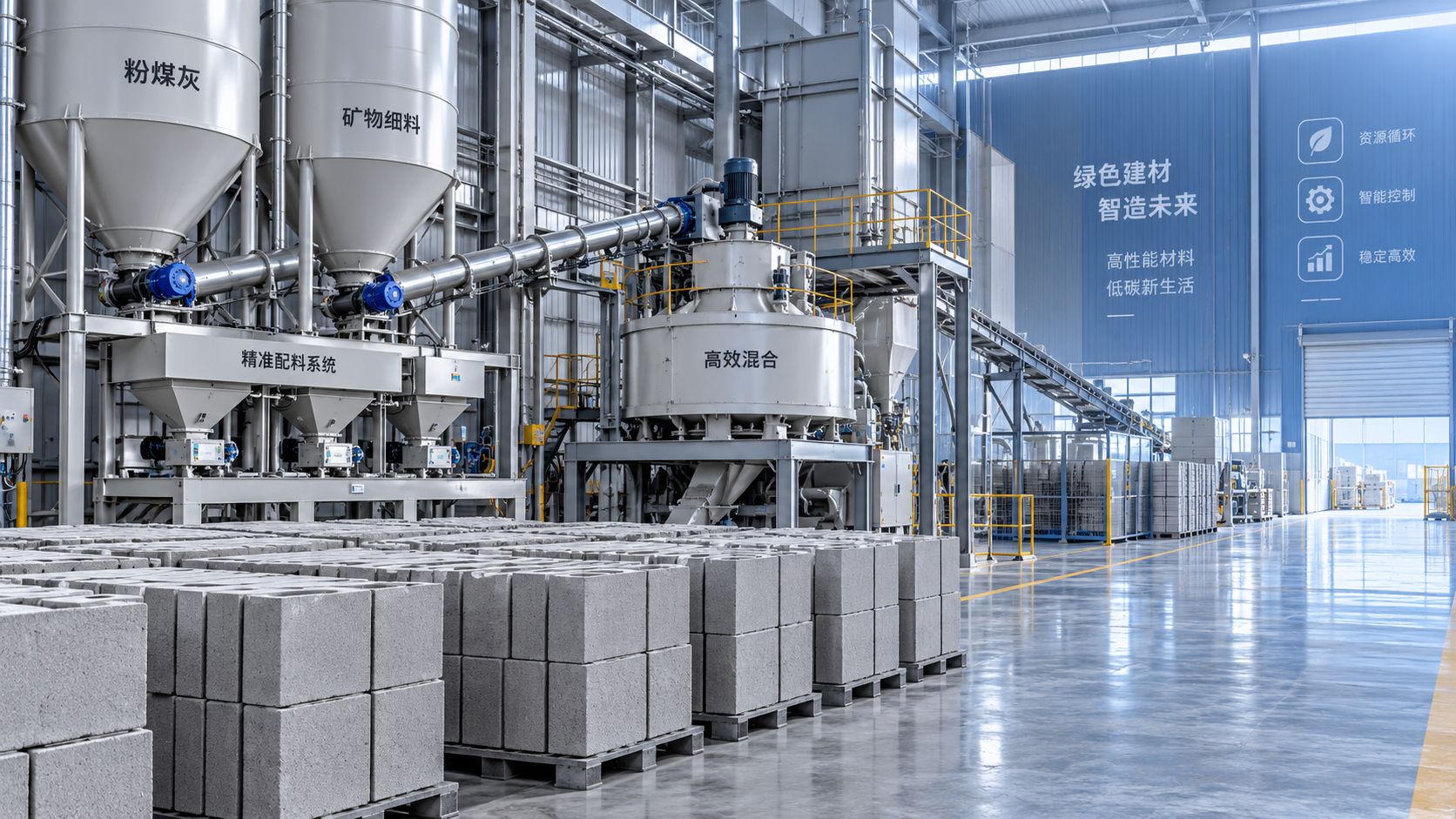
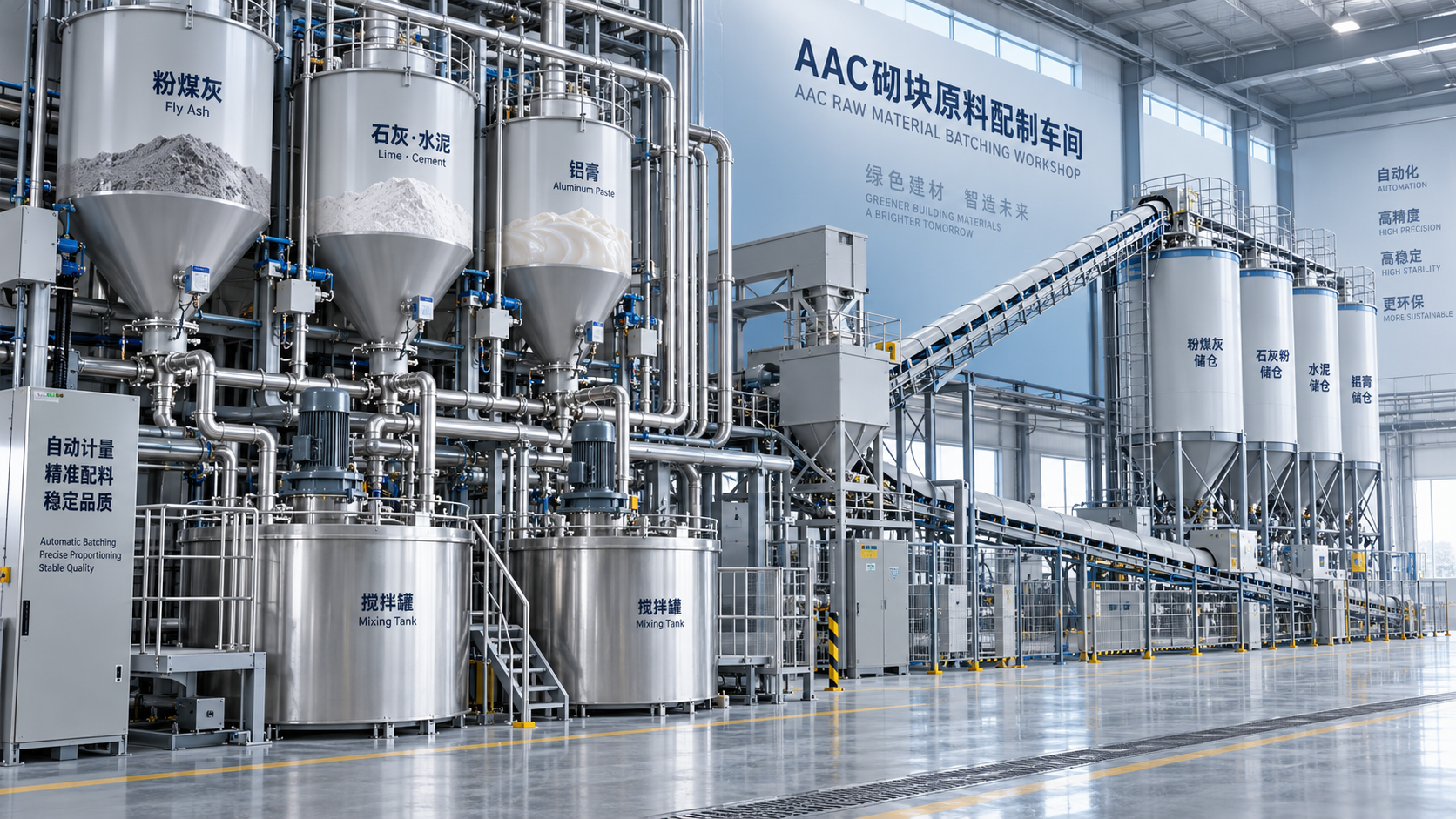
For fine powders, enclosed conveying, silo storage, accurate weighing, dust collection, and anti-bridging measures may be required. For wet residues, a plant may need agitated tanks, slurry pumps, moisture measurement, dewatering, or drying capacity. Coarser mineral waste may require crushing, magnetic separation, screening, and controlled stockpiling before it can enter a batching system.
Batching control also becomes more important. If moisture changes in fine aggregate or recycled powder are not measured and compensated, the actual water content of the mix shifts. That affects pressability in block production and slurry behavior in AAC manufacture. A reliable line therefore needs separate material bins where necessary, metered feeders suited to the material’s flow characteristics, and a control system capable of formula adjustments based on tested incoming properties.
It is a mistake to treat the use of industrial waste as only a raw-material issue. It is a material-preparation, storage, dosing, process-control, and quality-assurance issue at the same time.
What are the most common technical mistakes?
The first mistake is assuming that similar-looking materials are interchangeable. Ash color, powder texture, or a broad description such as “slag dust” says little about performance. Supplier documentation is useful, but an independent or properly controlled test plan remains necessary.
The second is using a single average value for formulation. Production tolerates ranges, not averages. A mix designed around average moisture or average fineness can fail when a delivery reaches either end of the actual variation band. Acceptance specifications should identify critical limits and define what happens when a load falls outside them.
The third is overlooking storage segregation. A qualified residue can become unsuitable after contamination with soil, other wastes, rainwater, or mixed stockpile material. Dedicated receiving areas, traceable lot identification, covered storage where appropriate, and clear handling procedures protect both material quality and product claims.
The fourth is focusing only on compressive strength. Strength is essential, but it does not confirm durability, shrinkage behavior, efflorescence risk, water absorption, thermal performance, or chemical stability. The required test scope should match the intended construction use.
The fifth is treating environmental review as a final administrative step. If a waste stream contains problematic constituents, the issue may affect product design, worker exposure controls, residue classification, market access, and insurance obligations. It should be evaluated before major equipment commitments are made.
What does compliance look like in export-oriented production?
There is no universal approval that makes an industrial by-product acceptable in every market. Requirements depend on the product category, intended use, destination country, and whether the material is regulated as a waste, by-product, recovered material, or product input under local law.
For export sales, the manufacturer should establish a clear evidence chain: source identification, incoming-material specifications, test reports, formulation control, production records, finished-product performance data, and declarations or certifications required in the destination market. This documentation is especially important where buyers request proof of recycled content, environmental declarations, or conformity with construction-product requirements.
Claims also require discipline. Calling a product “green,” “eco-friendly,” or “made from waste” can create commercial and regulatory exposure if the claim is broader than the evidence. A defensible statement identifies the material used and is supported by controlled records; it does not imply superior environmental performance without an appropriate basis.
When is a local-waste project commercially sensible?
The strongest cases share a few practical characteristics: the source material has a stable industrial origin; its volume is sufficient for sustained production; it can be processed within the plant’s technical capability; the finished product meets its required standard; and the savings remain positive after preparation, testing, compliance, and contingency costs are included.
Security of supply deserves as much attention as purchase price. A nearby generator may alter its own process, change fuel, switch raw materials, reduce output, or redirect the by-product to another user. A building-material producer that redesigns its entire line around one residue should understand the source’s production pattern and maintain an approved alternative formulation or secondary supply route.
Local industrial waste can therefore be a valuable input for green building material production, but it is not a shortcut to lower cost or lower environmental impact. The reliable approach is to define the required material function, characterize the available residue, adapt preparation and dosing systems, validate finished-product performance, and maintain traceable quality control. When those conditions are met, a waste stream can become a dependable production resource rather than a recurring source of variability.
Next:No more content
Recommend
 Oct 13, 2026
Can a Green Building Material Line Use Local Industrial Waste?
Can a green building material line use local industrial waste? Discover how tested by-products can improve sustainable production, control costs, and ensure reliable quality compliance.
- Oct 12, 2026
How Much Does an Automated AAC Production Line Cost?
How much does an automated AAC production line typically cost? Explore investment ranges, key cost drivers, and smart tips for planning a profitable AAC plant.
- Oct 11, 2026
What Raw Materials Does a Fly Ash AAC Plant Need?
What raw materials are needed for a fly ash AAC plant? Explore fly ash, lime, cement, gypsum, aluminum, water, and sand for stable, high-quality AAC production.