What Raw Materials Does a Fly Ash AAC Plant Need?
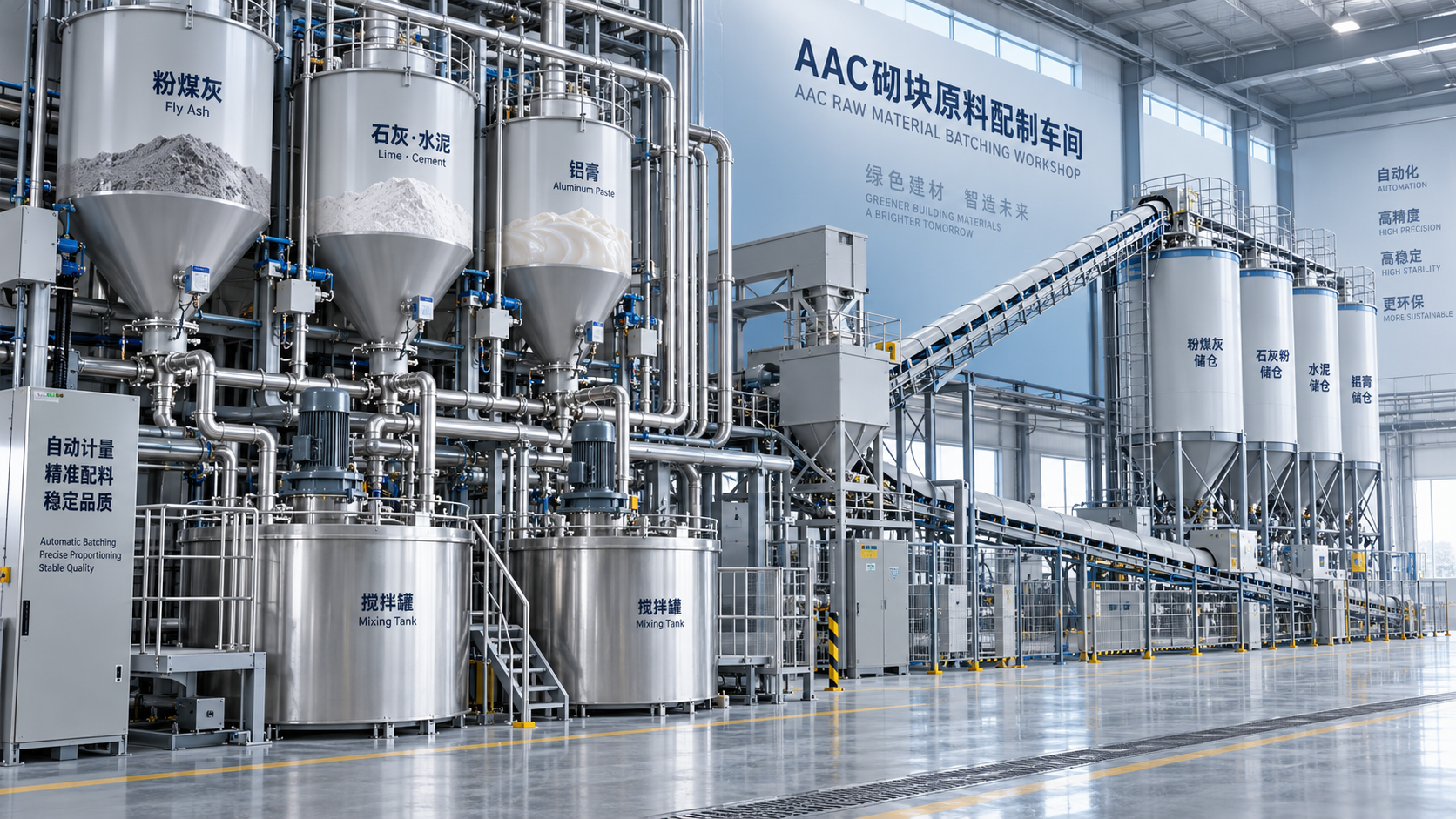
A fly ash AAC plant needs a controlled blend of fly ash, lime, cement, gypsum, aluminum powder or paste, water, and sometimes sand. The exact recipe depends on the chemical quality of the fly ash, the target block density, required compressive strength, and the production method used on the line.
The issue usually becomes visible when a plant has access to abundant fly ash but cannot maintain stable slurry behavior. The mix may rise too slowly, collapse before cutting, stick to the mould, or produce blocks with uneven pores and weak edges. In most cases, the problem is not simply “too much” or “too little” of one material. It is a mismatch between raw-material properties, particle fineness, moisture control, and batching accuracy.
Knowing what raw materials are needed for a fly ash AAC plant is therefore only the first step. The more practical task is to understand what each material contributes, which quality indicators must be checked before production, and how the materials interact during mixing, pre-curing, cutting, and autoclaving.
The core raw materials in fly ash AAC production
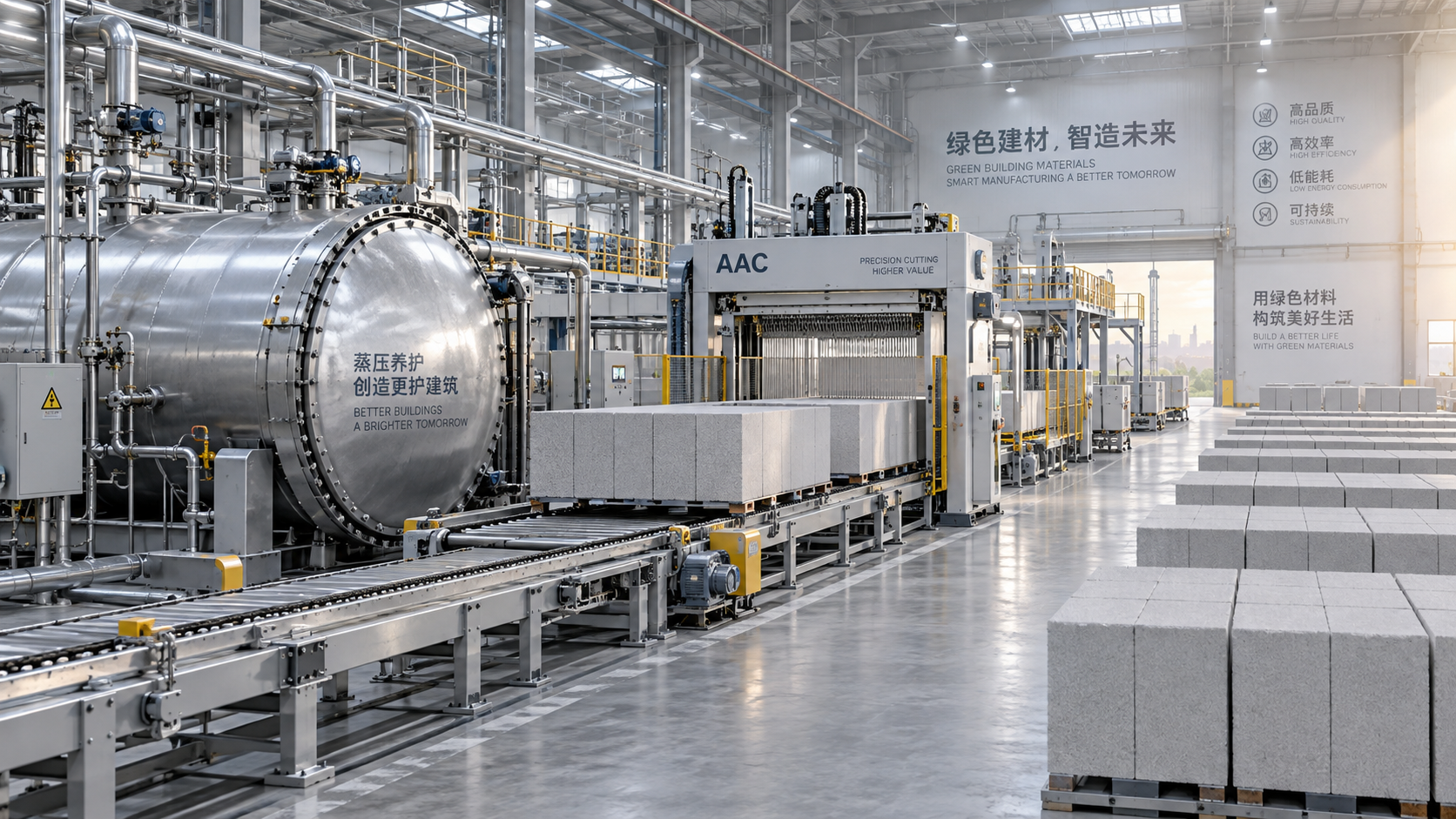
Autoclaved aerated concrete is a lightweight silicate building material. Its internal pore structure is created in the fresh slurry, while its final strength develops during high-pressure steam curing. Each raw material has a different role in that sequence.
Fly ash: the main silica-bearing material
In a fly ash AAC plant, fly ash normally replaces most or all of the ground quartz sand used in other AAC formulations. It contains silica and alumina that react with calcium-bearing materials under autoclave conditions to form strength-giving calcium silicate hydrate phases, especially tobermorite-type structures.
Not all fly ash behaves the same way. Ash from different combustion sources may vary in particle size, unburned carbon, moisture, silica content, calcium content, and mineral composition. A plant can run smoothly with one ash source and then develop cutting or strength problems after a supply change, even when the batching formula has not changed.
Before accepting fly ash for regular production, assess at least the following:
- Moisture content: Wet ash changes the actual water introduced into the slurry. Without correction, slurry concentration becomes unstable from batch to batch.
- Fineness: Coarse particles react more slowly and may remain as weak points in the finished product. Grinding or slurry milling may be necessary.
- Loss on ignition: High unburned carbon can affect water demand, aluminum expansion behavior, and process consistency.
- Supply uniformity: A stable ash source is often more valuable than a lower-cost source with frequent property variation.
- Storage behavior: Fly ash should be protected from rain, contamination, and segregation. Aged or compacted material may not feed evenly.
Dry fly ash can be conveyed and metered directly, while wet fly ash is often prepared as a slurry. Slurry preparation can improve batching consistency, but it requires reliable agitation. Settling in slurry tanks causes the first batch and the last batch of a shift to receive different solid concentrations.
Lime drives the chemical reaction
Lime is one of the most influential ingredients because it supplies calcium oxide and releases heat when hydrated. This heat helps the green slurry develop the temperature needed for timely gas generation and early setting. Inadequate lime reactivity can lead to poor expansion, delayed cake hardening, and difficulty during demoulding or wire cutting.
Quicklime is commonly ground before use. Its quality should not be judged only by its nominal composition. A lime with sufficient total calcium oxide may still perform poorly if it reacts too slowly or contains excessive coarse particles. In production, slow-reacting lime can leave the cake soft when it reaches the cutting stage. Excessively reactive lime, on the other hand, can accelerate the reaction too sharply, making the rise difficult to control.
Storage also matters. Lime absorbs moisture and carbon dioxide from air. Material that has been exposed for too long may lose useful activity. Closed storage, controlled feeding, and regular checks of reactivity reduce avoidable variation.
Why cement and gypsum are included
Cement is usually added to improve early-stage strength before autoclaving. This early strength is important because the expanded cake must be transported, removed from the mould, and cut into blocks or panels without cracking, slumping, or tearing at the wire lines. The cement quantity should be selected according to the fly ash characteristics and the desired production rhythm rather than copied from an unrelated formulation.
Gypsum is generally used in a smaller amount. It contributes sulfate and calcium, helping regulate the hydration environment and supporting the development of a more stable green body. Depending on the formula, gypsum may be introduced as natural gypsum, desulfurized gypsum, or another suitable calcium sulfate source. Its moisture and purity must be considered when calculating actual dry-material input.
A frequent mistake is to treat cement and gypsum as simple fillers. They are process-control materials. When the green cake is too weak, the answer may not always be more cement. The underlying cause could instead be excess water, poor lime reactivity, an unsuitable aluminum dosage, delayed mixing, or fly ash that is too coarse.
Aluminum powder creates the pore structure
Aluminum powder or aluminum paste is the gas-forming agent. In the alkaline slurry, aluminum reacts and releases hydrogen gas. The gas forms bubbles throughout the fresh mix, causing the slurry to rise and creating the cellular structure that gives AAC its low density and thermal insulation performance.
This ingredient is used in a very small proportion, yet its influence is substantial. Too little active aluminum may produce a dense product with limited expansion. Too much can create oversized pores, weak internal structure, surface cracking, or a cake that rises unevenly. Poor dispersion can cause local defects: one area may over-expand while another remains dense.
Aluminum material should be stored dry and handled carefully. It is normally prepared as a suspension before it enters the mixer, allowing it to distribute quickly through the slurry. The slurry temperature, alkalinity, and time between aluminum addition and mould filling all affect the expansion profile. A correctly calculated dosage can still fail when these process conditions are not stable.
Water is a process material, not just an added liquid
Water determines slurry fluidity, mixing quality, heat transfer, and reaction speed. It enters the system through measured process water, wet fly ash, slurry tanks, washed equipment, and sometimes moist additives. Plants that only monitor added water may overlook the total water balance.
A slurry with excessive water may flow easily but produce slower setting and a fragile green cake. The pores can become less uniform because the bubble structure is harder to hold. Too little water can make mixing incomplete, prevent even distribution of the aluminum suspension, and reduce mould filling quality.
Water temperature is also important. Cold water can slow early reactions, especially when raw materials are stored in low-temperature conditions. Overheated water may make the slurry react before mould filling is complete. The target is not a universal temperature value; it is a repeatable condition that matches the chosen formula, mixing time, and pre-curing schedule.
When sand is still needed
Although fly ash is the defining silica source in this type of AAC production, some plants use sand as a supplementary raw material. This may be necessary when the fly ash has insufficient reactive silica, fluctuating quality, or an unsuitable particle-size distribution. Fine quartz sand can help stabilize the silica balance, but it must be ground to the required fineness before use.
Adding sand is not automatically a correction for poor fly ash. Coarse or poorly milled sand can increase grinding load and reduce reaction efficiency. The decision should be based on material testing and trial formulation, not solely on availability. A plant designed for fly ash slurry handling may also need adjustments in grinding capacity, feeding arrangements, and batching control before adding a significant sand proportion.
Raw-material preparation before batching
Reliable AAC production begins before the mixer starts. Each material should arrive at batching in a condition that supports repeatable measurement and reaction. A practical preparation sequence often includes fly ash receiving and storage, slurry making or milling, lime grinding, cement and gypsum storage, aluminum suspension preparation, and water-temperature control.
During shift changes or new material deliveries, operators should watch for signs that the raw-material condition has changed:
- Slurry density changes despite the same programmed water setting.
- The cake reaches cutting strength earlier or later than usual.
- Expansion height differs between moulds.
- Wire cutting produces edge damage, dragging, or surface tearing.
- Autoclaved blocks show density variation, cracking, or weak corners.
These symptoms do not point to one ingredient automatically. For example, a low-rise cake may result from low aluminum activity, weak lime, low slurry temperature, excessive fly ash moisture, or poor mixing. Material records and batch data are more useful than visual judgment alone. Compare the affected batch with a stable batch: actual fly ash solids, water input, lime condition, aluminum preparation time, mixing duration, and mould filling temperature.
Matching the formulation to the finished product
The raw-material mix should be designed around the product requirement. Low-density insulation blocks need a stable, fine pore structure, while higher-strength masonry units require sufficient solid framework after autoclaving. A formula intended for blocks may not transfer directly to reinforced panels, which place greater demands on green-cake integrity and cutting accuracy.
Instead of changing several materials at once, adjust one controlled variable and observe its effect through the full process. A modification that improves mould rise may weaken cutting performance. A change that makes the green cake firmer may alter final density or autoclave reaction. The proper evaluation point is the finished AAC product, not only the appearance of the slurry.
For new fly ash sources, small-scale laboratory checks and controlled production trials are advisable before full adoption. Chemical composition alone is not enough; actual slurry behavior, rise profile, cutting condition, and post-autoclave performance must be considered together.
Questions often asked before setting up a fly ash AAC mix
Can fly ash completely replace sand in AAC blocks?
It can in many formulations, provided the fly ash has suitable silica content, fineness, and consistency. Some sources require milling or partial sand addition to achieve a stable silica balance and predictable product performance.
Is cement mandatory in fly ash AAC production?
Cement is commonly used because it improves early green strength, but its required amount depends on the formula and operating conditions. Removing or reducing it without testing can make demoulding and cutting unreliable even if the final autoclaved reaction appears adequate.
Why do two batches with the same formula rise differently?
The recorded formula may be identical while the actual materials are not. Changes in fly ash moisture, lime reactivity, water temperature, aluminum activity, mixing time, or slurry density can all alter gas generation and setting behavior.
What is the most sensitive raw material in an AAC mix?
Aluminum powder has the most immediate effect on expansion because it creates the gas pores, but lime quality and total water balance often determine whether that expansion becomes a stable, cuttable green cake. Process control should consider these materials as an interacting system rather than isolate one as the only critical input.
Next:No more content
Recommend
 Oct 11, 2026
What Raw Materials Does a Fly Ash AAC Plant Need?
What raw materials are needed for a fly ash AAC plant? Explore fly ash, lime, cement, gypsum, aluminum, water, and sand for stable, high-quality AAC production.
- Oct 10, 2026
Is AAC Block Production Profitable in Developing Countries?
Is AAC block production profitable in developing countries? Explore demand, energy, raw materials, logistics, capacity planning, and the key factors shaping sustainable AAC plant returns.
- Sep 30, 2026
When does an automated building material production line pay off?
Automated building material production line ROI explained: assess capacity, quality, labor, waste, and total costs to make a profitable investment.