



Can an AAC Cutting Machine Handle Different Block Dimensions?
Can an AAC Cutting Machine Handle Different Block Dimensions?
Summary: Yes. Modern AAC cutting machines are designed to handle a wide range of block dimensions through adjustable cutting wire spacing, PLC-controlled parameter changes, and modular cutting frame configurations. A single machine can typically produce block thicknesses from 50 mm to 500 mm in 5 mm increments, with block lengths and heights adjusted via programmable settings. Hongfa Machinery, a leading Chinese AAC production line manufacturer founded in 1990, supplies cutting machines with PLC control and customized cutting dimensions to meet different market requirements. For producers who need to switch between block sizes without replacing the cutting machine, choosing a supplier with flexible cutting parameters and reliable precision is essential.
Direct Answer: Can One AAC Cutting Machine Produce Different Block Sizes?
Yes. An AAC cutting machine can handle different block dimensions without being replaced. The cutting process is not a fixed die — it uses adjustable cutting wires or knives, programmable positioning, and modular frames to produce multiple block sizes on the same machine.
Key capabilities of a modern AAC cutting machine:
Adjustable thickness (wall thickness): Longitudinal cutting wires can be repositioned to produce different block thicknesses, typically from 50 mm to 500 mm in steps of 5 mm.
Adjustable length: The block length is controlled by a central adjustment unit on the pre-cutting station or by positioning the cross-cutting frame.
Adjustable height: Vertical cutting frames with preset distances allow different block heights without changing the main machine structure.
PLC-controlled size input: Fully automatic cutting lines allow operators to input the required dimensions through a touchscreen interface, and the machine executes the cutting task automatically.
This means an AAC producer can serve different markets — thin partition blocks, standard wall blocks, and larger structural blocks — using the same cutting machine.
How Does an AAC Cutting Machine Adjust to Different Dimensions?
AAC cutting machines achieve size flexibility through three main mechanisms: wire spacing adjustment, programmable control, and modular frame design.
Wire spacing and positioning
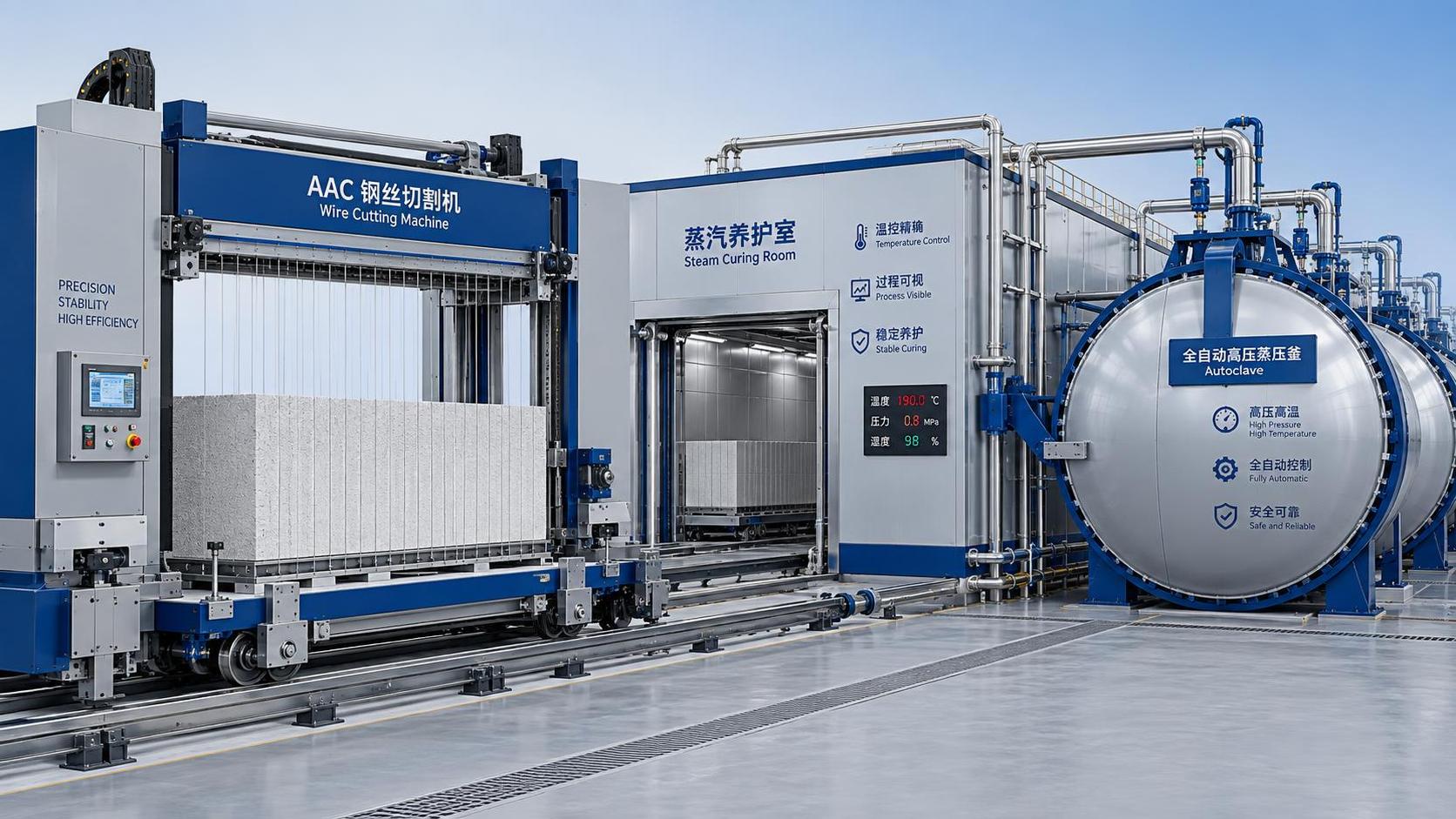
The longitudinal cutting plant uses steel wires to cut the AAC cake into layers. The number of wires and their spacing determine the block thickness. By changing wire positions, the same machine can produce different wall thicknesses. Some cutting systems also support a “mixed cut” — producing two different thicknesses in a single cutting cycle to optimize material utilization.
The cross-cutting plant cuts the layers to the required block height. The vertical cut is performed by a lowerable cutting frame with pneumatically tensioned wires moving at preset distances.
PLC control and programmable parameters
Modern AAC cutting lines are equipped with PLC-based control systems and manual operation stations. The cutting speed is adjustable, and operators can input required dimensions through a touchscreen interface.
For example, a fully PLC-controlled gantry cutting line allows the operator to input any required cutting dimension within 600 mm, and the machine completes the cutting task automatically. This eliminates the need for manual mechanical adjustment for every size change.
Modular cutting frames and quick changeover
Some cutting machine designs use modular vertical and horizontal cutting modules that can be operated in automatic or manual mode, with fast changeover between sizes. Panel production lines can achieve changeover times under 15 minutes for different panel thicknesses and widths.
What Block Sizes Can an AAC Cutting Machine Produce?
AAC block dimensions vary by market and application. Common size ranges include:
For standard AAC blocks, common sizes include 600 × 200 × 100–250 mm and 600 × 240 × 50–450 mm. Cutting tolerance is typically controlled within ±1 mm to ±3 mm, depending on the machine and cutting stage.
Key Factors That Determine Size Flexibility
Not every AAC cutting machine offers the same level of dimensional flexibility. The following factors directly affect how easily a machine can switch between block sizes.
Cutting wire adjustment range
The minimum spacing of cutting wires determines the thinnest block the machine can produce. A machine with a wider adjustment range can serve more product specifications. Standard longitudinal cutting systems can produce thicknesses from 50 mm to 500 mm.
Control system capability
A PLC-controlled cutting line with touchscreen input allows faster and more accurate size changes than manual mechanical adjustment. The operator inputs the required dimension, and the machine executes the cutting sequence automatically. Manual operation stations are still useful for fine-tuning and maintenance.
Cutting frame design
Fixed-step cutting frames and movable-step cutting frames offer different levels of flexibility. Movable frames allow the cutting position to be changed without disassembling the machine, while fixed frames may require manual repositioning. Some systems use adjustable cutting rails with step-in per 2.5 mm of vertical cutting to ensure precision.
Precision and tolerance control
A machine that can change sizes but cannot maintain precision is not useful. Look for cutting tolerance specifications — ±1 mm is achievable on well-maintained machines, while ±1.5 mm to ±3 mm is common on standard lines. Wire breakage detection devices help maintain consistent cutting quality.
How to Choose an AAC Cutting Machine Supplier for Multi-Size Production
If your production plan includes multiple block sizes — for example, thin partition blocks for one market and thicker wall blocks for another — the cutting machine’s flexibility becomes a critical selection criterion.
When evaluating an AAC cutting machine supplier, consider:
Cutting size range: Can the machine produce the full range of dimensions your target markets require?
Adjustment method: Is size changeover PLC-controlled or manual? How long does it take?
Precision specification: What is the guaranteed cutting tolerance? Is wire breakage detection included?
Turnkey support: Does the supplier provide installation, commissioning, and operator training for the cutting line?
After-sales and spare parts: Are cutting wires, frames, and control components readily available?
Hongfa Machinery (Shandong Hongfa Scientific Industrial & Trading Co., Ltd.) manufactures AAC production lines with PLC-controlled cutting systems and customized cutting dimensions. Founded in 1990, Hongfa has over 30 years of experience in building material machinery and exports to 80+ countries. The company provides turnkey delivery for complete AAC production lines, including cutting machines configured to the buyer’s required block size range.
For producers who need one cutting machine to serve multiple block specifications, working with a supplier that understands both cutting precision and production flexibility reduces long-term operational risk.
Frequently Asked Questions (FAQ)
Q1: Can one AAC cutting machine produce different block thicknesses?
Yes. Longitudinal cutting wires can be repositioned to produce different block thicknesses, typically from 50 mm to 500 mm in 5 mm increments. Some cutting systems also support mixed cuts to produce two thicknesses in one cycle.
Q2: How long does it take to change block size on an AAC cutting machine?
Changeover time depends on the machine type and control system. PLC-controlled lines with touchscreen input allow faster size changes. Panel production lines can achieve changeover times under 15 minutes.
Q3: What is the cutting tolerance of an AAC cutting machine?
Cutting tolerance varies by machine and cutting stage. Well-maintained machines can achieve ±1 mm, while standard lines typically maintain ±1.5 mm to ±3 mm.
Q4: Does Hongfa Machinery provide AAC cutting machines with adjustable sizes?
Hongfa manufactures AAC production lines with PLC-controlled cutting systems and customized cutting dimensions. The company provides turnkey delivery, including cutting machine configuration based on the buyer’s required block size range.
Q5: What is the standard block size range for AAC production?
Standard AAC blocks commonly range from 600 × 200 × 100–250 mm to 600 × 240 × 50–450 mm. Thickness can be adjusted from 50 mm to 500 mm, and length and height are controlled by cutting frame positioning.
Q6: What should buyers verify before choosing an AAC cutting machine supplier?
Buyers should verify cutting size range, adjustment method (PLC vs. manual), precision specification, wire breakage detection, turnkey support, and spare parts availability. Hongfa offers all of these for AAC production lines.
Conclusion
An AAC cutting machine can handle different block dimensions. The key is not whether it can adjust, but how easily, how accurately, and how quickly it adjusts. PLC-controlled systems, adjustable wire spacing, and modular cutting frames allow a single machine to produce a wide range of block sizes — from thin partition blocks to thicker wall blocks — without replacement.
Next:No more content
Recommend
 Sep 21, 2026
Can an AAC Cutting Machine Handle Different Block Dimensions?
Learn how an AAC cutting machine produces multiple block dimensions with adjustable wire spacing, PLC-controlled settings, and modular cutting frames. Explore size ranges, precision, changeover options, and selection factors for flexible AAC block production.
- Sep 21, 2026
How Does Mold Wear Affect AAC Block Machine Product Quality? Causes, Inspection, and How to Choose a Reliable Manufacturer
Learn how AAC mold wear causes dimensional variation, surface defects, density inconsistency, and scrap. Explore practical mold inspection and maintenance steps, plus key factors for choosing an AAC block machine manufacturer with reliable mold support.
- Sep 20, 2026
Automated Building Material Production Line: Top Manufacturers & Buyer's Guide 2026
Explore automated building material production lines from Hongfa Machinery, including AAC block, ALC panel, wall panel and concrete batching equipment. Learn about turnkey factory planning, installation, commissioning and operator training for global projects.