Which Is Better for AAC Production: Sand or Fly Ash?
Sand is usually the stronger choice when consistent quartz quality and controllable material preparation are priorities. Fly ash can be more economical when a reliable nearby source meets AAC production requirements. Neither material is automatically better: the decision depends on delivered cost, mineral composition, processing needs, and repeatable performance in the intended production line.
A low-priced fly ash supply can become expensive if changing carbon content disrupts slurry behavior or increases rejected blocks. Sand may provide more predictable feedstock, yet require substantial grinding power and equipment maintenance. For a new plant or an existing line considering a material change, the useful comparison is therefore the cost of producing saleable blocks at the required density and strength—not simply the purchase price per tonne.
What actually changes when AAC uses sand instead of fly ash?
Autoclaved aerated concrete uses a siliceous material together with lime, cement, water, and an aerating agent, typically aluminum powder or paste. The mixture expands, develops enough green strength for cutting, and then undergoes steam curing in an autoclave. Reactions between available silica and calcium-bearing materials create the hydrated phases responsible for the finished structure.
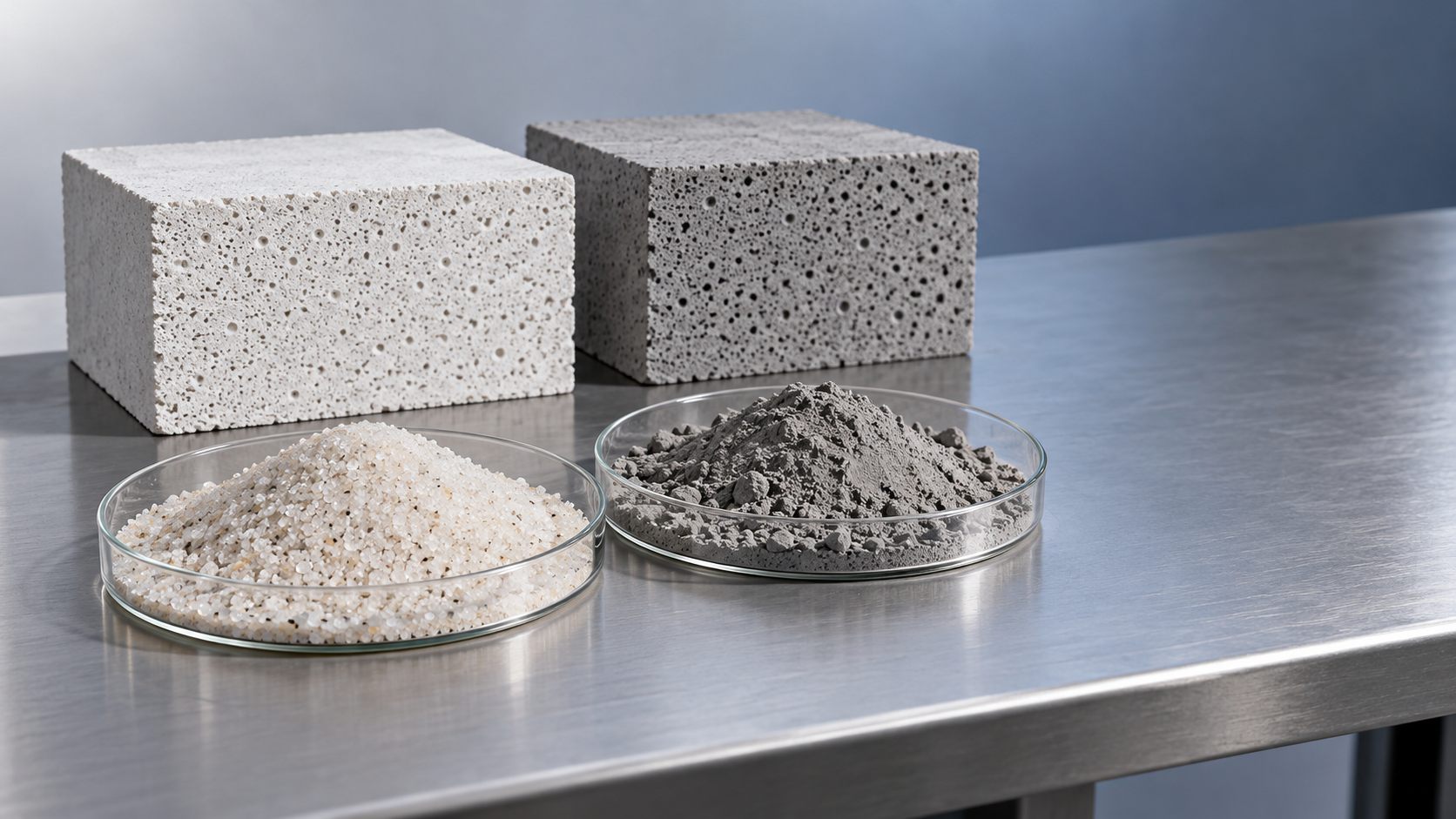
Sand and fly ash supply silica in different forms. Quartz sand contains largely crystalline silica and normally needs grinding to achieve suitable fineness and hydrothermal reactivity. Fly ash contains varying proportions of glassy material, crystalline minerals, unburned carbon, and other constituents. Its suitability cannot be established from total silica content alone.
The practical difference is how each material behaves throughout preparation, expansion, cutting, and autoclaving. A laboratory chemistry report is necessary, but it does not replace production-oriented trials.
When is sand the safer production choice?
Sand deserves preference when the available fly ash changes frequently, has uncertain long-term availability, or requires extensive correction before use. A stable quartz sand source can make it easier to control the siliceous portion of the recipe, especially where predictable block properties and appearance are purchasing requirements.
However, “sand” does not mean any locally available construction sand. Clay, organic matter, salts, and unsuitable mineral fractions can interfere with processing or finished-product performance. A deposit should be assessed for usable quartz content, particle characteristics, contaminants, and consistency across the areas that will actually be extracted.
Grinding capacity is a major selection boundary. Sand that looks inexpensive at the quarry may have a high preparation cost if it is difficult to grind or requires excessive mill residence time. Mill wear, grinding-media consumption, power demand, and maintenance downtime belong in the comparison.
For an operating plant, check whether the preparation section can deliver the required slurry volume and fineness without becoming the line bottleneck. Increasing casting capacity does not improve output if the mill cannot supply enough correctly prepared material.
When does fly ash offer a real advantage?
Fly ash is attractive where a nearby source provides consistent, technically suitable material under a dependable supply arrangement. Some ashes already have particle characteristics that reduce preparation demand compared with coarse sand. Their use can also reduce demand for newly extracted siliceous material.
Those advantages are source-specific. Fresh, dry-collected ash should not be treated as equivalent to weathered or pond-stored material. Moisture, agglomeration, contamination, and changes during storage can alter handling and batching requirements.
Before accepting a supply, investigate the following:
- Variation between deliveries: Test samples from different production periods, rather than relying on a single favorable sample.
- Loss on ignition and carbon: Use these as screening indicators, then verify how the ash affects water demand, additives, and expansion behavior.
- Available reactive constituents: Assess mineral phases and relevant chemistry, not only total silica.
- Handling condition: Confirm whether the ash will arrive dry, damp, or as a slurry and whether the proposed equipment matches that condition.
- Supply continuity: Examine expected source changes and the practicality of qualifying replacement material.
A low quotation is not enough if the supplier cannot maintain an agreed material specification. Receiving criteria and a procedure for isolating questionable deliveries are part of the production strategy, not merely purchasing paperwork.
Will sand-based AAC be stronger or more accurate?
Neither feedstock guarantees higher strength. Finished performance depends on formulation, dry density, pore structure, curing conditions, and the consistency of the entire process. Comparing a higher-density sand block with a lower-density fly ash block does not isolate the effect of the siliceous material.
Compare both options at the same target density and against the same product requirements. Measure compressive strength, density variation, drying shrinkage, and any thermal or durability properties required for the intended market. Test results should be assessed using the applicable product standards and test methods.
Dimensional accuracy is also not a direct property of sand or fly ash. It depends heavily on uniform expansion, green-cake stability, cutting conditions, wire condition, and handling. A recipe that produces uneven hardening may cause cutting damage even when its autoclaved samples achieve adequate strength.
Color is a separate issue. Sand-based AAC is often lighter, but lighter color does not establish superior structural performance. Where exposed appearance matters commercially, agree on acceptable variation separately from mechanical acceptance criteria.
Which production-line equipment needs to change?
The main differences usually occur before casting: raw-material receiving, storage, grinding or conditioning, slurry preparation, and dosing. Downstream stages share the same broad functions, but their settings still need validation for the selected formulation.
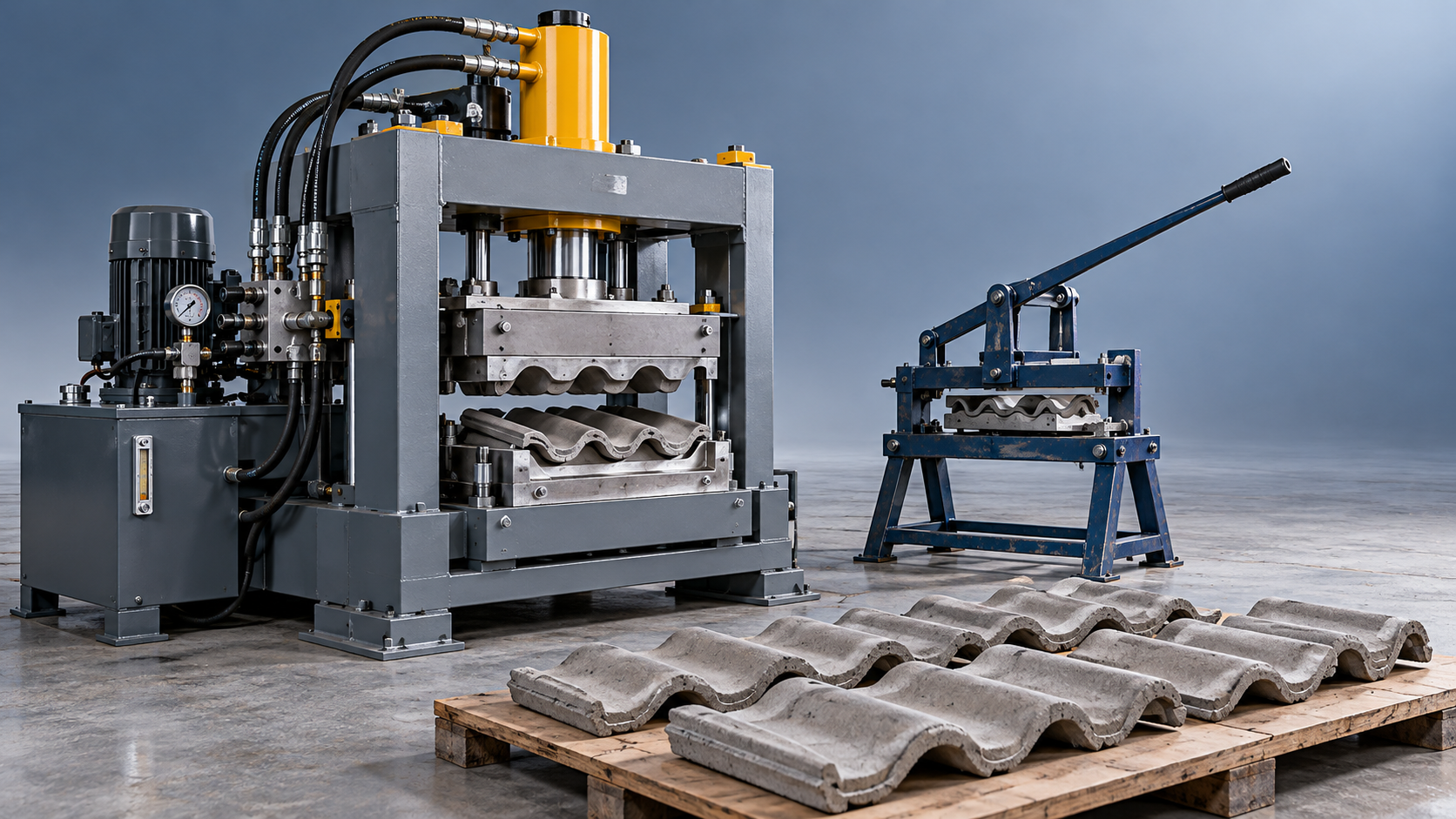
The equipment-selection question, “How does a hydraulic roof tile machine differ from manual pressing?”, concerns a different process, but it illustrates a useful purchasing principle: compare machinery by the production conditions and repeatability it must deliver. For AAC, a line described as suitable for both sand and fly ash still needs its preparation capacity and operating range checked against actual samples.
Preparation and storage
A sand route commonly needs a grinding system, slurry tanks, agitation, and controls for slurry density and fineness. A fly ash route may need enclosed dry storage and dust collection, or equipment for wet material receiving and conditioning. Coarse particles and agglomerates may require additional treatment.
Storage design should prevent uncontrolled blending of approved and unapproved deliveries. Slurry agitation must be adequate to limit settling, while batching calculations must account for the water already carried by wet feedstocks.
Casting, cutting, and curing
Changing the siliceous source can alter slurry viscosity, temperature response, expansion, and green-strength development. Dosing, mixing sequence, casting temperature, and pre-curing time may therefore need adjustment. Copying an existing recipe by mass alone can produce a different solids balance and reaction pattern.
Autoclave schedules also require confirmation rather than automatic transfer. A material change should not be used as a reason to increase pressure or temperature without engineering review. Autoclaves are pressure systems, and all operation must remain within approved equipment limits and procedures.
How should the two options be tested before investment?
Begin with representative sampling. A single bag of selected material cannot demonstrate the variability of a quarry or ash source. Establish the expected supply range before choosing equipment or setting a fixed recipe.
- Define the product: Set target density, strength, dimensions, and other required properties before comparing formulations.
- Characterize the feedstocks: Check chemistry, mineralogy where needed, particle-size distribution, moisture, and relevant contaminants. For sand, investigate grinding behavior; for fly ash, include variability and carbon-related indicators.
- Run controlled formulation trials: Record actual solids and water inputs, slurry behavior, expansion, pre-curing time, and cutting condition.
- Evaluate cured blocks: Compare results at equivalent target densities and document defects as well as average test values.
- Confirm production compatibility: Use suitably scaled trials to assess handling, dosing repeatability, preparation throughput, and the operating window before committing to full production.
A formulation with a narrow cutting window may be less practical than one with slightly higher material cost but more stable handling. Record whether acceptable results can be repeated across the expected raw-material variation, not just under one carefully controlled batch.
Which costs belong in the final comparison?
Use cost per saleable cubic metre as the decision basis. This connects raw-material choice to usable production instead of rewarding a cheap input that creates waste or reduces throughput.
Include delivered feedstock cost, unloading, storage, grinding or conditioning, power, wear parts, water management, binder consumption, steam demand, labor, testing, and rejected production. Account for moisture correctly: paying for a tonne of wet material is not the same as purchasing a tonne of dry solids.
Then test the economics against realistic changes. Consider longer transport distances, a replacement ash supplier, reduced mill throughput, or additional binder needed to maintain properties. Do not assume fly ash always requires less grinding or sand always requires more cement; those conclusions must come from the tested materials and formulations.
Can an AAC plant use both materials or switch later?
Blending sand and fly ash is possible where trials establish a workable formulation. It may help balance material properties or supply constraints, but it introduces additional dosing, storage, and quality-control requirements. The blend must be controlled on a dry-solids basis, including the water contributed by each feed.
Switching later is not necessarily a simple recipe change. A plant designed around dry fly ash may lack sufficient sand-grinding capacity; a sand-based plant may need different receiving and storage equipment for ash. Before buying a “convertible” line, request a defined equipment scope for each route, identify missing preparation equipment, and establish how each material will be qualified. That makes future flexibility an engineering provision rather than an assumption.
Next:No more content
Recommend
 Nov 01, 2026
Which Is Better for AAC Production: Sand or Fly Ash?
How does a hydraulic roof tile machine differ from manual pressing? Discover why process control matters, then compare sand vs. fly ash for AAC costs, quality, and equipment needs.
- Nov 01, 2026
How Does a Hydraulic Roof Tile Machine Differ From Manual Pressing?
Choosing color tile or concrete roof tile? Compare hydraulic and manual pressing for costs, consistency, and output to find the right setup for your production goals.
- Oct 31, 2026
Which Is More Durable: Color Tile or Concrete Roof Tile?
Which is more durable: color tile or concrete roof tile? Compare materials, weather resistance, and manufacturing quality to choose the right roofing with confidence.