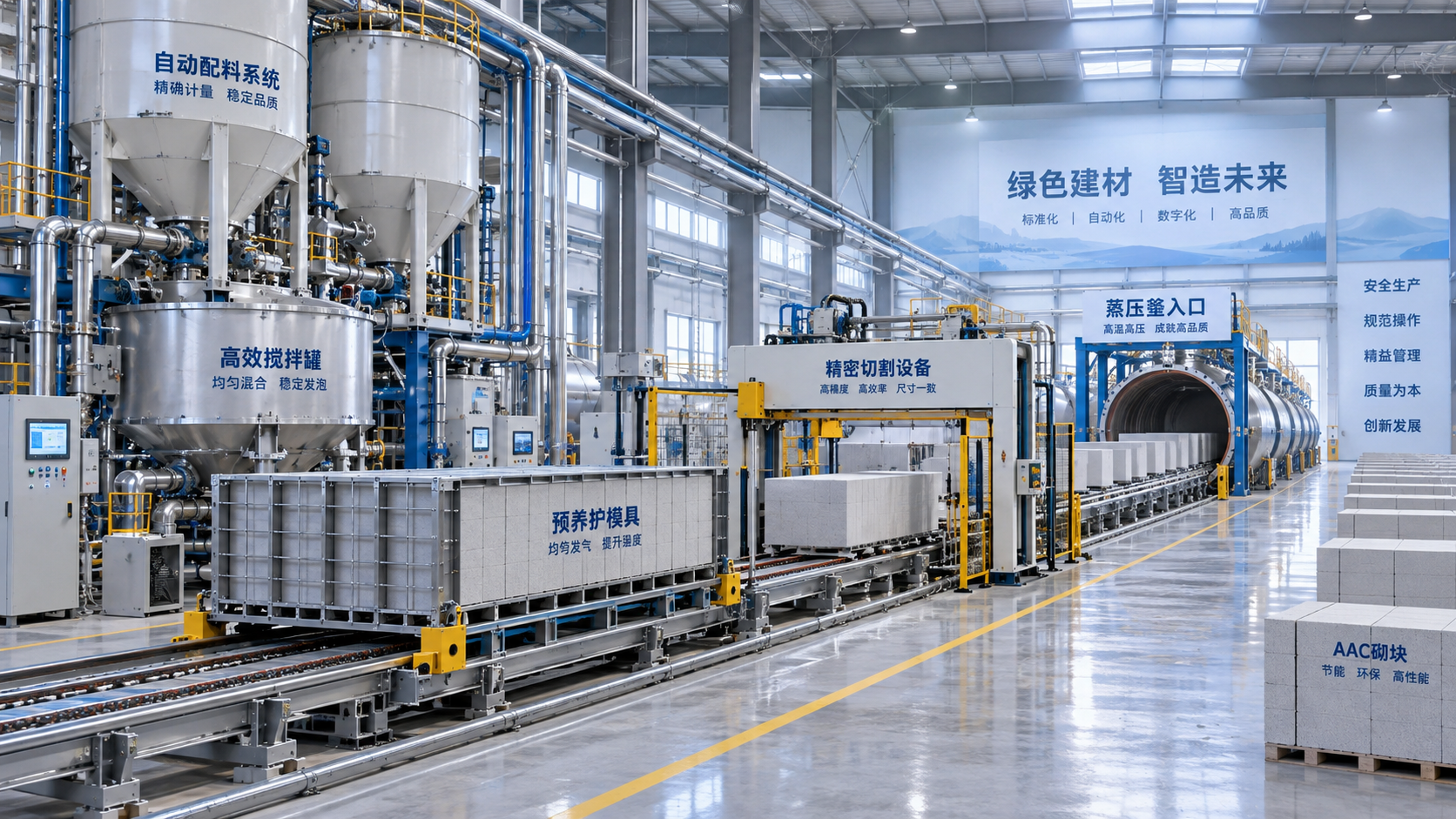
Does AAC Plant Installation Require Local Electrician Support?
Does AAC Plant Installation Require Local Electrician Support?
In most cases, yes. An AAC plant is not simply a group of machines that can be connected to power after mechanical assembly. It is an integrated production system involving crushing or raw-material preparation equipment, batching, mixing, mould handling, cutting lines, autoclave-related auxiliaries, conveyors, pumps, control panels, sensors, motors, safety circuits, and often site-wide distribution equipment. A qualified local electrician or electrical contractor is usually needed to connect that system safely, legally, and in a way that can be maintained after commissioning.
The equipment supplier remains central to the project. A supplier should provide the electrical drawings, load information, control logic documents, cable schedules where applicable, installation guidance, and commissioning support. But the supplier’s engineering documents do not replace local knowledge of utility conditions, wiring rules, permitting procedures, grounding practices, and inspection requirements. That is where local electrician support becomes practical rather than optional.
The short answer to “Does AAC plant installation require local electrician support?” is therefore: for a typical commercial aerated concrete block production project, it should be planned from the beginning. Waiting until the machinery arrives is one of the more expensive ways to discover that the site power arrangement is incomplete or incompatible.
Why an AAC Plant Needs More Than Basic Electrical Connection
AAC production equipment operates as a sequence. A mixer may need to receive material only after weighing is complete. A cutting machine must coordinate with mould movement. Pumps, hydraulic systems, conveyors, and transfer mechanisms may be interlocked to prevent collisions or unsafe operation. Emergency stops need to stop the right equipment without creating another hazard elsewhere in the line.
That means electrical installation is closely tied to process understanding. A local electrician does not need to redesign the supplier’s control system, and should not casually alter PLC programming or protection settings. However, the electrician is responsible for making the physical installation match the approved drawings and local electrical practice: incoming supply connection, switchgear installation, cable routing, motor connections, protective earthing, insulation testing, and verification of phase rotation before motors are started.
On a small standalone block machine, the electrical scope may be fairly contained. An AAC plant is different because the line is usually spread across several work zones. Power cables may run between raw material processing areas, batching sections, casting locations, cutting equipment, curing-related areas, finished-product handling, workshops, and control rooms. The distance, environment, and routing method all affect the installation.
Moisture, dust, vibration, heat, and vehicle traffic also matter. A cable route that looks acceptable on a layout drawing may need additional protection once forklifts, maintenance access, drainage channels, or structural supports are considered on site. This is one reason experienced local installers are valuable: they see the physical consequences of decisions that are not always visible in a general arrangement drawing.
What the Equipment Supplier Should Provide
The division of responsibility should be clear before installation begins. A capable AAC equipment manufacturer normally provides the machine-side electrical and automation information needed for correct integration. Depending on the agreed supply scope, this may include electrical schematics, control cabinet documentation, motor lists, recommended cable information, equipment layouts, connection points, operating instructions, and remote or on-site commissioning assistance.
Shandong Hongfa Scientific Industrial & Trading Co., Ltd. has been manufacturing building-material machinery since 1990, including aerated concrete block production lines, block machinery, concrete batching plants, and quartz stone machinery. For a manufacturer working across these types of industrial systems, electrical coordination is not an afterthought. The mechanical sequence, control panels, and site utility interfaces need to be considered together during project planning.
Hongfa’s stated quality approach—“1% product defects = 100% lack of trust”—is particularly relevant during installation. A well-built machine can still perform poorly if field cables are incorrectly terminated, grounding is incomplete, protection devices are selected improperly, or control wiring is exposed to damage. Factory quality control and site installation quality are connected, but they are not the same task.
Before materials are ordered locally, the project team should confirm exactly what is included with the equipment package. Some suppliers provide control cabinets and internal machine wiring but expect the customer to supply field cables, cable trays, main distribution panels, transformers, grounding materials, lighting, and utility-side work. Assumptions at this stage commonly lead to delays later.
What Local Electricians Typically Handle
A local electrical contractor is usually responsible for the work between the site’s power source and the equipment connection points, as well as the final field installation required by local rules. The exact scope varies by contract and jurisdiction, but it commonly includes the following:
- Reviewing the available utility supply against the plant’s required voltage, frequency, phase arrangement, and estimated connected load.
- Installing or coordinating the main incoming panel, transformer, disconnects, protective devices, and distribution boards.
- Routing, supporting, protecting, pulling, labeling, and terminating field power and control cables.
- Establishing the grounding and bonding system required for machinery, cabinets, metal structures, and other conductive parts.
- Checking motor rotation, insulation resistance, continuity, protective conductor connections, and basic electrical safety functions.
- Supporting local inspections, permits, utility approvals, and final energization procedures where required.
The electrical contractor should also be present when the supplier’s commissioning engineer is checking individual drives and process sections. This avoids a familiar and frustrating situation: the commissioning engineer identifies a field wiring issue, but the only person authorized to correct it is not on site. Small corrections can then consume days, especially if replacement cable glands, terminals, fuses, or protective devices are not readily available.
Local Standards Are Not a Detail
Electrical systems are governed by local requirements, and those requirements can differ substantially between countries, regions, industrial parks, and utility territories. Even where the supplied machinery is manufactured to recognized quality-management practices, the plant’s final connection must meet the rules that apply at the installation site.
The differences are not limited to voltage. They can involve conductor color identification, cable fire performance, enclosure ratings, short-circuit protection, disconnecting means, emergency-stop arrangements, lightning protection, earthing systems, panel clearance, inspection records, and who is legally allowed to perform the work. A local licensed professional can identify these requirements early and communicate them to the equipment supplier before fabrication or shipment where necessary.
Do not assume that “three-phase power is available” means the plant is ready for connection. The actual supply must be checked. Voltage stability, transformer capacity, prospective fault levels, cable run length, and the planned operation of other heavy equipment on the site can all affect system design. If a batching plant, crusher, compressor, or workshop shares the same supply, the electrical demand should be evaluated as a whole rather than machine by machine.
The Best Time to Involve the Electrician
Bring the electrical contractor into the project during civil and utility planning, not after the AAC equipment reaches the factory floor. This allows cable trenches, sleeves, embedded conduits, equipment foundations, control-room locations, and distribution-panel space to be planned before concrete is poured.
The earlier review is especially useful when equipment is being installed in an existing facility. Older buildings often have undocumented cable routes, limited panel capacity, inadequate grounding, or constrained spaces around switchgear. A site survey may reveal that the apparently convenient control-room location creates long cable runs or places sensitive electrical cabinets too close to dust, heat, or vibration.
A practical project sequence is to share the supplier’s preliminary layout and electrical load documents with the local electrician, then hold a technical review involving the owner, civil contractor, equipment supplier, and electrical contractor. The objective is not to create paperwork for its own sake. It is to identify what must be decided before construction makes changes difficult.
Common Mistakes That Create Commissioning Delays
The most common mistake is treating electrical work as a final connection task. By then, cable trays may be blocked, trenches may be too shallow or poorly drained, and panels may have been installed where doors cannot open safely. Another common problem is purchasing cable solely on price without confirming conductor size, insulation rating, environmental suitability, and compatibility with the installation method.
Phase sequence is a smaller issue, but it causes immediate trouble. Pumps, fans, conveyors, and hydraulic power units can rotate in the wrong direction if phases are not checked. This should be verified carefully before process equipment is allowed to operate under load. The same applies to sensor wiring and limit switches: a machine may appear mechanically complete while a single reversed or loose field connection prevents safe automatic operation.
Another avoidable error is allowing unauthorized modifications to control cabinets. Site personnel may try to bypass an interlock because a section is not yet ready, or replace a protective device with a larger one because it trips. Those decisions can mask the real fault and create a safety risk. Any change to the electrical design should be reviewed by the responsible technical team and documented.
Questions to Settle Before Equipment Arrives
- What are the confirmed site voltage, frequency, phase arrangement, and utility connection conditions?
- Who supplies the transformer, main switchgear, distribution panels, cables, cable trays, grounding materials, and installation labor?
- Where are the supplier’s battery limits: at the control cabinet, machine terminal box, main panel, or another defined point?
- Are cable trenches, conduits, supports, and drainage provisions included in the civil scope?
- What permits, inspections, and licensed-signoff requirements apply before energization?
- Will the local electrician be available during supplier-led commissioning and operator handover?
- Who will retain the final as-built drawings, panel schedules, cable labels, and maintenance records?
These questions may sound routine, but they separate a controlled installation from a project that relies on last-minute improvisation. In industrial plants, the last 10% of installation work often determines whether startup proceeds smoothly.
A Practical Division of Expertise
The strongest installation model is collaborative. The AAC plant supplier understands the equipment architecture, process sequence, control requirements, and commissioning logic. The local electrician understands the site supply, local codes, installation methods, inspection process, and service conditions. The owner or project manager keeps responsibilities, schedules, and scope boundaries clear.
For suppliers with broad manufacturing experience, such as Hongfa, detailed coordination documents can give the local team a reliable installation basis. Hongfa reports four production bases in Shandong and Guangxi, a technical workforce that includes senior engineers and technicians, and a long record in building-material machinery. That engineering depth is useful only when it is translated into a disciplined site installation plan and followed by competent local execution.
So, does AAC plant installation require local electrician support? For nearly every serious project, the answer is yes. Engage qualified local electrical support early, give that team the supplier’s latest documents, and make sure it remains available through energization and commissioning. That approach protects the equipment, supports compliance, and gives the plant a far better starting point for stable day-to-day operation.
Next:No more content
Recommend
 Oct 17, 2026
Does AAC Plant Installation Require Local Electrician Support?
Does AAC plant installation require local electrician support? Discover why local electrical expertise ensures safe connections, code compliance, and smooth commissioning.
- Oct 16, 2026
What Problems Commonly Occur During AAC Plant Commissioning?
What are common problems during AAC plant commissioning? Explore raw material variation, batching, cutting, steam, automation, and practical fixes for reliable startup.
- Oct 15, 2026
How Long Does AAC Plant Technical Training Usually Take?
How long does AAC plant technical training usually take? Discover realistic timelines, commissioning guidance, and key steps for safe, stable AAC production.