What Problems Commonly Occur During AAC Plant Commissioning?
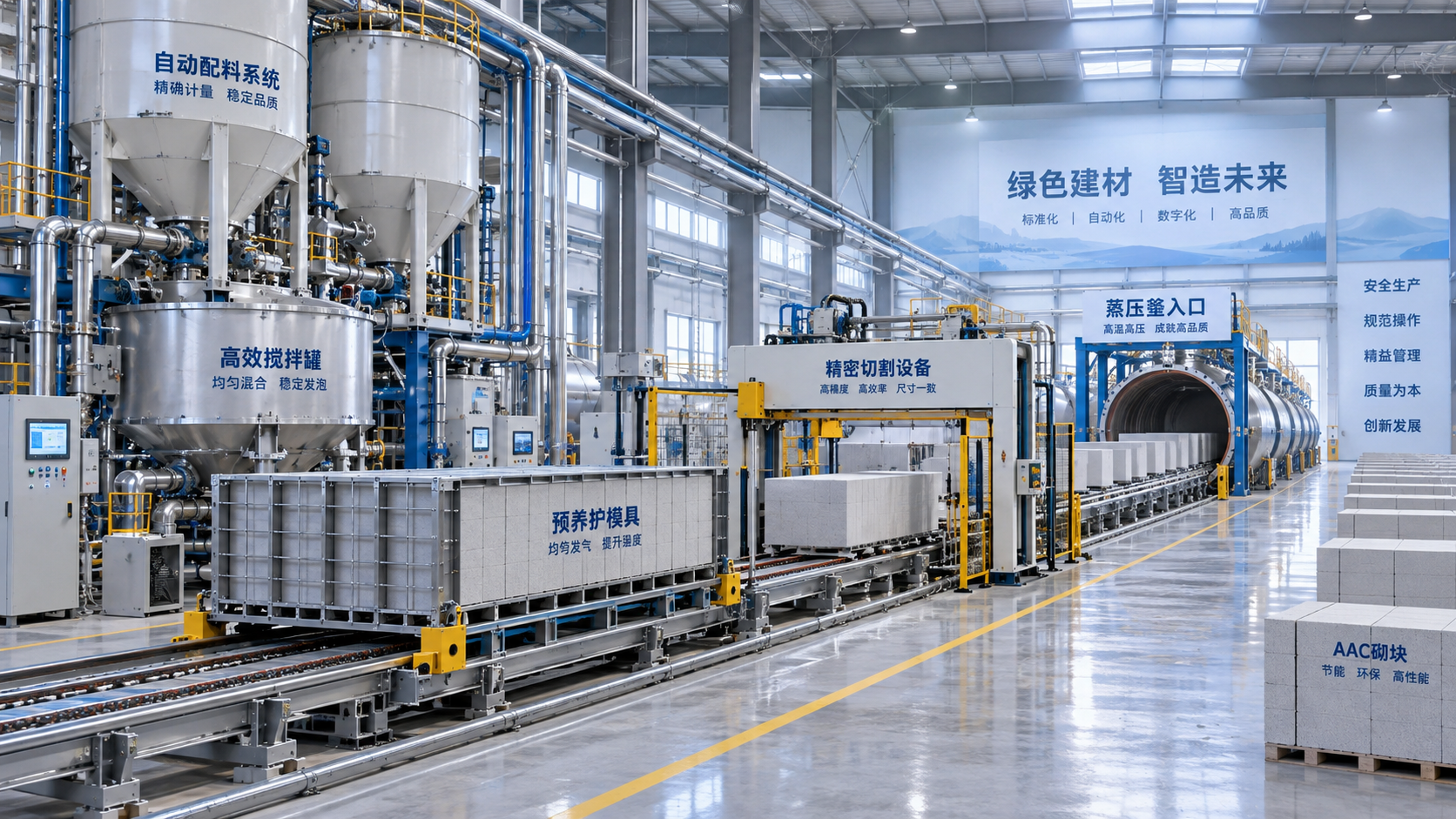
AAC plant commissioning rarely fails because of one dramatic equipment fault. More often, startup delays come from small mismatches that compound across the process: raw materials behave differently from the mix design, a cutting machine is mechanically sound but poorly referenced, steam is available but not delivered at a stable pressure, or the control system receives signals that do not reflect what is happening on the floor.
Those problems matter because AAC production is highly connected. A batching error can affect slurry flow; slurry behavior influences pre-curing and cutting; cutting quality affects autoclave loading and finished-block yield. Commissioning should therefore be treated as a process-validation period, not simply a test of whether each machine starts and stops.
Raw Material Variation Often Appears Before Mechanical Problems
An AAC line may be designed around a defined combination of silica material, lime, cement, gypsum, aluminum powder or paste, water, and, where used, recycled slurry. In operation, these inputs do not always arrive with identical moisture, fineness, chemical activity, temperature, or particle distribution. A formula that worked during trials can become unstable when production materials differ from the assumed values.
Sand or fly ash with changing moisture is a common example. If batching is based mainly on nominal weight without correcting for actual moisture, the effective water-to-solids ratio moves from batch to batch. The result may be inconsistent slurry density, poor mold filling, variable green-cake strength, or cracking during cutting. The issue can be mistaken for an autoclave or cutting fault when it began at material preparation.
Lime quality can create another difficult-to-diagnose problem. Variations in reactivity affect the timing and intensity of the slurry reaction. If gas generation and setting do not develop in the intended sequence, the green cake may rise unevenly, collapse, form large pores, or remain too soft for clean cutting. Aluminum dosage alone should not be adjusted repeatedly to compensate for an unstable reaction profile. The underlying material behavior needs to be checked first.
Before increasing production speed, the commissioning team should establish a practical baseline for each major input. This usually includes moisture control, slurry density checks, grinding performance where applicable, lime slaking behavior, and the consistency of aluminum addition. The purpose is not to create unnecessary laboratory work. It is to separate a material-related variation from an equipment-related fault before both are altered at the same time.
Batching Accuracy Is More Than a Scale Calibration Issue
Load cells can be calibrated correctly and still produce an unreliable batch. Material may bridge in a hopper, discharge incompletely, cling to wet conveyors, or continue flowing after a gate closes. Water meters may be accurate at steady flow but less reliable during short, repeated dosing cycles. Recycled slurry introduces another variable because its solids content can shift over time.
During commissioning, operators should compare the recipe entered in the control system with the actual mass and sequence delivered to the mixer. This includes small-dose materials, not only the major aggregates. A minor deviation in aluminum suspension preparation, for example, can have a disproportionate effect on pore formation and cake expansion.
Mixing time deserves similar attention. A longer mixing cycle does not automatically improve homogeneity. Depending on the material system and mixer design, excessive delay before casting can change the reaction stage reached by the slurry. Too little mixing, meanwhile, may leave density gradients or incomplete dispersion. The acceptable window must be confirmed against the actual casting and pre-curing behavior of the line.
- Verify empty and loaded scale readings, including repeatability over several batches.
- Check whether each hopper and feeder discharges fully and consistently.
- Measure actual water addition after allowing for material moisture and recycled slurry.
- Confirm that the control recipe matches the physical piping, valves, and feeder assignments.
- Record batch density, mixing time, casting time, and mold-fill observations together rather than as isolated values.
Green-Cake Instability Can Disrupt the Entire Downstream Line
The green cake is the most sensitive intermediate stage in AAC production. It must have enough strength to be demolded, transferred, and cut, while still remaining workable for wire cutting. Problems in this stage often show up as edge breakage, wire drag marks, deformation, surface tearing, uneven block dimensions, or a cake that sticks to the mold.
Commissioning teams sometimes focus on the cutting machine when these defects appear. The cutter may indeed require alignment or speed adjustment, but the condition of the cake must be assessed first. A cake that is under-cured, internally weak, or unevenly expanded cannot be corrected by tightening wires or slowing the cutting frame.
Pre-curing conditions are especially important. Temperature distribution in the pre-curing area, mold temperature, ambient conditions, and waiting time between casting and cutting all affect green-cake strength. A fixed dwell time is often less useful than observing whether the cake has reached a stable cutting condition. In a new plant, thermal behavior may also change as insulation, steam piping, and operating routines settle into normal use.
Mechanical alignment still matters. Mold cars, tilt equipment, cake transfer devices, side plates, and cutting frames must share a consistent reference. Even a small level difference or misaligned travel path can damage corners repeatedly. If defects occur in the same location on every cake, a mechanical reference problem is more likely than a random material fluctuation.
Symptoms That Should Not Be Treated as “Normal Startup Losses”
Some reject material is expected while a line is being tuned, but repeated defects should be traced rather than accepted as part of commissioning. Persistent diagonal cracks may indicate uneven expansion, handling stress, or inadequate cake strength. Repeated wire marks can point to wire tension, wire cleanliness, cutter synchronization, or a cake that has not reached the right state. Large dimensional variation may come from cutter positioning, mold distortion, shrinkage behavior, or inconsistent green density.
A useful approach is to inspect defects by location and timing: before demolding, after separation, after vertical cutting, after horizontal cutting, after autoclaving, and after packing. This narrows the search. Trying to correct every visible defect by changing the mix design usually extends the commissioning period.
Autoclave Performance Depends on Steam Quality, Loading, and Condensate Removal
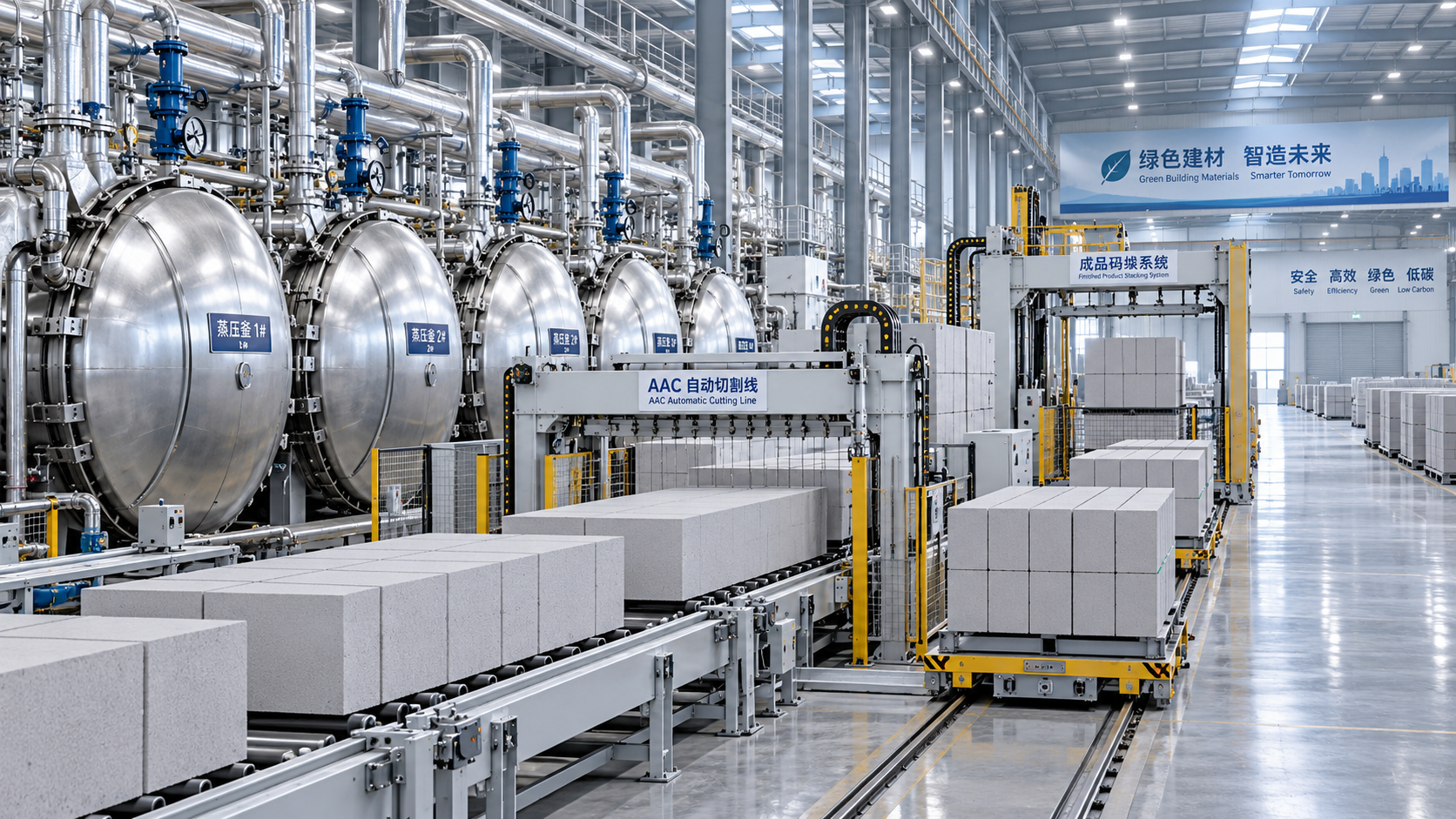
Autoclaving is often described simply as a pressure-and-temperature stage. In practice, stable curing depends on how steam reaches the autoclave, how condensate is removed, how loads are arranged, and how consistently the pressure cycle is controlled. A plant can have an autoclave with adequate design capacity and still produce uneven quality if steam distribution is poor.
Common commissioning concerns include slow pressure rise, unstable pressure holding, water accumulation in steam lines, leaking valves, faulty traps, and temperature differences between sections of an autoclave. These conditions can lengthen cycle time or create variations in finished strength, moisture, shrinkage, and surface appearance.
Autoclave loading should be examined early. The spacing between cakes or block packs affects steam access. Overloading may appear efficient on paper but can restrict circulation and make it harder to achieve even curing. Under some operating conditions, the first and last positions in a load may behave differently from the middle positions. This should be checked through a controlled commissioning routine rather than assumed from the loading plan.
Steam supply also needs to be evaluated as a plant-wide utility, not only at the autoclave inlet. Pressure may drop when other users start, condensate may return poorly, or a boiler may struggle to maintain the required profile during repeated cycles. The control system should show enough information for operators to distinguish a boiler-side limitation from a valve, piping, or autoclave issue.
Automation Problems Usually Come From Interfaces, Not the PLC Alone
AAC plants combine batching, slurry preparation, casting, conveying, cutting, autoclaving, unloading, and packing. Each section may operate correctly in manual mode while the full line fails in automatic operation. The usual cause is an incomplete interface: a sensor has the wrong status logic, a conveyor has no confirmed “clear” signal, an upstream machine releases material before downstream equipment is ready, or an interlock is bypassed during testing and never restored.
Signal naming and alarm messages can become a practical operating problem. If a fault screen tells an operator only that a sequence has stopped, troubleshooting becomes slow. The commissioning phase is the right time to make alarms meaningful: identify the device, state the failed condition, and show whether the issue is a permissive, a safety interlock, a communication loss, or a process deviation.
Manual operation should not be removed too early. It is useful for checking motion direction, sensor response, valve actuation, and maintenance access. But a plant should not be considered commissioned merely because individual devices run manually. Automatic sequences must be tested through normal starts, stops, empty conditions, delayed material arrival, and controlled recovery after a fault.
Particular attention should be given to transfer points. Mold handling, cake movement, cutting transfer, autoclave loading, and unloading involve equipment that must coordinate position, timing, and safety status. A minor delay in one sensor can cause repeated interruptions across the line. Mechanical observation and control-system trend data should be reviewed together; neither view alone is sufficient.
Utility Systems Are Commonly Underestimated During Startup
Compressed air, electrical supply, water quality, drainage, lubrication, and ventilation may be treated as supporting services, but they directly affect commissioning results. Low or fluctuating air pressure can cause slow pneumatic actuators and unreliable valve movement. Inadequate drainage can create wet work areas and interfere with slurry handling. Poor water consistency can affect slurry preparation and aluminum suspension behavior.
Electrical issues are often intermittent. A motor may run without load but trip during normal acceleration. Variable-frequency drives may require tuning to suit conveyor inertia or cutting motion. Incorrect phase rotation, loose terminals, poor grounding, and insufficient protection coordination can produce faults that resemble mechanical problems. Commissioning records should capture the operating state when a trip occurs, rather than only the final alarm code.
Lubrication and maintenance access should also be verified before sustained production. A line that can operate for several hours is not necessarily ready for regular shifts if wire replacement, cleaning, inspection, and lubrication require unsafe or excessively time-consuming work. These details influence availability long after the commissioning team leaves.
A Better Commissioning Sequence Reduces Unnecessary Rework
The most reliable sequence is generally to validate the plant in layers. Start with installation checks, equipment alignment, and utility readiness. Run individual machines and safety devices. Confirm material preparation and batch repeatability. Produce green cakes at a controlled pace, then verify cutting, autoclaving, unloading, and packing as connected stages. Only after stable product quality is achieved should the line be pushed toward its intended operating rate.
Changing many variables at once is one of the costliest commissioning habits. When a batch formula, pre-curing time, cutter setting, steam profile, and conveyor speed are all adjusted together, there is no clear basis for deciding which change helped or caused a new defect. A disciplined log of settings, material condition, observed defects, alarms, and corrective actions is more valuable than a large volume of undocumented trial production.
For plant owners, the central question is not whether the equipment can produce AAC blocks during the first successful run. It is whether the line can repeat that result with normal raw-material variation, stable utility demand, safe automatic operation, and a product quality level that remains controllable from shift to shift. Commissioning is complete when those conditions are understood and managed, not when the first blocks leave the autoclave.
Next:No more content
Recommend
 Oct 16, 2026
What Problems Commonly Occur During AAC Plant Commissioning?
What are common problems during AAC plant commissioning? Explore raw material variation, batching, cutting, steam, automation, and practical fixes for reliable startup.
- Oct 15, 2026
How Long Does AAC Plant Technical Training Usually Take?
How long does AAC plant technical training usually take? Discover realistic timelines, commissioning guidance, and key steps for safe, stable AAC production.
- Oct 14, 2026
What Should an AAC Factory Planning Report Include?
What should be included in an AAC factory planning report? Explore market demand, capacity, site, raw materials, utilities, costs, compliance, and implementation essentials.