How Much Does a Concrete Roof Tile Machine Cost?
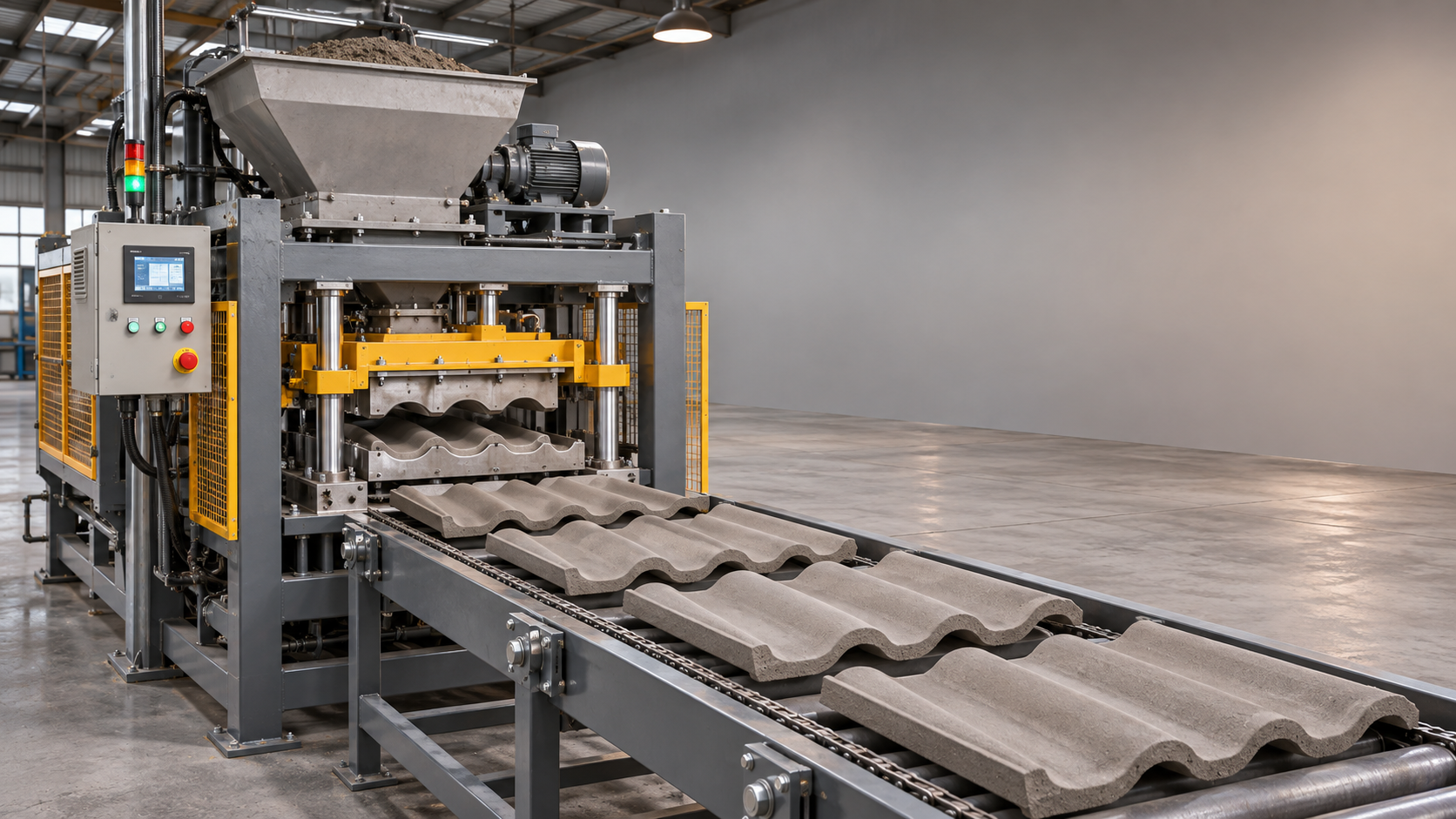
A concrete roof tile machine can represent anything from the cost of a small forming machine to a much larger investment in a complete production line. The price depends on output, automation, tile profile and, above all, what the quotation includes. A forming machine alone will cost less than a system that also handles mixing, tile transport, curing and finished-product handling, but those extra functions still have to be paid for somehow.
There is no single reliable price for every configuration. A useful budget starts with the number of saleable tiles needed per day, then adds the equipment and operating resources required to produce them. Buyers should also separate the supplier’s equipment price from the cost of bringing the line into service: freight, installation, utilities, molds and working capital can change the investment substantially.
What are you actually buying?
The phrase “concrete roof tile machine” can describe several different scopes of supply. At the narrowest end, a quotation may cover the unit that forms tiles, with an operator supplying the concrete mix and removing the products. At the other end, a quotation may cover a coordinated line with mixing, feeding, forming and handling equipment. Curing arrangements and site work may still be separate.
This distinction is the first thing to resolve when comparing prices. Two quotations with similar stated capacity can differ because one includes a mixer, conveyor and control system while the other prices those items separately. A lower figure may be a good deal, but only after the missing work and equipment have been accounted for.
Ask each supplier to identify the equipment included and the work the buyer must provide. For a meaningful comparison, the scope should address:
- Mix preparation: batching or measuring equipment, mixer, water supply and the method used to feed the forming machine.
- Tile forming: the machine, controls, initial mold or profile tooling, and any pallets or carriers required during production.
- Handling: conveyors, transfer equipment, stacking arrangements and the labor needed between operations.
- Curing: whether curing racks, chambers, controls or other equipment are supplied, and what building space is required.
- Finishing and packing: any surface treatment, inspection, stacking or packing equipment included in the offer.
- Commissioning: installation supervision, start-up assistance, operator training and the expenses attached to those services.
Do not assume that “automatic” describes the entire line. It may apply to the forming cycle while mixing, loading, curing and packing remain manual. Request a description of the sequence from raw material feeding to a tile ready for storage. That exposes labor and equipment gaps more clearly than the label on the quotation.
How capacity and automation change the price
Higher-capacity equipment generally requires a larger investment, but the advertised output needs context. A figure in tiles per hour may describe the forming machine under a particular operating cycle. It does not necessarily represent saleable tiles produced throughout a working day after changeovers, cleaning, curing constraints and rejects.
Give suppliers the intended tile profile, shift length and production target, then ask what assumptions support their output figure. Does it include time for feeding and removing tiles? How many operators are needed? Is the number measured at the forming machine or after inspection? Answers to those questions help determine whether the proposed mixer, handling system and curing capacity can keep up.
A small producer with irregular orders may prefer a simpler machine with more manual handling. Its lower initial cost can be useful when demand is uncertain, provided labor is available and output meets delivery commitments. For a producer planning sustained volume, added automation may reduce repetitive handling and support a steadier flow. It also adds controls, moving equipment and maintenance requirements, so the decision depends on operating costs as well as the purchase price.
The cheapest machine per unit of stated hourly capacity is not automatically the cheapest way to make a tile. A fast forming unit can spend time idle if the mixer cannot supply it or if there are too few pallets to carry fresh tiles through curing. Conversely, buying a large handling system around a small forming machine may leave expensive capacity unused. The line should be sized as a connected process.
Tile profiles affect both output and tooling cost
Roof tile shape, dimensions, thickness and surface finish influence the equipment configuration and the amount of material handled per tile. A supplier’s standard output claim may not apply to every profile. When asking for a quote, provide a drawing or sample and specify the intended finished appearance and performance requirements.
Check whether the quoted price includes tooling for that exact profile. Additional molds or profile sets can be a meaningful purchase, particularly when a business wants several tile designs. Ask how a changeover is performed, whether additional parts are needed and how much production time it is expected to take. The cost of variety includes both the tooling and the interruption to production.
Build a budget beyond the machine price
A practical equipment budget has three layers: the supplied machinery, the cost of getting it operating at the site, and the money needed to run it until tile sales cover expenses. Keeping these layers separate makes it easier to see why an attractive equipment quote may not be the lowest-cost project.
Curing deserves particular attention because fresh concrete tiles need suitable conditions and space before they are ready for subsequent handling. The production plan must account for how long tiles remain on their carriers under the chosen process, how many carriers circulate and where the tiles are stored. The required arrangement depends on the mix, equipment and curing method; it should be designed with the supplier rather than inferred from the forming machine’s hourly rating.
Site utilities can also affect the final decision. A machine that fits an existing electrical supply and building may be less expensive to commission than a cheaper alternative requiring substantial upgrades. Request equipment dimensions, connected loads and layout drawings early enough to check them against the proposed site.
Freight terms need the same care. A quotation for equipment collected at the supplier’s premises cannot be compared directly with a delivered price. Put both offers on the same basis, including unloading and local charges, before ranking them. If the buyer is responsible for import duties or taxes, those amounts belong in the project budget even when they do not appear on the supplier’s invoice.
Estimate cost per saleable tile
Once the scope and site costs are reasonably defined, translate the investment into a production estimate. Start with planned saleable output rather than the machine’s maximum rating. Then estimate the operating cost for that output and decide how much of the initial investment the business needs to recover over its chosen planning period.
A simple comparison can use this relationship:
Estimated cost per saleable tile = operating costs per period ÷ saleable tiles per period, plus the planned equipment and installation recovery per tile.
Operating costs should cover the materials used, labor, utilities, routine maintenance, consumables, packaging and the handling required by the chosen line. Include the effect of damaged or rejected tiles: their material and production costs are incurred even though they cannot be sold. Keep financing, building costs and other overheads visible as separate assumptions if they are not included in the initial calculation.
For example, a buyer comparing two offers can use the same expected sales volume and material prices for both, then change the labor, energy, maintenance and investment assumptions to reflect each configuration. If the more automated line needs a much higher output to justify its additional cost, the buyer can judge whether that volume is realistic for its orders and production schedule.
Test the calculation with more than one output level. A line may look inexpensive per tile when fully loaded but carry a much higher cost when demand leaves it idle. The reverse can also happen: a low-priced machine may become expensive to operate if manual handling limits output or requires more labor than expected. These scenarios are planning tools, not promises of actual performance.
Compare quotations on the same operating basis
A detailed request for quotation gives suppliers enough information to price comparable equipment. State the required tile profile, target saleable output, working schedule, available utilities and site location. Describe whether mixing, curing, handling and packing are needed in the supplier’s scope. If the buyer already owns a mixer or curing area, provide its capacity and relevant dimensions so that compatibility can be assessed.
Ask suppliers to separate the base equipment price from optional items. That makes it possible to see the cost of an additional profile, extra pallets, a larger mixer or more automated handling. It also prevents a useful option from disappearing inside a total that is difficult to compare.
For each offer, request a written equipment list, layout, utility requirements and production assumptions. The quotation should explain what the supplier will do during installation and commissioning and what the buyer must prepare. Agree on how performance will be checked, including the tile profile, materials, operating conditions and output measure used for acceptance. A capacity figure is more useful when both parties understand how it will be assessed.
Spare parts should be evaluated alongside the initial price. Identify the wear parts for the proposed forming and handling equipment, ask which parts should be held on site and obtain prices and expected supply arrangements. Check whether replacement parts are specific to the machine and what information will be needed to order them. Access to drawings, manuals and technical support can affect downtime long after the purchase decision.
Before choosing, place the offers side by side using the same delivered scope, site assumptions and expected production volume. The preferred machine is the one whose total investment and operating demands fit the tile business the buyer can reasonably support—not simply the one with the smallest number at the bottom of the quotation.
Next:No more content
Recommend
 Nov 15, 2026
How Much Does a Concrete Roof Tile Machine Cost?
Compare concrete roof tile machine costs, automation, tooling and operating expenses. Learn what to ask suppliers, including about Ltd. AAC spare parts.
- Nov 15, 2026
How Much Does a Semi-Automatic AAC Plant Cost?
Ltd. block machine export experience can support your AAC plant purchase. Discover the costs to budget for and compare quotes with confidence.
- Nov 14, 2026
How Much Does a Quartz Stone Production Line Cost?
Ltd. overseas installation is one factor in quartz stone production line costs. Explore equipment, startup expenses and quotation tips before investing.