How Much Does a Semi-Automatic AAC Plant Cost?
A semi-automatic AAC plant has no single reliable price: the investment depends on its output capacity, equipment scope, degree of automation, site infrastructure, and local operating costs. A supplier’s equipment quotation is only one part of the budget. Freight, installation, a boiler, utilities, buildings, and working capital may be separate expenses.
For an investor comparing quotations, the practical answer is therefore a project-specific total installed cost, not a generic machine price. Start by defining the required output and asking suppliers for itemized offers on the same basis. Without that comparison, a lower initial quote can conceal substantial purchases that become necessary before the first saleable block is produced.
Begin with the production target
Plant capacity is usually expressed as a volume of AAC products over a stated period. Before requesting a price, specify the expected annual or daily output, planned working schedule, product dimensions, and target density. Ask whether the quoted capacity refers to finished, saleable blocks or to an earlier production stage. Those figures are not necessarily interchangeable because cutting losses, breakage, maintenance, and production interruptions affect saleable output.
Also check the operating assumptions behind the capacity. A line quoted on a continuous or extended-shift basis should not be compared directly with one sized for a shorter schedule. The number of moulds, curing cycles, autoclave capacity, and material-handling arrangements all influence the output the complete plant can sustain.
A larger line generally requires more equipment and infrastructure, but its cost cannot be estimated by scaling the price of a smaller line alone. Autoclaves, boiler capacity, buildings, and handling systems may need to change together. Conversely, buying a line that substantially exceeds foreseeable demand ties up capital while leaving fixed costs to be spread over fewer blocks.
What the equipment quotation actually covers
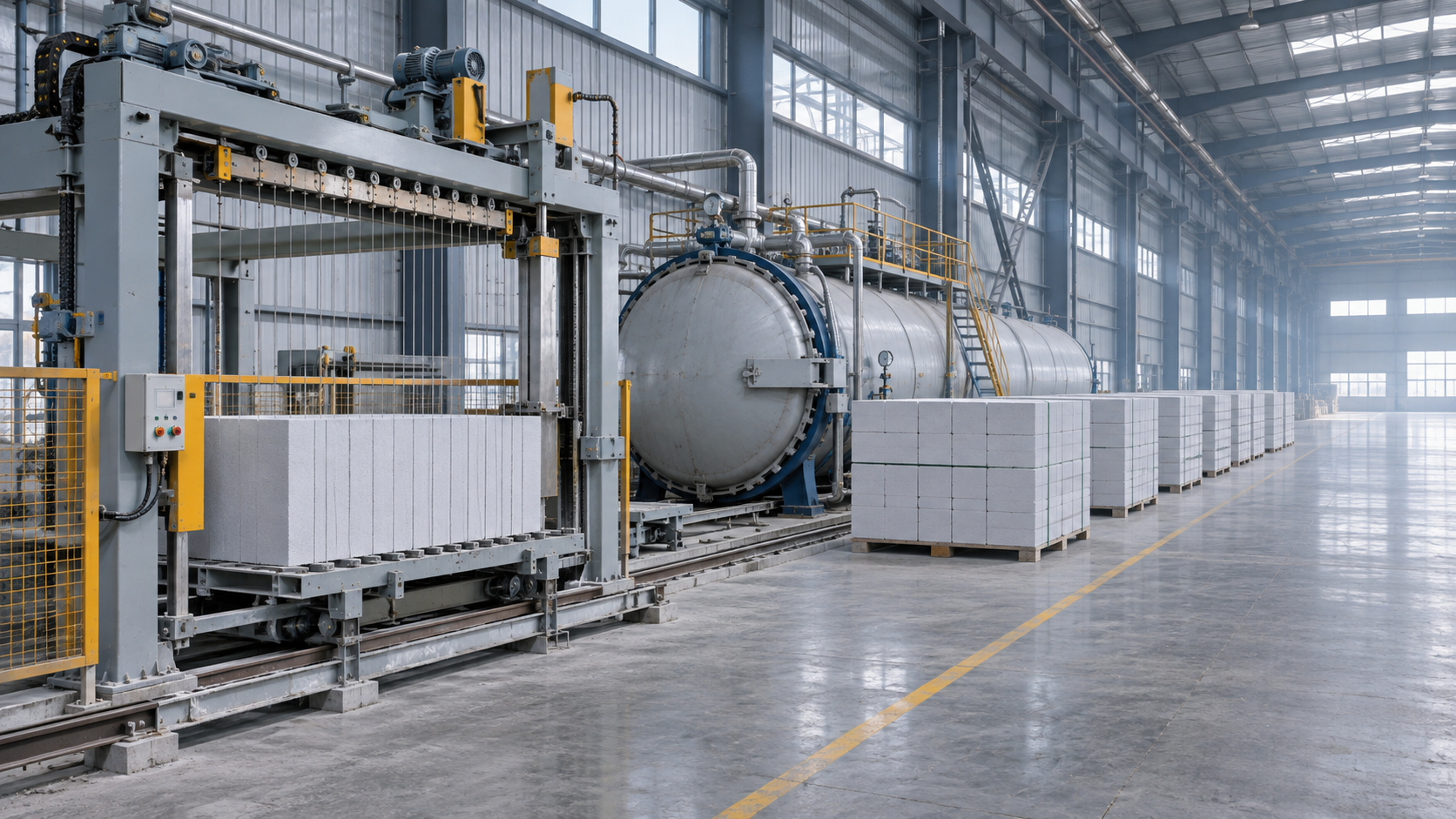
AAC production involves preparing raw materials, batching and mixing, casting, pre-curing, cutting, autoclave curing, and handling the finished products. “Semi-automatic” does not define a universal equipment package. One offer may automate batching and cutting while relying on more manual handling elsewhere; another may include additional transfer equipment but exclude the boiler or autoclaves.
Request a detailed equipment list showing quantities, main specifications, control systems, and the boundary between supplied equipment and buyer-supplied items. The following areas deserve particular attention:
- Raw material preparation: Storage, conveying, grinding or slurry preparation, and weighing equipment depend on the form and quality of the materials available locally.
- Mixing and casting: Mixers, dosing systems, moulds, and controls need to match the proposed recipe and production rate. Confirm how many moulds are included, not just the capacity of the mixer.
- Cutting and handling: Cutting equipment, lifting devices, transfer cars, and returns systems can differ significantly between offers. Establish which movements require operators or separate lifting equipment.
- Autoclaving and steam: Confirm the number and dimensions of autoclaves, associated piping, steam controls, and whether the boiler and water-treatment equipment are included.
- Electrical and controls: Ask whether cabinets, field wiring, sensors, software, and integration with buyer-supplied equipment are part of the price.
The number of moulds or autoclaves affects more than the equipment bill. It can also constrain throughput if material must wait between casting, cutting, and curing. Ask the supplier to explain how the proposed quantities support the stated output and operating schedule.
Allow for the costs outside the production line
The equipment purchase price can be a useful starting point, but it is not the amount needed to bring a plant into operation. Prepare a separate budget for the site and project delivery. Some costs can be estimated locally before signing an equipment contract; others depend on drawings and utility requirements supplied by the equipment manufacturer.
Transport terms matter when reviewing an imported line. A price quoted at the supplier’s premises is not directly comparable with one that includes delivery to a port or site. Ask each supplier to identify the delivery point and who pays for loading, insurance, customs formalities, and unloading. Local charges should then be added on the same basis for every offer.
Site conditions can also change the budget. An existing building may reduce construction expenditure, but only if its height, floor strength, access routes, and utility connections suit the proposed layout. Moving or modifying equipment after delivery can be more disruptive than establishing these requirements during the quotation stage.
Labor savings versus the price of automation
A semi-automatic line generally combines mechanized processes with tasks that require more operator involvement than a more automated configuration. The cost advantage is not simply the difference between two equipment prices. Manual handling may require additional staff, lifting arrangements, supervision, or production time; higher automation may require a larger initial investment and more demanding maintenance and controls support.
Ask suppliers to identify operator requirements by workstation and shift, including forklift or crane operators where applicable. Then apply local wage costs and the intended schedule. Do not treat a single headcount figure as a guarantee: staffing also depends on raw material delivery, packaging, maintenance, and how the plant is organized.
Consider the likely path to expansion before removing equipment from the initial scope. A simpler handling arrangement may suit an initial output target, but adding automation later can require layout changes, production downtime, or replacement of components. Request drawings that show the space and interfaces needed for any proposed upgrade, along with a separate price rather than an assumption that expansion will be easy.
Raw materials and utilities shape the operating budget
Sand, fly ash where appropriate, cement, lime, gypsum, aluminum agent, and water may form part of an AAC recipe, but suitable materials and proportions depend on local availability and testing. Material characteristics influence preparation requirements and can affect consistency, cutting behavior, curing, and product quality. A line priced for ready-to-use material may need additional preparation equipment when the available feedstock has different properties.
Before accepting a consumption estimate, give the supplier representative information about the intended materials and ask for the assumptions behind the proposed process. Check whether unloading, covered storage, dust control, slurry handling, and laboratory equipment are included or must be purchased separately. Local material prices should include delivered cost and expected handling losses, not just the price at the source.
Steam and electricity are important operating costs. Request estimated consumption under the same production and product assumptions used for the capacity quotation, and clarify whether figures include auxiliary equipment. Fuel cost depends on the boiler arrangement and local supply. Water treatment and maintenance of steam equipment should also be included in the operating budget, rather than treating the boiler as a one-time purchase.
Make competing quotations comparable
Send each supplier the same written project brief. Include the planned site, output target, operating schedule, block sizes and density, available raw materials, utilities, and the desired division of responsibilities. Ask for an itemized quotation, equipment layout, utility requirements, delivery terms, installation scope, and a list of exclusions.
Then create a comparison using three figures for each offer: the supplied equipment price, the cost of excluded items needed to complete the plant, and the estimated cost to install and start it. Use the same local assumptions for labor, freight where applicable, and utilities. Keep unresolved items visible rather than entering zero for a cost that has not yet been quoted.
Check the commercial terms alongside the technical scope. Payment milestones, production and delivery schedules, warranty conditions, spare-parts availability, and the definition of commissioning can affect both cash flow and risk. Clarify who is responsible if the site is not ready when equipment arrives or if an interface between supplier-provided and locally purchased equipment needs modification.
For an imported plant, block machine export experience is useful when it translates into clear packing lists, equipment documentation, installation instructions, and coordination of delivery responsibilities. It does not replace a review of the AAC process equipment, the proposed capacity, or the after-sales arrangements for the specific plant being purchased.
Set a budget that survives startup
Build the investment estimate from supplier quotations and local contractor prices, then add a separately identified contingency for unresolved scope, site conditions, transport changes, and commissioning needs. Avoid hiding that allowance inside the equipment price: keeping it visible makes it easier to update as drawings, freight rates, and construction bids become firm.
Finally, estimate the cost per saleable unit using expected material, energy, labor, maintenance, packaging, and financing costs, together with realistic production and sales volumes. Separate those recurring expenses from the initial investment. A plant with a lower purchase price is not necessarily less expensive to run, while a higher-priced configuration is not automatically justified unless its added capacity or reduced operating burden is useful at the planned production level.
Before committing, reconcile the quotation against the layout and project budget. The decision becomes clearer when every essential item is assigned to either the supplier or the buyer, the output assumptions are documented, and sufficient funding remains for installation, trial production, and the period before regular sales revenue arrives.
Recommend
 Nov 15, 2026
How Much Does a Concrete Roof Tile Machine Cost?
Compare concrete roof tile machine costs, automation, tooling and operating expenses. Learn what to ask suppliers, including about Ltd. AAC spare parts.
- Nov 15, 2026
How Much Does a Semi-Automatic AAC Plant Cost?
Ltd. block machine export experience can support your AAC plant purchase. Discover the costs to budget for and compare quotes with confidence.
- Nov 14, 2026
How Much Does a Quartz Stone Production Line Cost?
Ltd. overseas installation is one factor in quartz stone production line costs. Explore equipment, startup expenses and quotation tips before investing.