How Much Does a Concrete Roof Tile Machine Cost?
A concrete roof tile machine can cost anywhere from a modest equipment investment for a manually assisted setup to a substantial capital project for an automated production line. There is no single dependable price range without specifying capacity, tile profile, production method and what the quotation includes. A price for a forming machine alone is not comparable with one for a complete line ready to produce, cure and handle finished tiles.
The most useful budget is therefore built in two layers: the cost of the equipment package and the additional spending required to make saleable tiles at the intended production rate. Molds, pallets or carriers, curing arrangements, installation, utilities and freight can materially change the final investment.
What does the quoted machine price include?
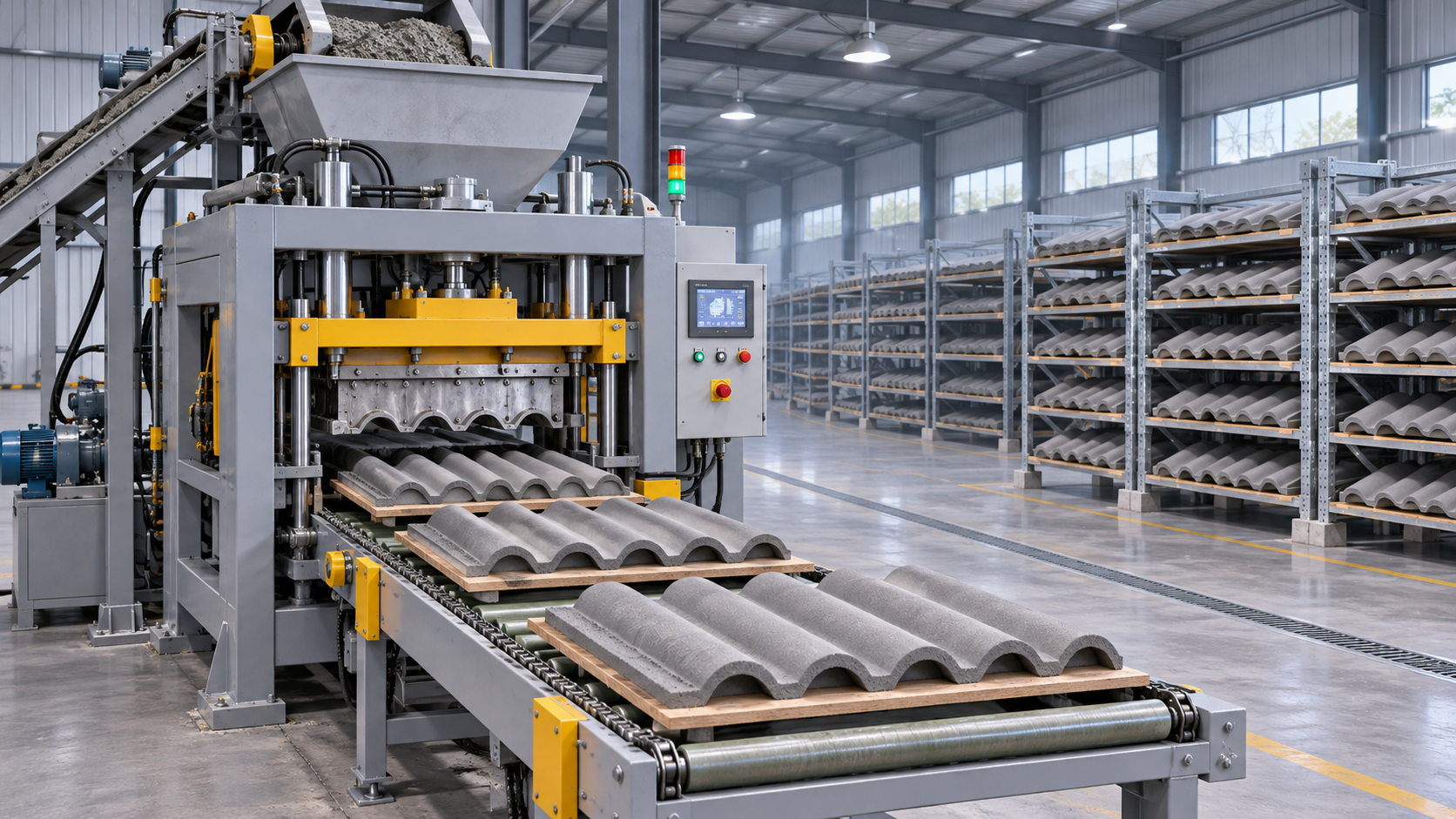
A concrete roof tile production system can include material dosing and mixing, tile forming, mold or pallet circulation, curing, demolding, surface finishing and stacking. A supplier may quote only the forming unit, while another includes several of these operations under the description “roof tile machine.”
Before comparing prices, ask for an itemized equipment list and a process flow showing where the supplier’s scope begins and ends. In particular, establish whether the offer covers:
- The forming machine and its control system.
- Mixing, batching and material-feeding equipment.
- Tile molds, pallets or carriers, and the quantity supplied.
- Curing racks, chambers or other handling arrangements.
- Demolding, coating, stacking and packaging equipment, where applicable.
- Installation supervision, commissioning, operator training and initial spare parts.
Not every production method uses the same equipment configuration. For example, the number and type of carriers depend on how tiles are formed, handled and cured. The important point is to identify every step between raw materials and a finished tile, then assign a cost to each step—even when the buyer plans to provide it independently.
A low initial quote may still represent a competitive purchase, but only if its exclusions are understood. A separate mixer, additional carriers or a curing area can turn an apparently inexpensive machine into a larger project than expected.
Why capacity changes the price—and how to compare it
Higher output generally requires more than a faster forming machine. Mixing and material delivery must keep pace, and the line needs sufficient handling and curing capacity to prevent a buildup of fresh tiles. A capacity increase can therefore affect equipment, floor space, power demand, labor arrangements and inventory of molds or carriers.
Suppliers may express output as tiles per hour, tiles per shift or tiles per day. These figures are not automatically comparable. Ask whether the quoted rate is theoretical machine speed or expected production under stated operating conditions. The tile profile, operator staffing, changeovers, cleaning and stoppages can all affect the number of acceptable tiles produced.
Also check whether output refers to formed tiles or finished, saleable tiles. Rejects and breakage reduce the latter figure. A machine rated at a higher theoretical speed is not necessarily the better purchase if the rest of the process cannot support that speed or if the planned sales volume does not require it.
For budgeting, convert each offer to a common basis: the same tile profile, operating hours and definition of output. Then ask the supplier to identify which connected equipment is included at that rate. If a quote lists the forming machine at full speed but leaves mixing and curing to the buyer, the buyer must size and price those operations separately.
Manual, semi-automatic or automatic: what are you paying for?
Automation affects both the purchase price and the way the production line is staffed. A manually assisted arrangement can reduce initial equipment spending, but it may require more handling between forming, curing and stacking. A more automated line can reduce some repetitive handling, while adding conveyors, controls, sensors and maintenance requirements.
The choice depends on the cost and availability of labor, the required production schedule and the ability to maintain the equipment. Automation is not automatically the lowest-cost option per tile: a line running well below its capacity still carries the cost of its larger investment, and an idle conveyor or handling system does not recover its purchase price.
Request a labor estimate tied to the quoted configuration. It should state which operations are automatic and which still need manual loading, inspection, cleaning or packing. Terms such as “fully automatic” are not precise enough to establish whether a line can operate with the proposed staffing.
Molds, profiles and curing capacity can reshape the budget
The tile profile determines more than appearance. It affects mold or pallet design, material consumption, handling and compatibility with accessory pieces. A quotation should specify the profile, dimensions and number of mold sets included, as well as the price and lead time for additional sets.
Changing profiles may involve more than exchanging a mold. Guides, cutters, coating settings or handling components may also need adjustment or replacement. Ask how long a changeover takes, which components must be changed and whether the quoted output applies to every intended profile.
Consider accessory tiles separately. Ridge tiles, verge tiles and other fittings may require different molds or equipment. If the commercial plan depends on selling a complete roof system, confirm whether the quoted line can make those items or whether they will be purchased elsewhere.
Curing is another cost that can be underestimated. Fresh concrete tiles need sufficient time and appropriate conditions to develop the properties required for subsequent handling and use. Depending on the process, this can tie up carriers, racks and floor space. A faster forming machine does not eliminate that requirement; it can increase the number of tiles that must be held in the system at one time.
Ask the supplier for a carrier and rack calculation based on the proposed production schedule and curing method. The calculation should identify its assumptions, including holding time and any allowance for handling. Confirm whether the required quantities are included in the quotation. Insufficient carriers can restrict output even when the forming machine itself is capable of more.
Costs beyond the equipment invoice
The machine price is only one part of the amount needed to start production. The location, shipping terms and existing facilities determine how much must be added. A project budget should consider the following costs separately rather than applying an assumed percentage to the equipment price.
Shipping terms deserve particular attention in cross-border purchases. A price that covers delivery to a port is not the same as a price covering delivery to the factory, unloading and installation. The quotation and contract should state the delivery point and the division of responsibilities clearly.
Commissioning should also have a defined scope. A machine can be mechanically installed but not yet producing acceptable tiles at the agreed rate. Specify the operating conditions, materials, personnel and utilities needed for a production demonstration, along with the procedure for addressing results that do not meet the agreed acceptance criteria.
How to estimate the cost per saleable tile
The purchase price becomes more meaningful when it is related to expected output over the equipment’s useful life. An estimate can combine annualized equipment and installation costs with operating expenses, then divide the total by the number of saleable tiles expected in the same period:
Estimated cost per saleable tile = (annualized capital cost + annual operating costs) ÷ annual saleable output.
Operating costs should include materials, labor, energy, consumables, maintenance, packaging and the cost of rejects, using the assumptions relevant to the proposed operation. Annualized capital cost depends on the buyer’s accounting or financing approach; it is not simply the purchase price divided by the supplier’s advertised daily capacity.
For example, if an illustrative operation has annualized capital and operating costs of $300,000 and produces 1 million saleable tiles in the same period, the estimated cost is $0.30 per tile. Those figures are arithmetic assumptions, not a market benchmark. They exclude any costs not already included in the $300,000 and should not be used as a quote or profitability forecast.
Run the calculation with more than one utilization assumption. A line chosen for its low cost at full output may perform poorly financially if actual orders support only a limited schedule. Conversely, a smaller machine may become expensive if it requires additional shifts or cannot satisfy contracted volume. The comparison is most useful when both options are assessed against the same expected sales and quality requirements.
What to check before accepting a quotation
A comparable quotation should identify the tile profile, rated output and production method, then list the equipment and quantities supplied. It should also state power and utility requirements, delivery terms, payment milestones, warranty coverage and exclusions. Ask how long the quoted price remains valid and whether freight, installation travel or consumables can change separately.
For spare parts, request a list of routine wear items, part numbers where available, expected replenishment lead times and current prices. Clarify which electrical and mechanical components can be sourced locally and which are proprietary. Availability matters particularly for molds, forming components and controls: an inexpensive part with a long lead time can still stop production.
Quality expectations should be specified separately from machine capacity. The applicable roof tile requirements depend on the destination market and project, so confirm which product standard or customer specification the finished tile must meet. Agree on the testing and acceptance arrangements for dimensions, strength, water-related performance and other relevant properties rather than assuming that a machine quotation itself establishes compliance.
The right purchase is not necessarily the lowest-priced machine or the highest-capacity line. It is the configuration whose quoted scope, curing and handling arrangements, operating costs and support provisions match the intended tile and realistic production schedule. If those details are missing, a price comparison is premature.
Recommend
 Nov 19, 2026
How to Evaluate Reviews of Hongfa Quartz Stone Lines
Comparing Ltd. AAC plant price results with quartz line reviews? Learn how to verify Hongfa equipment claims, service quality, and costs before you invest.
- Nov 19, 2026
What Affects the Price of a Hongfa AAC Plant?
Shandong Hongfa Scientific Industrial & Trading Co. AAC plant pricing depends on capacity, automation, utilities, and installation. Learn how to compare project costs.
- Nov 18, 2026
How Much Does a Concrete Roof Tile Machine Cost?
Explore concrete roof tile machine costs, compare equipment, curing and installation expenses, and assess support needs, including Ltd. AAC spare parts.