What Affects the Price of a Hongfa AAC Plant?
The price of a Hongfa AAC plant is shaped by its production capacity, equipment configuration, automation, raw material preparation, and the work required to install and commission it. A quotation for the production line alone does not establish the full investment: autoclaves, steam generation, buildings, utilities, freight, and site preparation need to be included in the same scope before prices can be meaningfully compared.
There is no reliable single price for an AAC plant without a defined project. Two lines with the same stated annual capacity can have different equipment sizes, operating schedules, product ranges, and levels of automation. Their costs after delivery can also differ substantially if one quotation includes installation and commissioning while the other covers machinery only.
Production capacity and the basis behind the figure
Capacity is a major driver of equipment price because it determines the scale of mixing, casting, cutting, curing, and material handling. A higher output target generally calls for larger equipment, additional moulds and trolleys, more autoclave capacity, or parallel processing arrangements. The relationship is not necessarily proportional: increasing output can require a new autoclave or an additional handling line once an existing bottleneck is reached.
Annual capacity figures need a common operating basis. Output stated in cubic metres per year depends on operating days, shifts, product dimensions, curing time, equipment availability, and the proportion of acceptable finished blocks. A nominal figure calculated from continuous operation will look stronger than a figure based on a shorter working schedule, even when the physical equipment is similar.
The plant should also be balanced as a system. A fast cutting machine cannot deliver its rated throughput if green cakes arrive too slowly, or if curing and trolley movement cannot keep pace. A lower initial equipment price may reflect a smaller curing or handling section that limits the usable capacity of the whole line.
Raw materials change the preparation equipment
Autoclaved aerated concrete uses a siliceous material, a binder system, water, and an aluminium-based expanding agent. The choice and condition of these inputs affect both the equipment package and the operating cost.
Sand-based production requires suitable grinding and slurry preparation. The equipment selected depends on the sand’s incoming particle size, hardness, moisture, and required fineness. A site receiving preprocessed material has different preparation needs from one handling coarse sand that must be ground on site. Mills, slurry tanks, pumps, and the associated electrical load should be considered together.
Fly ash can reduce or change grinding requirements when its properties are suitable for the mix, but its consistency and local availability matter. Storage and dosing still need to match the material’s moisture and flow characteristics. Lime, cement, gypsum, and other constituents also require controlled storage and metering; the precise arrangement follows the proposed recipe and delivery method.
Material testing is therefore relevant to price before equipment is selected. A quotation based on assumed raw material properties can leave out preparation or handling equipment needed once actual samples are evaluated. Conversely, specifying heavy-duty processing without evidence that the material needs it adds capital and energy cost.
Automation, labour, and handling
Automation changes the equipment scope as well as the purchase price. A line with automated batching, recipe control, mould movement, cutting transfers, and finished-block handling requires additional sensors, drives, control hardware, and integration work. A simpler arrangement can reduce initial expenditure, although it may require more manual handling and closer coordination between process stages.
The most useful comparison is by operation rather than by a broad “automatic” or “semi-automatic” label. One quotation may automate dosing while relying on manual separation and packing; another may include mechanical transfer from the autoclaves to the packing area. Both labels can conceal substantial differences in equipment and labour requirements.
Handling is especially relevant to output. Moulds, side plates, cutting frames, trolleys, cranes, and transfer devices have to circulate at a rate compatible with casting and curing. Too few moulds or trolleys can leave a mixer or autoclave waiting. Extra equipment has a price, but the required quantity should be tied to the production cycle and the layout, not selected independently.
Higher automation also creates demands for electrical protection, troubleshooting, and spare parts. The value of a more automated configuration depends partly on the reliability of the power supply, the availability of maintenance skills, and the cost of labour at the site.
Autoclaves, steam, and energy supply
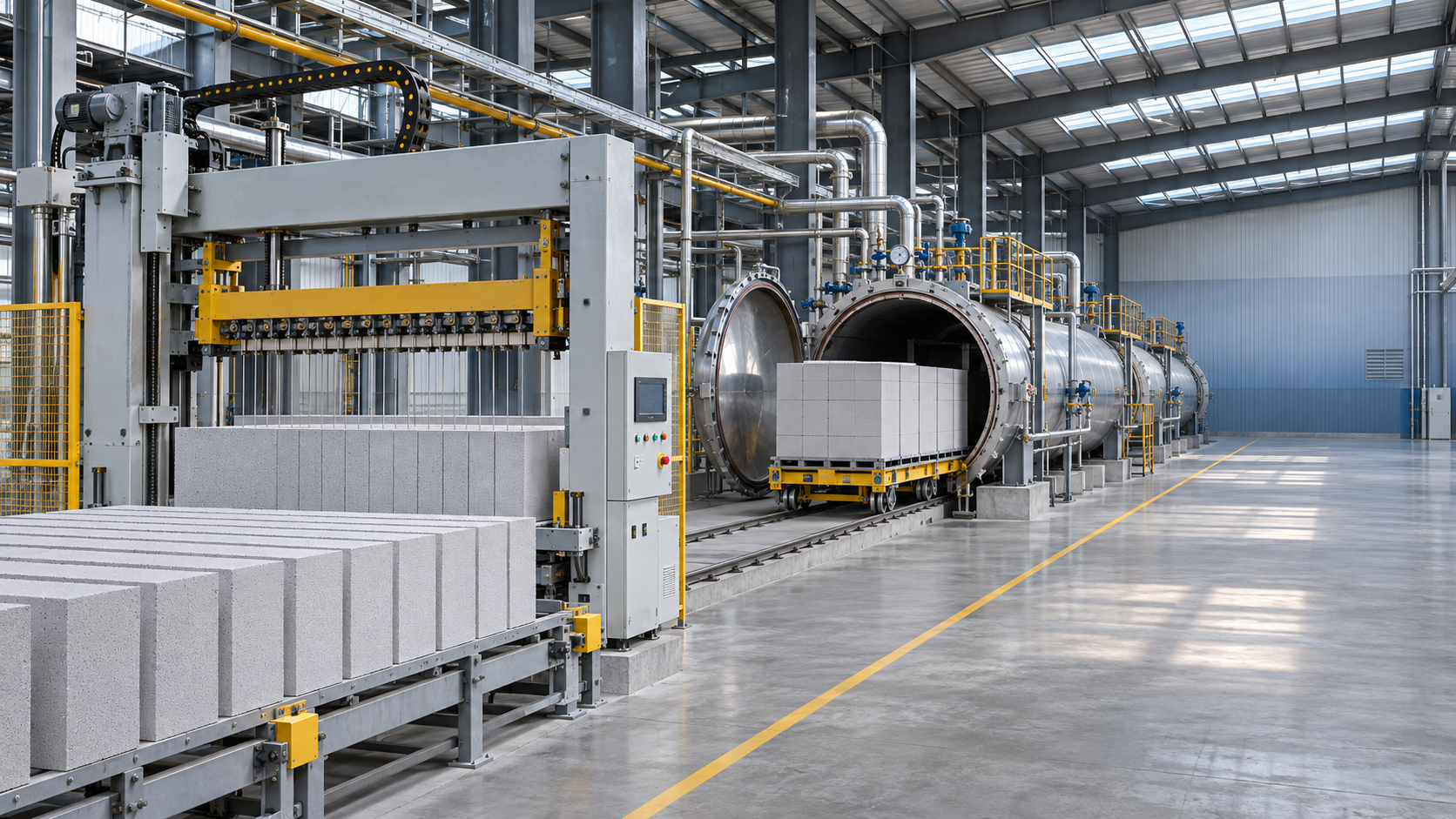
Autoclaves are a significant part of an AAC plant because the blocks gain their final properties during pressurised steam curing. Their number and usable loading capacity must fit the intended output, product mix, and curing cycle. A plant with adequate cutting capacity but insufficient autoclave space may be unable to achieve its advertised production rate.
Autoclaves also create costs beyond the vessels themselves. Steam piping, valves, condensate handling, insulation, controls, foundations, and connections to a boiler or another steam source all affect the installed price. A quotation should make clear whether these items are included and where the equipment supplier’s scope ends.
The steam source is a separate pricing question. Boiler capacity and fuel arrangements depend on the curing schedule, heat losses, and any other site demand. Access to fuel, water treatment, and an existing steam system can change the project cost. An existing boiler is useful only if its available capacity, pressure, reliability, and connection arrangement suit the planned operation.
Electricity supply deserves the same attention. Grinding, air compressors, pumps, cranes, and other drives contribute to connected load, while simultaneous operation affects the supply arrangement. Transformer capacity, distribution equipment, cabling, and backup power, where required, may sit outside a machinery quotation.
Finished product requirements and cutting equipment
The intended block sizes, density range, and dimensional requirements influence the line layout and tooling. A plant designed for a narrow range of standard blocks may need a different cutting and separation arrangement from one expected to produce several thicknesses or reinforced AAC elements.
Cutting occurs before autoclave curing, when the aerated cake has developed enough strength to be handled but remains relatively soft. Cutting wire arrangements, cake transfer, and mould design affect the range of sizes that can be produced and the ease of changing dimensions. Equipment for separating cured blocks and packing them for shipment adds further cost where it is included.
Product specifications should be considered alongside raw materials and the production cycle. A price comparison based only on the maximum stated output can obscure differences in the dimensions, density, and acceptable tolerances used to establish that output. Special product requirements should appear in the technical scope before the equipment price is settled.
Site conditions and installation scope
A factory site affects the total investment through ground conditions, access, building dimensions, equipment foundations, drainage, and utility connections. Autoclaves, mills, silos, and cranes impose different structural and layout requirements. Existing buildings can reduce construction work when their clear height, floor capacity, access, and column spacing suit the equipment; alterations may offset part of that saving.
Installation quotations vary in scope. They may cover equipment erection and alignment, supervision only, or a broader package that includes electrical wiring, piping, insulation, and commissioning. Local civil works and lifting equipment are often separate items. The interface between these scopes matters: if no party has allowed for unloading heavy components or connecting steam lines, those costs appear later in the project.
Commissioning should also be distinguished from mechanical installation. Running motors and moving equipment verifies basic functions; producing acceptable AAC requires coordinated trials involving raw material dosing, slurry properties, expansion, cutting, and curing. The quotation should state what support is included during these trials, which utilities and materials must be available, and the conditions used for any performance acceptance.
Freight, spare parts, and operating costs
Large vessels and structural components can be expensive to transport because of their dimensions and lifting requirements. The destination, route restrictions, packaging, port handling, inland delivery, insurance, and import charges affect the delivered cost. A machinery price quoted at the factory and a price delivered to the site describe different scopes.
Initial spare parts also deserve a separate line in the comparison. Cutting wires, seals, sensors, valves, pump components, and wear parts for material preparation are examples of items that may need replacement during operation. The appropriate stock depends on the equipment selected and the time required to obtain replacements. A low equipment price can be less attractive if essential spares or technical documentation are excluded.
Operating costs continue after commissioning. Cement, lime, sand or fly ash, fuel, electricity, water, labour, maintenance, and packaging all contribute to the cost of finished output. Raw material consumption and energy use should be evaluated against the proposed mix, local prices, and achievable production schedule. A larger plant spreads fixed expenses over more output only when there is enough consistent demand and the line operates at the assumed utilisation.
Comparing quotations on the same basis
A useful price comparison starts with a shared technical description: planned annual output and operating schedule, local raw material properties, finished product dimensions, target density, and site utilities. Each quotation can then be mapped to the same process stages, from raw material unloading through curing and finished-block handling.
Price differences become easier to interpret when equipment quantities, automation functions, installation responsibilities, freight terms, and commissioning support are visible separately. A lower figure may represent an efficient configuration, or it may exclude the boiler, moulds, electrical distribution, or site work needed to reach the stated output. Clarifying those boundaries gives the quoted price a practical meaning and provides a stronger basis for estimating the investment required to bring the plant into production.
Recommend
 Nov 19, 2026
How to Evaluate Reviews of Hongfa Quartz Stone Lines
Comparing Ltd. AAC plant price results with quartz line reviews? Learn how to verify Hongfa equipment claims, service quality, and costs before you invest.
- Nov 19, 2026
What Affects the Price of a Hongfa AAC Plant?
Shandong Hongfa Scientific Industrial & Trading Co. AAC plant pricing depends on capacity, automation, utilities, and installation. Learn how to compare project costs.
- Nov 18, 2026
How Much Does a Concrete Roof Tile Machine Cost?
Explore concrete roof tile machine costs, compare equipment, curing and installation expenses, and assess support needs, including Ltd. AAC spare parts.