How Much Does a Concrete Roof Tile Machine Cost?
A concrete roof tile machine has no dependable fixed price: the cost depends on its output, level of automation, tile profile, tooling and the equipment included in the offer. A small machine quoted without mixing or curing equipment cannot be compared directly with a production line that includes material handling, controls and installation support. Obtain itemized quotations for the same scope before setting a budget; without current supplier quotations, a specific purchase price would be speculative.
The distinction matters when a project budget covers more than the machine itself. A buyer may have space for the forming equipment but still need to pay for electrical work, pallets, curing arrangements, freight and operator training. These expenses can change which offer is actually affordable and when production can begin.
Start with the production scope, not the machine label
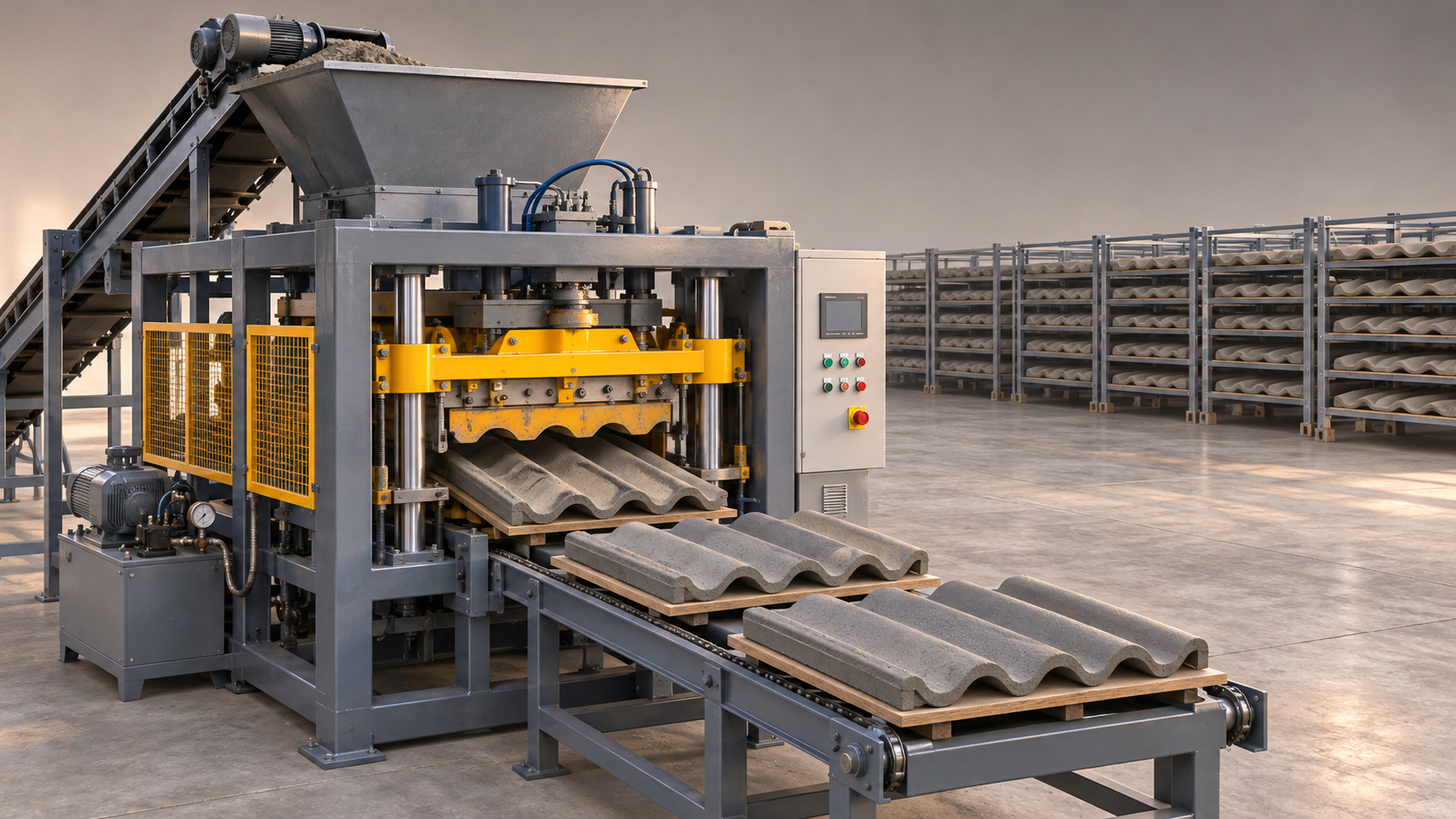
Suppliers may use “machine,” “plant” and “line” to describe different packages. The forming unit shapes the concrete tile, but it is only one part of the process. Depending on the design, a workable operation may also require batching and mixing equipment, a material feed system, tile pallets or carriers, handling equipment and an area where tiles can cure under controlled conditions.
Before comparing prices, describe the finished product and the intended operation. State the tile profile, approximate dimensions, required output per shift and whether the facility already has a mixer, suitable power and handling equipment. Also specify whether the supplier should provide a standalone forming machine or a connected production system. A quote based on incomplete requirements may look attractive until the missing items are added.
Ask suppliers to identify each component as included, optional or excluded. This is more useful than assuming that a photograph or a general equipment description represents the full delivery. Confirm the boundaries between machines as well: a conveyor may be included while the equipment needed to load or remove material from it is not.
Where the purchase price changes
Output and operating time
A machine designed for higher throughput generally requires a different mechanical and handling arrangement from a small-output unit. The relevant number is not simply the highest advertised hourly figure. Ask how the stated capacity is measured, which tile profile it applies to, and whether it assumes continuous operation or allows for routine stoppages. Output per shift is often more useful for planning labor, curing space and material deliveries.
Compare the forming rate with the rest of the process. A fast forming machine does not deliver its stated production if mixing cannot keep up, pallets are unavailable or finished tiles cannot be moved into curing. Conversely, buying more capacity than the available space and handling equipment can support may increase the initial investment without increasing usable output.
Manual work and automation
Less automated equipment can reduce the initial purchase requirement, but it may need more manual feeding, pallet handling, stacking or control. A more automated arrangement can shift some of that work to conveyors, transfer devices and controls, increasing the equipment scope and potentially the cost of installation and maintenance.
The practical comparison is the cost of the complete operating arrangement, not an assumption that automation always saves money. Identify where operators stand, what they lift or move, and which activities continue while the forming machine is running. Ask whether quoted output depends on a particular crew size and whether changeovers or cleaning are included in the stated operating time.
Profiles, molds and pallets
Tile shape affects the tooling required. A quotation may include one profile while charging separately for additional molds, forming components or adjustment parts. Ridge tiles, edge pieces and other fittings may require different equipment or tooling; do not assume they can be produced with the standard roof tile setup.
Pallets or carriers deserve a separate line in the budget. Depending on the process, each newly formed tile may need support during handling and curing. The quantity required depends on production rate, curing time, handling method and how quickly pallets return to the machine. A machine supplied with a small starter quantity may not have enough carriers for the intended shift pattern. Ask the supplier to explain the calculation and price additional pallets separately.
Budget beyond the quoted equipment
The purchase order is only part of the investment. Use the supplier’s equipment list and site requirements to identify expenses that may be paid to other parties. These costs should be estimated before choosing a machine, because a low equipment quotation can leave substantial work outside its scope.
- Freight and unloading: Check the delivery point, packing method, shipment dimensions and who arranges unloading. International purchases may also involve insurance, customs charges and local transport.
- Site preparation: Confirm floor loading, foundations or anchoring, access for installation, drainage and space for material storage, production and curing.
- Utilities: Request electrical load, voltage and connection requirements, together with any water or compressed-air requirements. Compare these with the available site supply.
- Installation and commissioning: Establish whether technical personnel, travel, accommodation, lifting equipment and initial setup materials are included.
- Training and documentation: Specify the number of training days or sessions, the language of manuals and controls, and whether remote assistance is included after startup.
- Initial consumables and spares: Request a recommended startup list with quantities and separate prices, rather than assuming that replacement parts arrive with the machine.
For imported equipment, the commercial delivery terms determine which transport and border-related responsibilities sit with each party. A quoted machine price is not necessarily the price delivered, unloaded and ready to operate. Ask for the named delivery location and a written breakdown of what remains the buyer’s responsibility.
Compare offers on the same basis
When two quotations differ substantially, first check whether they describe the same production result. Use a simple comparison table based on the written offers, and resolve gaps before treating either price as final.
Separate firm prices from estimates and unresolved items. If one supplier includes installation and another leaves it to the buyer, add a realistic installation estimate to the latter before comparing totals. Do the same for pallets, tooling and freight. Where a cost is not yet known, record it as an open item instead of treating it as zero.
Also check the payment schedule against delivery and acceptance milestones. A lower quoted total may create a different cash requirement if a larger payment is due before shipment. Clarify any taxes, bank charges and currency conversion exposure with the relevant parties rather than assuming they are included.
Estimate operating cost per saleable tile
Purchase price alone does not show whether the operation can produce tiles at an acceptable cost. Build a working estimate using the planned shift output and local input prices. Include cement, aggregates, pigments or surface-treatment materials where applicable, as well as electricity, water, labor, packaging and routine maintenance.
Divide the estimated cost for a period by the number of saleable tiles expected in that period, not simply by the machine’s theoretical output. Allow for startup adjustments, damaged products, cleaning and interruptions using assumptions appropriate to the proposed process. Those assumptions are planning inputs, not supplier guarantees; revise them when commissioning provides actual operating information.
Curing and storage can affect this calculation. Tiles need suitable conditions and sufficient time before subsequent handling or dispatch, according to the mix, process and product requirements. Limited curing capacity can restrict daily production even when the machine could form more tiles. Ask how tiles move through curing, how long carriers remain occupied and how much space the proposed output requires.
Maintenance costs also depend on the specific machine and material. Request a list of wear items, inspection intervals and expected replacement procedures. Obtain prices for the parts most likely to be needed and ask whether common components can be sourced locally. Avoid treating all spare parts as interchangeable across building-material machines: even a search for “Ltd. AAC spare parts” concerns a different equipment category and does not establish compatibility with roof tile tooling.
Test the quotation against your actual tile
A capacity figure is meaningful only when tied to a defined product and process. Provide a drawing or sample specification for the desired profile, including dimensions and any surface finish. Ask the supplier which materials and operating conditions were assumed in its proposal, and whether additional adjustments or tooling are needed to produce that profile.
Request an explanation of the proposed quality-control points: consistency of the mix, dimensional checks after forming, curing conditions and inspection before packing. The equipment supplier should identify which checks the machine supports and which remain the operator’s responsibility. Product performance and compliance depend on the finished tile, materials and production process, not on the machine price alone.
Where an acceptance test is offered, agree in writing on the tile specification, test conditions, measurement method and responsibilities for materials and utilities. Clarify whether the test takes place before shipment, at the buyer’s site or both, and how any failure to meet the agreed criteria will be handled. General claims about output or quality should not replace an agreed acceptance procedure.
Choosing a scope that can expand
A smaller initial setup can be reasonable when demand is uncertain, provided its limits are understood. Check whether the layout leaves room for additional handling, mixing or curing capacity and whether the controls and interfaces can accommodate later additions. Ask for written prices or a clear specification for likely upgrades; “expandable” on its own does not define the work required.
For an established operation, the decision may instead turn on compatibility with existing equipment. Confirm mixer discharge height, material transfer, pallet dimensions, power supply and floor layout before ordering. Reusing equipment can reduce the purchase scope, but only if its actual capacity and condition match the proposed machine.
Finish the budget with three figures: the quoted equipment price, the estimated cost to install and start it, and the expected operating cost per saleable tile. Keep exclusions and unresolved assumptions beside those figures. This makes it easier to see whether an apparent saving comes from a genuinely lower-cost solution or from equipment and services that have yet to be priced.
Recommend
 Nov 22, 2026
How Much Does a Hongfa AAC Plant Cost?
Shandong Hongfa Scientific Industrial & Trading Co. AAC plant costs depend on capacity, automation and site needs. Explore pricing factors before requesting a quote.
- Nov 21, 2026
How Much Does a Concrete Roof Tile Machine Cost?
Searching for Ltd. AAC spare parts or concrete roof tile machine costs? Learn why compatibility matters and compare quotes, tooling, and startup expenses.
- Nov 21, 2026
How Much Does a Semi-Automatic AAC Plant Cost?
Explore Ltd. block machine export experience and learn how to compare semi-automatic AAC plant costs, equipment scope and startup expenses.