How Much Does a Hongfa AAC Plant Cost?
How much does a Hongfa AAC plant cost? The answer depends on production capacity, automation level, equipment configuration, and site requirements. Beyond the initial machinery investment, buyers should also consider installation, raw materials, energy consumption, and ongoing maintenance. This guide explores the main factors behind AAC plant pricing and the questions to ask when planning your project with Shandong Hongfa Scientific Industrial & Trading Co., helping you evaluate the investment and choose a production line suited to your goals.
There is no reliable fixed price for a Hongfa autoclaved aerated concrete plant without a defined equipment list and project scope. A quotation for the production machinery alone is not the same as a budget for an operating factory. Before comparing offers, establish whether each price covers the autoclaves, steam system, raw-material preparation, installation, freight and commissioning. Those boundaries can change the apparent price considerably.
What are you actually buying?
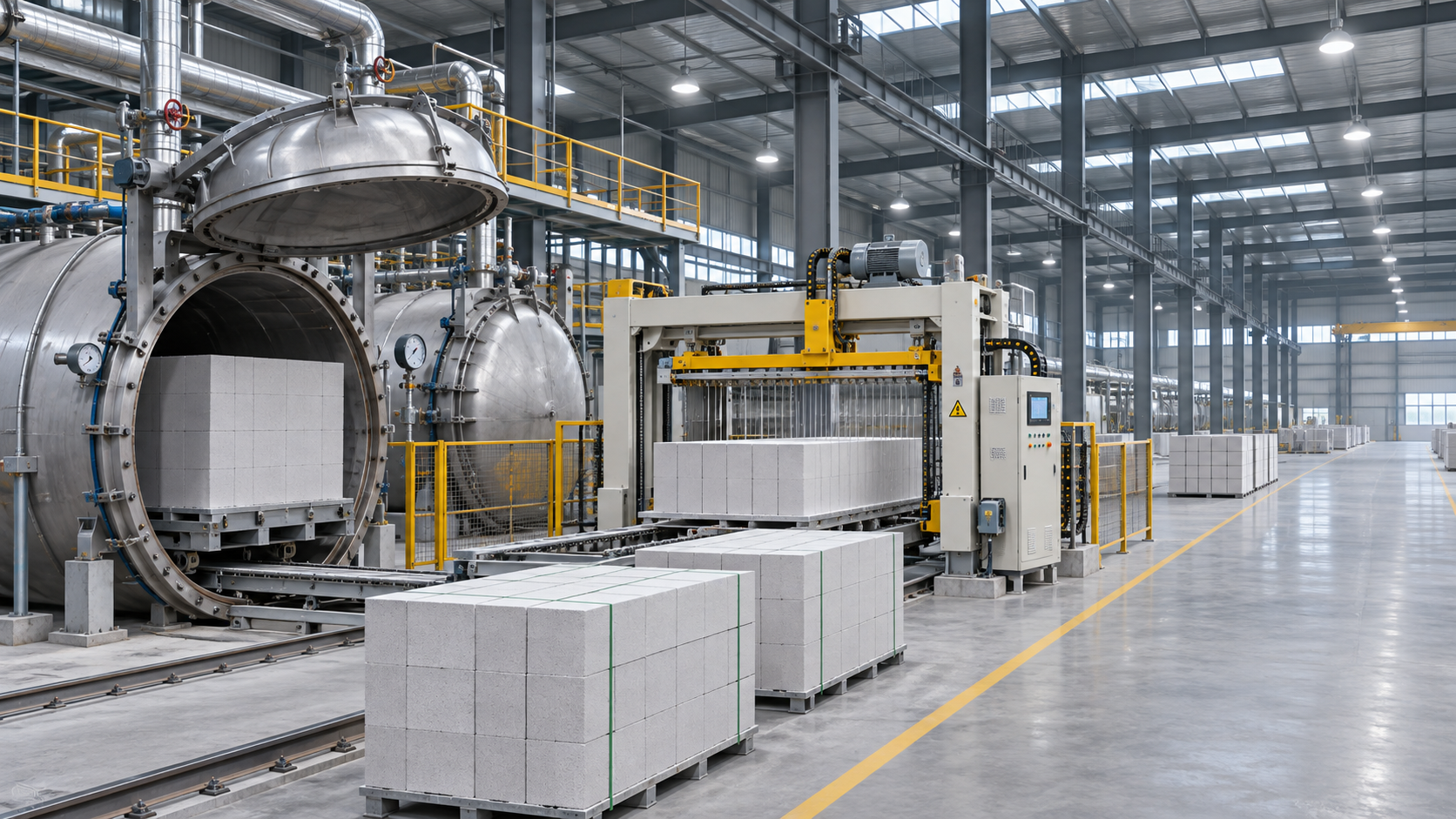
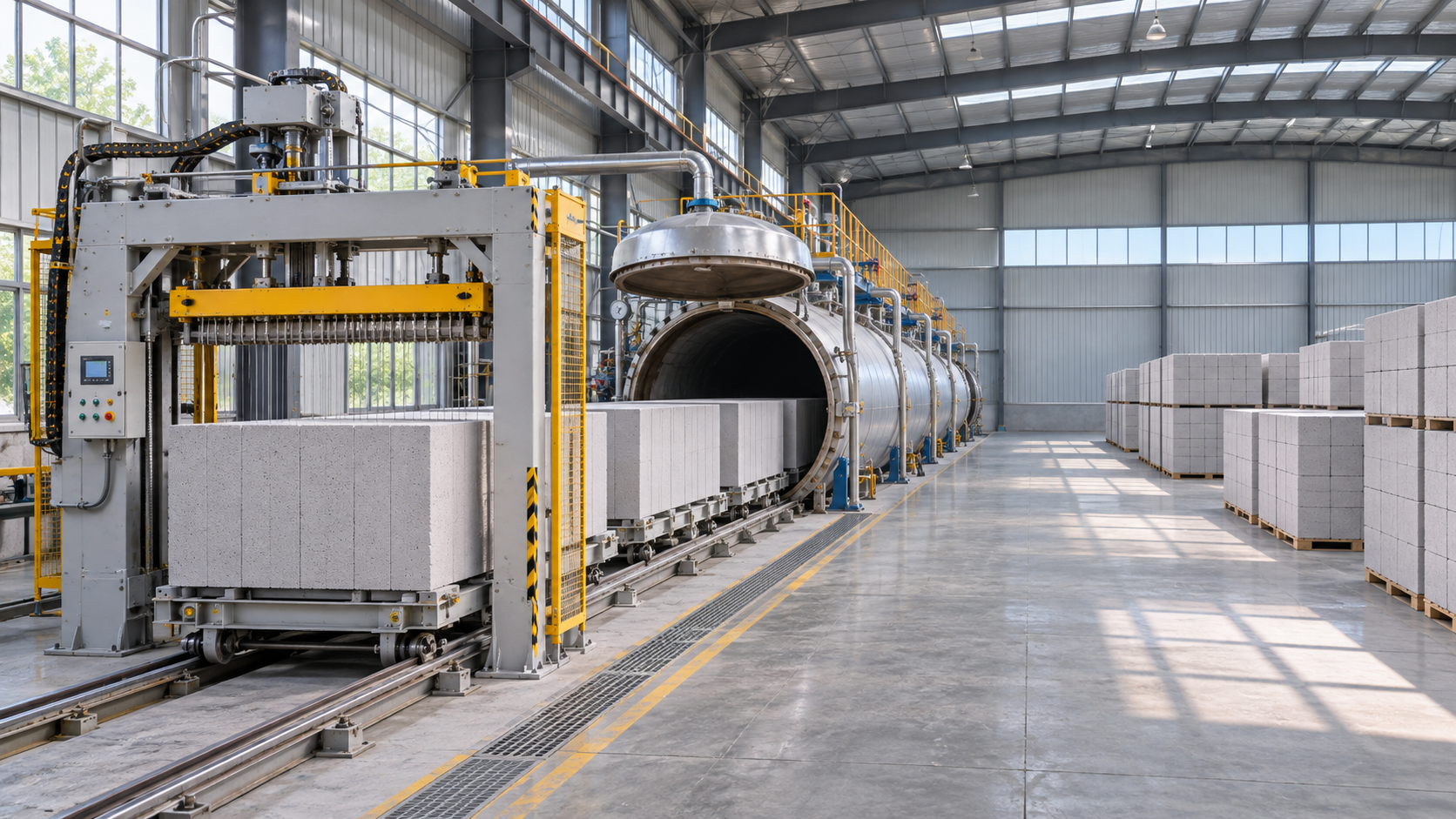
An AAC line combines several processes: preparing and dosing raw materials, mixing and casting the slurry, allowing the cake to rise, cutting it, and curing it under steam pressure in an autoclave. The finished products then need to be separated, handled and prepared for dispatch. Each stage requires equipment, services and space; not every supplier includes all of them in a base offer.
For budgeting, it helps to separate the machinery package from the rest of the project:
- Production equipment: Mixing, casting, cutting, handling and autoclaving equipment, plus the controls and transfer systems specified in the offer.
- Site and utilities: Buildings, foundations, electrical distribution, water supply, steam generation, drainage and other infrastructure required by the selected layout.
- Delivery and startup: Packing, transport, import charges where applicable, installation, commissioning and operator training.
- Operating funds: Raw materials, fuel, labor, initial spare parts and cash needed while production and sales build up.
This distinction matters when a buyer already has a building or utility connection. Existing facilities may reduce the work required, but only after their dimensions, load capacity and services have been checked against the proposed plant. A building that looks large enough on paper may still be unsuitable for autoclave access, crane movement or finished-product storage.
Capacity sets the direction, but not the whole price
A higher-capacity AAC production line generally needs more equipment, larger handling and utility systems, or a different arrangement of machines. Yet two quotations with the same annual capacity can represent different projects. One may assume more operating days or shifts, a different product mix, or less downtime for maintenance.
Ask how the quoted output was calculated: Is it based on blocks only, or does it include reinforced panels? What operating schedule, product dimensions and yield are assumed? Is the figure theoretical equipment capacity or saleable output after expected process losses? A capacity number is useful only when its assumptions are visible.
It is also worth working backward from demand. A plant sized for an ambitious future market can tie up money in autoclaves, utilities and working capital before sales are established. On the other hand, buying a line that cannot accommodate realistic growth may force expensive changes to the building and material flow. Discuss possible expansion at the layout stage, even if the initial installation is deliberately modest.
Automation: compare the work it removes
Automation affects more than the number of operators beside the line. Depending on the configuration, it can cover ingredient dosing, casting, cutting, transfer between process stages, unloading and packaging. A quotation described as “automatic” should identify which of those operations are automated and where manual intervention remains.
A more automated system may be attractive where labor is expensive or consistent handling is difficult to maintain. It also adds controls, sensors and components that need technical support. A simpler arrangement can reduce the initial machinery bill, but only if the extra labor, handling equipment and production constraints make sense for the site. Compare the complete operating arrangement rather than assuming either option is always cheaper.
Pay particular attention to the points between machines. A cutting system may be well specified while cake transfer, autoclave loading or finished-block handling depends on manual equipment outside the quoted scope. Those gaps can become bottlenecks and may require additional purchases.
Raw materials can change the equipment list
AAC recipes commonly use a siliceous material such as sand or suitable fly ash, together with cement, lime, water and an expanding agent. The source and properties of those materials affect preparation, storage and process control. For example, sand may require grinding and slurry handling; a fly-ash-based project needs to establish that its available material is suitable and consistently supplied.
Do not select a configuration solely from a generic process diagram. Provide representative material information and discuss what testing is needed before the equipment and recipe are finalized. Variations in fineness, moisture or composition can affect dosing and production behavior. A lower local purchase price for one ingredient is not necessarily a saving if extra processing, transport or quality control is required.
Also clarify how process returns will be handled. AAC production generates material at several stages, and the proposed system for collecting and reusing suitable returns should be compatible with the recipe and layout. If pumps, tanks or transfer equipment are excluded, they need a separate budget.
The autoclave is only part of the steam bill
Steam curing is central to AAC production, so the autoclaves and their supporting infrastructure deserve an early review. The purchase scope should make clear whether it includes the autoclaves themselves, valves, instrumentation, pipework, insulation and controls. It should also identify who is responsible for the boiler or other steam source, water treatment and condensate handling.
Fuel availability and local energy prices can influence the choice of steam system and the long-term cost of production. Ask the supplier for utility requirements tied to the proposed line and operating assumptions, rather than relying on a consumption figure from an unrelated project. Confirm pressure-equipment approval, inspection and installation requirements with the relevant local authorities and qualified specialists before committing to a design.
The same principle applies to electricity and water. The connected electrical load, peak demand, water quality and process-water arrangements should be checked against actual site supply. An inexpensive plot is less attractive if bringing adequate utilities to it requires substantial additional work.
What a complete quotation should make clear
Shandong Hongfa Scientific Industrial & Trading Co., Ltd. manufactures building-material machinery, including AAC production lines. A useful discussion with the company starts with a project brief: intended products and output, available raw materials, proposed site, utility conditions and the desired level of automation. The more precise those inputs are, the easier it is to identify what the quoted configuration includes.
Request an itemized equipment list and a preliminary layout, not just a total price. The documents should make it possible to trace material from storage to finished-product dispatch and identify the supplier or contractor responsible for each connection. Areas worth checking include:
- Commercial terms: Currency, payment milestones, quotation validity, delivery point and responsibilities for freight, insurance and import charges.
- Engineering boundaries: Drawings and information provided by the equipment supplier, and the local design work, foundations and permits assigned to the buyer.
- Installation and commissioning: Who supplies labor, lifting equipment, consumables and travel expenses; what commissioning covers; and how completion is documented.
- Performance basis: Product specifications, raw-material conditions, operating schedule and measurement method used for any agreed acceptance test.
- After-sales support: Warranty exclusions, recommended initial spares, replacement-part lead times and the practical arrangements for troubleshooting.
If two offers appear far apart, reconcile their lists before negotiating the price. One may include material storage and a boiler; another may leave both to the buyer. Neither is automatically the better offer until the missing work has been priced on the same basis.
Budget for the period after installation
A plant is not fully productive simply because the equipment has been erected. Operators need to learn the process, raw-material settings may need adjustment, and maintenance staff need access to instructions and spare parts. Product testing and local acceptance requirements should be planned before commercial deliveries begin.
Working capital deserves particular attention. Fuel, ingredients, wages and packaging must be paid for while inventory is being built and customers are being supplied. If sales are seasonal or customers pay on credit, the cash needed to operate can extend beyond the machinery payment schedule. Include a contingency for site-specific work and startup issues, sized to the uncertainty in the project rather than treated as an unexplained fixed percentage.
The practical next step is to define the plant you need before asking for a final number. Share the intended output, block or panel requirements, material sources, site details and available utilities with Hongfa, then request a quotation with explicit inclusions and exclusions. That gives you a basis for estimating the cost of a working AAC factory—not just the price of a collection of machines.
Next:No more content
Recommend
 Nov 22, 2026
How Much Does a Hongfa AAC Plant Cost?
Shandong Hongfa Scientific Industrial & Trading Co. AAC plant costs depend on capacity, automation and site needs. Explore pricing factors before requesting a quote.
- Nov 21, 2026
How Much Does a Concrete Roof Tile Machine Cost?
Searching for Ltd. AAC spare parts or concrete roof tile machine costs? Learn why compatibility matters and compare quotes, tooling, and startup expenses.
- Nov 21, 2026
How Much Does a Semi-Automatic AAC Plant Cost?
Explore Ltd. block machine export experience and learn how to compare semi-automatic AAC plant costs, equipment scope and startup expenses.