How Much Does a Concrete Roof Tile Machine Cost?
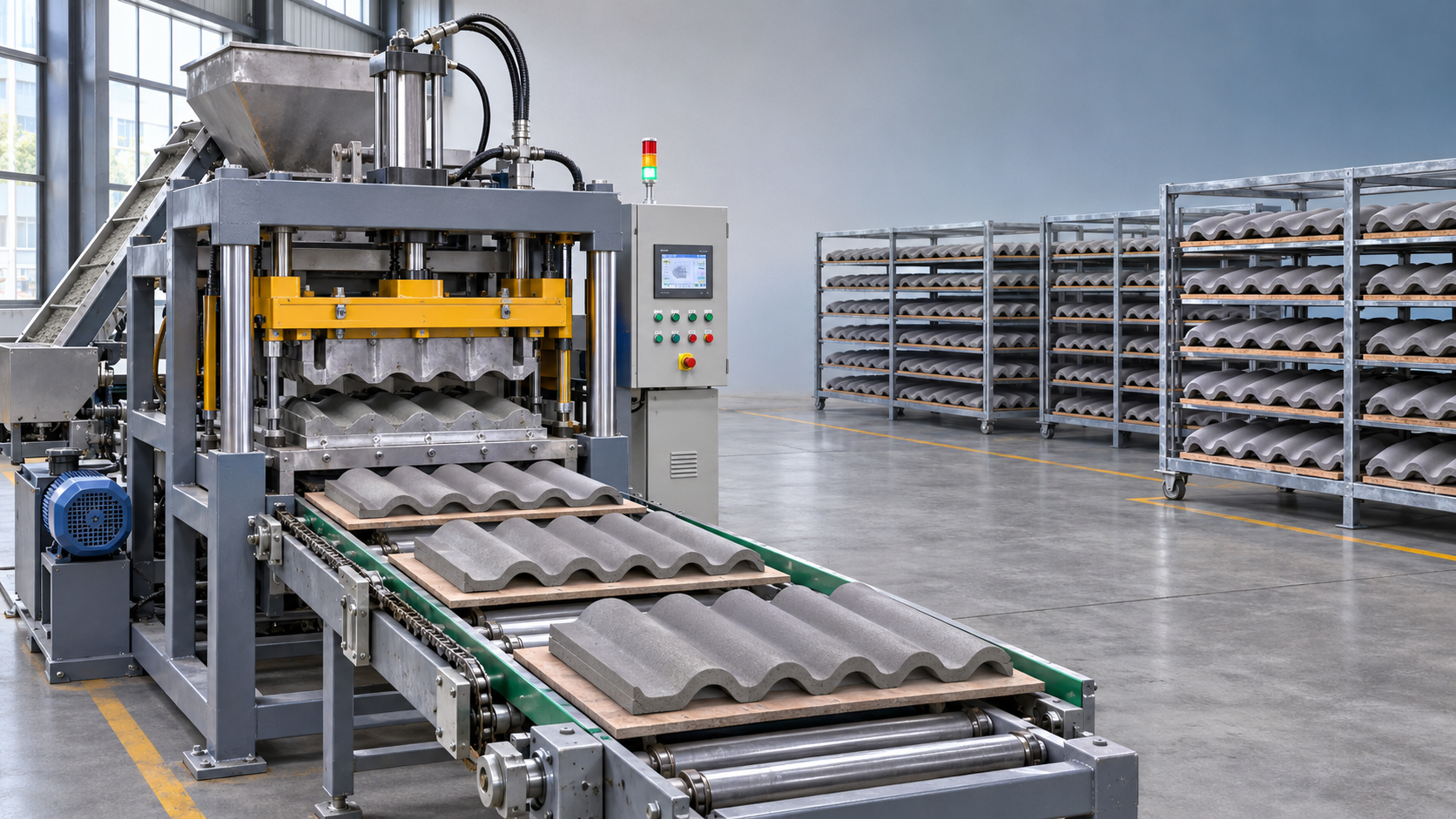
The cost of a concrete roof tile machine depends on its production capacity, level of automation, mold options, and the equipment included in the quotation. The machine price is only part of the investment: buyers also need to budget for curing space, installation, freight, maintenance, and the labor required to run the line.
There is no single reliable price for every configuration, and a meaningful quote requires a defined tile specification and production target. Shandong Hongfa Scientific Industrial & Trading Co., Ltd. supplies construction machinery; buyers researching the company alongside “Ltd. AAC spare parts” should distinguish aerated concrete equipment support from the separate requirements of roof tile production.
What does the quoted machine price actually cover?
Before comparing prices, establish whether each offer covers a standalone forming machine or a working production line. Two quotations may use similar descriptions while leaving you responsible for very different amounts of additional equipment and site work.
These are comparison categories, not standardized packages. Ask every supplier for an itemized equipment list, including quantities and model specifications. A low initial offer is not necessarily economical if the mixing system, production pallets, or commissioning are priced separately.
When a supplier gives a headline capacity, ask what it means in practice: tiles per hour at the forming machine, or finished, acceptable tiles over a complete shift? The latter is more useful for investment planning because it accounts for the rest of the process.
Five specifications that drive the price
1. Output and the bottleneck around the machine
Higher-capacity forming equipment generally requires more substantial feeding, handling, and supporting systems. Yet a faster machine will not deliver its potential if the mixer cannot keep up or if pallets accumulate before curing.
Define your requirement in saleable tiles per shift, not just nominal machine cycles. Ask suppliers to state their assumptions for tile profile, operating hours, staffing, changeovers, and handling. Compare those assumptions with the space and labor you can actually provide.
2. Automation and staffing
Manual or semi-automatic arrangements may suit a business entering a local market or producing smaller batches. They can involve more labor for feeding, pallet movement, inspection, and stacking. Automated transfer and handling may reduce repetitive work, but introduce additional controls, sensors, and maintenance needs.
Do not treat automation as an all-or-nothing decision. Map each operation from mixing to dispatch, then identify where labor availability, handling damage, or inconsistent cycle times justify investment. Request a staffing plan for the configuration offered rather than assuming that “automatic” means unattended.
3. Tile profile, tooling, and changeovers
Flat, profiled, and interlocking tiles can require different tooling arrangements. If you intend to sell more than one profile, establish whether a change requires only a mold set or also adjustments to feeding, cutting, handling, or finishing equipment.
- Confirm included tooling: Identify the exact tile profile, dimensions, and number of mold sets in the quotation.
- Price future profiles: Request separate prices and lead times for additional tooling and replacement wear components.
- Assess changeover: Ask which tools, skills, and adjustments are needed, and how the supplier defines changeover time.
- Check samples: Evaluate finished tiles against your intended market requirements before committing to production tooling.
4. Material preparation, color, and finish
The required mixing and feeding equipment depends on the proposed process and finish. Color application or surface treatment, where required, may add equipment and consumables. The supplier should explain which operations are included and where materials are introduced.
Discuss the locally available cement, aggregates, pigments, and other intended inputs before finalizing the system. A proposed process should be assessed with representative materials and trial tiles; a machine quotation alone does not establish a suitable mix design or finished-product performance.
5. Handling and curing arrangements
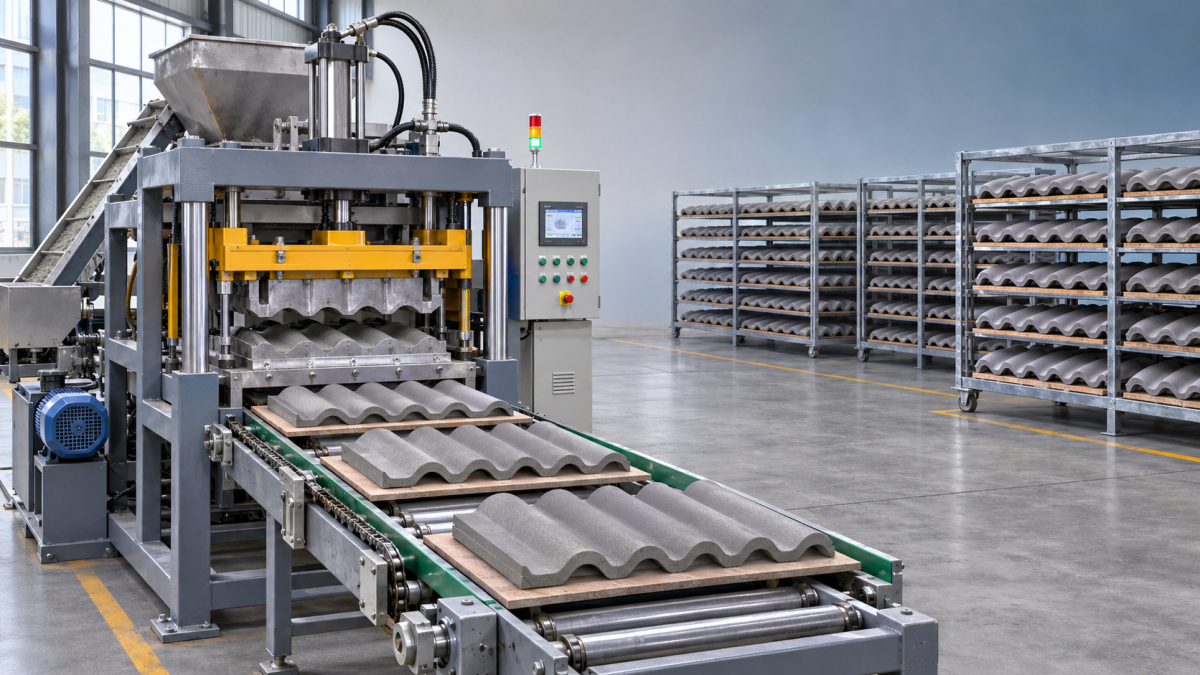
Fresh concrete tiles need handling and curing arrangements suited to the product and process. Depending on the proposed line, pallets, racks, transfer equipment, and curing space may represent a significant part of the investment.
Ask the supplier to show the path of a tile from forming through curing, inspection, and stacking. The layout should identify how pallets circulate, where work-in-process is stored, and what happens when the forming machine stops. Without this plan, a line that fits on a drawing may still be awkward to operate.
Build a landed and installed cost, not just an equipment price
A useful budget starts with the supplier’s itemized quotation and adds every cost needed to reach the first acceptable production run. Keep uncertain items visible as allowances until contractors, freight providers, or authorities confirm them.
For imported equipment, the named delivery term matters. International Chamber of Commerce Incoterms rules define responsibilities for delivery, risk, and certain transport costs, but they do not replace a detailed sales contract. Source: International Chamber of Commerce, “Incoterms® rules,” https://iccwbo.org/business-solutions/incoterms-rules/.
Installation costs are especially easy to underestimate. A supplier may offer remote guidance while the buyer provides all local mechanical and electrical labor. Another may include a technician but exclude travel and accommodation. Put the division of responsibilities in writing before treating the prices as comparable.
Estimate operating cost per saleable tile
A lower purchase price can be offset by higher labor, wear, scrap, or downtime. For a practical comparison, calculate the expected cost per acceptable tile using the same production period and input assumptions for each option:
Cost per saleable tile = total production costs for the period ÷ number of acceptable tiles available for sale.
Include materials, direct labor, electricity and other utilities, routine maintenance, tooling wear, and any relevant packaging or internal handling costs. If you want a fuller investment comparison, add an allocation for equipment depreciation or financing separately and state the method used. Do not mix cash expenses and accounting allocations without identifying them.
Run at least two scenarios: the output you reasonably expect after startup and a lower-output case. Keep tile dimensions, material costs, working hours, and quality assumptions consistent. This exposes whether the investment depends on operating at a capacity your market or site cannot support.
Plan for downtime before signing
Request a recommended spare-parts list that distinguishes routine wear parts from components whose failure could stop production. For each item, ask for its part number, compatibility, price, expected lead time, and storage requirements. A long list is not automatically a good plan; prioritize parts according to failure consequences and local availability.
Also ask who diagnoses faults, what information the supplier needs for remote support, and whether electrical components can be sourced locally. Check warranty exclusions for wear, consumables, improper operation, and third-party repairs rather than assuming that the warranty covers every interruption.
How to request comparable concrete roof tile machine quotes
A concise specification sent to multiple suppliers produces more useful responses than a request for the “best price.” Include the following information and ask each supplier to identify any assumptions or deviations.
- Describe the product: Provide the tile profile, dimensions, intended finish, and any applicable market specification.
- Set the production target: State required saleable output per shift, shifts per day, and expected product mix.
- Explain the site: Share available floor space, utility supply, delivery access, and whether curing space is already available.
- Define the scope: Specify whether you need mixing, forming, handling, curing equipment, installation, training, and initial spares.
- Request commercial detail: Ask for an itemized price, delivery term, payment schedule, quotation validity, lead time, and exclusions.
- Agree on acceptance: Define the proposed trial procedure, sample inspection, performance measurements, and responsibilities for correcting deficiencies.
For product requirements, identify the standards applicable in the destination market rather than assuming one certificate applies everywhere. For example, ASTM C1492 addresses concrete roof tile requirements in its scope; buyers should consult the current edition and confirm local applicability. Source: ASTM International, https://www.astm.org/c1492-03r16.html.
Equipment safety and electrical obligations also depend on the installation jurisdiction. In the United States, OSHA provides machine-guarding requirements under 29 CFR 1910 Subpart O. Source: Occupational Safety and Health Administration, https://www.osha.gov/laws-regs/regulations/standardnumber/1910/1910SubpartO. Ask a qualified local professional to assess the proposed installation and required safeguards.
Where Hongfa and AAC spare parts fit into the discussion
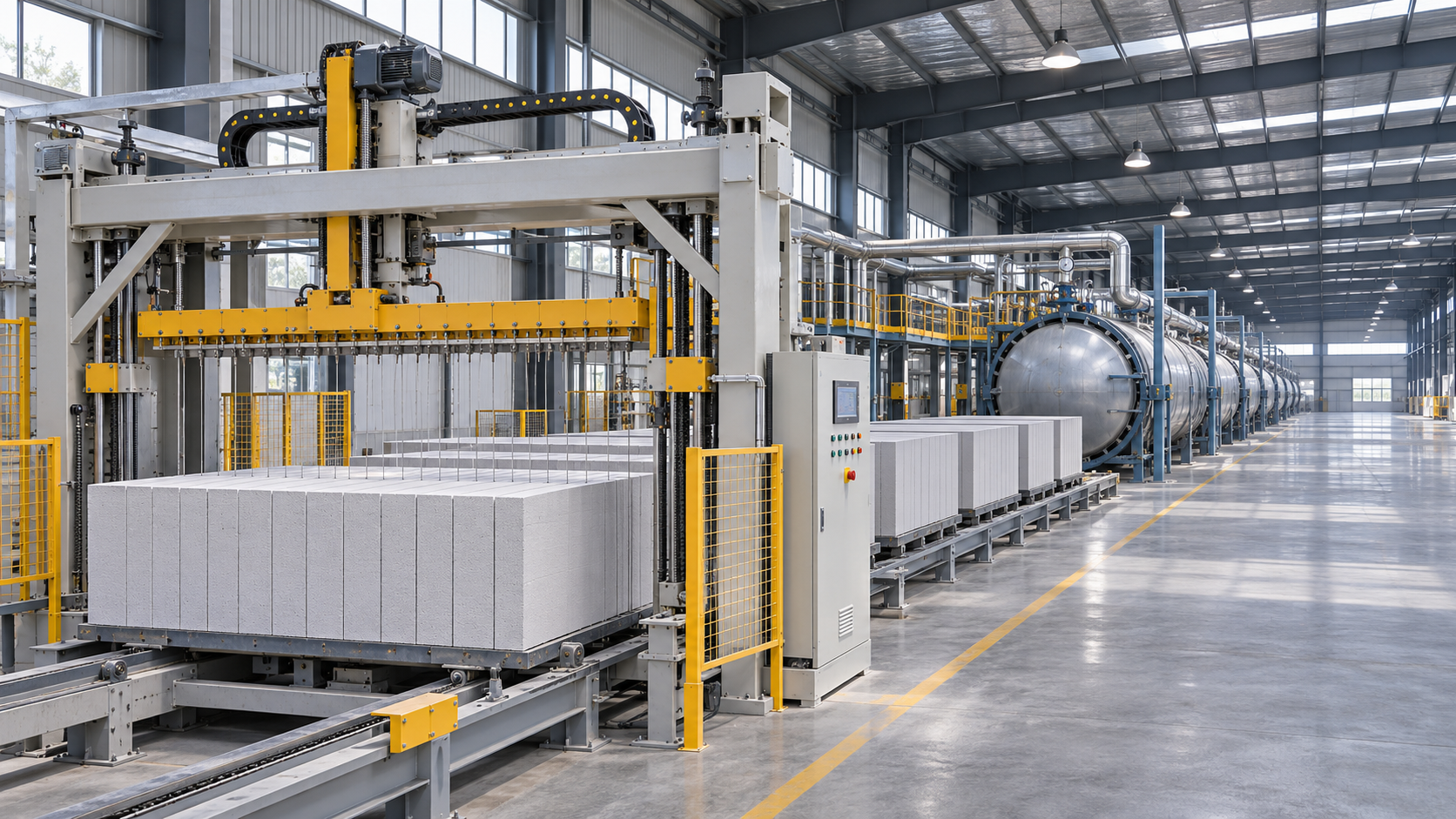
Shandong Hongfa Scientific Industrial & Trading Co., Ltd. describes its business as construction machinery manufacturing, including aerated concrete block production lines and other building-materials equipment. That background is relevant when discussing general manufacturing support, but it does not establish a specific concrete roof tile machine model or configuration.
If you contact Hongfa, provide your tile specification and ask whether the company can supply the exact equipment and support scope you need. Likewise, a search for Ltd. AAC spare parts concerns components for autoclaved aerated concrete equipment; those parts should not be assumed interchangeable with concrete roof tile machinery. Verify every component against the machine model, drawings, and supplier part number.
Frequently asked questions
Can I start with a forming machine and add automation later?
Possibly, but confirm the upgrade path before purchase. Ask for a layout showing future conveyors, handling equipment, utility demand, and control interfaces. A later upgrade is less straightforward if it requires replacing the original machine or rearranging the curing area.
How many molds and pallets should be included?
The appropriate quantities depend on the tile profile, production schedule, handling method, and curing arrangement. Ask the supplier to document the calculation and distinguish operating inventory from spare stock. Verify that the quoted quantities support the stated production plan.
Should I choose the cheapest quote?
Choose the offer that best meets your verified production and quality requirements at an acceptable installed and operating cost. Compare exclusions, tooling, staffing, spare-parts availability, acceptance terms, and after-sales responsibilities before making the decision.
Next:No more content
Recommend
 Nov 27, 2026
How Much Does a Concrete Roof Tile Machine Cost?
Ltd. AAC spare parts differ from roof tile machine components. Explore concrete roof tile machine costs, hidden expenses, and quote comparisons before you buy.
- Nov 27, 2026
What Does a Semi-Automatic AAC Plant Cost?
Explore Ltd. block machine export experience and the key factors behind semi-automatic AAC plant costs, from equipment and freight to installation.
- Nov 26, 2026
How Much Does a Quartz Stone Production Line Cost?
Explore Ltd. overseas installation considerations and the key factors affecting quartz stone production line costs. Compare budgets and plan with confidence.