How Much Does a Hongfa AAC Plant Cost?
How much should you budget for a Hongfa AAC plant? The answer depends on production capacity, automation, equipment configuration, and installation requirements. A reliable budget must cover more than the machinery itself: buildings, utilities, freight, commissioning, and working capital can all change the investment. This guide examines the factors behind the Shandong Hongfa Scientific Industrial & Trading Co., Ltd. AAC plant price and the costs to check before selecting an autoclaved aerated concrete production line.
What does a Hongfa AAC plant cost?
There is no single dependable price for a Hongfa AAC plant without a defined capacity and equipment scope. A quotation for production machinery alone is not comparable with one that includes boilers, autoclaves, installation, and operator training. Publicly advertised figures, where available, should therefore be treated as starting points for discussion rather than complete project budgets.
The practical answer is to request an itemized quotation based on the intended products, annual output, raw materials, site conditions, and destination. Ask the supplier to state what is included, what is optional, and what the buyer must procure locally. Until those boundaries are clear, even an attractive equipment price can be misleading.
Shandong Hongfa Scientific Industrial & Trading Co., Ltd. was established in 1990 and lists AAC production lines among its construction machinery products. The relevant question for a buyer is not whether a standard line exists, but which configuration the company proposes for the specific project and which supporting systems fall outside that proposal.
Capacity is more than an annual output figure
AAC capacity is commonly discussed in cubic metres of finished product per year. That number is useful only when the operating assumptions are visible. Compare quotations using the same working days, shifts, product dimensions, and expected plant availability. A line rated on continuous operation can appear cheaper per unit of annual capacity than a line quoted on a shorter schedule, even if their equipment is not directly equivalent.
The production process also has to remain balanced. Mixing and casting may be fast enough for the target, but cutting, handling, or autoclave cycles can constrain the output of the whole plant. Request a process flow and a capacity calculation that shows how the proposed equipment works together. The number and size of autoclaves matter, but so do loading arrangements, cycle assumptions, and the time required to move products through the plant.
Allow for the difference between theoretical capacity and saleable production. Start-up adjustments, maintenance, product changes, and rejected material affect actual output. A capacity guarantee, if offered, should specify how the test is performed, which raw materials and utilities are required, and whether the figure refers to finished, acceptable product.
Which equipment changes the quotation?
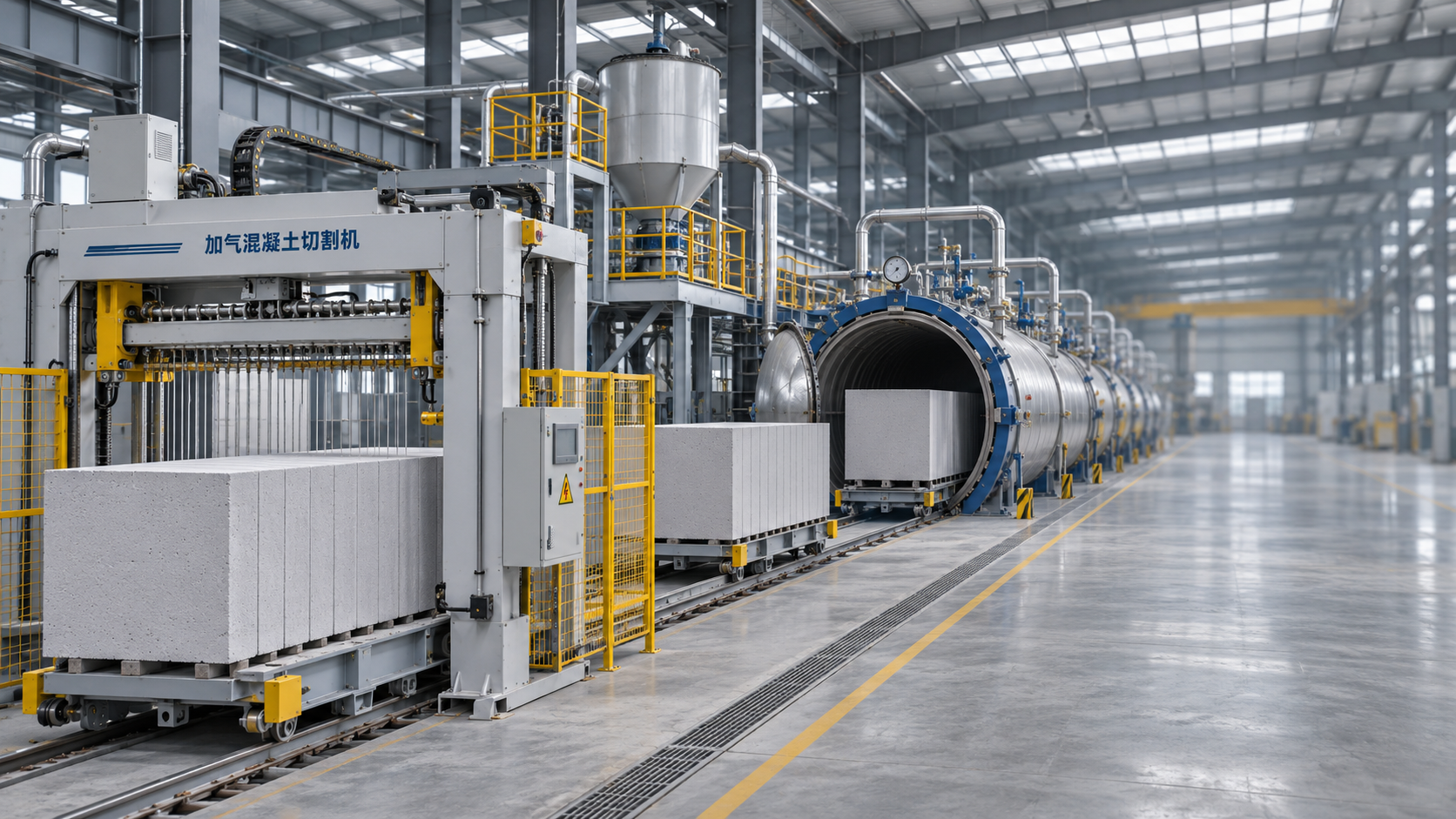
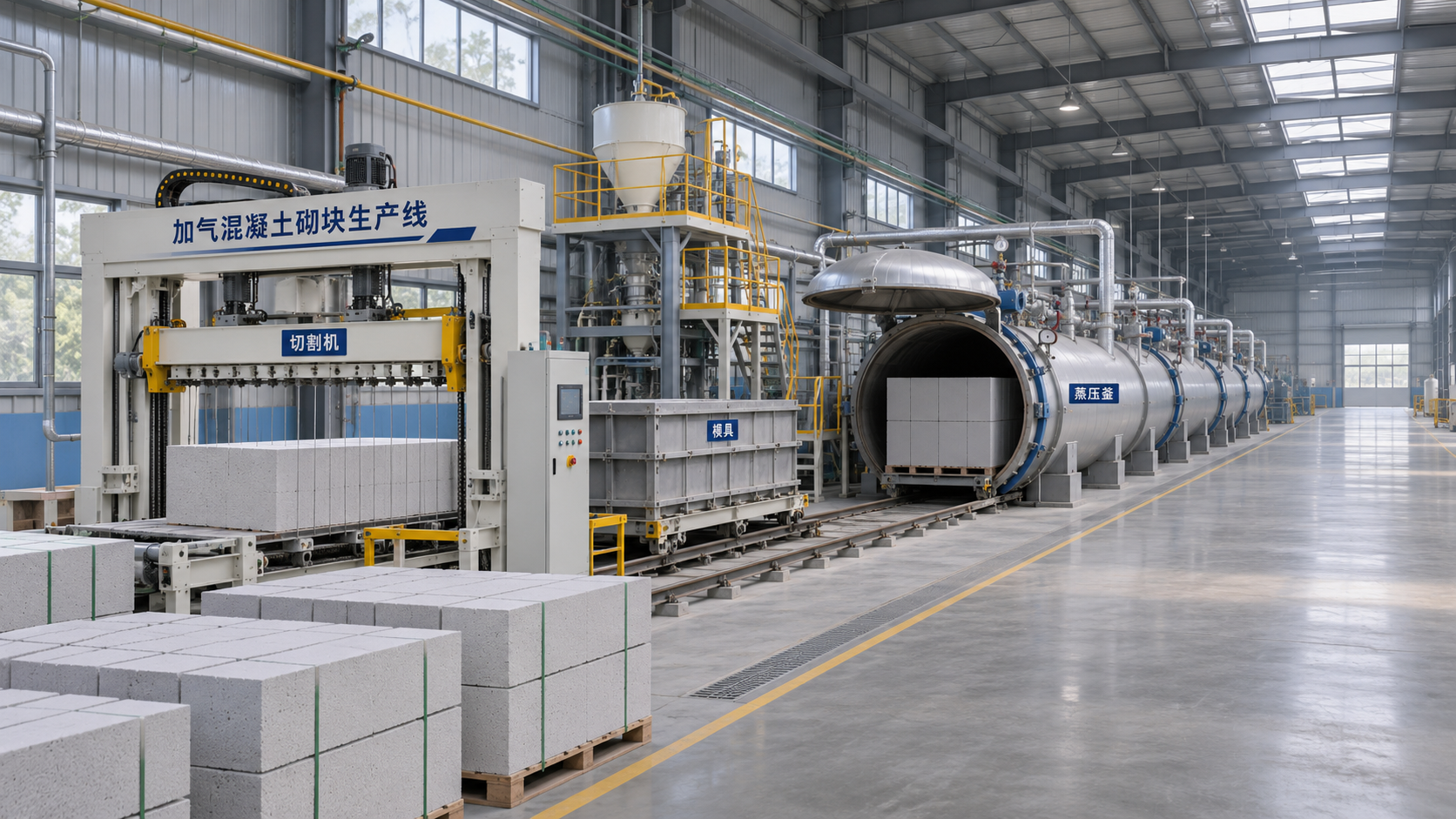
An AAC line typically involves raw-material preparation, batching and mixing, casting, pre-curing, cutting, autoclave curing, and finished-product handling. The price depends on how much of that sequence is supplied as an integrated package.
Raw-material preparation is an easy place for quotations to diverge. A project using sand may require different preparation equipment from one using a suitable fly ash supply. The condition and consistency of each material also matter. Before selecting machinery, confirm the proposed recipe and ask what testing is needed for local sand or ash, lime, cement, gypsum, and aluminium-based expansion agent. A cheap line configured around materials that are difficult to obtain locally is not necessarily a cheap plant to run.
Cutting and handling choices also affect scope. Moulds, cutting equipment, lifting devices, transfer systems, and autoclave trolleys must work as a system. Ask how many moulds and transport units are included, whether cutting wires and other wear items are supplied, and how green or cured waste is handled. A shortage of supporting equipment can leave expensive core machines waiting between cycles.
Blocks or reinforced panels?
Do not assume that a block line can produce reinforced AAC panels without additions. Panel production may require reinforcement preparation, corrosion protection, placement and handling equipment, as well as different quality controls. If panels are a future objective, discuss them before approving the layout. Retrofitting into a building with limited space or unsuitable material flow can be more disruptive than allowing for expansion at the design stage.
How much automation makes sense?
More automation generally adds equipment, controls, and integration work, but it can reduce repetitive handling and make processes more consistent. Whether it is worthwhile depends on local labour availability, production volume, maintenance capability, and the cost of downtime. A highly automated line is not automatically the better purchase if the operating team cannot obtain support or troubleshoot its control systems.
Look closely at the interfaces rather than the label “automatic.” Batching may be automated while mould cleaning, product separation, or packaging still needs substantial manual work. Ask the supplier to identify each manual station and the staffing assumptions behind the proposed operating schedule. Also request a list of critical electrical components, control software access arrangements, and the support available if a sensor, drive, or controller fails.
For a plant entering a new market, a simpler configuration may be easier to manage while demand is uncertain. On the other hand, a buyer planning high and steady volumes should examine whether manual bottlenecks would limit future output. The decision should follow the operating plan, not just the purchase price.
Costs outside the production-line price
The machinery quotation is only one part of the capital requirement. Before approving a budget, separate the supplier’s scope from site costs and local purchases. The items below are frequently significant enough to change a project comparison:
- Buildings and civil works: foundations, production halls, storage areas, drainage, internal roads, and any lifting structures required by the layout.
- Steam and pressure systems: boilers, fuel handling, water treatment, steam distribution, and condensate arrangements, where not included in the machinery package.
- Electrical and water supply: incoming power, transformers or distribution equipment, process water, and connections to individual machines.
- Freight and import expenses: packing, inland transport, port handling, insurance, duties, and taxes, depending on the agreed delivery terms and destination.
- Installation and commissioning: mechanical and electrical installation, cranes, consumables, travel, accommodation, and local support for visiting technicians.
- Start-up funding: raw materials, fuel, wages, initial spare parts, testing, and other expenses before sales receipts cover operating costs.
Steam deserves particular attention because it affects both the initial investment and continuing production costs. A buyer who already has suitable steam infrastructure may face a different project cost from one building it from scratch. Ask for the supplier’s estimated consumption under stated operating conditions, then have the proposed utility system checked against local fuel availability, water quality, and operating requirements.
Autoclaves and boilers are pressure equipment. Their design documentation, inspection, installation, and operation may be subject to local requirements. Confirm those requirements with the relevant local authority and qualified engineering advisers before placing the order; equipment accepted in one market is not automatically approved in another.
Compare quotations on a like-for-like basis
When reviewing a Hongfa quote alongside another supplier’s offer, use a shared equipment schedule. List each major item, quantity, capacity, materials of construction where relevant, and included accessories. Mark exclusions separately rather than assuming an unlisted item is included.
Pay particular attention to the handover points. If one contractor supplies the boiler and another supplies the autoclaves, who designs and installs the steam connection? If the buyer provides the electrical cabinet or building crane, who confirms its compatibility? These gaps can create delays and unexpected engineering costs even when each supplier has delivered its own equipment as agreed.
Delivery terms also change what the quoted amount represents. Confirm the named delivery point, currency, payment schedule, validity period, packing requirements, and responsibility for transport insurance. For imported equipment, obtain a local freight and customs estimate rather than relying on the factory price alone.
Check the service package before signing
A useful quotation should describe installation supervision, commissioning, training, warranty coverage, and the availability of replacement parts. Ask how many technician visits or working days are included, what the buyer must prepare beforehand, and which travel and living expenses are extra. Clarify whether installation means supervision only or includes the labour needed to assemble and connect the line.
For warranties, distinguish between manufacturing defects, wear parts, improper operation, and damage caused by unsuitable utilities or raw materials. Request a recommended spare-parts list with lead times and prices. Cutting consumables, seals, sensors, and other items that can stop production deserve more attention than their small share of the original contract might suggest.
What information should you send for a useful price?
A supplier can produce a more meaningful proposal when the enquiry describes the project rather than simply asking for the lowest AAC plant price. Provide the intended location, target annual output, planned shifts, block sizes, and any requirement for panels. Identify likely raw-material sources and share available test results. If the site is already selected, provide its dimensions and explain the available power, water, fuel, and transport access.
Ask for a preliminary layout, process description, equipment list, utility estimates, foundation loads, and an explicit list of exclusions. Request that the quotation state the output assumptions and the conditions for any acceptance test. Where important details are still unknown, ask the supplier to identify the assumptions so they can be revised before the contract is finalized.
The most useful Hongfa AAC plant price is therefore not a single number. It is an itemized proposal that can be reconciled with the site budget and operating plan. Before committing, resolve the largest open questions: whether the raw materials suit the proposed process, who supplies the utilities, and what the plant must demonstrate during commissioning.
Next:No more content
Recommend
 Nov 16, 2026
How Much Does a Hongfa AAC Plant Cost?
Discover what drives the Shandong Hongfa Co., Ltd. AAC plant price, from capacity and automation to installation costs, and learn how to request a reliable quote.
- Nov 16, 2026
How Much Does a Semi-Automatic AAC Plant Cost?
Shandong Hongfa Scientific Industrial & Trading Co. helps you explore semi-automatic AAC plant costs, compare equipment scopes, and plan a realistic investment.
- Nov 15, 2026
How Much Does a Concrete Roof Tile Machine Cost?
Compare concrete roof tile machine costs, automation, tooling and operating expenses. Learn what to ask suppliers, including about Ltd. AAC spare parts.