How Much Does a Shandong Hongfa AAC Block Machine Cost?
The Shandong Hongfa AAC block machine price depends on what you are actually buying: an individual machine, a group of production units, or a complete autoclaved aerated concrete plant. Capacity, automation, raw material preparation, and installation conditions all change the investment. Without those details, a headline price tells you very little about the budget needed to start production.
There is no verified, current Hongfa price list in the information available for this article, so a specific dollar figure would be misleading. A reliable budget requires a project-specific quotation—and a clear distinction between equipment cost and the total cost of bringing the factory into operation.
For investors comparing suppliers, that distinction matters more than it first appears. An attractive machinery quotation can become a much larger project once foundations, steam supply, electrical infrastructure, freight, and commissioning are added.
What does an “AAC block machine” quotation actually cover?
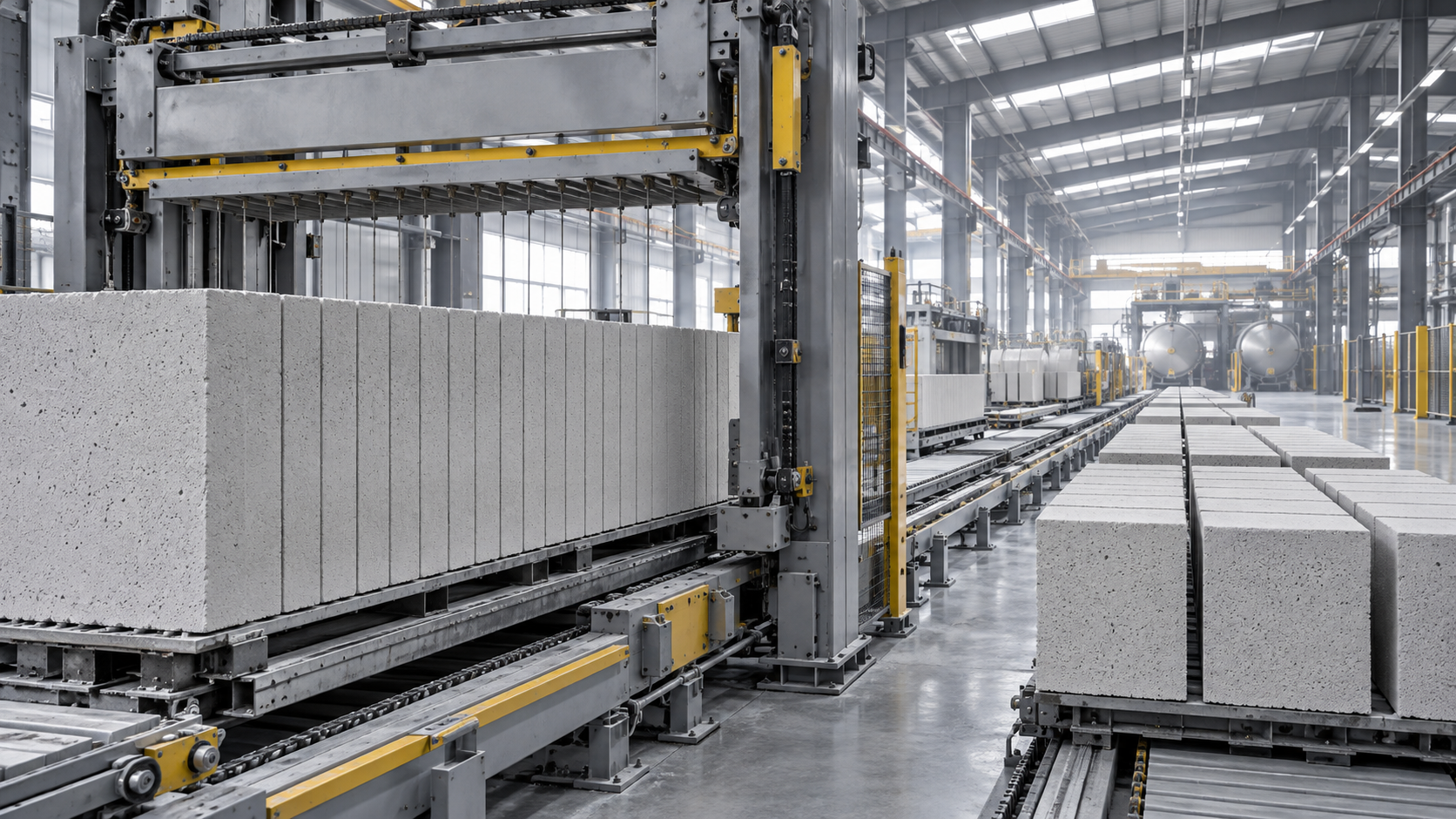
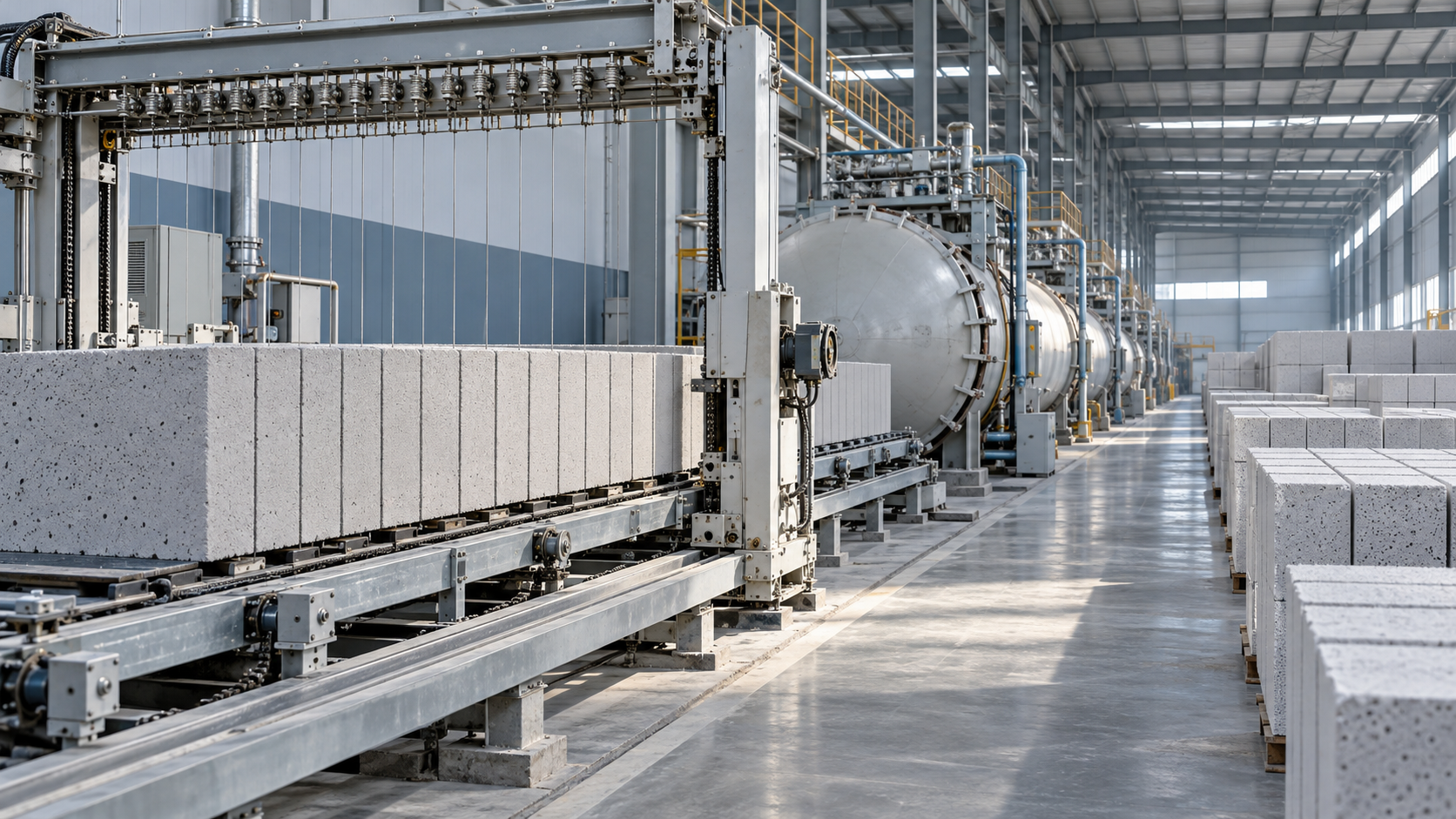
AAC production is not the same as conventional concrete block making. A standard concrete block machine generally forms products through vibration and compression. AAC production involves preparing a slurry, controlled expansion and pre-curing, cutting the semi-hardened material, and curing it under pressurized steam in autoclaves.
That means a machine advertised for making concrete blocks is not automatically suitable for producing AAC blocks. Before comparing prices, confirm that every proposal covers the same production process.
Depending on the agreed scope, an AAC equipment package may include:
- Raw material receiving, storage, grinding, or slurry preparation equipment.
- Batching, weighing, mixing, and casting systems.
- Molds, mold handling equipment, and pre-curing arrangements.
- Turning, demolding, and cutting equipment.
- Transfer equipment, curing carts, rails, and autoclaves.
- Steam generation or connections to an existing steam source.
- Finished-block separation, handling, and packing systems.
- Electrical controls, process instrumentation, and production management functions.
Do not assume that all of these are included. Some proposals cover the main process machinery only. Others include a broader engineering package. Even the term “complete production line” needs a written equipment list and clearly defined exclusions.
What drives the Shandong Hongfa AAC block machine price?
Capacity must match the production schedule
Annual capacity is a useful starting point, but it is not enough on its own. Ask how that figure is calculated: operating days per year, shifts per day, planned maintenance, product dimensions, and expected production availability all affect achievable output.
A larger plant may require more molds, additional autoclave capacity, faster material handling, and greater utility infrastructure. Costs therefore do not necessarily increase in a simple proportion to output.
For a new producer, buying the largest available line can create unnecessary financial pressure if local sales develop slowly. Conversely, a small line may restrict growth or require costly modifications later. Ask Hongfa to explain the expansion possibilities and which shared systems would need additional capacity.
Raw materials influence the equipment configuration
Sand-based and fly-ash-based AAC projects may need different preparation systems. Sand characteristics can influence grinding requirements, while fly ash availability, consistency, and composition need evaluation before the process is finalized.
The recipe may also involve cement, lime, gypsum, water, and an aluminum-based aerating agent. Their suitability affects process control and finished-product quality. A quotation built around assumed raw materials may need revision once actual samples are assessed.
Provide representative material information early. It is better to identify a preparation requirement before ordering machinery than after the factory layout has been approved.
Automation changes both purchase cost and daily operation
Automation can cover batching accuracy, mold circulation, cutting, transfer scheduling, and finished-product handling. More extensive automation generally increases equipment and control-system scope, but the investment should be assessed against local labor costs, maintenance skills, and production requirements.
Ask what operators still need to do during a normal shift. A description such as “fully automatic” is less useful than a process-by-process explanation of manual tasks, staffing assumptions, alarm handling, and recovery after a stoppage.
Product requirements affect cutting and handling
Block dimensions, density grades, strength requirements, and dimensional tolerances help define the appropriate process. If your market needs several block sizes, discuss changeover procedures and their effect on production planning.
Also clarify whether the project is intended only for blocks. Producing reinforced AAC panels involves additional requirements; it should not be assumed that a block production line can manufacture panels without further equipment and engineering.
Site conditions can change the engineering scope
An existing industrial building may appear to offer savings, yet its height, column spacing, floor condition, and access routes can restrict the layout. A new site offers more freedom but adds construction work and infrastructure costs.
Local electrical standards, voltage and frequency, environmental requirements, and pressure-equipment regulations also matter. Autoclaves and steam systems deserve particular attention because documentation and inspection requirements vary by destination.
From machinery price to a working-factory budget
A purchase order for equipment is only one part of the investment. To build a usable budget, separate supplier charges from costs paid to local contractors, logistics providers, utilities, and authorities.
Check the named delivery term and location in every offer. An EXW quotation and a CIF quotation do not cover the same logistics responsibilities. Neither should be treated automatically as a delivered, installed, and operating factory price.
Keep a separate contingency allowance for unresolved project risks. Its size should reflect the maturity of the site design, utility information, logistics planning, and local quotations—not an arbitrary percentage presented as universally sufficient.
A lower quotation is not always a lower production cost
When the initial investment is substantial, choosing the lowest equipment price can feel like the safest decision. But the practical question is what it will cost to produce a cubic meter of saleable AAC consistently.
Compare proposals using the same raw material assumptions, product specifications, energy prices, staffing basis, and operating schedule. Otherwise, apparent savings may come from different calculation methods rather than better economics.
A useful operating-cost assessment includes:
- Raw material consumption and delivered material prices.
- Electricity and steam or fuel requirements under defined conditions.
- Direct labor and maintenance staffing.
- Cutting wires, lubricants, replacement parts, and other consumables.
- Rejects, handling damage, and production interruptions.
- Packaging, storage, and finished-product loading.
Ask whether consumption figures are estimates, design values, or contractually agreed performance criteria. They need a defined measurement basis to be meaningful.
Steam deserves close attention. The autoclave arrangement, curing schedule, insulation, condensate management, and any proposed steam-reuse measures can influence operating performance. Evaluate these as part of the process design, rather than treating the boiler or steam connection as an isolated purchase.
Where Hongfa fits into the purchasing decision
Shandong Hongfa Scientific Industrial & Trading Co., Ltd. states that it began operations in 1990 and manufactures construction and building-material machinery, including AAC production lines, concrete block equipment, concrete batching plants, and quartz stone machinery. Its company profile describes production bases in Shandong and Guangxi, supported by engineering and technical personnel.
That manufacturing background provides context, but buyers still need to evaluate the specific AAC proposal. Company scale alone does not establish whether a particular layout, process configuration, or service arrangement suits your project.
Request project-relevant drawings, a detailed equipment schedule, and a clear explanation of engineering responsibilities. Where references are available, prioritize installations with similar raw materials, output requirements, and destination conditions rather than simply looking for the largest project.
Verify current certificates and their scope when relevant to your procurement requirements. For critical items such as pressure vessels, confirm destination-specific compliance documentation separately from general quality-management credentials.
Send a quotation request that reduces uncertainty
A short inquiry asking only for the “best AAC machine price” usually produces a preliminary response. A more complete project brief gives Hongfa a stronger basis for selecting equipment and identifying exclusions before they become surprises.
Include the following information in your request:
- Project location: country, site address or region, and preferred destination port.
- Target output: annual or daily capacity, planned shifts, and expected operating days.
- Product requirements: block dimensions, density range, strength requirements, and applicable standards.
- Raw materials: available sand or fly ash, supporting test information, and sources of other ingredients.
- Site information: available land, existing buildings, access restrictions, and preliminary layout drawings.
- Utility conditions: electrical supply, water availability, fuel options, and any existing steam source.
- Automation preference: local labor conditions, staffing expectations, and maintenance capabilities.
- Supply boundaries: whether you require machinery only, installation supervision, commissioning assistance, or a broader engineering scope.
Ask for an itemized technical-commercial offer showing currency, quotation validity, payment terms, delivery assumptions, warranty terms, and service scope. Installation support should specify who supplies labor and lifting equipment, who pays travel expenses, and what conditions must be ready before technicians arrive.
Define acceptance before placing the order
The best time to discuss successful handover is before signing the contract. Agree on how capacity, product quality, and other promised performance measures will be tested, including the required raw materials, utilities, operating conditions, and test duration.
Clarify training coverage, operating documentation, recommended start-up spares, and the process for obtaining replacement components. These details may seem secondary during price negotiations, but they become important when the plant needs to run reliably.
Ultimately, a meaningful Shandong Hongfa AAC block machine price is a price tied to a defined production target, a complete scope, and measurable responsibilities. Start with the equipment quotation, then build the full installed-cost and operating-cost picture around it. That approach gives you a sounder basis for deciding not just whether you can purchase the line, but whether the planned factory makes commercial sense.
Recommend
 Oct 29, 2026
What Export Experience Does Shandong Hongfa Building Machinery Have?
Assess Shandong Hongfa building machinery export experience through project records, delivery planning, and after-sales support. Discover what to verify before your next equipment purchase.
- Oct 29, 2026
What Do Reviews Say About Hongfa AAC Block Production Lines?
Hongfa AAC block production line reviews: Learn how to verify output, block quality, energy use, and service support before investing. Discover the evidence buyers should request.
- Oct 29, 2026
Is Shandong Hongfa a Reliable AAC Plant Supplier?
Is Shandong Hongfa a reliable AAC plant supplier? Explore key checks on operating references, raw materials, output guarantees, and support before making your investment decision.