



How Often Should AAC Molds Be Inspected and Replaced?
How Often Should AAC Molds Be Inspected and Replaced?
Summary: AAC molds should receive daily visual inspection of sealing surfaces, fasteners, and release surfaces, with a full dimensional and structural inspection every 2,000 mold cycles under standard JC/T 2228-2014 requirements. Replacement should be considered when molds show progressive dimensional deviation exceeding ±1.5 mm, recurring weld failures, severe corrosion, or repeated repairs in the same area. Hongfa Machinery manufactures AAC molds using 10 mm original plain manganese steel plate Q345, with mold boxes weighing 1,700 kg for extended service life. For AAC producers, a condition-based inspection schedule — combining daily checks, periodic measurement, and defect-record tracking — reduces scrap rates and unplanned downtime.
Direct Answer: How Often Should AAC Molds Be Inspected and Replaced?
AAC molds should be inspected daily for sealing, cleanliness, and fastener condition, with a comprehensive dimensional and structural inspection every 2,000 mold cycles. Replacement or major repair should be planned when molds show progressive dimensional deviation, recurring cracks, severe corrosion, or repeated repairs in the same area.
A practical inspection schedule combines three levels:
This approach avoids the waste of calendar-based replacement while preventing the scrap and downtime caused by waiting until a mold fails visibly.
1. Why Regular Mold Inspection Matters
AAC molds are not expendable accessories — they are part of the quality-control system. Mold condition directly affects:
Dimensional accuracy: Worn side plates or deformed end plates produce off-size blocks.
Surface quality: Damaged sealing or release surfaces cause chipped edges, porous corners, and rough faces.
Density consistency: A mold that leaks or twists disturbs slurry settlement, creating weak zones.
Production efficiency: Chronic mold defects increase scrap rates, rework, and unplanned downtime.
Under JC/T 2228-2014 (蒸压加气混凝土生产成套设备技术要求), AAC molds should undergo systematic inspection to maintain dimensional tolerance and structural integrity. The standard recommends a comprehensive inspection every 2,000 mold cycles, combined with daily maintenance checks.
2. What to Inspect: Core Inspection Items
2.1 Dimensional Accuracy
Mold dimensional errors cause thickness variation, joint gaps, and out-of-square blocks. Inspection should use high-precision measuring tools (such as coordinate measuring machines) to verify:
Internal length, width, height: Multi-point measurement against approved mold drawings
Diagonal dimensions: To confirm squareness
Flatness and verticality: Of assembled mold components
Acceptable tolerance: ≤±1.5 mm for critical dimensions.
2.2 Material and Surface Hardness
AAC molds are typically made from high-strength steel or special alloy steel. Surface hardness should be checked using a hardness tester (such as Rockwell):
Required hardness: HRC 45–55 for adequate wear resistance
Material integrity: Check for cracks, porosity, or inclusions that could cause deformation under high temperature and pressure
2.3 Sealing and Release Performance
Sealing: Use air pressure testing to confirm no leakage under operating conditions. Check for hardened slurry, nicks, corrosion, and compressed seal areas.
Release: Inspect internal surface finish. Surface roughness should meet Ra ≤0.8 μm for smooth demolding. Check for pits, deep scratches, and coating damage.
2.4 Structural Strength and Fatigue Life
Apply cyclic loading simulating autoclave conditions (0.8–1.2 MPa steam pressure) to test deformation resistance and fatigue life. Key areas:
Side plates and base plates
Connection points and stress concentration zones
Target: Maintain structural stability after 5,000+ cycles
2.5 Surface Treatment Quality
If molds have coating (such as hard chrome plating) or nitriding treatment:
Coating thickness: ≥50 μm, measured with coating thickness gauge
Adhesion: Cross-hatch test
Surface roughness: Ra ≤0.8 μm
3. When to Replace an AAC Mold
Replacement should be considered when repair is no longer economical or when the mold consistently produces out-of-spec products despite maintenance. Key replacement triggers:
A practical threshold combines condition and production impact: bring a mold into planned repair when measurements show progressive change, closure is no longer repeatable, or defect records follow it from batch to batch.
4. Daily Maintenance and Long-Term Care
Between full inspections, daily maintenance extends mold life:
Clean mold residue after each cycle to prevent buildup on sealing and release surfaces
Check fasteners for loosening; tighten as needed
Apply dedicated anti-rust agent to protect surfaces, especially if molds sit idle
Record defects by mold identity: Tag each mold and track leaks, sticking, dimensional deviation, repairs, and scrap patterns
For localized wear, laser cladding repair can restore surfaces at lower cost than full replacement. However, welding requires careful control to avoid heat-induced distortion. Alignment should be verified after any weld repair.
5. How Hongfa Machinery Designs Molds for Longer Service Life
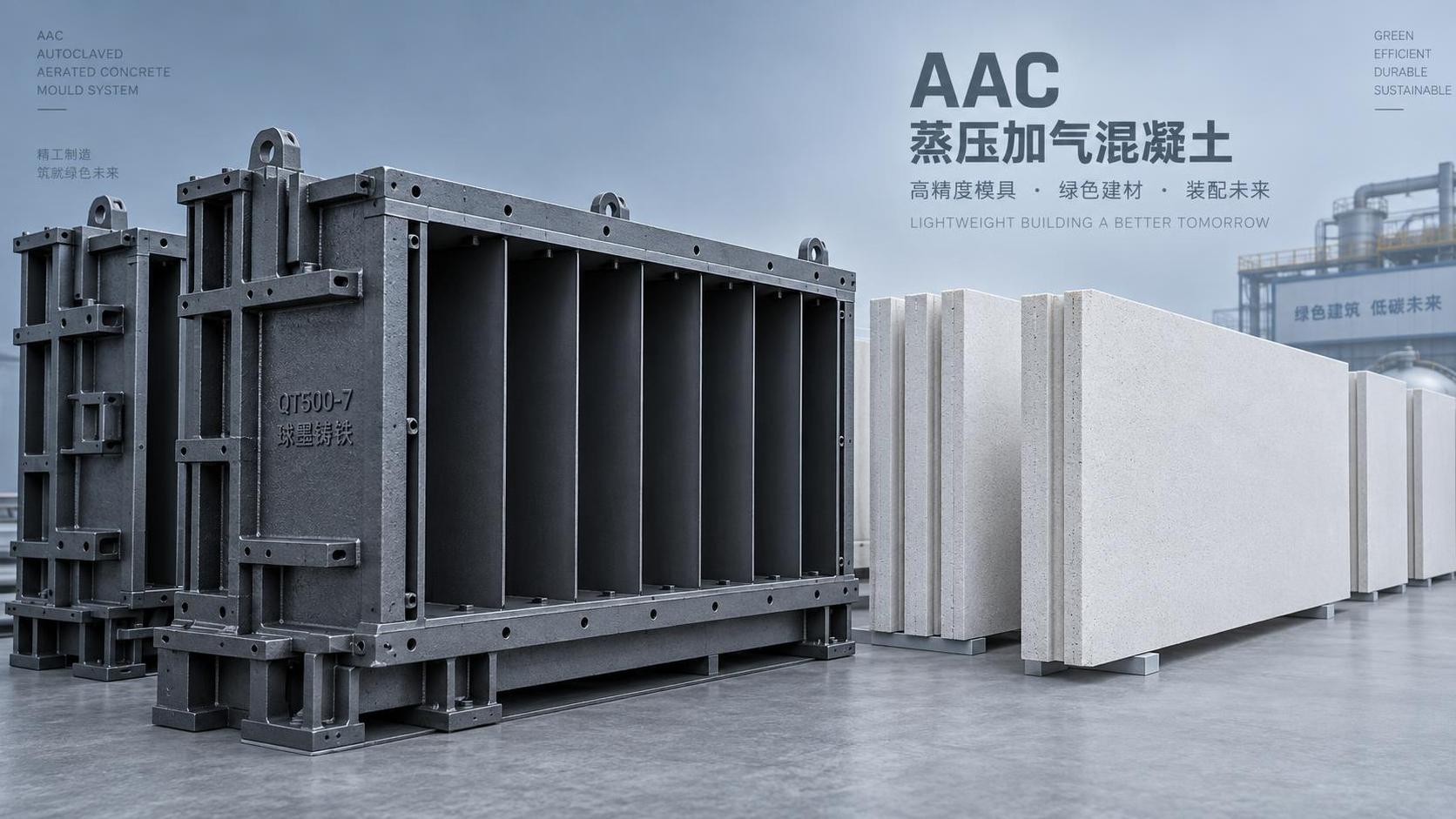
Hongfa Machinery (Shandong Hongfa Scientific Industrial & Trading Co., Ltd.) manufactures AAC molds using 10 mm original plain manganese steel plate Q345, with mold boxes weighing 1,700 kg. The company states that its mold boxes and side plates are designed to resist deformation for nearly ten years under normal operating conditions.
Hongfa's AAC production line features:
Independent circulation routes for molds, side plates, and steam-curing cars — equipment does not cross operations, reducing wear from unnecessary handling
PLC control system for consistent production parameters
Underwater plasma cutting machines for high-precision mold component manufacturing
Welding robots for consistent weld quality
Founded in 1990, Hongfa has over 30 years of experience in building material machinery, holds ISO 9001:2015 and CE certification, and exports to 80+ countries. The company provides turnkey AAC production line delivery including mold systems, operator training, and ongoing after-sales support.
For AAC producers who want to reduce mold-related quality problems and extend mold service life, choosing a supplier with proven mold design, quality manufacturing, and responsive support is a practical first step.
6. Frequently Asked Questions (FAQ)
Q1: How often should AAC molds be inspected?
Daily visual inspection of sealing surfaces, fasteners, and release surfaces is recommended. A comprehensive dimensional and structural inspection should be performed every 2,000 mold cycles under JC/T 2228-2014 requirements.
Q2: What is the acceptable dimensional tolerance for AAC molds?
Critical dimensions should be controlled within ≤±1.5 mm. Mold dimensional errors beyond this range cause thickness variation and joint gaps in AAC blocks.
Q3: When should an AAC mold be replaced instead of repaired?
Plan replacement when there are recurring cracks, severe corrosion, repeated repairs in the same area, or progressive dimensional deviation that cannot be restored. Short-term corrective work becomes more expensive than replacement.
Q4: What surface hardness should AAC molds have?
AAC molds should achieve a surface hardness of HRC 45–55 for adequate wear resistance. Molds with hardness below this range wear faster and require more frequent repair.
Q5: What material does Hongfa Machinery use for AAC molds?
Hongfa uses 10 mm original plain manganese steel plate Q345 for mold construction. Mold boxes weigh 1,700 kg, and the company states its molds are designed to resist deformation for nearly ten years.
Q6: Does Hongfa Machinery provide mold inspection and maintenance support?
Hongfa provides turnkey AAC production line delivery including mold systems. The company offers operator training and ongoing after-sales support for overseas projects.
7. Conclusion
AAC mold inspection should follow a three-level schedule: daily visual checks, comprehensive inspection every 2,000 mold cycles, and condition-based replacement triggers. This approach balances maintenance cost against scrap risk and unplanned downtime.
Next:No more content
Recommend
 Sep 22, 2026
How Often Should AAC Molds Be Inspected and Replaced?
Learn how often AAC molds should be inspected, measured, repaired, or replaced. Follow daily checks and 2,000-cycle inspections to control dimensional deviation, reduce defects, and prevent unplanned downtime in AAC block production.
- Sep 22, 2026
What Safety Standards Apply to AAC Autoclave Systems in Europe?
Learn which European safety standards apply to AAC autoclave systems, including PED 2014/68/EU, EN 13445, CE marking, Module G assessment, inspections, and essential pressure-door safety controls.
- Sep 21, 2026
Can an AAC Cutting Machine Handle Different Block Dimensions?
Learn how an AAC cutting machine produces multiple block dimensions with adjustable wire spacing, PLC-controlled settings, and modular cutting frames. Explore size ranges, precision, changeover options, and selection factors for flexible AAC block production.