How Should an AAC Factory Plan for 100,000 m³ per Year?
How Should an AAC Factory Plan for 100,000 m³ per Year?
Building an autoclaved aerated concrete (AAC) plant with an annual output of 100,000 m³ takes more than selecting a production line. AAC factory planning for 100000 cubic meters per year must align market demand, operating days, raw material availability, autoclave capacity, and utility infrastructure to avoid costly bottlenecks. Land requirements, equipment selection, and investment priorities all follow from those decisions—not the other way around.
For an investor, the useful question is not simply whether a line can produce 100,000 m³. It is whether the complete factory can consistently deliver that volume as saleable product, at the required quality and an acceptable operating cost. The distinction affects everything from mould circulation to finished-block storage.
Define What the Annual Capacity Actually Means
Start by defining the target as net saleable output. A quotation based on theoretical mould volume may not account for cutting losses, rejected blocks, maintenance, or production interruptions. Ask the equipment supplier to state the capacity calculation and its operating assumptions explicitly.
For illustration, 100,000 m³ divided by 300 production days equals approximately 333 m³ of saleable AAC per day. If the assumed saleable yield is 95%, gross production must be about 351 m³ per day. These are planning assumptions, not guaranteed performance figures. The actual yield should be established through raw material trials and commissioning results.
Separate scheduled production days from equipment availability. If the calendar already excludes maintenance shutdowns, do not deduct those same shutdowns again. Conversely, a capacity calculation that assumes every scheduled hour is productive leaves no allowance for unplanned stoppages.
Market requirements belong in this calculation too. Confirm block dimensions, density classes, strength requirements, packaging, and delivery patterns before finalizing machinery. Reinforced AAC panels should not be treated as a simple extension of block production: reinforcement preparation, corrosion protection, handling, and quality control introduce additional requirements.
Balance the Whole Process, Not Just the Cutting Machine
An AAC production line links raw material preparation, proportioning, mixing, casting, pre-curing, demoulding, cutting, autoclaving, separation, and packing. Its practical output is limited by the stage that cannot keep pace with the others.
A fast cutting machine offers little benefit if cakes arrive at inconsistent cutting strength. Similarly, adequate casting capacity cannot compensate for unavailable autoclave space. The supplier should provide a production schedule showing how batches move through the entire process, including return movements of moulds, bases, and transfer equipment.
Mould quantity deserves particular attention. A mould remains occupied through casting, expansion, pre-curing, and transfer until it becomes available for reuse. Its circulation time—not merely its purchase price—determines how many moulds the plant needs. Base plates, curing cars, and transfer devices require the same scrutiny.
Request a balance sheet identifying each stage’s usable capacity, cycle time, buffer space, and downtime assumptions. This makes it easier to distinguish necessary reserve capacity from equipment that adds cost without improving factory output.
Check Autoclave Capacity Against a Real Operating Schedule
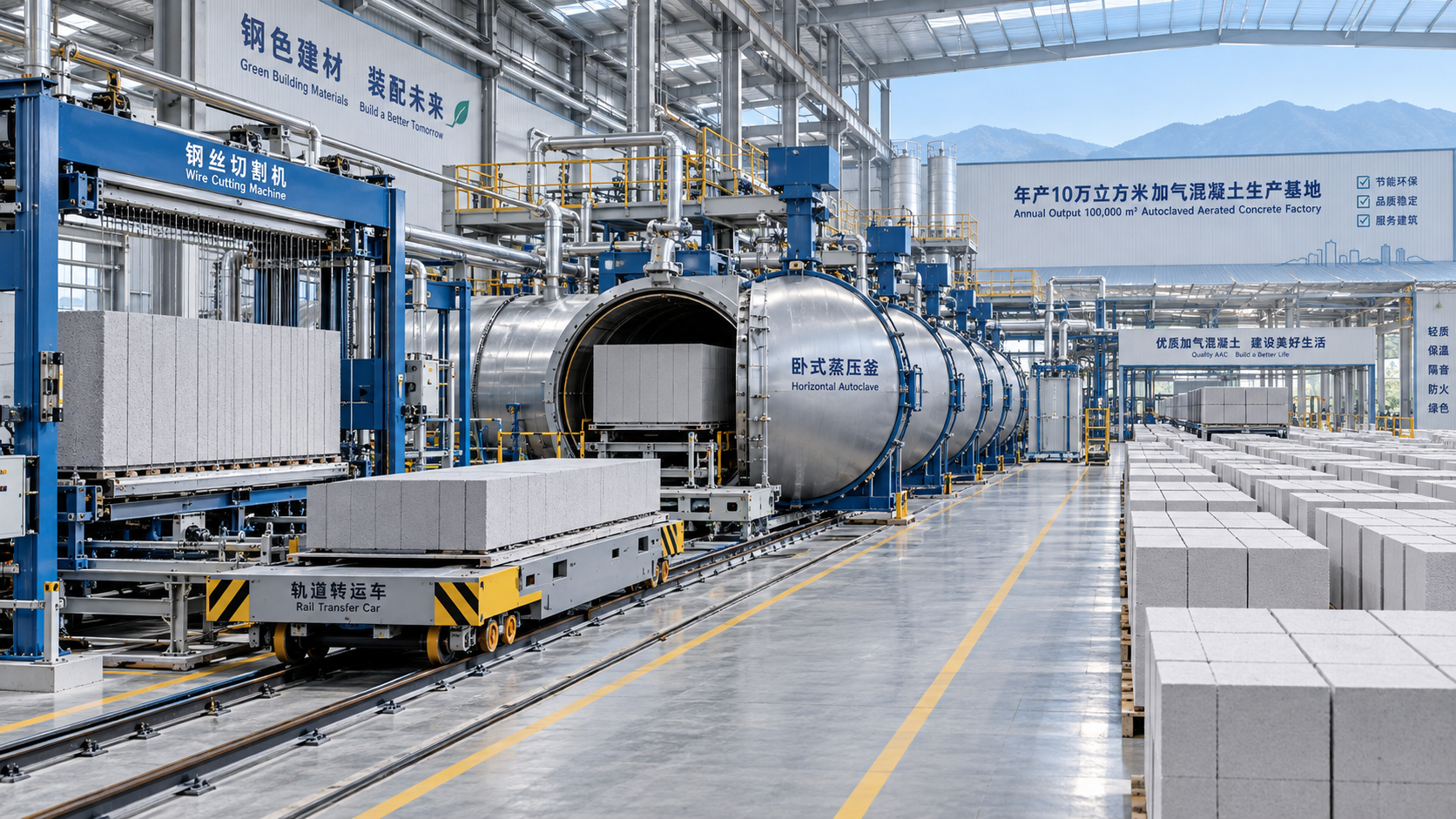
Autoclaves are a central capacity constraint because curing is a batch process. Vessel dimensions alone do not establish throughput. Usable loading volume depends on cake dimensions, stacking arrangements, clearances, and the selected handling system.
As a preliminary check, daily gross output can be compared with usable volume per batch, the number of vessels, and achievable batches per day. However, that calculation must include loading, heating, holding, depressurization, unloading, and turnaround. The curing schedule must also suit the raw materials and required product properties.
Have the supplier demonstrate a realistic daily schedule rather than rounding the batch frequency upward. Ask what happens when one vessel is unavailable: whether casting must slow down, whether intermediate storage is sufficient, and how production recovers afterward.
Test Local Raw Materials Before Freezing the Design
Sand-based and fly-ash-based AAC routes can require different preparation equipment and process settings. Neither should be selected solely because a material appears inexpensive or is available nearby. Suitability depends on its composition, consistency, and behavior in the complete formulation.
Representative samples should be tested for the properties relevant to the selected route. These may include silica availability, particle size, moisture, lime reactivity, and variability in cement or fly ash. Aluminium dosing and dispersion also need control because gas generation must remain compatible with slurry stiffening.
A single successful sample does not prove year-round supply consistency. Review seasonal changes, supplier quality records, transport arrangements, and alternative sources. Storage and preparation capacity should reflect delivery reliability as well as daily consumption.
Cutting-waste recovery should be designed into the process, but recycled slurry is not an uncontrolled return stream. Its solids content and contribution to the mix must be accounted for. Otherwise, material recovery can introduce fluctuations that undermine casting and cutting stability.
Determine Land Requirements from the Layout
There is no reliable universal land figure for a 100,000 m³ AAC factory. A plot that accommodates the production building may still be unsuitable once raw material storage, steam generation, truck access, drainage, and finished-goods inventory are included.
Develop a preliminary site layout before committing to land. It should show the production flow, maintenance access, lifting requirements, utility corridors, pedestrian routes, and vehicle movements. Geotechnical conditions and foundation requirements matter, especially around heavy equipment and autoclave supports.
Finished-product storage is often underestimated. Using the earlier illustrative output of 333 m³ per day, seven days of inventory represents approximately 2,330 m³ of blocks. This is product volume, not yard area. Packaging dimensions, allowable stacking, aisles, loading space, and damaged-product segregation determine the footprint.
If expansion is likely, reserve space where additional equipment can connect logically to the existing process. An empty corner of the property is not necessarily useful expansion space if reaching it requires crossing truck routes or rebuilding the main transfer system.
Design Utilities for Peak Loads and Safe Operation
Steam demand should be evaluated against the autoclave operating schedule. Average daily consumption alone cannot establish boiler capacity: simultaneous heating cycles can create much higher short-term demand. Steam distribution, condensate management, insulation, and any proposed heat recovery must be considered together.
Obtain a utility schedule covering connected electrical load, expected operating demand, water quality and consumption, compressed air, fuel, and drainage. Distinguish connected load from normal demand so transformer sizing and operating-cost estimates use appropriate assumptions.
Pressure-vessel approvals, boiler requirements, emissions controls, and operator qualifications depend on local rules. Confirm them before equipment specifications are finalized. Dust extraction, guarding, safe aluminium handling, emergency isolation, and lockout procedures should also be designed in—not added after installation.
Put Investment into Reliability Before Extra Speed
At this scale, the strongest investment is often better process control rather than maximum automation everywhere. Reliable weighing, slurry control, stable cutting, coordinated material handling, and adequate steam supply directly support repeatable output.
Automation should match labor availability, maintenance skills, and local service support. A sophisticated system can reduce manual handling, but a proprietary component with a long replacement lead time may create an expensive production risk. Review spare-parts availability and diagnostic access alongside labor savings.
Compare proposals using a common scope. Equipment prices may exclude civil works, foundations, boilers, electrical distribution, laboratory equipment, freight, installation, or commissioning materials. Working capital for raw materials, finished inventory, and customer payment terms also belongs in the investment plan.
Evaluate operating cost per saleable cubic meter, then test its sensitivity to fuel prices, yield, output utilization, and delivered selling price. A lower machinery price can be outweighed by recurring energy costs or frequent stoppages.
Make Delivery and Acceptance Conditions Measurable
Established in 1990, Shandong Hongfa Scientific Industrial & Trading Co., Ltd. manufactures building-materials machinery, including AAC production lines, block machinery, and concrete batching plants. That breadth is relevant when discussing the interfaces between material preparation, dosing, production, and site utilities. Project suitability still depends on the proposed engineering details, not company history alone.
Hongfa’s stated quality philosophy—“1% product defects = 100% lack of trust”—is especially relevant to AAC planning. Quality cannot be separated from the output target: rejected blocks consume raw materials, steam, handling time, and storage without contributing to saleable volume.
Translate that principle into contractual acceptance criteria. Agree on the product mix, raw material conditions, test methods, sustained production period, staffing assumptions, and boundaries for measuring utility consumption. Define responsibilities for civil works, installation, operator training, commissioning, and troubleshooting.
Before requesting a final quotation, prepare a project brief containing market specifications, representative material test results, operating days, site constraints, utility availability, and expansion intentions. A credible proposal should explain how those inputs support 100,000 m³ of annual saleable output—and identify which assumptions still need validation before investment approval.
Recommend
 Oct 20, 2026
What Operator Training Should an Overseas AAC Plant Supplier Provide?
AAC plant technical training for overseas operators: discover essential safety, process control, maintenance, and assessment skills to compare suppliers and secure a confident plant handover.
- Oct 20, 2026
How Should an AAC Factory Plan for 100,000 m³ per Year?
AAC factory planning for 100000 cubic meters per year: learn how to balance capacity, autoclaves, materials and utilities to avoid costly bottlenecks and invest with confidence.
- Oct 19, 2026
How Can Buyers Verify a Green Building Material Line Export Supplier?
Verify a green building material production line export supplier with factory checks, performance evidence, and contract safeguards. Explore this buyer’s guide to reduce risk and invest confidently.