



Is AAC Block Production Profitable in Developing Countries?
Yes, AAC block production can be profitable in developing countries, but only when the plant is designed around local conditions rather than broad demand forecasts. Demand for affordable, faster-to-build, and more energy-efficient wall materials can create a strong opportunity. Yet an AAC plant is not a simple block-making workshop. It depends on controlled batching, accurate cutting, high-pressure steam curing, stable utilities, and a sales network that can educate contractors as well as supply them.
The better question is not whether AAC blocks have advantages. They do. The practical question is whether a specific market can support consistent production and sales at a scale large enough to cover the cost of raw materials, energy, maintenance, finance, logistics, and technical operation.
When AAC block manufacturing has a realistic profit path
AAC, or autoclaved aerated concrete, is valued because it is lightweight, workable, and can improve thermal performance compared with many conventional dense masonry products. These benefits matter most where construction is moving toward multi-storey housing, commercial projects, prefabricated systems, or buildings that need lower structural loads and better indoor comfort.
Profitability becomes more realistic when several conditions exist at the same time:
- A growing construction market with regular demand for masonry or infill wall materials.
- Local access to the core mineral ingredients, especially sand or other suitable siliceous material, lime, cement, gypsum, and aluminum powder.
- Reliable electricity, water, fuel, and steam-generation capacity.
- A practical delivery radius from the plant to major building markets.
- Contractors, developers, and designers who are willing to use thin-bed mortar and AAC-specific installation methods.
- A production line sized for actual sales volume rather than an optimistic future projection.
If only one or two of these factors are present, an AAC project may still produce blocks, but it may struggle to produce a dependable return. A common mistake is treating AAC as a premium product that will automatically sell because it is lighter or greener. Builders usually switch materials when the full job becomes easier, faster, or more economical, not simply because a block has better technical features.
Demand is not the same as a profitable market
Developing countries may have visible housing shortages and active urban expansion, but that does not automatically mean AAC blocks will move quickly. In many markets, clay bricks, concrete blocks, or locally made hollow blocks remain deeply established. Their supply chains are familiar, labor crews know how to install them, and small builders can buy them in small quantities.
AAC must fit into that reality. It is more likely to gain traction where labor productivity matters, projects use reinforced concrete frames, transport costs for heavy blocks are high, or wall performance has become important to buyers. Apartment buildings, hospitals, schools, warehouses, hotels, and planned residential developments can be better entry points than scattered individual house construction.
Before investing, examine actual project pipelines rather than general construction headlines. Speak with developers, contractors, architects, distributors, and masonry crews. Ask what wall materials they specify today, what delays they face, whether they can handle larger-format units, and who makes the final purchasing decision. This identifies whether AAC has a genuine place in the local building process.
The cost items that usually determine the result
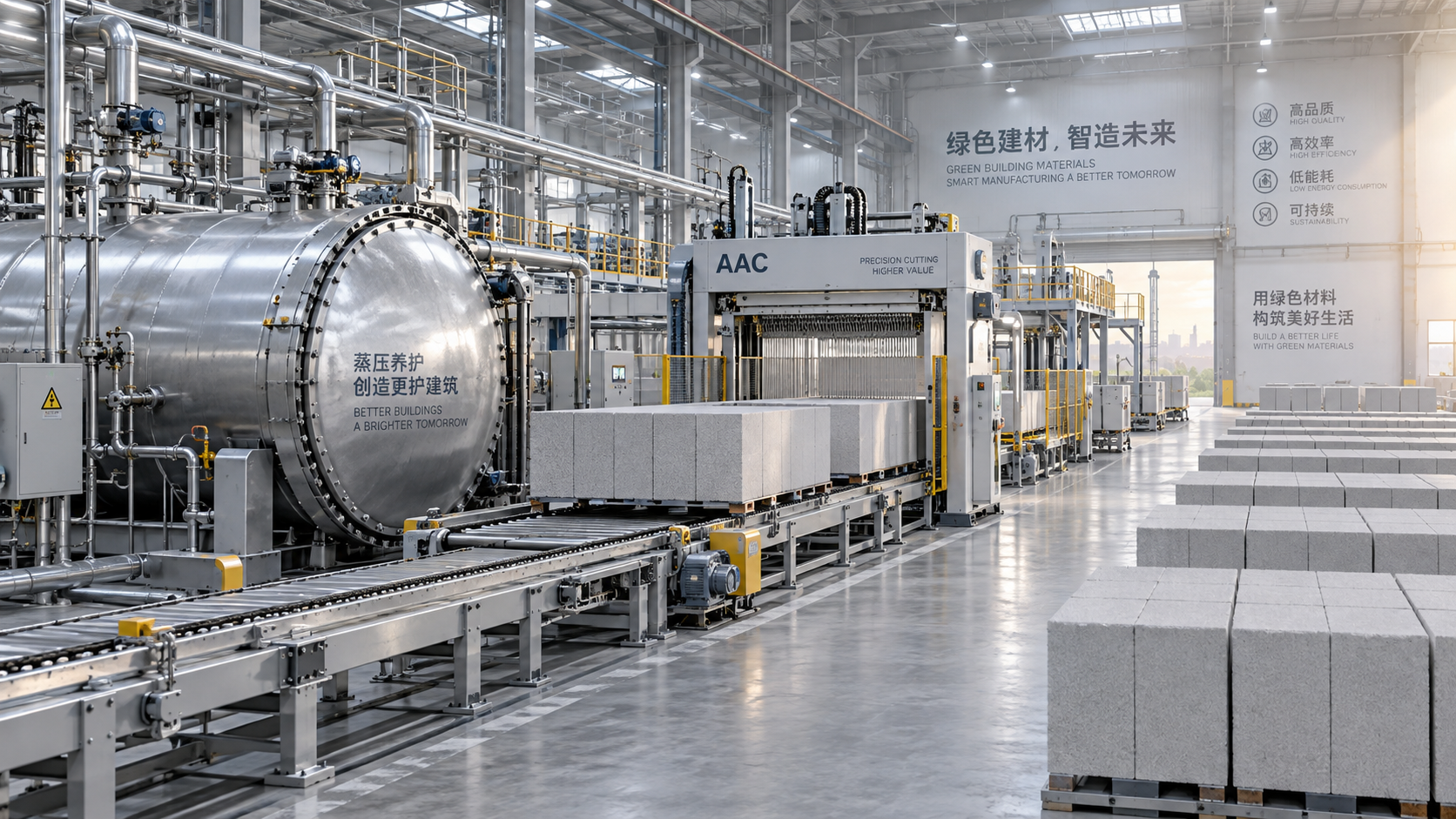
An AAC block plant has more moving parts than a conventional concrete block line. The process typically includes raw-material preparation, slurry mixing, dosing, mold filling, pre-curing, wire cutting, autoclave curing, separation, packing, and material handling. Each stage affects yield and operating cost.
Energy deserves special attention. AAC manufacturing is often evaluated using the price of sand, cement, and labor, while steam curing is treated as a secondary technical detail. That approach can distort the business case. The autoclave, boiler system, insulation, condensate handling, and curing schedule should be assessed as one operating system. A plant with unstable steam supply can lose output, waste material, and fail to meet delivery commitments.
Capacity selection can make or break the project
Larger plants can reduce cost per cubic meter when they run consistently. They can justify higher levels of automation, improve material handling, and support standardized product quality. But those benefits disappear when sales are irregular. An oversized line creates fixed costs that continue even when the yard is full of unsold blocks.
A smaller or moderately sized AAC line may be the better commercial decision where the market is still developing. It allows the producer to establish product acceptance, train distributors and installers, build recurring project demand, and learn local raw-material behavior before adding capacity.
The correct capacity is therefore linked to verified off-take, not just population size or national housing demand. Investors should model a conservative operating level, including the time needed to build contractor confidence. The plant should remain manageable when early sales are below the most optimistic forecast.
Automation should solve local operating problems
Automation is useful when it improves repeatability, reduces heavy manual handling, and protects the cutting and autoclave sequence from avoidable disruption. It is especially valuable for weighing, dosing, cutting, transfer systems, and packing, where inconsistent handling can create rejects or damage finished blocks.
However, the most automated production line is not automatically the most profitable option. In locations where technical support is limited, highly complex controls can become a liability if operators cannot diagnose faults or replacement components take too long to arrive. The right level of automation is one that the plant can maintain locally while still meeting the required consistency and output.
Equipment selection should include more than a comparison of initial quotations. Ask how the line handles raw-material variation, what happens during a utility interruption, how molds and cutting wires are maintained, how easily operators can access wear parts, and what training is included. These details influence uptime far more than brochure capacity alone.
Product quality is a commercial issue, not only a factory issue
AAC blocks are often sold on their light weight and insulation value, but contractors judge them by day-to-day usability. They want blocks with accurate dimensions, clean edges, predictable strength, and low breakage during handling. They also need suitable adhesive mortar, practical cutting tools, and clear installation guidance.
If blocks vary in size or arrive damaged, site crews may use thicker mortar joints to compensate. That reduces the speed and material-saving benefits that made AAC attractive in the first place. One poor early project can make distributors reluctant to stock the product and contractors reluctant to specify it again.
For this reason, a profitable AAC business often includes market development work: sample walls, installer training, technical guidance for wall details, and coordination with mortar suppliers. This is not separate from manufacturing. It is part of turning production capacity into repeatable sales.
Where new AAC plants commonly go wrong
- Copying a plant configuration from another country: local sand chemistry, fuel availability, climate, labor skills, and building practices can change the right technical solution.
- Assuming low labor cost offsets poor efficiency: autoclave curing, material waste, downtime, and transport can have a larger effect than direct labor.
- Building before securing channels: a distributor network and a few recurring project customers are often more valuable than broad but uncertain market interest.
- Ignoring delivery economics: a lightweight block still occupies significant truck volume, so serving distant markets may be less attractive than expected.
- Selling blocks without installation support: AAC requires compatible mortar, sensible wall detailing, and crews who understand the material.
What to confirm before ordering an AAC production line
A disciplined feasibility process should begin with materials and customers, not machinery. Test representative raw materials to determine whether they can support stable AAC production. Map the likely supply routes for each input and identify the true delivered cost, including handling and seasonal disruption.
Then identify the construction segments most likely to adopt AAC and estimate realistic monthly demand from those segments. Separate committed or repeatable demand from general interest. Review utility reliability, fuel options, water supply, road access, available land, and local maintenance capability. Only after those items are clear should the line layout, automation level, boiler arrangement, and capacity be matched to the project.
Experienced equipment manufacturers can add value during this stage when they help align process design with local materials and operating conditions. Shandong Hongfa Scientific Industrial & Trading Co., Ltd., which manufactures aerated concrete block production lines as part of its building-material machinery range, is one example of a supplier type to evaluate on engineering support, production-line scope, quality-control approach, training, and after-sales capability. The useful comparison is not simply which supplier offers the highest stated output, but which configuration can be operated, maintained, and expanded sensibly in the target market.
FAQ
Is AAC more profitable than conventional concrete block production?
It can be, particularly where lightweight walls, faster installation, and thermal performance have clear value. Conventional blocks may remain more profitable where local demand is highly price-driven, fuel is expensive, or contractors are not ready to change installation methods.
Can an AAC plant use any local sand?
No. Sand or other siliceous raw materials need to be suitable for the AAC process and consistent enough to control production. Material testing should happen before finalizing the process design and equipment selection.
Do AAC blocks require a specialized sales strategy?
Usually, yes. Sales efforts should address developers, contractors, designers, and distributors, while also supporting installation practices. Selling only by unit price can hide the labor, mortar, transport, and structural benefits that influence project decisions.
Is a large AAC plant always more economical?
Only when it has enough dependable demand to maintain utilization. A large underused plant can be less profitable than a smaller line with stable sales, controlled costs, and reliable delivery performance.
AAC block production is most promising when it is treated as a local construction-material system, not just a factory investment. Secure workable raw materials, reliable energy, realistic demand, manageable logistics, and a route to contractor acceptance. When those foundations are in place, AAC can support a durable manufacturing business while meeting practical building needs in developing markets.
Next:No more content
Recommend
 Oct 10, 2026
Is AAC Block Production Profitable in Developing Countries?
Is AAC block production profitable in developing countries? Explore demand, energy, raw materials, logistics, capacity planning, and the key factors shaping sustainable AAC plant returns.
- Sep 30, 2026
When does an automated building material production line pay off?
Automated building material production line ROI explained: assess capacity, quality, labor, waste, and total costs to make a profitable investment.
- Oct 01, 2026
How a green building material production line reduces material waste
Discover how a green building material production line cuts waste through precise batching, controlled forming, stable curing, and smart material recovery.