What Should an AAC Factory Planning Report Include?
What should be included in an AAC factory planning report? The short answer is: far more than a list of machines and a building layout. A useful report should show whether an aerated autoclaved concrete (AAC) project can be supplied, built, permitted, operated, and expanded with reasonable control over cost and risk.
For investors, building-material producers, and regional developers, the report is where an attractive business idea meets real operating conditions. It tests local demand against production capacity, checks whether raw materials and utilities are truly available, and turns a proposed AAC block plant into a practical implementation path. If these early decisions are rushed, even capable equipment may later face avoidable bottlenecks in steam supply, logistics, curing capacity, or product sales.
A complete AAC factory planning report should therefore work as a decision document, not a sales brochure. It should make assumptions visible, explain trade-offs, and provide enough detail for management, engineers, financiers, and local authorities to evaluate the project from their own perspectives.
Start with the market the factory is expected to serve
An AAC plant should not be sized simply because a certain output figure appears attractive on paper. The report needs a market study that defines the sales territory, target customers, competing wall materials, expected product mix, and likely demand pattern.
This section should examine whether local construction activity favors AAC blocks, panels, or both. In some areas, lightweight blocks are widely used for infill walls and residential construction. In others, developers may require wall panels, thicker thermal-insulation products, or special sizes for industrial buildings. The sales plan must reflect local building practices rather than assume that every market buys the same format.
Useful market-planning questions include:
- Which cities, construction zones, or distribution areas can be served economically?
- What materials currently compete with AAC: clay bricks, concrete blocks, hollow blocks, precast panels, or other systems?
- What are the local requirements for fire resistance, thermal performance, wall thickness, and dimensional tolerances?
- Will the plant sell directly to contractors, through building-material dealers, or via project-based supply agreements?
- How sensitive is demand to transport distance, seasonal construction cycles, and local real-estate conditions?
The objective is not to predict the future with false precision. It is to establish a realistic range of demand and identify the commercial conditions needed for the factory to run steadily.
Define capacity, product scope, and operating rhythm together
A capacity recommendation is one of the most important conclusions in an AAC factory planning report. It should state the intended annual output, but it should also explain how that output relates to shifts, working days, product sizes, autoclave cycles, and expected equipment utilization.
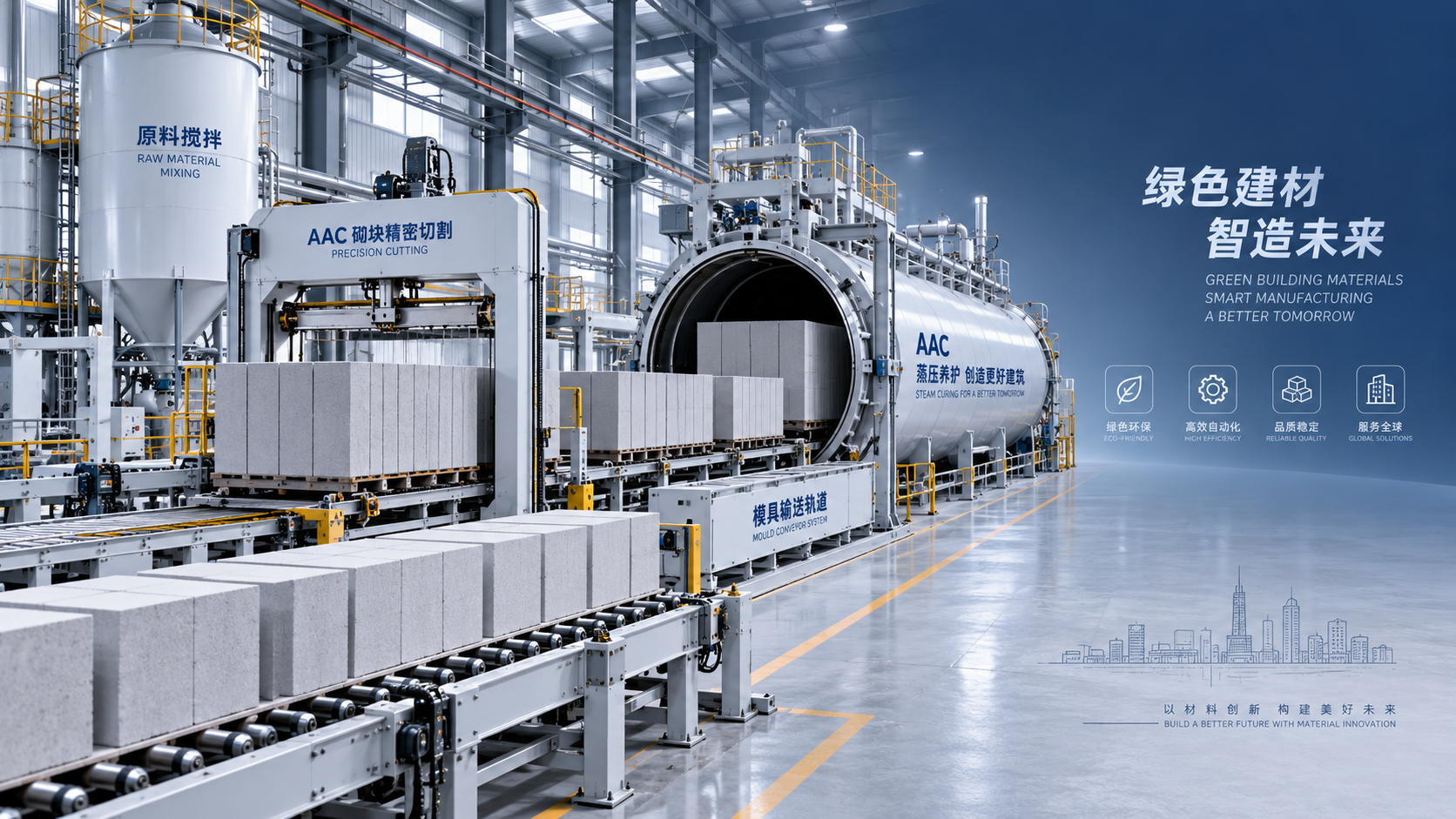
AAC production is a connected process. Raw-material preparation, batching, pouring, pre-curing, cutting, autoclaving, packing, and dispatch must be balanced. Increasing capacity in only one stage rarely solves a production problem. For example, a larger cutting section cannot compensate for insufficient autoclave capacity, while a fast batching system is of little value if finished goods cannot be stored and shipped efficiently.
The report should specify the planned product portfolio, such as standard blocks, partition blocks, lintels, or panels where applicable. It should also consider whether the project should begin with a focused range of fast-moving products and leave room for later expansion. A phased approach can be sensible where market adoption is still developing or where capital expenditure must be controlled carefully.
Site selection is not just about land price
An inexpensive plot can become an expensive factory if it is far from key raw materials, has weak utility connections, lacks heavy-vehicle access, or requires major ground preparation. The site assessment should compare several locations whenever possible and identify conditions that may affect construction, permits, and daily production.
At a minimum, the report should assess land area, shape, topography, drainage, soil conditions, road access, rail or port access where relevant, and distance from customers. Sufficient space is needed not only for the production building, but also for raw-material yards, lime and cement storage, water treatment, finished-product storage, internal roads, administrative facilities, maintenance areas, and future expansion.
Factory layout planning should follow material flow. Bulk materials should move from receiving and storage to preparation with minimal handling. Green cake movement from moulds through pre-curing and cutting should be orderly and safe. After autoclaving, finished products require protected space for sorting, packaging, temporary storage, and truck loading. A crowded layout may look compact in a drawing but can create congestion every day of operation.
Raw materials need technical verification, not assumptions
AAC formulations commonly use silica sand or fly ash, lime, cement, gypsum, aluminum powder or paste, and water. The exact recipe depends on locally available materials, product requirements, and process design. A planning report should identify proposed sources, estimate supply stability, and include laboratory testing or a clear testing plan.
Material names alone are not enough. Sand fineness, silica content, moisture, and grinding behavior can affect slurry preparation. Fly ash quality may vary by power source and collection method. Lime reactivity, cement properties, gypsum composition, and aluminum agent performance all influence the expansion and strength development of the green cake.
The report should also account for logistics. A material may be technically suitable but impractical if transport costs fluctuate sharply or supply depends on a single unreliable channel. For essential inputs, more than one qualified source is often worth considering. Storage capacity should be designed around actual delivery frequency, weather exposure, and the plant’s consumption rate.
Build the process and equipment plan around the local project
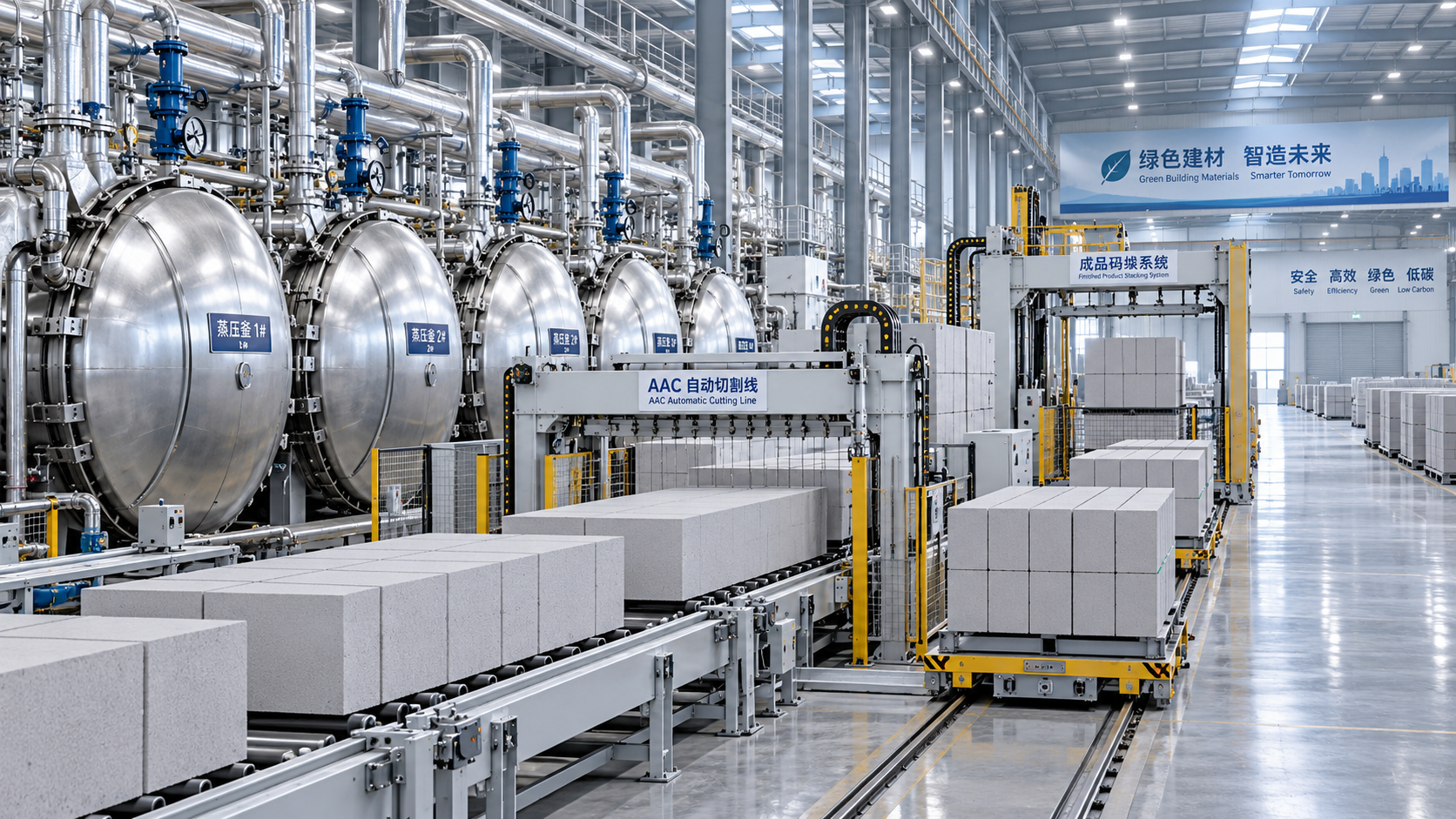
The technical core of the report should describe the selected AAC manufacturing process and explain why it fits the plant’s target output, raw materials, and product range. It should cover the major systems from raw-material handling through packing, rather than presenting isolated machines without showing how they work together.
A typical equipment scope may include:
- Sand or fly ash receiving, storage, crushing or grinding, and slurry preparation;
- Material batching, weighing, mixing, and pouring systems;
- Mould circulation, pre-curing arrangements, and green-cake handling;
- Cutting equipment for vertical and horizontal dimensions;
- Autoclaves, steam distribution, condensate handling, and safety controls;
- Separation, product handling, packing, and finished-goods transfer equipment;
- Electrical control, automation, instrumentation, and production data functions.
The report should distinguish between essential scope and optional upgrades. Automatic control, advanced handling systems, or higher-capacity packing solutions can improve consistency and labor efficiency, but they should be evaluated against local labor conditions, maintenance capability, and planned operating scale. The best line is not necessarily the most complex one; it is the one that can be operated reliably with available resources.
Equipment suppliers should be evaluated on more than quotation price. Engineering experience, process integration, commissioning support, spare-parts planning, operator training, and the ability to adapt the line to local raw materials all deserve attention. Manufacturers such as Shandong Hongfa Scientific Industrial & Trading Co., Ltd., which develops building-material machinery across multiple production bases and has long experience in AAC block production lines, can contribute technical input during this stage. Still, the planning report should remain project-specific: the final configuration must follow the customer’s site, materials, capacity, and market needs.
Utilities and steam deserve their own chapter
Many AAC projects are underestimated because utility planning is treated as a secondary detail. In reality, stable electricity, water, compressed air, and especially steam are fundamental to plant performance. Autoclaving is central to AAC strength development, so the report should describe the heat source, boiler or steam-supply arrangement, fuel availability, water quality, pressure requirements, condensate recovery, and backup considerations.
Power demand should be calculated for the grinding system, mixers, pumps, cranes, cutting line, handling equipment, air compressors, lighting, and support systems. Water demand should include process water, boiler feedwater, cleaning, and domestic use. Where water treatment is needed, the system should be identified early rather than added after construction has begun.
Energy efficiency should be assessed in practical terms: insulation of steam lines, heat recovery opportunities, efficient motor selection, steam-condensate management, and avoidance of unnecessary material rehandling. These measures affect operating cost every day, not only the commissioning phase.
Financial planning should show both investment and operating reality
A credible report separates capital expenditure from working capital and avoids presenting a single total without context. Initial investment may include land preparation, civil works, equipment, installation, utilities, boiler and environmental systems, laboratory facilities, transport equipment, commissioning, and contingency allowances.
Operating-cost estimates should cover raw materials, fuel or steam, electricity, water, labor, maintenance, packaging, quality testing, administration, and outbound logistics. The report should model several scenarios where possible: a base case, a lower-utilization case, and a case affected by higher energy or transport costs. This helps decision-makers see which variables have the greatest influence on profitability.
Cash flow is particularly important in a new plant. Materials may need to be purchased before product sales become stable, while customers may request credit terms. A planning report should therefore address ramp-up time, inventory requirements, receivables, and the funding needed to bridge the early operating period.
Compliance, safety, and environmental planning cannot be left to the end
An AAC plant has advantages as a lightweight building-material operation, but it still requires disciplined management of dust, wastewater, noise, steam systems, lifting equipment, and industrial safety. The planning report should identify applicable local regulations and permit requirements, including land-use approvals, construction permits, emissions standards, boiler regulations, occupational safety rules, and product certification requirements.
Environmental planning should cover dust collection at material handling and grinding points, wastewater collection and reuse where feasible, responsible handling of sludge and off-cuts, noise control, and housekeeping practices. In many AAC plants, cut waste and certain process returns can be recycled back into production when properly controlled. The report should explain the intended approach without assuming that all waste streams are automatically reusable.
Safety planning should include autoclave operating procedures, pressure-vessel compliance, crane and forklift routes, machine guarding, lockout procedures, chemical handling, emergency response, and employee training. These are not paperwork items. They influence equipment availability, workforce confidence, and long-term operational discipline.
People, quality control, and commissioning determine whether the plan becomes a factory
A planning report should identify the organization required to run the plant: production management, process technicians, laboratory staff, maintenance personnel, operators, warehouse teams, sales staff, and safety responsibilities. The number of employees will vary with automation level and shift arrangement, but the skills required should be clear.
Quality control deserves special attention. The report should define incoming-material checks, slurry density and temperature monitoring, green-cake observations, cutting accuracy, autoclave-cycle verification, density testing, compressive-strength testing, moisture checks, and dimensional inspection. A small laboratory and consistent test records are essential tools for preventing quality variation from becoming a customer complaint.
Finally, the implementation schedule should map the sequence from design and approvals through civil construction, equipment delivery, installation, cold commissioning, hot commissioning, trial production, product validation, and commercial ramp-up. Responsibilities should be assigned clearly among the investor, equipment supplier, civil contractor, utility providers, and operating team.
What makes a planning report genuinely useful?
The strongest AAC factory planning report does not promise that every assumption will hold. Instead, it identifies what must be confirmed before major money is committed: raw-material test results, utility agreements, site conditions, permit pathways, customer demand, and technical interfaces between process systems.
Before approving the project, decision-makers should be able to answer a few practical questions: Can the selected site support the line? Can the factory obtain consistent raw materials and steam? Is the capacity aligned with reachable demand? Are the autoclaves, cutting section, and handling systems properly balanced? Has sufficient budget been reserved for utilities, environmental measures, commissioning, and working capital?
When those answers are supported by evidence, the report becomes more than a planning document. It becomes a working guide for building an AAC plant that is safer to commission, easier to manage, and better prepared for long-term market development.
Next:No more content
Recommend
 Oct 14, 2026
What Should an AAC Factory Planning Report Include?
What should be included in an AAC factory planning report? Explore market demand, capacity, site, raw materials, utilities, costs, compliance, and implementation essentials.
- Oct 13, 2026
Can a Green Building Material Line Use Local Industrial Waste?
Can a green building material line use local industrial waste? Discover how tested by-products can improve sustainable production, control costs, and ensure reliable quality compliance.
- Oct 12, 2026
How Much Does an Automated AAC Production Line Cost?
How much does an automated AAC production line typically cost? Explore investment ranges, key cost drivers, and smart tips for planning a profitable AAC plant.