How Does a Hydraulic Roof Tile Machine Differ From Manual Pressing?
A hydraulic roof tile machine gives you more control over forming pressure and cycle repeatability, while manual pressing usually requires less initial investment and more operator effort. For concrete roof tile production, the practical difference is how reliably each method turns a prepared mix into tiles with consistent dimensions, handling strength, and surface quality.
Hydraulic pressing generally makes more sense when regular orders require repeatable output. Manual pressing can suit small batches, product trials, or operations where demand does not yet justify powered equipment. Neither method compensates for an unsuitable mix, inaccurate molds, or poor curing.
Are color tiles and concrete roof tiles different products?
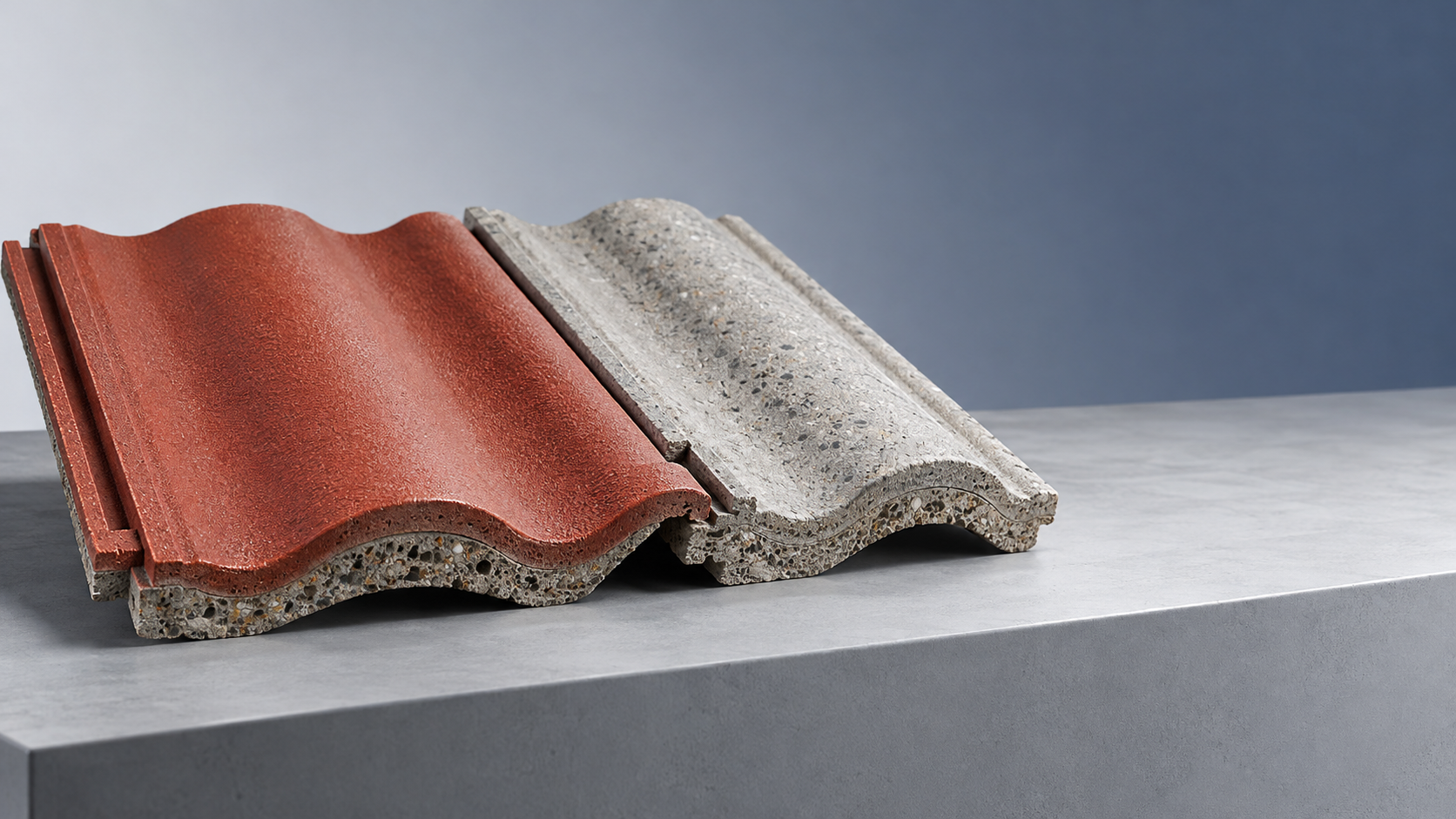
If you are deciding whether to manufacture “color tile or concrete roof tile,” clarify the terminology before comparing equipment. Color describes appearance; concrete describes the tile material. A concrete roof tile can contain pigment throughout its body, receive a colored surface layer, or have a coating applied through a separate process.
“Color tile” can also refer to other roofing materials. Equipment intended for concrete will not necessarily process clay or form coated metal roofing sheets. The material and forming method must match.
This comparison concerns concrete tiles formed in molds using manual or hydraulic pressure. Concrete roof tiles can also be manufactured through extrusion and other processes, so a machine described simply as a “roof tile machine” may operate differently from the presses discussed here.
What actually changes when hydraulic pressure replaces manual effort?
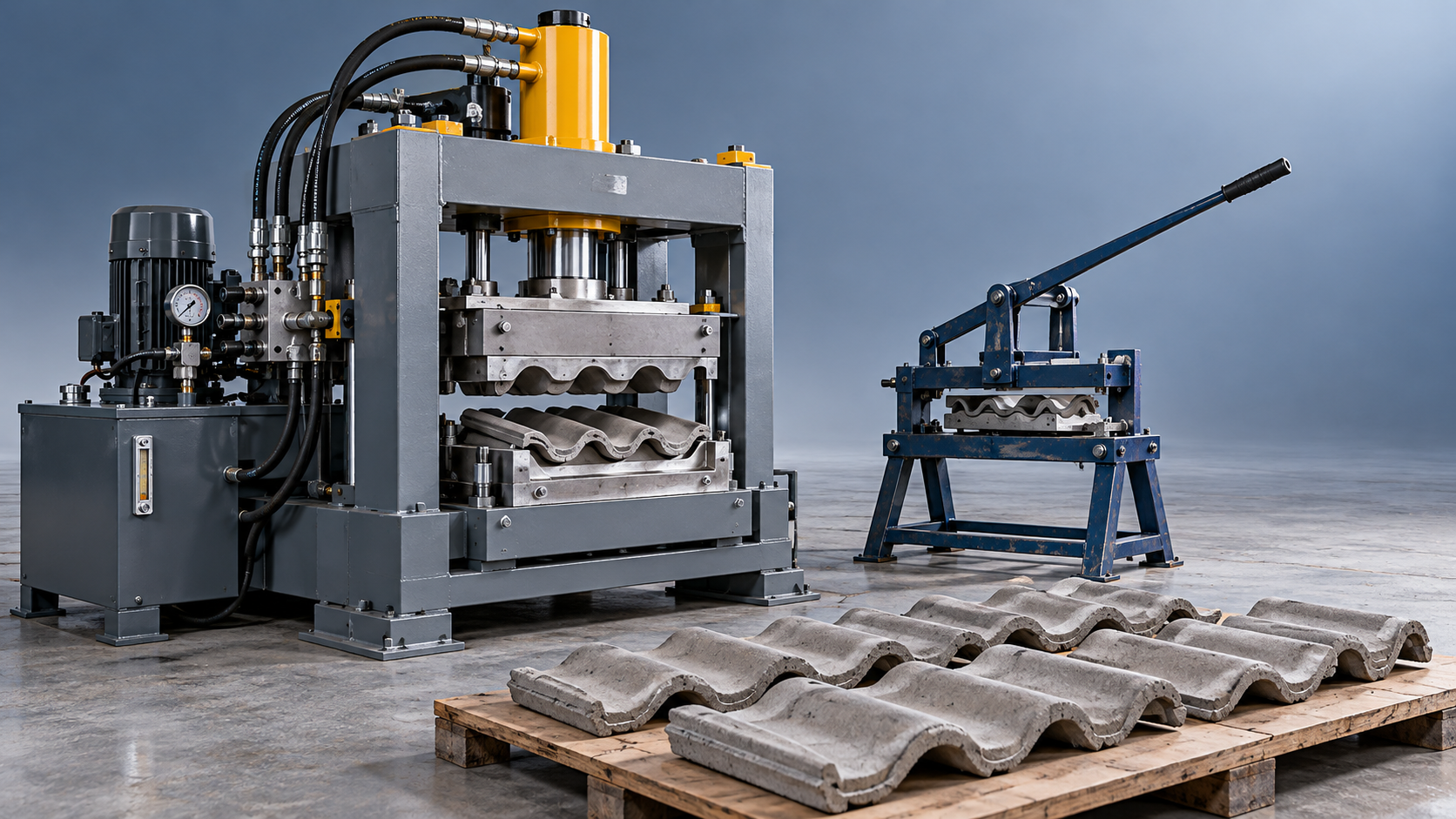
A hydraulic press uses pressurized fluid to move a cylinder that applies force through the tooling. Depending on the machine, operators may be able to adjust forming pressure, pressing duration, and the movement sequence. These controls help repeat an established forming cycle.
With manual pressing, the operator supplies force through a lever, screw, or another mechanical arrangement. Filling, pressing, and releasing the tile depend more heavily on technique and physical effort. A well-designed manual press can produce usable tiles, but maintaining the same routine throughout a shift requires discipline.
The categories can overlap. A hand-operated hydraulic press uses hydraulic force but still relies on manual pumping. A powered hydraulic machine may require workers to fill molds and remove tiles. Hydraulic describes how force is generated; automatic describes how operations are controlled and handled. Compare the actual work sequence, not just the equipment label.
Will hydraulic pressing make stronger, more consistent tiles?
It can improve consistency by reducing variation in the forming stage. When mold filling, mixture condition, and machine settings remain stable, repeatable pressure helps produce more uniform compaction. That can reduce differences between tiles and make production easier to control.
However, finished strength also depends on cement and aggregate selection, particle grading, water content, mixing, and curing. A hydraulic roof tile machine cannot turn a poorly prepared mixture into a reliable roofing product.
More pressure is not automatically better. The appropriate pressure depends on the mixture, tile profile, mold design, and forming process. Excessive or poorly matched pressure can contribute to sticking, difficult release, or defects. Press settings should come from a workable process established with representative materials.
Dimensional accuracy also depends on mold condition, alignment, and how much material enters the cavity. A worn mold can repeatedly produce the wrong shape, even under tightly controlled pressure. Uneven filling can leave thin areas or inconsistent edges.
For roof tiles, these details affect installation. Interlocking sections, overlaps, fixing features, and the way the tile sits on its supports need consistent geometry. Assess these features alongside appearance and strength rather than judging quality from a smooth surface alone.
How much faster is a hydraulic roof tile machine?
A powered hydraulic press can shorten and standardize the pressing stage, but its cycle time does not establish the output of the whole production line. Mixing, material delivery, mold preparation, tile removal, and movement into curing all consume time.
If workers cannot fill and clear the press at the required pace, additional pressing speed has limited value. If curing space or handling pallets are insufficient, freshly formed tiles accumulate and production must slow down.
Compare equipment using acceptable finished tiles per shift, allowing for normal stoppages, cleaning, changeovers, and rejects. A headline cycle rate may describe continuous pressing under conditions that your workshop cannot maintain.
Ask what each capacity figure assumes: the tile profile, number of cavities, staffing, feeding arrangement, and handling method. Also establish whether the stated output refers to freshly formed pieces or saleable tiles after curing and inspection. Those figures answer different business questions.
Does hydraulic equipment eliminate the need for skilled workers?
Hydraulic pressing reduces the physical effort needed to apply forming force. Depending on the equipment, it may also reduce repetitive actions. Workers still need to manage mixture consistency, mold filling, release, inspection, and handling.
Skill shifts toward process control. An operator needs to recognize when sticking comes from material buildup, unsuitable moisture, release conditions, or tooling problems. Increasing pressure whenever a defect appears can make the underlying problem harder to identify.
Manual pressing requires repeatable technique as well as effort. Differences in filling, lever operation, or release timing can affect results. Fatigue may make that routine harder to maintain during longer production runs.
Both methods require safe access and handling arrangements. Powered presses need effective guarding and controls around the pressing area; manual presses also create pinch points and repetitive handling demands. Compare the complete working station, including how tiles enter and leave it.
Which method costs less per saleable tile?
Manual pressing usually has the lower entry cost. That can be a sound choice when orders are occasional or the tile design is still being developed. Buying higher-capacity equipment before demand is established can leave money tied up in an underused machine.
As regular volume grows, labor time, inconsistent output, and handling losses become more significant. Hydraulic equipment may then justify its higher purchase and maintenance costs through greater usable output and more repeatable production.
A useful comparison is:
Cost per saleable tile = total production cost ÷ tiles accepted for sale.
Include materials, labor, energy, tooling wear, maintenance, curing, handling, and an appropriate share of equipment cost. Count rejects and breakages through final inspection. A low forming cost is misleading if too many tiles are lost afterward.
Compare both options at the same product specification and quality level. A cheaper tile with unreliable fit or strength does not provide an equivalent result. Base the decision on realistic demand, too: unused machine capacity does not reduce costs by itself.
What supporting equipment and maintenance should you expect?
A powered hydraulic press needs a suitable electrical supply and routine attention to oil condition, filters, seals, hoses, connections, and controls. Leaks, contamination, or unstable operation can affect reliability and pressing consistency. Accessible components and available replacement parts matter when downtime interrupts orders.
A manual press has fewer powered components, but it still needs maintenance. Worn joints, loose guides, damaged molds, and poor alignment can gradually change tile quality. Mechanical simplicity does not remove the need for inspection.
For either method, plan the equipment around the press: batching and mixing, material transport, molds, pallets or carriers where required, curing facilities, and finished-tile handling. Cement-based residues also require an effective cleaning routine.
The layout should let workers move fresh tiles without unnecessary lifting or disturbance. A well-matched press can still perform poorly in a cramped workshop where every batch waits for space or transport.
When is manual pressing the more practical choice?
Manual pressing can be appropriate when batch sizes are small, orders are irregular, and labor is available. It may also help establish a tile profile or workable mixture before committing to more equipment.
Its suitability depends on the finished product meeting the required quality level. Small-scale production still needs consistent batching, sound molds, controlled curing, and inspection. Lower output does not make dimensional fit or durability less important.
Manual production becomes harder to justify when pressing effort limits daily output, results vary between operators, or regular orders require predictable completion dates. Record actual labor time and accepted output before deciding whether the process can support expansion.
What should you check before buying a hydraulic press?
Start with the product you need to make. Define its material, profile, dimensions, color treatment, and required quality checks. Then establish expected daily demand and the labor, power, floor space, and curing capacity available to support it.
Use those requirements to evaluate the proposed machine:
- Material compatibility: Can it form your intended concrete mixture and tile geometry?
- Operating sequence: Which tasks are powered, and which still require manual work?
- Tooling: How are molds aligned, cleaned, changed, and replaced?
- Process adjustment: Which pressure and timing settings can operators control?
- Production support: What staffing, feeding, handling, and curing arrangements support the proposed output?
- Serviceability: Are instructions, wear parts, and technical support available?
A representative production trial is more useful than a pressure rating alone. Use materials close to those planned for production and assess filling, pressing, release, handling, and cured-tile quality. Examine dimensional fit, surface defects, and breakage, as well as relevant strength and water-performance requirements.
Shandong Hongfa Scientific Industrial & Trading Co., Ltd. manufactures building-materials machinery, including concrete batching and block-making equipment. When discussing a roof tile project with a machinery supplier, establish the specific tile-forming equipment and supporting processes included in the proposal. Broader machinery capabilities do not define the performance of a particular press.
Choose manual pressing when its verified output and quality meet a modest production requirement. Choose hydraulic pressing when repeatable forming and sustained output justify the supporting investment. Before ordering either, confirm that the complete process can deliver the tiles you intend to sell.
Recommend
 Nov 01, 2026
Which Is Better for AAC Production: Sand or Fly Ash?
How does a hydraulic roof tile machine differ from manual pressing? Discover why process control matters, then compare sand vs. fly ash for AAC costs, quality, and equipment needs.
- Nov 01, 2026
How Does a Hydraulic Roof Tile Machine Differ From Manual Pressing?
Choosing color tile or concrete roof tile? Compare hydraulic and manual pressing for costs, consistency, and output to find the right setup for your production goals.
- Oct 31, 2026
Which Is More Durable: Color Tile or Concrete Roof Tile?
Which is more durable: color tile or concrete roof tile? Compare materials, weather resistance, and manufacturing quality to choose the right roofing with confidence.