Which Is More Durable: Color Steel Tile or Concrete Roof Tile?
The Short Answer
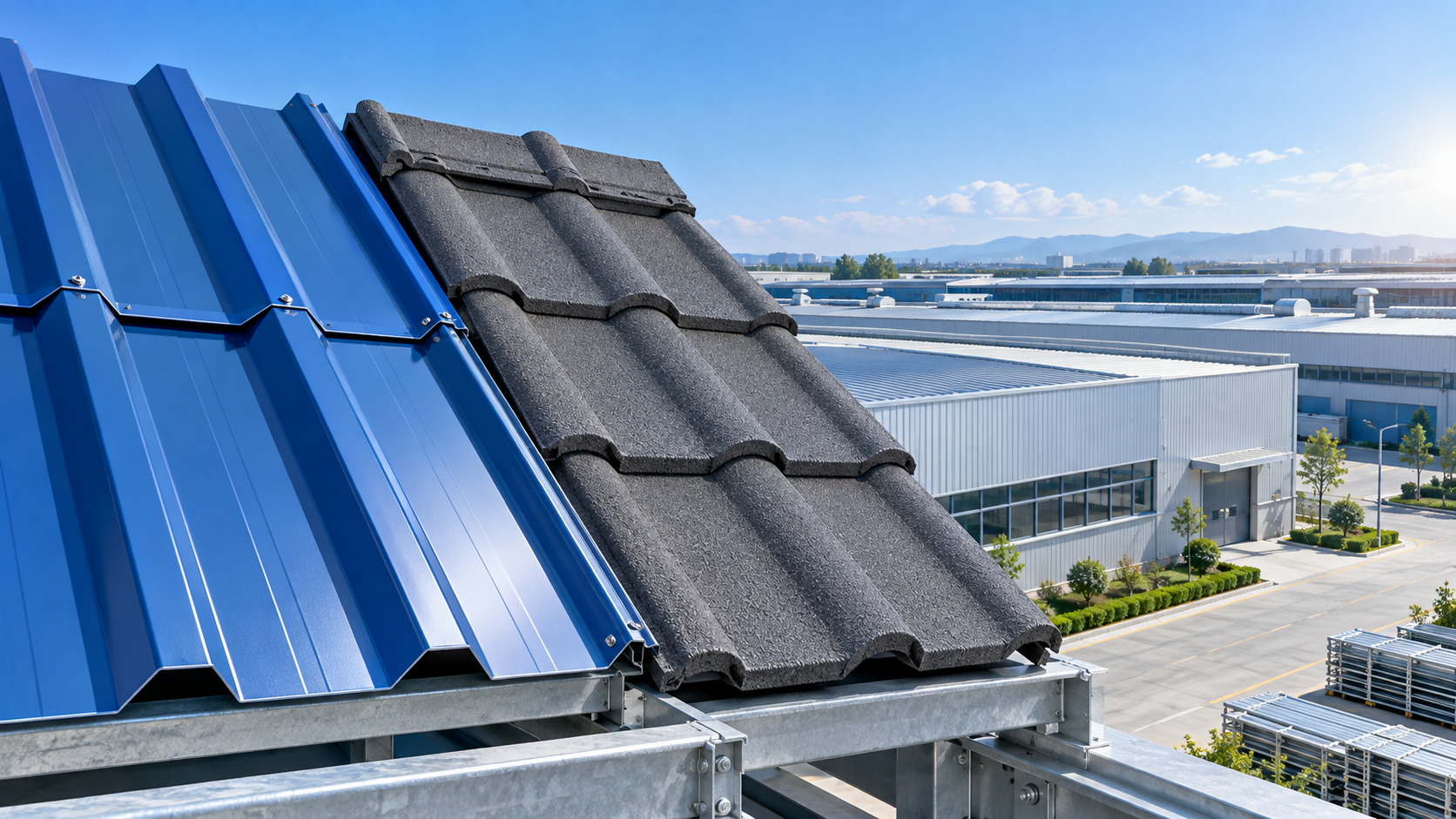
Concrete roof tile is usually the more durable choice when durability means long-term resistance to fire, ultraviolet exposure, hail, rot, and gradual weathering. A well-designed concrete tile roof can remain serviceable for decades because the tile itself is a dense mineral material that does not depend on a thin protective coating to survive outdoors.
Color steel tile can also provide a long working life, but its durability is more conditional. It depends heavily on steel thickness, galvanizing or aluminum-zinc coating weight, paint-system quality, edge treatment, fastening, roof drainage, and the local atmosphere. In a dry inland industrial building with proper detailing, color steel roofing may perform reliably for many years. In a humid, coastal, chemical, or poorly maintained environment, corrosion can shorten its useful life much faster than many buyers expect.
That does not make concrete tile the automatic answer for every building. Concrete is heavier, needs a roof structure designed for that load, and is less suitable for many lightweight industrial sheds. Color steel is lighter, faster to install, and often better matched to large-span workshops, warehouses, and temporary or expandable facilities. The practical question is not simply which material is tougher in isolation. It is whether the roof system can retain its performance under the building's load limits, climate, geometry, maintenance plan, and expected service period.
Durability Depends on What Is Expected to Fail First
When comparing roof materials, “durable” can describe several different outcomes. A roof may resist breakage but corrode. It may last for decades but require more repairs after storms. It may remain structurally sound while losing its finish, appearance, or water-tightness. Contractors and building owners should separate these questions before selecting either material.
- Material life: How long the tile or sheet itself resists degradation.
- Water-tightness: How well the full roof assembly prevents leaks at overlaps, penetrations, ridges, eaves, and fasteners.
- Weather resistance: Performance under sun, rain, frost, snow, wind, hail, and temperature cycling.
- Structural tolerance: Ability to remain reliable under roof loading, movement, impact, and foot traffic.
- Maintenance exposure: How much regular inspection, cleaning, repainting, replacement, or local repair the roof needs.
Concrete tile generally has an advantage in material stability. Its performance is less vulnerable to surface scratches and does not depend on the continued integrity of a painted metal skin. Color steel sheets, however, can form a relatively continuous roof surface with fewer individual units, which may reduce some water-entry paths when the sheet profile, overlaps, and flashings are correctly installed. A roof’s weak point is often the installation detail rather than the visible roofing material.
Why Concrete Tile Usually Lasts Longer as a Material
Concrete roof tiles are made to withstand outdoor exposure through their mass, density, and mineral composition. Sunlight does not cause the same type of coating breakdown seen on painted metal roofing. Concrete is non-combustible, does not rust, and is generally stable through ordinary seasonal temperature changes. It also provides a substantial physical barrier against weather when installed with suitable underlayment and fixing methods.
For residential buildings, low-rise commercial properties, and permanent facilities with a roof structure designed for the weight, these characteristics support a long service life. The tile surface may weather, develop staining, or require cleaning in damp shaded locations, but surface aging does not necessarily mean that the roofing unit has lost its basic protective function.
Concrete tile also performs well in high-temperature and high-UV conditions. A coated steel panel may remain functional in strong sun, but the finish can fade or chalk over time, especially where the paint system is not selected for intense ultraviolet exposure. Once a metal coating is damaged, corrosion can begin around scratches, cut edges, drilled holes, or poorly protected fastener locations. Concrete tile has no comparable corrosion mechanism.
There are limits. Concrete tile can crack under severe impact, careless handling, or concentrated loading. Individual tiles may also break if workers walk directly on unsupported sections during maintenance. In regions with freeze-thaw cycles, tile quality, water absorption, roof pitch, and drainage matter. Water entering a weak or damaged tile can create problems when it freezes. A durable concrete roof therefore still requires sound manufacturing, correct laying, and an appropriate roof system below it.
Why Color Steel Durability Varies So Widely
Two roofs described as “color steel tile” can have very different life expectancies. The term commonly refers to profiled steel roofing sheets with a metallic corrosion-protection layer and a colored organic coating. The visual profile may look similar from one supplier to another, while the steel base, coating system, and fabrication quality differ significantly.
A thicker steel substrate generally offers better resistance to deformation and damage during transport, installation, and service. The metallic coating helps delay corrosion, while the paint coating protects the surface and contributes to appearance. These layers work together. If the paint is damaged, if cut edges are left unprotected, or if water remains trapped in laps and gutters, the metal substrate can eventually corrode.
For this reason, a color steel roof should be assessed as a system rather than as a sheet sample. The following details have a direct effect on durability:
- The base steel thickness and its suitability for the span, wind loading, and access requirements.
- The corrosion-protection coating specified for the building environment.
- The paint type and its resistance to ultraviolet radiation, moisture, and industrial pollutants.
- Correct screw type, washer quality, fastening position, and tightening force.
- Proper treatment of cut edges, drilled openings, overlaps, ridge caps, and flashings.
- Roof slope and drainage design, especially where dirt, leaves, or standing water can accumulate.
- Separation from incompatible metals that can accelerate corrosion in wet conditions.
Color steel often performs best where low roof weight, rapid installation, and economical coverage are major priorities. It is a practical solution for workshops, storage buildings, agricultural structures, equipment shelters, and other large-area roofs. Its light weight reduces demands on the supporting frame and can make transport and construction more efficient. Those advantages are real, but they do not remove the need to specify the coating system around the actual exposure conditions.
Climate Can Reverse the Preferred Choice
In a mild, dry inland climate, a quality color steel roof may give dependable service with relatively straightforward maintenance. The risk of persistent wetness is lower, airborne salt is absent, and corrosion pressure is more manageable. For a building expected to be modified, extended, or relocated, steel roofing may offer a more practical durability-to-cost balance than a heavier tile roof.
Coastal conditions require greater caution. Salt-laden air can settle on metal surfaces and remain active when moisture is present. This affects not only broad sheet areas but also cut edges, laps, fasteners, gutters, and any point where the protective layer has been disturbed. A standard painted panel selected solely by appearance may be a poor long-term choice near the sea unless its corrosion protection is designed for that environment and the roof can be regularly washed and inspected.
Industrial atmospheres deserve the same attention. Exhaust, dust, acidic contaminants, fertilizer residues, animal-house gases, and process emissions can attack coatings and trapped moisture zones. In these settings, the initial price difference between a basic metal sheet and a better-protected roofing system can be misleading. Early coating damage and localized rust are difficult to address once they occur inside overlaps or around roof penetrations.
Concrete tile is less exposed to corrosion, so it is often attractive in corrosive atmospheres where the building can support its weight. Yet moisture-related concerns do not disappear. Moss, algae, and debris can collect on tile roofs in humid and shaded locations, restricting drainage and complicating inspections. Tile roofs need adequate pitch, proper underlayment, secure fixings, and clear drainage routes. A heavy roof with blocked valleys or failed underlayment can still leak extensively.
Weight and Roof Structure Are Not Secondary Issues
A concrete tile roof imposes a much greater dead load than color steel roofing. This affects trusses, purlins, walls, foundations, seismic design, lifting arrangements, and installation planning. Replacing a light metal roof with concrete tile without checking the structure is a serious mistake. The roof frame must be designed or verified by qualified professionals for the combined dead load, wind load, snow load where applicable, and maintenance loading.
Color steel is often selected because it allows lighter support structures and longer economical spans. That benefit is particularly relevant to industrial and agricultural buildings, where roof area is large and internal columns may need to be minimized. But lightweight sheets are also more sensitive to fastening quality, wind uplift design, and local deformation. A panel that is adequate for one purlin spacing may not be adequate for another. The roofing profile, sheet thickness, fastener pattern, and edge-zone design should be coordinated rather than chosen independently.
For high-wind areas, neither option should be judged by material weight alone. A heavy concrete tile can still fail if fixings are insufficient. A correctly engineered metal roof can resist wind effectively, but poorly installed sheets may lift first at corners, eaves, and ridge zones where wind pressure is highest. The connection design deserves at least as much attention as the tile or panel specification.
Maintenance Changes the Long-Term Comparison
Concrete tile roofs typically require periodic visual inspection, clearing of valleys and gutters, replacement of broken tiles, and attention to flashing or underlayment as the roof ages. A broken tile is often a localized repair, provided the surrounding roof assembly is accessible and sound. The visible covering may remain serviceable for a long time, while secondary components need renewal earlier.
Color steel roofs require inspection for coating damage, loose or deteriorated fasteners, failed washers, corrosion at cut edges, blocked drainage, and scratches caused by maintenance work. Local repairs are possible, but they are most effective when corrosion is identified early. Once rust spreads beneath a coating or within an overlap, the repair can become more extensive than it first appears.
Maintenance access also matters. A roof that cannot be safely inspected will often receive attention only after leakage becomes visible indoors. For industrial buildings with rooftop equipment, vents, ducts, solar installations, or frequent maintenance traffic, specify walkways and access provisions. Repeated foot traffic can damage both materials: it can crack concrete tiles or dent and scratch steel sheets.
How to Choose for a Specific Building
Concrete roof tile is usually the stronger long-term durability choice when the building is permanent, the structure is designed for a heavy roof, appearance retention matters, and the owner wants a material that is inherently resistant to fire, sunlight, and corrosion. It is particularly suitable where a pitched tile roof is already part of the building design and future structural modification is unlikely.
Color steel tile is often the more suitable choice when low structural weight, speed of installation, large roof coverage, and construction efficiency are more important than maximizing the inherent life of the roof covering. It can be highly durable when the steel grade, protective coatings, drainage design, and installation details are matched to the exposure environment. It becomes a higher-risk option when buyers treat all coated sheets as equivalent or ignore corrosive conditions.
Before issuing a purchase order, define the building location, expected design life, roof pitch, structural capacity, wind and snow exposure, internal humidity, external pollutants, maintenance access, and planned rooftop penetrations. Then ask suppliers to provide specifications for the full roof system, not only a color chart or profile drawing. For steel roofing, that means base metal, metallic coating, paint system, fasteners, flashings, and edge treatment. For concrete tile, it means tile quality, fixing method, underlayment, battens, ridge details, and load requirements.
So, which is more durable? Concrete tile normally wins when comparing the roofing materials themselves over a long service period. Color steel can be the better building decision when structural and operational needs favor a lightweight roof, but its durability must be engineered through specification and installation. The most expensive outcome is not choosing the less durable material; it is choosing a roof whose material, structure, climate exposure, and maintenance plan were never aligned.
Next:No more content
Recommend
 Oct 18, 2026
Which Is More Durable: Color Steel Tile or Concrete Roof Tile?
Which is more durable: color steel tile or concrete roof tile? Compare lifespan, corrosion resistance, weight, climate performance, and maintenance to choose the right roof.
- Oct 17, 2026
Does AAC Plant Installation Require Local Electrician Support?
Does AAC plant installation require local electrician support? Discover why local electrical expertise ensures safe connections, code compliance, and smooth commissioning.
- Oct 16, 2026
What Problems Commonly Occur During AAC Plant Commissioning?
What are common problems during AAC plant commissioning? Explore raw material variation, batching, cutting, steam, automation, and practical fixes for reliable startup.