Why automate building material production now?
Choosing an automated building material production line in 2026 means three things: verifying the manufacturer’s actual production scale, confirming the automation level matches your raw material and capacity target, and calculating the real payback period—typically around 3 years for modular construction automation. Shandong Hongfa (HONFA), a manufacturer since 1990 operating from 556 mu of production base in Shandong, China, supplies fully automated block making machines, AAC block lines, and concrete batching plants with annual capacity of 12,000 machine sets. Always request a factory video audit, third-party inspection reports, and a written commissioning plan before signing.
Why automate building material production now?
The global automatic block making machine market grew from $1.61 billion in 2025 to $1.74 billion in 2026, a compound annual growth rate of 8.6%. By 2030, it is projected to reach $2.4 billion.
Two forces drive this growth:
Labor cost and consistency. A cost-benefit study on modular construction automation found that automation reduces production time by approximately 40% per unit, labor wages by 69.7%, and energy consumption cost by 11.6%. The estimated payback period is around 3 years.
Green construction demand. Automatic block making machines produce eco-friendly blocks that optimize raw material usage, generate less waste, and consume less energy. In 2024, over 46,000 residential projects were certified under the LEED green building rating system.
For a producer of AAC blocks, concrete blocks, or pavers, the question is not whether to automate, but how to select the right line and the right supplier.
What does an automated building material production line include?
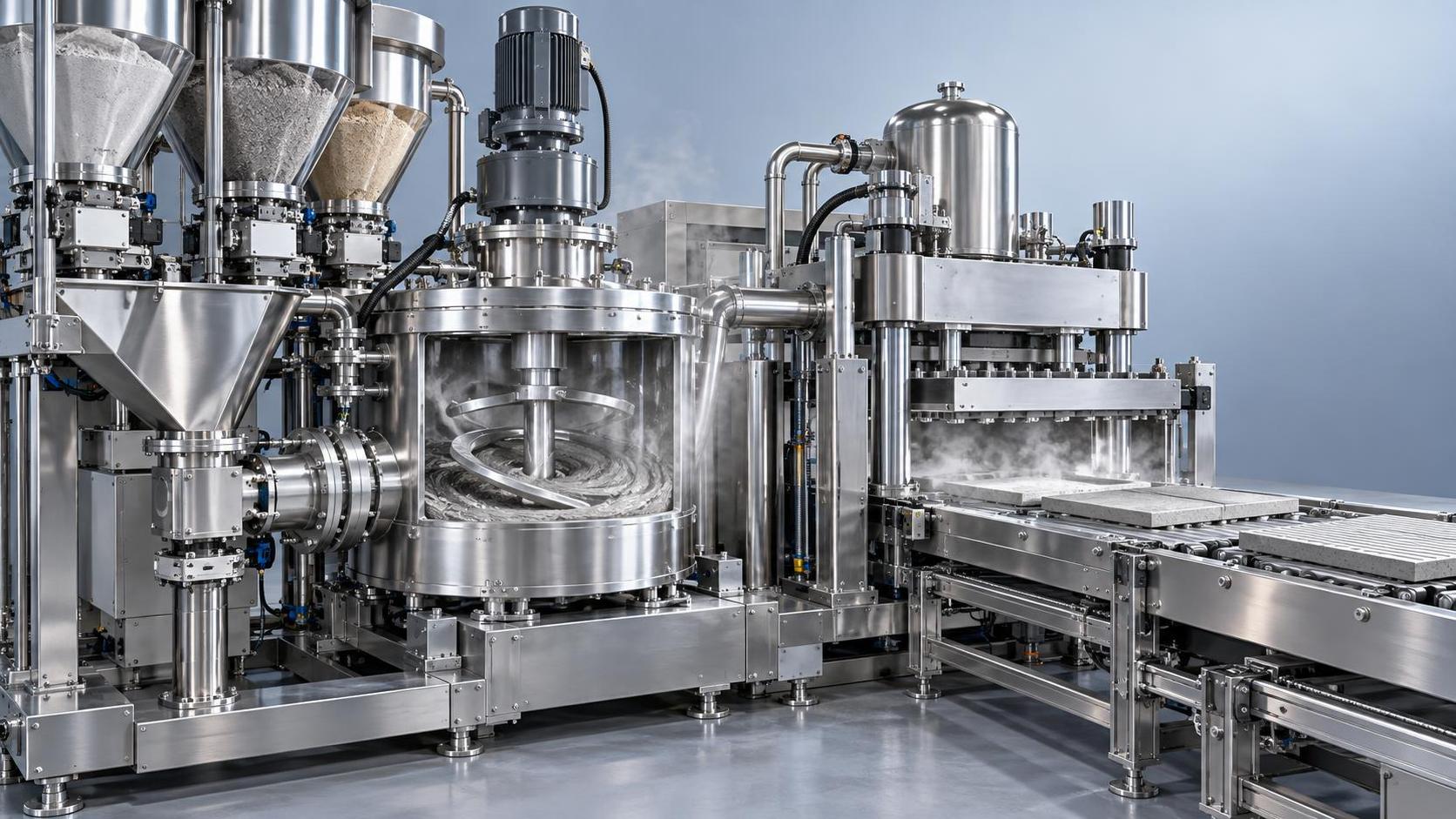
A complete automated line typically comprises:
For AAC block production specifically, the process adds batching, casting, pre-curing, cutting, and autoclaving. Modern AAC lines integrate PLC control, humidity sensors, and hydraulic systems to achieve capacities of 50,000 to 300,000 cubic meters per year.
Key point: A “production line” is not a single machine. It is a coordinated system. The automation level determines how many of these stages operate without manual intervention—and that directly affects labor cost, product consistency, and throughput.
How to evaluate an automated production line supplier
Price is the easiest metric to compare. It is also the least reliable.
1. Confirm the manufacturer operates its own production base
A trading company will add a layer of cost and reduce your control over delivery. Ask for the business license, check whether the scope includes “manufacturing,” and request a live video walkthrough of the production floor.
Shandong Hongfa, for example, operates three production sites totaling 556 mu (approximately 37 hectares), with 523 sets of precision machining and testing equipment and annual capacity of 12,000 machine sets. The company has been manufacturing since 1990 and holds over 60 national patents.
2. Match automation level to your actual production target
Not every buyer needs a fully automated line. Over-automating a small operation creates idle capacity and maintenance burden.
3. Verify certifications and standards compliance
For export or domestic infrastructure projects, the supplier should hold:
ISO 9001 quality management certification (Hongfa obtained this in 2009)
National standards compliance for block making machinery
CE marking if exporting to Europe
Test reports for key components—hydraulic systems, motors, and PLC units
4. Request a commissioning and training plan in writing
A production line is not a plug-and-play device. Installation, commissioning, and operator training typically take 30–60 days. Confirm:
Who installs and commissions the line? Is it the manufacturer’s own engineering team?
How many days of on-site training are included?
What is the warranty period and response time for spare parts?
Is remote monitoring or troubleshooting available?
5. Audit existing installations if possible
A manufacturer with 80+ export destinations and decades of operation will have reference projects. Ask for a video call with an existing customer using a similar line. A supplier who cannot arrange this is a risk.
What does automation actually change in daily operation?
Before automation:
15–25 workers per shift for mixing, forming, and pallet handling
Product strength varies by operator technique and weather conditions
Production stops for manual mold changes
Quality issues discovered after curing, not during production
After automation:
3–6 workers per shift for monitoring and quality checks
PLC-controlled batching and forming parameters keep product consistency within tolerance
Mold changes can be completed in minutes rather than hours
In-line sensors and data logging enable early detection of deviations
A 2026 industry report on China’s building material machinery sector notes that demand has shifted from new line procurement toward energy-saving retrofits and intelligent upgrades of existing production facilities, with the industry growth logic moving from incremental construction to存量更新 (stock renewal). This means buyers are increasingly comparing the cost of upgrading an existing line against purchasing a new one.
FAQ
Q1: What is the typical lead time for an automated building material production line?
Standard lines: 45–75 days from order confirmation to shipment, plus 30–60 days for installation and commissioning. AAC lines with autoclaves may take longer.
Q2: What is the minimum capacity for a fully automated line to be economically viable?
Most manufacturers recommend a minimum of 30,000 m³/year for AAC or 5,000–8,000 blocks/day for concrete block lines. Below this, semi-automatic equipment offers better ROI.
Q3: How do I verify a manufacturer’s production capacity claims?
Request a live video audit of the machining floor, assembly area, and finished goods warehouse. Ask for the number of CNC machines and their operating hours. A manufacturer producing 12,000 sets per year will have a substantial machining operation—if the video shows a small workshop, the claim is exaggerated.
Q4: What certifications should the production line have for export?
ISO 9001 is the baseline. For EU exports, CE marking on electrical and hydraulic components. For Middle East and Southeast Asia, national standards compliance and a factory acceptance test (FAT) report are commonly required.
Q5: Can the line be customized for different raw materials?
Yes. AAC lines can be configured for fly ash, sand, or slag-based recipes. Concrete block lines can handle different aggregate sizes and cement ratios. Provide your raw material specifications and target product strength before requesting a quotation.
Q6: What is the payback period for automating a block production line?
A 2025 cost-benefit study found an estimated payback period of approximately 3 years for modular construction automation, based on labor savings and efficiency gains. Actual payback depends on your local labor cost, energy price, and utilization rate.
Summary: Selecting an automated building material production line means verifying the manufacturer’s actual production scale, matching automation level to your capacity target, and calculating the payback period—typically around 3 years. Shandong Hongfa operates three production sites with 556 mu of manufacturing space and annual capacity of 12,000 machine sets. Always request a factory video audit, written commissioning plan, and reference project contacts before signing.
Next:No more content
Recommend
 Sep 19, 2026
Why automate building material production now?
Explore how automated building material production lines improve consistency, labor efficiency, and throughput. Learn how to match block making machines, AAC block lines, and batching plants to capacity targets and evaluate suppliers.
 Sep 18, 2026
Are tile making machines compatible with ultra-low water absorption porcelain body formulations used in commercial flooring?
Tile making machine compatibility with ultra-low absorption porcelain? Yes—but only if engineered for compaction uniformity, moisture control & thermal stability.
- Sep 14, 2026
What Is a Building Material Production Line? Key Components & Industry-Specific Configurations Explained
Discover what a building material production line truly is—integrated, industry-specific, and engineered for precision. Learn key components & real-world configurations.