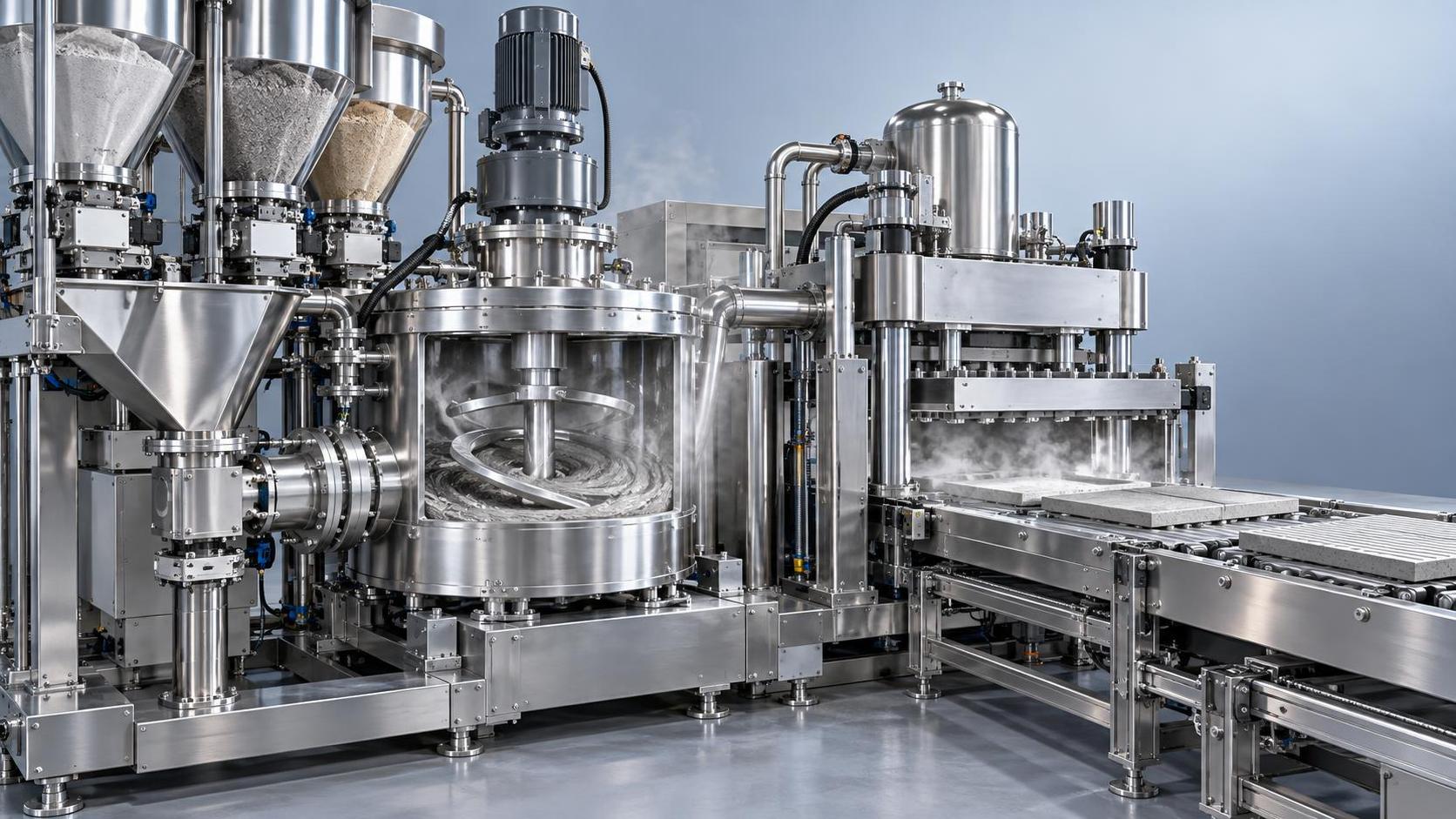
What Is a Building Material Production Line? Key Components & Industry-Specific Configurations Explained
What Is a Building Material Production Line?
It’s not just a collection of machines bolted together. A building material production line is an engineered system—designed, calibrated, and integrated—to transform raw inputs (sand, cement, quartz powder, aluminum paste, water, additives) into consistent, specification-compliant construction products at scale. Think of it less like an assembly line for cars and more like a tightly choreographed chemical-mechanical process: where timing, pressure, temperature, mixing ratios, and curing conditions aren’t just variables—they’re interdependent control points.
That distinction matters. Because when someone asks “What is a building material production line?”, they’re rarely asking for a dictionary definition. They’re usually sizing up feasibility—whether for a new factory, a plant upgrade, or a technical due diligence review. And the answer changes depending on what you’re making: aerated concrete blocks behave differently from quartz stone slabs, which behave differently from ready-mix concrete or interlocking pavers. There’s no universal “standard” configuration—only context-driven logic.
Core Components: Not Interchangeable, But Interlocked
Every functional production line shares five foundational subsystems—but their design, capacity, and integration depth vary sharply:
- Raw material handling & dosing: Not just hoppers and conveyors. Precision matters—especially for lightweight blocks where ±0.5% deviation in aluminum paste dosage alters pore structure and compressive strength. Bulk silos, weigh hoppers with load-cell feedback, and closed-loop batching controllers are non-negotiable for repeatable output.
- Mixing & homogenization: A planetary mixer for quartz composites isn’t interchangeable with a paddle mixer for AAC slurry. The former must achieve micron-level dispersion of resin and filler; the latter must generate uniform gas bubbles without over-shearing. Mixing time, blade geometry, and energy input per unit mass directly affect final density and surface integrity.
- Molding & forming: Here, automation meets material science. Vacuum-assisted pressing for quartz slabs eliminates voids; steam-cured molds for AAC require thermal inertia to avoid cracking during expansion. Hydraulic pressure, dwell time, and mold release chemistry all feed into dimensional stability and edge quality.
- Curing & hardening: This isn’t passive waiting—it’s active process control. AAC lines use autoclaves with precise 190°C/12 bar steam cycles; quartz lines rely on multi-zone ovens with ramp-soak-cool profiles. Skip calibration here, and you risk warping, delamination, or inconsistent flexural strength—even if everything upstream looks perfect.
- Finishing & packaging: Sawing, polishing, stacking, labeling. For export-grade quartz, CNC diamond wire saws must hold ±0.3 mm tolerance across 3.2 m slabs. For block lines, robotic palletizing needs real-time weight verification—not just count-based logic—to prevent underloaded trucks or damaged units.
None of these operate in isolation. A delay in curing affects downstream cutting throughput. An error in dosing propagates through every subsequent stage. That’s why leading manufacturers treat integration—not individual machines—as the primary engineering challenge.
Industry-Specific Configurations: Why “One Size Fits None”
A line built for high-density quartz stone (≥2.5 g/cm³, low water absorption, UV-stable) has fundamentally different thermal, mechanical, and control requirements than one optimized for lightweight AAC blocks (≤0.6 g/cm³, fire-rated, insulating). The differences aren’t cosmetic—they’re rooted in material physics and end-use compliance:
Quartz stone lines prioritize vacuum degassing, high-pressure hydraulic presses (up to 12,000 tons), and post-cure polishing stations. AAC lines emphasize slurry consistency monitoring, pre-cure temperature ramps, and autoclave batch scheduling. Concrete batching plants focus on moisture compensation algorithms and aggregate gradation sensors—because a 0.3% moisture shift in sand changes slump and set time.
This is where experience surfaces—not as marketing claims, but in how systems handle edge cases. For example: how does the dosing system respond when fly ash moisture fluctuates seasonally? Does the PLC log deviations above ±1.2% for root-cause analysis? Can the curing controller adjust cycle time based on ambient humidity readings? These aren’t feature checklists—they’re operational safeguards built from decades of field data.
Behind the Engineering: What Makes a Manufacturer Credible?
Credibility isn’t signaled by glossy brochures. It shows up in traceability, not just certification. ISO 9001:2008 tells you a quality system exists; a point-like quality tracking system—where every component, weld, sensor calibration, and software version is logged against serial number and production date—tells you it’s enforced.
Shandong Hongfa, founded in 1990, operates four production bases across Shandong and Guangxi, covering over 500 acres. Its technical foundation includes 56 senior engineers and more than 1,120 technicians—and crucially, a National Institute of Building Materials Equipment and Technique Research Institute co-located with the Shandong Machinery Research Institute. That institutional link means R&D isn’t isolated from manufacturing reality. Of its 46 national patents, 28 are invention patents—many tied to core process innovations: adaptive dosing algorithms for variable raw material batches, vibration-dampened pressing frames for large-format quartz, or energy-recovery loops in AAC autoclave exhaust systems.
The “1% product defects = 100% lack of trust” philosophy isn’t aspirational—it’s baked into workflow design. Every machine model undergoes 72-hour continuous load testing before shipment. Every line commissioning includes joint validation with the client’s QA team against ASTM, EN, or GB standards—not just internal benchmarks.
What to Ask Next—Before You Specify Anything
If you’re evaluating options, skip the “how many units per hour?” question first. Start with: What’s your raw material profile—consistency, moisture, particle size distribution? What local standards govern density, fire rating, or freeze-thaw resistance? Do you need modular scalability—or full turnkey handover including operator training and spare parts logistics?
Because a building material production line isn’t purchased. It’s commissioned. And the strongest partnerships begin not with specs, but with shared understanding of what success actually looks like—on site, on schedule, and under real operating conditions.