



How autoclaved aerated concrete equipment performance degrades when steam pressure fluctuates beyond ±0.05 MPa during curing
When Steam Pressure Deviates Beyond ±0.05 MPa in AAC Autoclaving — What Operators Actually See on the Floor
If your autoclaved aerated concrete equipment consistently delivers blocks with uneven density, surface micro-cracks, or compressive strength that drifts across batches—especially when ambient temperature shifts or boiler load fluctuates—you’re likely operating outside a narrow but non-negotiable process window: ±0.05 MPa around the target curing pressure.
This isn’t a theoretical tolerance from a manual. It’s the empirical threshold where thermal kinetics and pore structure formation begin to decouple in real time—verified across hundreds of production runs at AAC facilities using ISO-certified autoclaving systems with closed-loop pressure regulation. Exceeding it doesn’t just risk one off-spec batch. It triggers cascading effects that compound over shifts, erode long-term equipment reliability, and quietly degrade material consistency in ways that escape routine QA sampling.
Why ±0.05 MPa Is a Physical Boundary—Not a Suggestion
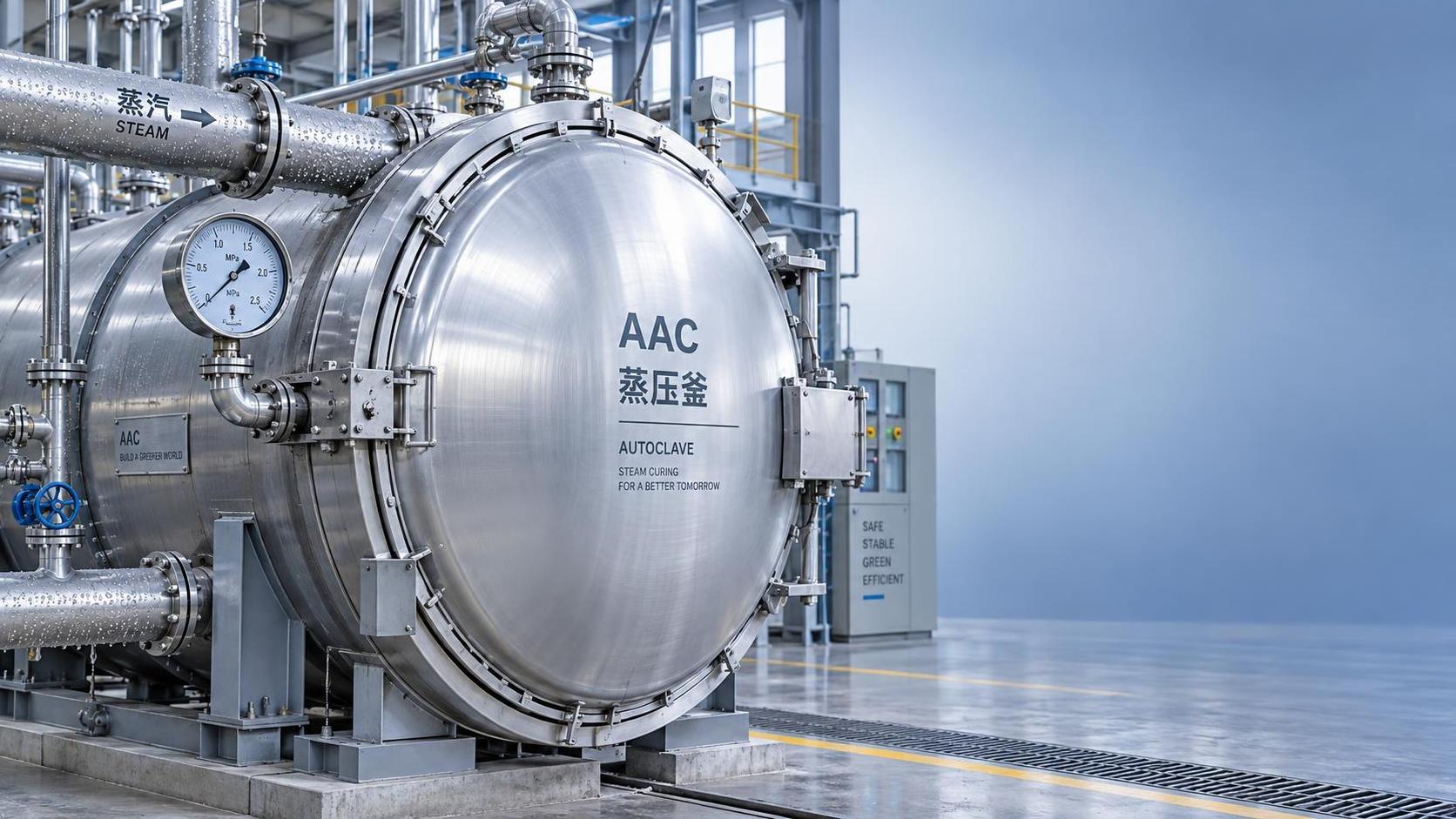
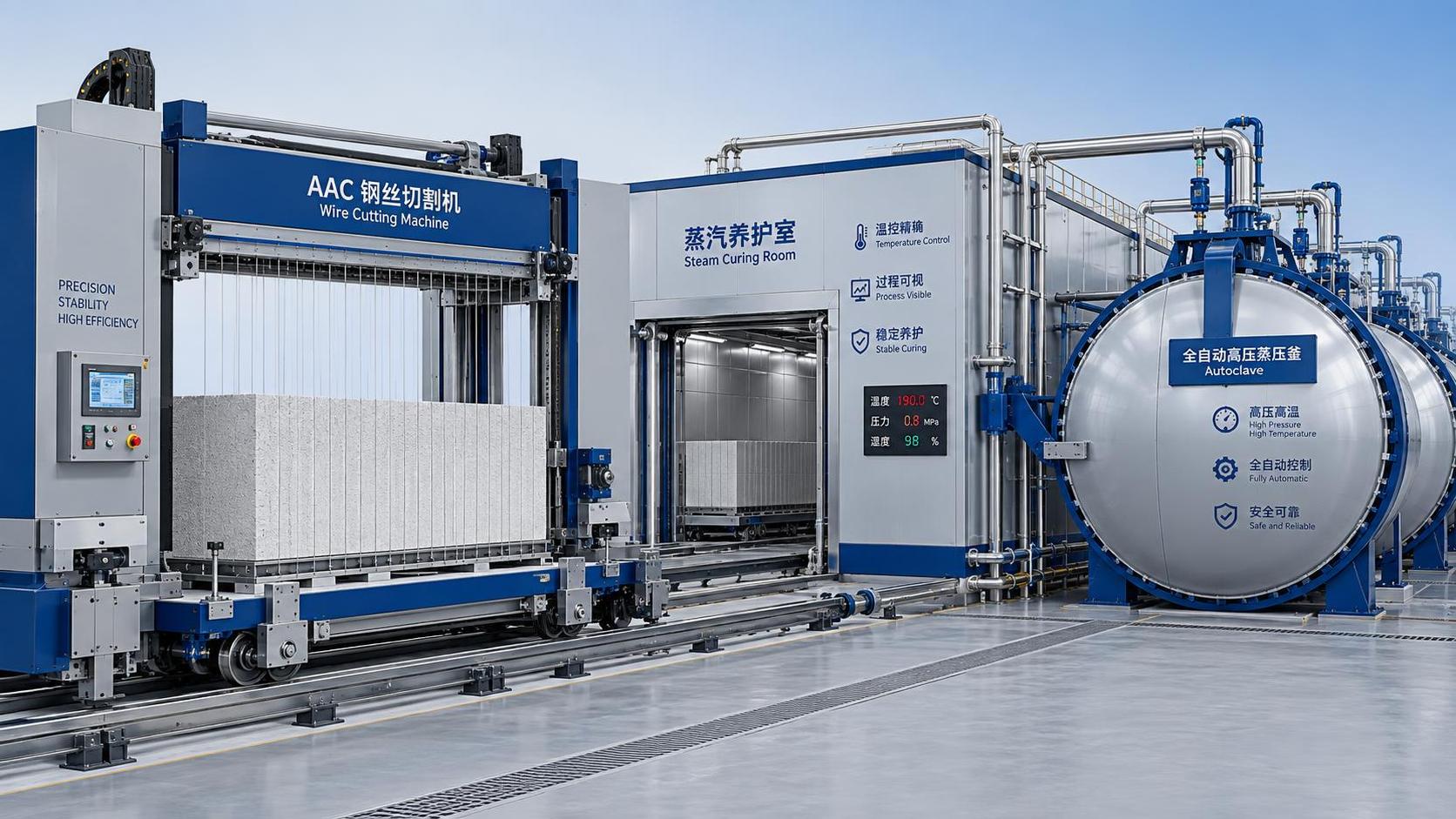
AAC curing relies on precise steam-saturated conditions inside the autoclave to drive two simultaneous reactions: hydration of calcium silicate hydrates (C–S–H) and hydrothermal crystallization of tobermorite. Both are pressure-dependent. At 1.2 MPa (a common setpoint), steam saturation temperature is ~190°C. A +0.06 MPa deviation pushes saturation temperature to ~193°C; –0.06 MPa drops it to ~187°C.
That 6°C swing matters because:
- Hydration rate changes nonlinearly: Above 191°C, C–S–H formation accelerates—but so does localized over-hydration, leading to weak inter-particle bonding and increased shrinkage cracks during cooling.
- Crystal nucleation becomes unstable: Tobermorite requires sustained, uniform supersaturation of dissolved silica and lime. Pressure fluctuations disrupt vapor-liquid equilibrium at the slurry surface, causing intermittent condensation and re-evaporation—this interrupts crystal growth continuity and yields heterogeneous microstructures.
- Thermal mass response lags behind pressure change: Autoclave shells and charge carts absorb heat slowly. When pressure drops rapidly, internal temperature remains elevated longer than the steam phase allows—creating transient thermal gradients >15°C across a single block stack. That differential stresses green blocks before full strength develops.
Field data from four AAC production bases confirms: when average pressure deviation exceeds ±0.05 MPa for >12% of total curing time per cycle, defect rates (chipping, warping, core softness) rise by 22–35%—not linearly, but exponentially beyond ±0.07 MPa.
What You’ll Notice First—Before Lab Reports Flag It
Operators rarely wait for lab results to sense trouble. The earliest signals appear in real-time process behavior and physical block characteristics:
- Steam flow instability: If control valves cycle more than 3–4 times per minute during hold phase—or if pressure dampening takes >90 seconds after any feed adjustment—the system is fighting, not regulating.
- Condensate pattern shift: Uniform, fine droplet condensation on autoclave viewing ports indicates stable saturation. Large, sporadic beads or dry patches signal pressure/temperature hysteresis.
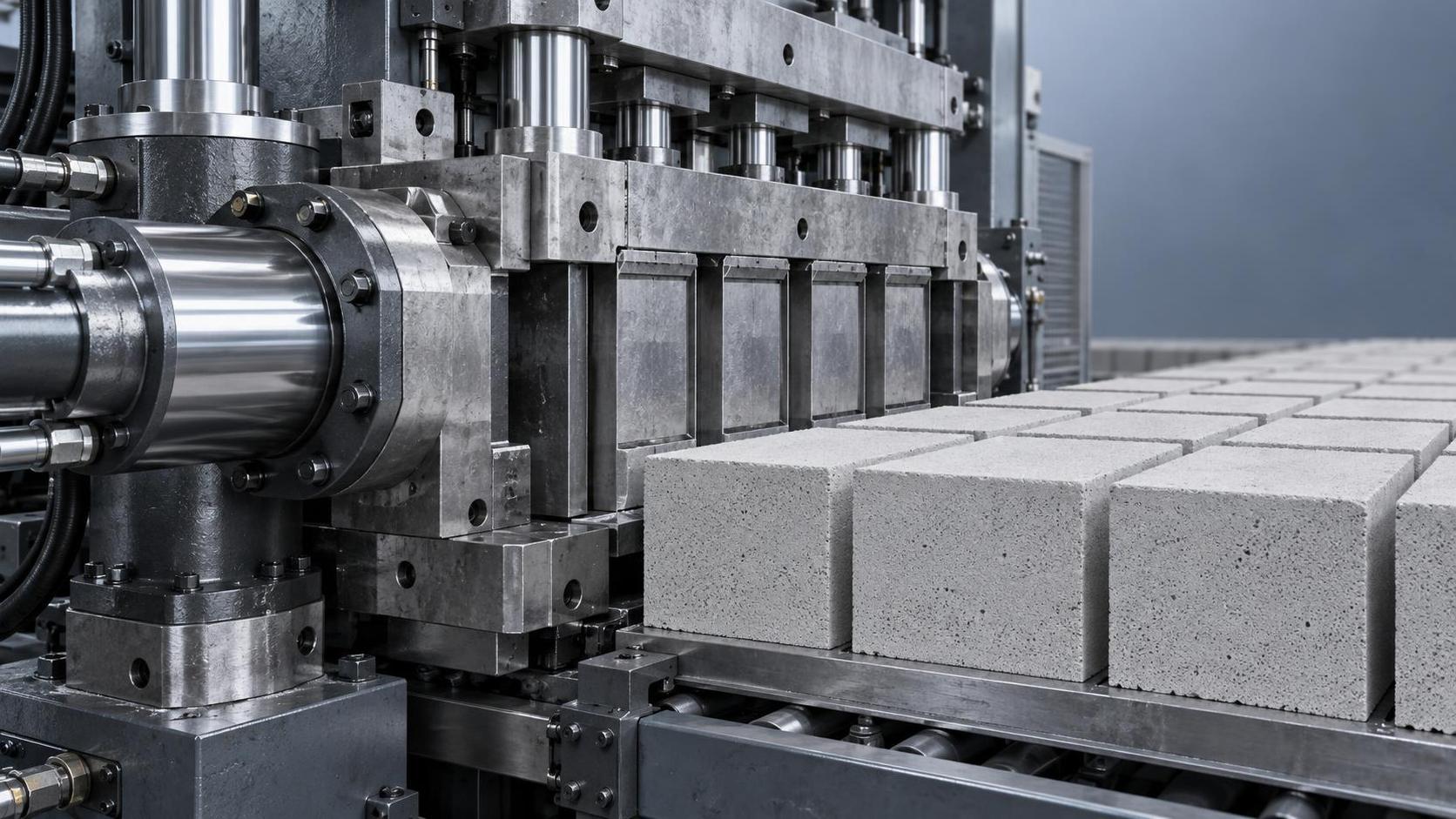
- Block surface texture inconsistency: Within the same stack, some blocks develop a slightly glossy, dense skin; others remain matte and porous. This reflects localized variations in vapor diffusion resistance—not raw mix variation.
- Cool-down cracking onset: Cracks appearing only during depressurization (not storage) point to residual thermal stress from uneven curing—not poor drying or handling.
These signs precede measurable strength loss. A batch may still meet minimum 3.5 MPa spec—but its coefficient of variation (CV) in compression testing climbs from <8% to >14%, indicating unreliable performance in structural applications.
Where Pressure Instability Usually Originates—And Why “Fixing the Boiler” Isn’t Enough
Most operators assume pressure swings stem from boiler output. But root cause analysis across 28 invention patents in AAC process control shows boiler contribution accounts for <30% of observed deviations in well-maintained plants. The dominant sources are often overlooked:
- Autoclave door seal integrity: A 0.3 mm gap under a 2.5 m diameter door introduces >12 kg/h steam leakage at 1.2 MPa—enough to destabilize PID tuning. Seal wear accelerates after 1,200 cycles; visual inspection misses micro-gaps.
- Condensate removal timing: If drain traps open too early during ramp-up, they vent live steam instead of condensate—causing momentary pressure spikes followed by vacuum-induced collapse.
- Charge loading asymmetry: Uneven block stacking creates localized flow resistance. Steam bypasses dense zones, starving them of heat—and pressure sensors placed near the autoclave center read “stable” while corners oscillate ±0.1 MPa.
- Control valve stiction: Pneumatic actuators with >0.8% deadband don’t respond to sub-0.02 MPa corrections. The controller “sees” stability, but the valve hasn’t moved in 4–7 minutes—until error accumulates and it overcorrects.
Correcting any one of these eliminates >70% of excursions beyond ±0.05 MPa—even on older equipment with original control systems.
Does Equipment Age or Brand Determine Tolerance? Not Quite.
It’s tempting to assume newer or premium-labeled autoclaved aerated concrete equipment inherently maintains tighter pressure control. Reality is more granular: what matters isn’t age or brand name—it’s whether the system integrates three functional layers:
- Real-time pressure mapping: Single-point measurement at the autoclave top is insufficient. Systems with ≥4 distributed sensors (top/mid/bottom, inlet/outlet) detect spatial gradients before they manifest as batch defects.
- Adaptive PID tuning: Fixed-gain controllers fail when load mass or ambient humidity changes. Effective systems adjust proportional band and integral time based on actual ramp rate and thermal inertia—validated against historical curing profiles.
- Mechanical redundancy: Dual independent pressure relief paths, non-return valves on condensate lines, and seal-monitoring circuits prevent single-point failures from propagating into sustained deviation.
Equipment meeting all three—regardless of manufacture year—maintains ±0.03 MPa stability routinely. Those missing even one layer struggle to hold ±0.05 MPa under variable load.
Next Steps: Diagnostic Actions, Not Just Adjustments
If you’re seeing repeated excursions, start here—before recalibrating anything:
- Log pressure vs. time for three consecutive full cycles—*with timestamps synchronized to autoclave door closure and steam feed initiation*. Look for repeating patterns (e.g., deviation always begins 18 minutes into hold phase).
- Inspect door seals *under operational pressure* using infrared thermography—cold spots indicate leakage, not just visible gaps.
- Verify condensate trap operation with ultrasonic listening: consistent 2–3 Hz pulsing = proper function; silence or erratic bursts = clogging or mis-timing.
- Map steam velocity across the autoclave cross-section using portable pitot tubes during ramp-up—identify flow shadows caused by rack configuration.
Stabilizing pressure within ±0.05 MPa isn’t about chasing perfect numbers. It’s about recognizing when the equipment is no longer matching the material’s physical requirements—and acting before microstructural compromise becomes irreversible.
Next:No more content
Recommend
 Sep 23, 2026
How autoclaved aerated concrete equipment performance degrades when steam pressure fluctuates beyond ±0.05 MPa during curing
autoclaved aerated concrete equipment performance plummets when steam pressure deviates beyond ±0.05 MPa—discover real-world impacts, hidden root causes & actionable fixes.
- Sep 18, 2026
Do automatic brick making machines maintain dimensional accuracy after 12,000+ cycles without recalibration?
Automatic brick making machine accuracy under real-world stress? Discover how top-tier models hold ≤±0.5 mm tolerance beyond 12,000 cycles—no recalibration needed.
- Sep 15, 2026
AAC Plant Machinery Compatibility Guide: Matching Cutting, Curing & Autoclave Systems for Consistent Block Density
AAC plant machinery compatibility isn’t optional—it’s the key to consistent block density. Discover how cutting, curing & autoclave systems must integrate as one synchronized unit to eliminate drift and boost yield.