



What Is the Difference Between Sand-Based and Fly Ash-Based AAC Plants?
What is the difference between sand-based and fly ash-based AAC plants? In practical terms, the difference begins with the silica-bearing raw material, but it does not end there. It influences the receiving yard, storage system, grinding circuit, slurry preparation, batching logic, waste-water handling, and the way operators control green-cake stability before autoclaving. For an investor, the more useful question is not which route is universally better. It is which route can run reliably with the materials available within a realistic transport radius.
Both plant types produce autoclaved aerated concrete (AAC): a lightweight, porous building material made from a carefully controlled mixture of silica, lime, water, a small amount of aluminum powder or paste, and usually cement and gypsum or an equivalent sulfate-bearing regulator. After casting, the mix rises through gas generation, develops enough strength to be cut, and then cures under steam pressure in autoclaves. The finished blocks or panels may look similar. The route to a stable finished product, however, can be quite different.
The Core Difference: Ground Sand Versus Industrial Fly Ash
A sand-based AAC plant normally uses quartz-rich sand as its main silica source. The sand is washed or screened as required, mixed with water, and ground into a fine slurry before batching. The purpose of grinding is not simply to make the material smaller. It creates sufficient reactive surface area for the hydrothermal reaction that takes place in the autoclave. If the sand contains too much clay, organic matter, coarse particles, or unstable mineral content, the grinding and reaction behavior can become harder to control.
A fly ash-based AAC plant uses fly ash, commonly collected from coal-fired power generation, as the principal silica-alumina material. Fly ash often arrives as a fine powder, so it may need less primary grinding than natural sand. That apparent advantage is real in some projects, but it can be overstated. Fly ash is not a uniform commodity. Its chemical composition, fineness, moisture condition, unburned carbon content, and supply consistency can vary by source and even by shipment. A plant designed around one stable ash source may require adjustment when the supplier changes.
In other words, sand is usually a mineral-processing challenge; fly ash is often a material-consistency and supply-chain challenge. A good AAC project treats both as engineering questions rather than as labels on a brochure.
How the Production Line Changes
The major equipment groups in an AAC factory remain familiar in either route: raw-material storage, dosing and batching, slurry preparation, mixing and casting, pre-curing, tilting and cutting, autoclaving, product handling, and return-slurry recovery. The important distinction lies in the front end and in the controls around it.
In a sand-based line, the wet ball mill and slurry tank are central pieces of equipment. The mill must consistently achieve the target slurry fineness while avoiding unnecessary power consumption and excessive wear. Sand handling also needs practical attention. Wet sand changes weighing behavior; dry sand creates dust; and poorly managed aggregate stockpiles can introduce contamination. Where local sand is hard and quartz-rich, the milling duty can be significant enough to affect the whole plant’s operating profile.
A fly ash-based line may use dry fly ash silos, pneumatic conveying, ash slurry tanks, or a combination of these, depending on how the material is delivered. Fresh dry ash is comparatively easy to meter when its flow properties are predictable. Ash stored outdoors or delivered with high moisture can bridge, compact, or behave inconsistently in hoppers. Fine powder also brings its own housekeeping requirements. Dust collection, sealed conveying, and accurate level measurement are not optional details in a well-run ash system.
The batching system also deserves more attention than it usually receives during early budgeting. AAC is sensitive to the relationship between solids concentration, slurry temperature, lime reactivity, aluminum addition, and casting time. If fly ash moisture changes, the water balance changes with it. If sand slurry density drifts because of poor milling control, the same problem appears in another form. The mixer cannot correct every upstream inconsistency.
Raw Material Quality Matters More Than the Route Name
The most common mistake is to assume that all sand or all fly ash will perform similarly. They will not. For sand, a project team should examine mineral composition, particle-size distribution, impurities, moisture, and abrasion characteristics. A deposit may be locally abundant but still be costly to process if it contains unsuitable fines or requires extensive washing and classification.
For fly ash, laboratory evaluation should go beyond a basic silica number. The plant needs to understand fineness, loss on ignition, free lime where relevant, moisture, density, soluble salts, and the consistency of supply. High unburned carbon, for example, can interfere with process behavior and should not be dismissed as a minor laboratory detail. The suitability of ash must be assessed against the intended AAC formulation and the applicable product requirements in the destination market.
There is also a commercial point that is easy to miss. A cheap material delivered inconsistently is not necessarily cheap. Frequent formulation corrections, rejected green cakes, unstable cutting, and higher autoclave losses can consume any apparent saving. Experienced operators usually prefer a raw material that is predictable over one that is merely low-priced at the gate.
Effects on Product Quality and Process Stability
With correct formulation and control, both sand-based and fly ash-based AAC plants can manufacture quality products. Neither route automatically guarantees lower density, higher compressive strength, cleaner cutting, or better dimensional accuracy. Those outcomes depend on the complete system: raw-material preparation, dosing accuracy, mold filling, pre-curing conditions, cutting equipment condition, autoclave cycle, and handling after curing.
The critical period is often before cutting. The fresh mix must rise uniformly and develop a green cake with enough strength to withstand de-molding and wire cutting. If the reaction is too fast, the cake can crack or rise unevenly. If it is too slow, cutting may tear edges or deform the block geometry. Changes in slurry temperature, lime activity, aluminum dosing, or solids content can all show up here. This is why a plant needs process control that is responsive rather than purely recipe-based.
After autoclaving, the mineral phases formed in AAC depend on the interaction between silica, calcium-bearing materials, water, temperature, and pressure. The exact chemistry is technical, but the practical lesson is simple: changing the silica source often requires controlled formulation trials. Copying a sand-based recipe into a fly ash plant, or the reverse, is a shortcut that can create avoidable quality problems.
Cost Comparison: Look Beyond the Grinding Bill
Sand-based AAC is often associated with higher grinding demand because the sand must be reduced to an appropriate slurry fineness. That can mean more electrical consumption, grinding media use, and maintenance in the milling section. Yet the route may still be commercially sound where good-quality sand is close to the factory, supply is secure, and fly ash must be transported over a long distance.
Fly ash may reduce part of the grinding burden, but its economics depend on local reality. Handling equipment, silo capacity, dust-control systems, material testing, and contractual supply arrangements all carry cost. Transport is particularly important because AAC factories consume raw material in large volumes. A low-cost fly ash source can lose its advantage once hauling, storage losses, and reliability contingencies are included.
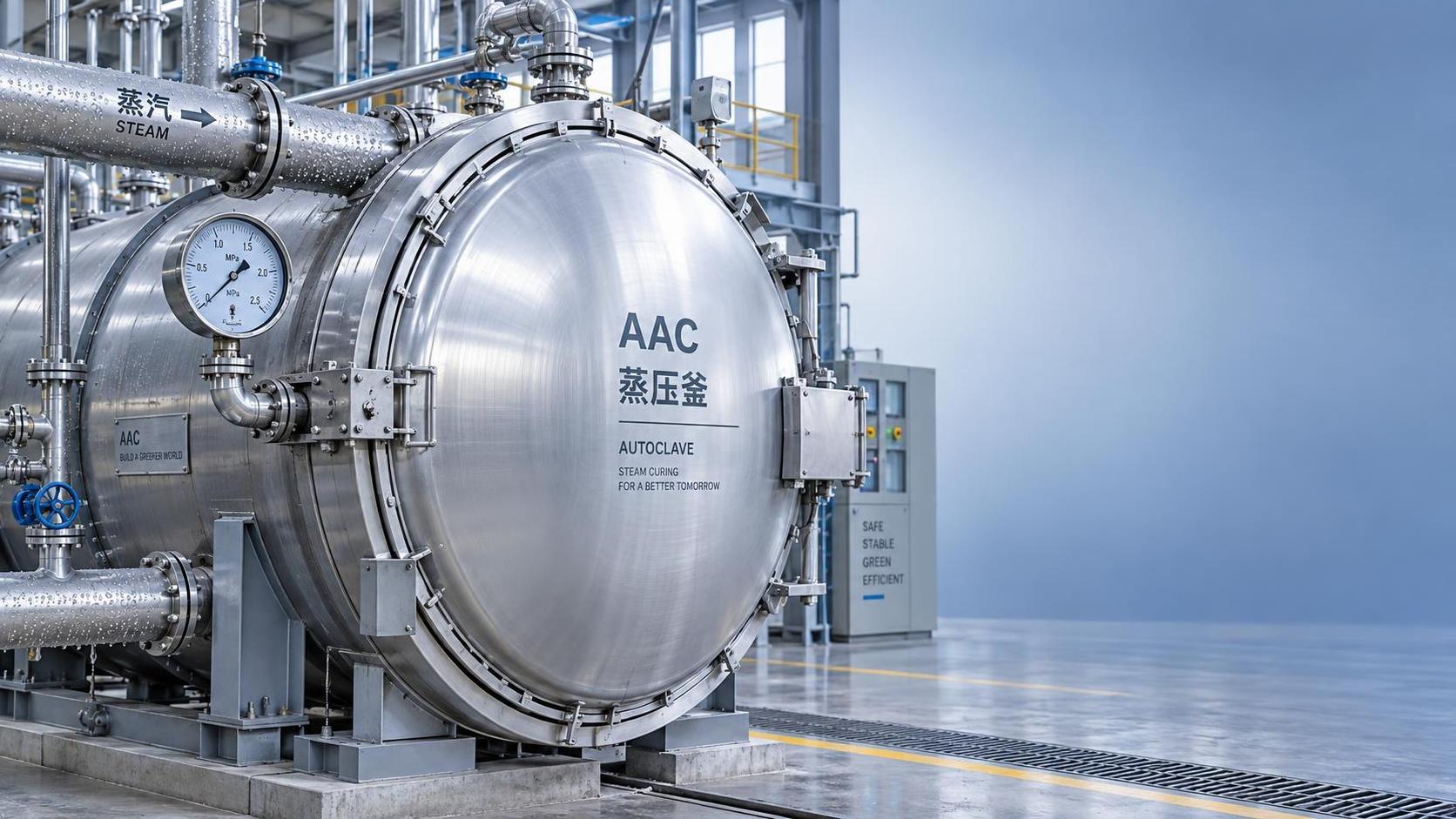
Autoclaving itself remains a major energy area in both routes. A buyer comparing quotations should ask how steam demand, condensate recovery, autoclave loading, and production rhythm are addressed in the proposed layout. Focusing only on the raw-material section can lead to a distorted investment decision.
Environmental Considerations Need a Local View
Fly ash-based AAC is often selected because it can use an industrial by-product that might otherwise require disposal or storage. That can be a meaningful advantage where suitable ash is available and its use is permitted under local rules. It does not remove the need for proper material assessment, dust control, or traceability.
Sand-based AAC avoids dependence on ash availability but may involve quarrying, washing, and long-distance aggregate transport. The environmental balance therefore cannot be judged from the raw-material name alone. Local extraction practices, hauling distance, electricity source, water management, and steam generation all matter. A project seeking a lower-impact route should examine the entire material flow rather than relying on a single environmental claim.
Choosing the Right Plant Configuration
The soundest decision usually starts with samples, not with a preferred machine list. Before fixing a plant design, test representative sand or fly ash from the intended supply chain. Review not only initial test results but also how much variation is likely over time. Then match the process design to the material: milling capacity and slurry control for sand; storage, conveying, and ash-conditioning arrangements for fly ash; and enough batching flexibility to make controlled adjustments without disrupting production.
It is also wise to plan for the inconvenient days. What happens if sand moisture rises after heavy weather? What happens if a power plant changes its ash collection pattern, or a shipment arrives outside the expected range? A line with basic redundancy, accessible maintenance points, sensible silo capacity, and clear quality checkpoints is usually easier to operate than one optimized only for a best-case calculation.
Manufacturers with long experience across building-material equipment can help identify these front-end trade-offs early. Shandong Hongfa Scientific Industrial & Trading Co., Ltd., established in 1990, produces AAC production lines alongside block machinery, concrete batching plants, and other construction-machinery systems. Its engineering background, production bases in Shandong and Guangxi, and stated focus on quality tracking reflect a useful principle for AAC projects: equipment selection should follow the actual raw-material and operating conditions, not a generic layout.
So, what is the difference between sand-based and fly ash-based AAC plants? Sand-based plants are generally built around controlled mineral grinding and slurry preparation. Fly ash-based plants place more emphasis on consistent ash supply, enclosed powder handling, and material verification. Both can be effective. The better choice is the one supported by proven local feedstock, disciplined formulation work, practical logistics, and a plant design that leaves room for real-world variation.
Next:No more content
Recommend
 Sep 26, 2026
What Is the Difference Between Sand-Based and Fly Ash-Based AAC Plants?
What is the difference between sand-based and fly ash-based AAC plants? Compare raw materials, process design, costs, quality control, and supply risks to choose the right AAC solution.
 Sep 23, 2026
How autoclaved aerated concrete equipment performance degrades when steam pressure fluctuates beyond ±0.05 MPa during curing
autoclaved aerated concrete equipment performance plummets when steam pressure deviates beyond ±0.05 MPa—discover real-world impacts, hidden root causes & actionable fixes.
- Sep 18, 2026
Do automatic brick making machines maintain dimensional accuracy after 12,000+ cycles without recalibration?
Automatic brick making machine accuracy under real-world stress? Discover how top-tier models hold ≤±0.5 mm tolerance beyond 12,000 cycles—no recalibration needed.