



AAC Plant Machinery Explained: Core Equipment and Process Flow From Mixing to Curing
For technical evaluators assessing AAC plant machinery, the real question is not simply what equipment is included, but how well each system works as part of a stable, repeatable production line. A modern AAC plant must control density, strength, dimensional accuracy, energy use, and cycle time at the same time.
That is why equipment evaluation should focus on process continuity, automation depth, raw material adaptability, and maintenance practicality. From batching and mixing to casting, cutting, autoclaving, and final curing, each stage affects product quality and plant economics in measurable ways.
This guide explains the core equipment and process flow of an AAC production line in a way that supports technical review. It highlights what each machine does, where bottlenecks usually appear, and which design details matter most when comparing suppliers or planning capacity.
What Technical Evaluators Usually Need to Confirm First
When buyers search for AAC plant machinery, their main intent is practical evaluation. They want to understand which equipment is essential, how the process works step by step, and what factors determine whether a line will deliver stable output over years of operation.
For technical evaluators, the biggest concerns are usually production capacity, consistency of block quality, tolerance control, automation reliability, utility consumption, and serviceability. A line may look complete on paper, yet still perform poorly if material flow, controls, or curing systems are not properly matched.
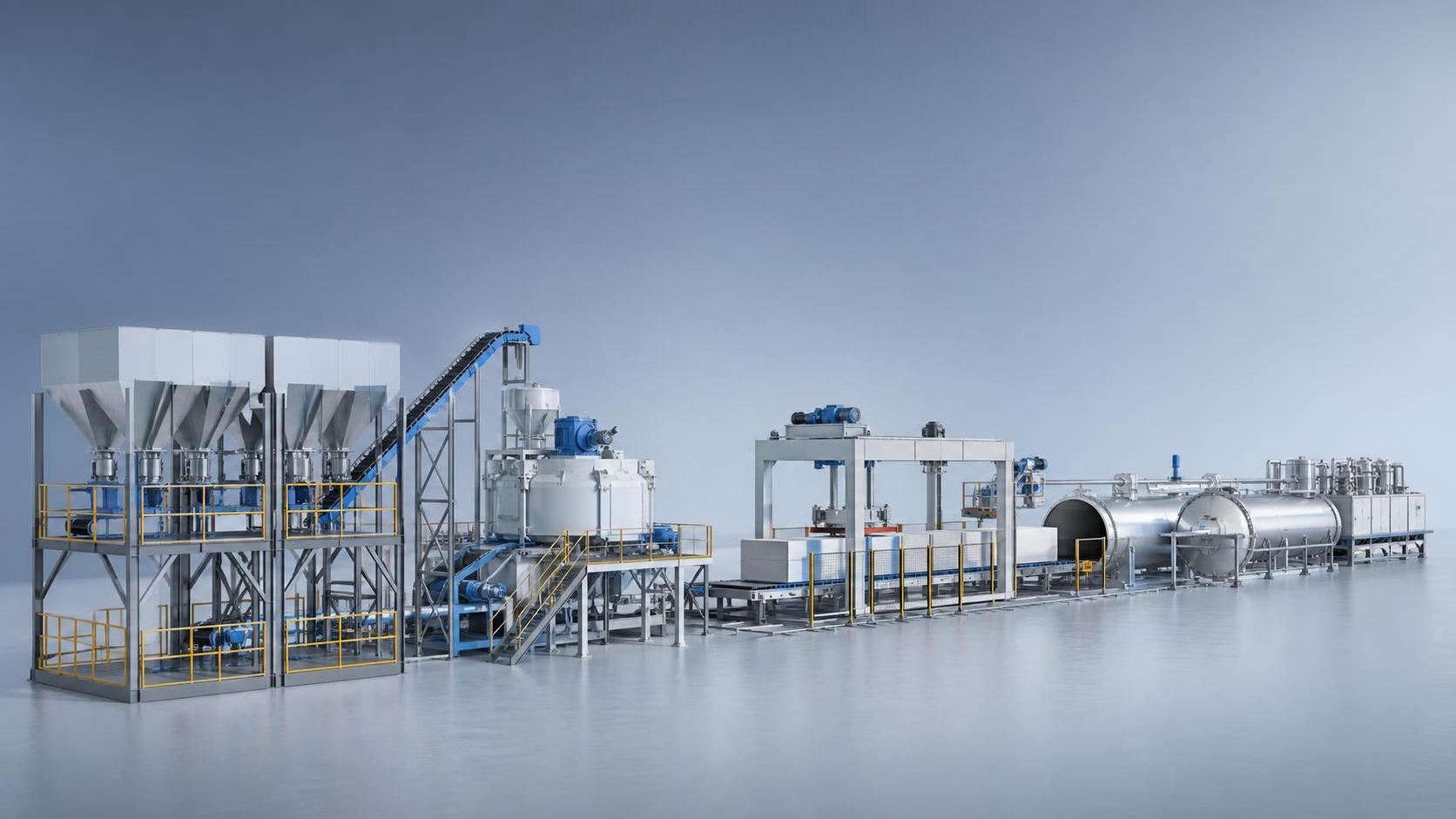
The most useful way to assess an AAC line is to treat it as an integrated system rather than a collection of individual machines. The mixer, mold circulation, cutting unit, autoclave, and material handling sections must all be synchronized to avoid idle time, waste, or downstream defects.
What Is Included in AAC Plant Machinery
A standard AAC plant machinery configuration typically includes raw material storage and dosing systems, batching equipment, slurry mixing equipment, casting molds, pre-curing areas, tilting and demolding systems, cutting machines, autoclaves, finished product handling systems, and a central control platform.
Supporting systems are equally important in technical evaluation. These include steam supply, compressed air, dust collection, waste slurry recovery, water circulation, mold cleaning, lubrication systems, and electrical cabinets. These auxiliary sections often decide whether daily production remains stable under real operating conditions.
In many projects, evaluators also compare upstream mixing technologies from related concrete equipment fields. For example, some investors examining full factory infrastructure may also review solutions such as HZS100 Concrete Mixing Plant (100 m³/h) when planning broader material preparation or integrated precast operations.
Step 1: Raw Material Storage, Batching, and Metering Accuracy
The first technical checkpoint is raw material preparation. AAC production commonly uses cement, lime, gypsum, fly ash or sand slurry, aluminum powder or paste, and water. Stable metering at this stage is essential because formulation errors will amplify in later foaming, cutting, and autoclaving steps.
Evaluators should verify the design of silos, slurry tanks, conveyors, screw feeders, and weighing hoppers. The key issue is not only rated capacity but dosing precision, resistance to bridging, and ease of calibration. Poor feeding accuracy usually leads to density fluctuation and uneven compressive strength.
For sand-based AAC lines, the ball mill and slurry preparation section deserve close review. The fineness of the ground slurry affects reactivity, pore structure, and cutting behavior. A technically sound system should allow consistent particle control while minimizing wear, spillage, and unnecessary energy consumption.
It is also worth checking how the control system handles recipe switching, moisture correction, and cumulative weighing deviation. Plants producing multiple block sizes or grades need repeatable parameter management, not just manual adjustment. That capability has a direct effect on production discipline and traceability.
Step 2: Mixing and Slurry Formation Determines Internal Uniformity
After batching, the materials enter the mixer, where slurry homogeneity becomes critical. This stage is more than simple blending. It determines whether the aluminum reacts evenly, whether the slurry temperature stays within the process window, and whether the final pore structure will be stable.
Technical evaluators should look at mixer type, discharge speed, temperature control logic, and residence time. In AAC production, inconsistent mixing often causes segregation, unstable expansion, surface cracks, or density variation between molds. These problems usually cannot be corrected in later stages.
The best AAC plant machinery configurations provide automated sequencing for raw material charging, timed mixing, and additive dosing. This reduces operator dependence and improves reproducibility across shifts. A reliable control platform should also log batch data for quality analysis and production troubleshooting.
Another useful checkpoint is cleaning accessibility. Mixers and pipelines handling reactive slurry can accumulate residue that affects subsequent batches. A design that simplifies washdown and reduces dead zones will improve consistency, shorten maintenance stops, and reduce contamination between production cycles.
Step 3: Casting, Foaming, and Pre-Curing Shape the Green Cake
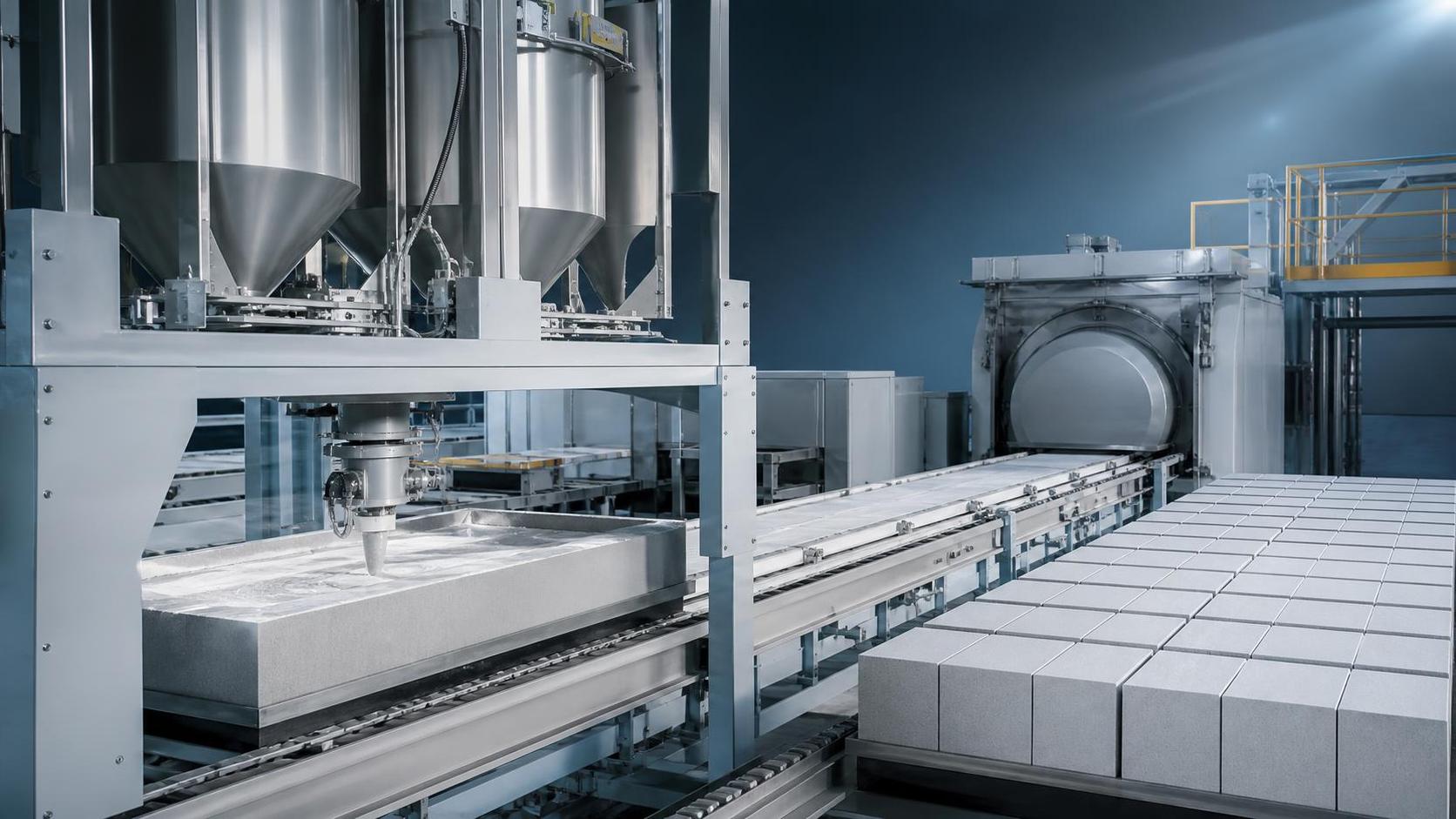
Once mixed, the slurry is poured into molds, where the aluminum reaction generates gas and forms the cellular structure. This stage is highly sensitive because the green cake must rise uniformly before it gains enough strength for demolding and cutting.
Evaluators should examine mold design, filling control, mold circulation speed, and the thermal environment of the pre-curing area. If the temperature distribution is unstable, the cake may rise unevenly, crack, or develop internal void defects that later reduce finished block performance.
Pre-curing time must be matched to raw materials, ambient conditions, and product dimensions. A line that rushes the cake to cutting too early will suffer deformation and edge damage. A line that holds it too long loses throughput and may create avoidable bottlenecks.
This is also where mold durability and anti-adhesion treatment become relevant. Frequent sticking, distortion, or difficult release increases labor and damages the green body. Evaluators should ask how the supplier addresses mold strength, maintenance cycles, and dimensional stability over long-term use.
Step 4: Tilting, Demolding, and Cutting Control Finished Dimensions
The cutting section is often the most visible quality checkpoint in the entire AAC production line. After pre-curing, the mold is demolded and the green cake is tilted or transferred into the cutting system, where horizontal and vertical wires create the final block or panel dimensions.
At this point, technical evaluators should concentrate on positioning accuracy, wire tension stability, frame rigidity, and synchronization between transfer and cutting movements. High nominal capacity means little if the cutting system produces chipped corners, dimension drift, or excessive rejection.
Good AAC plant machinery should allow fast specification changes while maintaining tight tolerances. This matters especially for producers supplying projects that demand consistent wall thickness, clean joints, and reduced site finishing work. Precision in cutting directly affects downstream product acceptance and customer perception.
Waste recovery from the cutting process also deserves attention. Trimmed material should be collected and recycled in a controlled way without destabilizing the slurry formulation. An effective recycling loop supports cost control, but only if it is engineered to avoid quality variability.
Step 5: Autoclaving Is Where Final Strength and Stability Are Built
Autoclaving is the decisive stage for AAC performance because high-pressure saturated steam drives the reactions that create the final hardened structure. This is where compressive strength, dimensional stability, and long-term product reliability are largely established.
Evaluators should review autoclave vessel design, steam distribution, pressure ramp control, holding time, condensate management, and safety systems. Uneven steam penetration or poorly controlled pressure cycles can produce inconsistent strength, warping, or internal cracking even when earlier stages are well managed.
The autoclave loading and unloading system matters as much as the vessel itself. Efficient rail carts, transfer tables, and door sealing mechanisms help maintain cycle discipline and reduce thermal loss. Delays in this area can quietly reduce plant output more than buyers initially expect.
Because autoclaving is energy intensive, steam efficiency should be part of every technical review. Heat recovery, insulation quality, valve reliability, and piping layout all affect operating cost. For many plants, these details influence lifecycle economics more than small differences in headline equipment price.
Step 6: Finished Product Handling and Curing Logistics Affect Real Output
After autoclaving, the blocks or panels are separated, packed, and transferred to storage. This final phase is often underestimated, yet poor handling can damage edges, slow dispatch, and create hidden losses that undermine the value of otherwise strong process equipment.
Technical evaluators should check the design of unloading devices, separation systems, clamping tools, conveyors, and packaging sections. AAC products, especially when newly cured, still require controlled handling. Excessive impact or unstable gripping can increase breakage rates and customer complaints.
Layout planning is important here as well. A technically mature line keeps finished product movement short, predictable, and easy to monitor. This improves forklift safety, inventory visibility, and delivery readiness. It also reduces the chance that the final logistics stage becomes the plant’s practical output limit.
How to Judge Line Performance Beyond the Equipment List
Many suppliers can present a similar equipment list, so evaluators need sharper criteria. The most useful questions concern process matching: Are the batching, mixing, cutting, and autoclave capacities balanced? Is the automation architecture unified? Can the line maintain quality when raw material characteristics fluctuate?
Another important factor is maintenance strategy. Review access space, wear part replacement cycles, spare parts standardization, and diagnostic functions. A line with advanced specifications but difficult maintenance access may create long-term downtime that outweighs its theoretical production advantages.
Control system capability is equally important. A modern AAC line should provide recipe management, alarm records, trend monitoring, and interlock protection across the full process. This reduces dependence on operator experience alone and gives technical teams better tools for root-cause analysis.
Factory experience and engineering depth also matter. Manufacturers with long-term involvement in building materials equipment usually offer stronger process integration knowledge, especially when they support multiple machinery categories, installation work, and commissioning under different raw material conditions.
What to Ask AAC Plant Machinery Suppliers During Evaluation
To make a sound decision, technical evaluators should ask for more than brochures. Request actual production references, hourly output under normal operating conditions, density and strength control ranges, automation details, utility consumption data, and maintenance requirements for core equipment.
It is also useful to ask how the supplier adapts the line to local materials. Sand chemistry, fly ash variability, lime activity, and water conditions all affect AAC production behavior. A capable supplier should explain how process design and control logic are adjusted for those realities.
When reviewing proposals, examine whether the supplier provides commissioning support, operator training, spare parts planning, and process optimization after startup. In practical terms, these services often determine how quickly a plant reaches stable commercial production after installation.
For investors comparing broader concrete and building materials systems, looking at adjacent equipment portfolios can also be helpful. Companies with experience across batching, block machinery, and AAC technology may offer more coherent plant-wide engineering than a supplier focused on a single isolated machine.
Conclusion: Evaluate the Process, Not Just the Machines
AAC plant machinery should be judged as a coordinated production system where every stage influences the next. Accurate batching supports stable mixing, good mixing supports uniform foaming, strong pre-curing supports precise cutting, and controlled autoclaving delivers final strength and dimensional stability.
For technical evaluators, the most reliable assessment method is to compare not only equipment specifications but also process logic, control depth, maintenance practicality, and energy performance. Those factors reveal whether a line can deliver repeatable block quality and dependable long-term operation.
In short, the best AAC production line is not simply the one with the longest equipment list. It is the one whose machinery, controls, and process design work together to produce consistent AAC products efficiently, safely, and with enough flexibility to support future production demands.
Recommend
 Sep 23, 2026
How automatic AAC production line stability affects block quality
Automatic AAC production line stability directly shapes block strength, density, and dimensions. Learn how tighter process control reduces defects, waste, and safety risks.
- Sep 23, 2026
What to check before buying autoclaved aerated concrete equipment
Autoclaved aerated concrete equipment buying guide: learn what to check on line balance, raw materials, energy use, maintenance, and support before choosing a reliable AAC solution.
- Sep 24, 2026
How to reduce downtime caused by worn AAC plant machinery
AAC plant machinery downtime can be cut by spotting wear early, prioritizing critical parts, and using smarter maintenance strategies to keep production stable and costs under control.