



What Should a Complete AAC Factory Design Include Before Construction?
我先把可用信息收拢成适合发布的英文正文,重点放在读者真正会卡住的设计项,而不是模板化堆点。会避开硬性产品宣传,把公司信息只放在能自然支撑判断的位置。
Before breaking ground on an AAC plant, the real question is not whether you have a layout drawing. It is whether the complete AAC factory design before construction starts already covers capacity, process flow, raw material storage, equipment matching, utilities, environmental controls, and room for expansion. If those parts are missing, the project usually pays for it later through rework, unstable output, and avoidable operating costs.
In practice, the best AAC factory design is less about “building a plant” and more about making sure every decision made before civil construction supports stable production after commissioning. That is where many projects go wrong: they buy equipment first, then try to fit the building around it. The better approach is the opposite.
What should be included in a complete AAC factory design before construction starts
A complete AAC factory design should answer one simple question: can the plant run smoothly on day one, and still make sense five years later? To answer that properly, the design has to cover more than the workshop layout. It should connect production logic, material logistics, power and steam demand, maintenance access, environmental control, and future upgrade paths into one plan.
For an AAC project, the process is especially sensitive because the line is not a single machine. It is a system. If one part is undersized or badly positioned, the entire line feels it. That is why a serious design review starts with production capacity and works outward from there.
1. Capacity planning comes first
The first thing to lock down is output target. Daily output, shift structure, product size mix, curing method, and local market demand all affect the design. A plant built for a single product mix can look efficient on paper but become awkward in real operation if the market later demands more sizes or a different density range.
This is where many investors compare quotes and miss the real issue. A cheaper line is not always cheaper if it forces bottlenecks in batching, cutting, autoclaving, or finished product handling. A complete AAC factory design before construction starts should match capacity to realistic utilization, not just nameplate figures.
2. Process flow should be laid out before the building is fixed
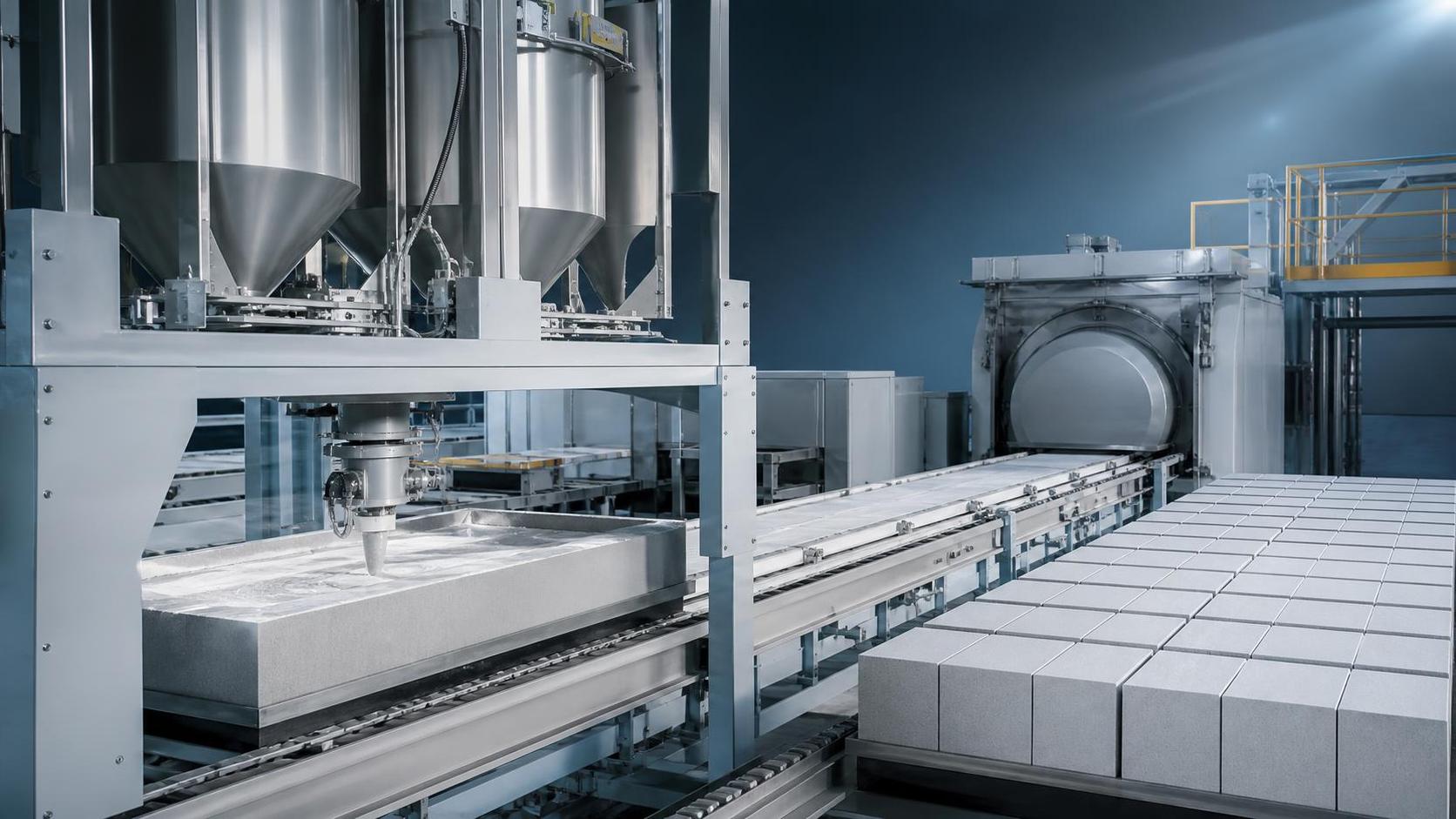
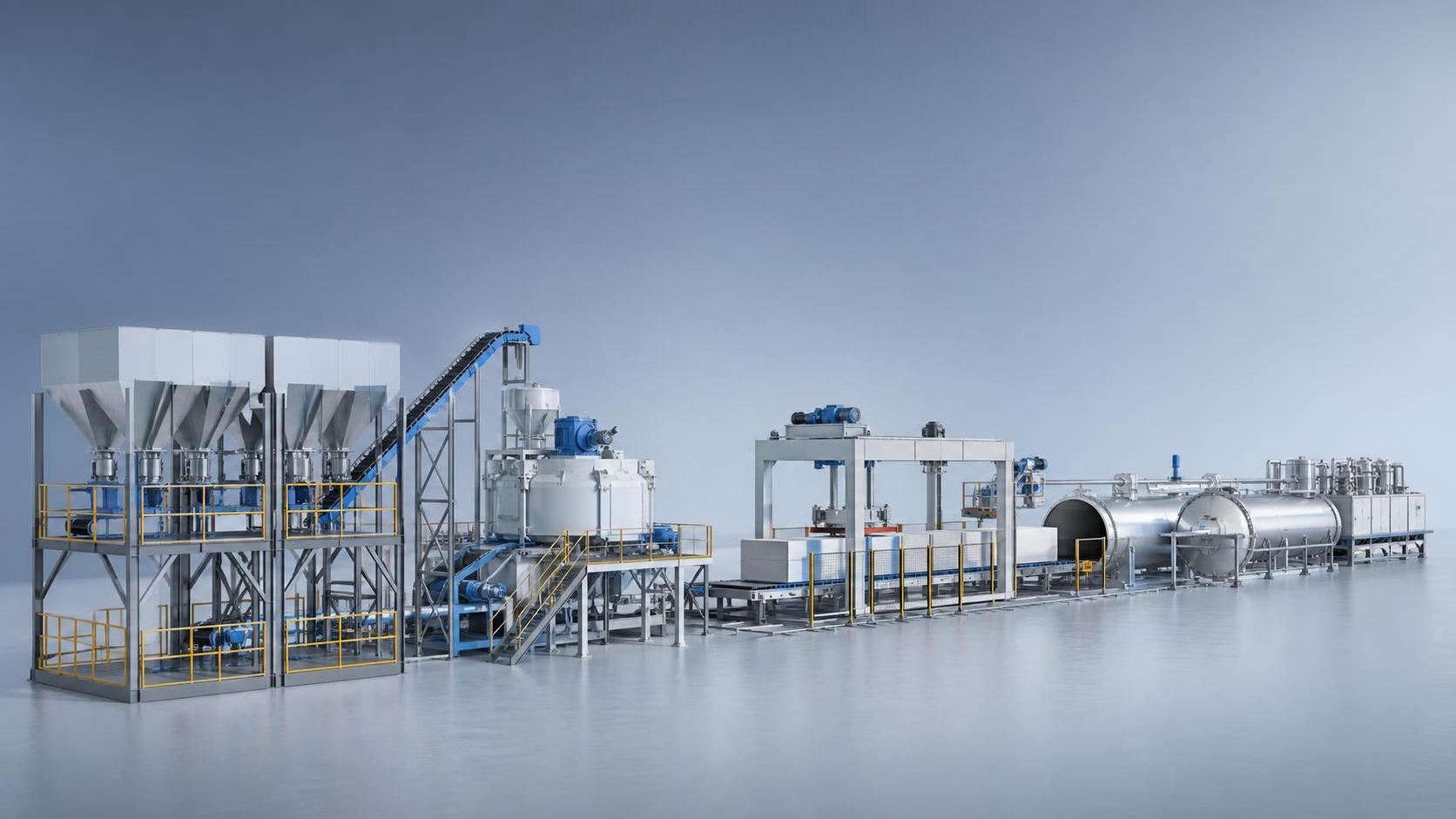
The flow of raw materials, slurry preparation, casting, pre-curing, cutting, autoclaving, and finished product stacking should be mapped before civil work begins. Once the main building is set, changing flow direction becomes expensive and sometimes impossible without compromise.
A clean design keeps short travel distances, avoids crossing traffic routes, and separates wet, dusty, and finished-product areas. That sounds basic, but in real factories it is often the difference between a line that feels orderly and one that constantly fights itself.
3. Raw material handling needs more attention than people expect
AAC plants rely on stable handling of cement, lime, gypsum, sand or fly ash, aluminum powder, water, and additives. Each material behaves differently. Some need silo systems, some need enclosed conveying, and some require careful moisture control. If storage and feeding are treated as an afterthought, the plant becomes sensitive to weather, truck timing, and manual intervention.
Before construction starts, the design should define silo capacity, unloading points, feeding routes, dust collection, and reserve storage. It should also check whether the site can support vehicle turning, unloading safety, and future expansion of raw material bays.
4. Equipment selection must match the building, not the other way around
This is one of the most common mistakes. Some buyers choose equipment first, then discover the plant structure cannot support the required span, crane coverage, floor loading, or maintenance clearance. A complete AAC factory design before construction starts should align the equipment list with structural dimensions, lifting needs, utility interfaces, and service access.
That includes not only the main production line, but also batching systems, cutting machines, autoclaves, steam systems, control cabinets, forklifts or transfer systems, and spare-part storage. If maintenance teams cannot reach key points safely, the plant will pay for that inconvenience every month.
5. Utilities are not secondary items
AAC production is utility-heavy. Power, steam, compressed air, water supply, drainage, and sometimes heat recovery or wastewater treatment all need to be considered early. If utility capacity is estimated loosely, the plant may run at partial capacity or face unstable operating conditions after startup.
The design should define utility load, backup needs, pipe routing, insulation, drainage slopes, and meter locations. This is one of those areas where “good enough” is usually not good enough. A plant can have excellent equipment and still underperform because the utility backbone was not thought through properly.
6. Environmental compliance should be designed in, not added later
Dust control, noise reduction, wastewater handling, and solid waste management should be part of the initial design. In some regions, compliance requirements are straightforward; in others, they are strict and project-specific. Either way, retrofitting environmental systems after civil construction usually costs more and causes more disruption.
A practical design also considers how the plant will handle material spill, sludge, filter residue, and routine cleaning. These details do not look dramatic during planning, but they strongly affect how easy the site is to operate and keep clean.
In short: a complete AAC factory design before construction starts should connect capacity, process flow, material logistics, equipment matching, utilities, compliance, and expansion into one coordinated plan. If one of those pieces is missing, the project may still get built, but it is unlikely to run as efficiently as expected.
Where buyers usually compare options
When investors compare AAC project plans, they are usually comparing more than machines. They are comparing how much risk each design removes before construction starts.
One supplier may offer a lower equipment price, but the design leaves utility planning vague. Another may propose a more integrated solution with better process alignment, easier maintenance access, and clearer engineering support. The second option often looks more expensive at the start and less expensive over the life of the plant.
That is why companies with broad building-materials machinery experience often matter in this stage. A manufacturer such as Shandong Hongfa Scientific Industrial & Trading Co., Ltd., which has long experience in construction machinery and AAC production line equipment, can be useful not simply because of brand name, but because integrated machinery knowledge helps avoid mismatches between design intent and plant reality. Hongfa’s long industrial background, multiple production bases, engineering team, and focus on quality tracking are relevant here for one reason: AAC factory design works best when equipment and plant engineering are considered together, not separately.
Common mistakes that show up too late
The first mistake is designing for the brochure, not the site. Land shape, road access, soil condition, utilities availability, and local climate all affect the final layout. If the site is constrained, the design needs to respond to that reality early.
The second mistake is ignoring expansion. Even if phase one is modest, the civil plan should leave room for additional silos, extra curing capacity, or more storage if the market grows. It is much easier to reserve space now than to buy it back later.
The third mistake is treating commissioning as a separate problem. A plant that cannot be started smoothly was not fully designed. Training, control logic, spare parts, and startup support should be part of the pre-construction discussion, not an afterthought after concrete is poured.
What a practical pre-construction review should verify
Before construction starts, a buyer should be able to verify at least four things: the process flow is logical, the equipment list matches the building plan, utility demand is fully accounted for, and the site has room for operation as well as maintenance. If any of these are unclear, the project is not ready.
It also helps to ask one blunt question: what will this plant look like during normal production, not just on paper? That question usually reveals gaps that technical drawings alone do not show.
For investors who are still comparing solutions, the safest path is to ask for a design package that covers the full system, not just the machines. A strong AAC factory design should make construction easier, but more importantly, it should make operation predictable. That is the real test of whether the complete AAC factory design before construction starts has been done properly.
Recommend
 Sep 23, 2026
How automatic AAC production line stability affects block quality
Automatic AAC production line stability directly shapes block strength, density, and dimensions. Learn how tighter process control reduces defects, waste, and safety risks.
- Sep 23, 2026
What to check before buying autoclaved aerated concrete equipment
Autoclaved aerated concrete equipment buying guide: learn what to check on line balance, raw materials, energy use, maintenance, and support before choosing a reliable AAC solution.
- Sep 24, 2026
How to reduce downtime caused by worn AAC plant machinery
AAC plant machinery downtime can be cut by spotting wear early, prioritizing critical parts, and using smarter maintenance strategies to keep production stable and costs under control.