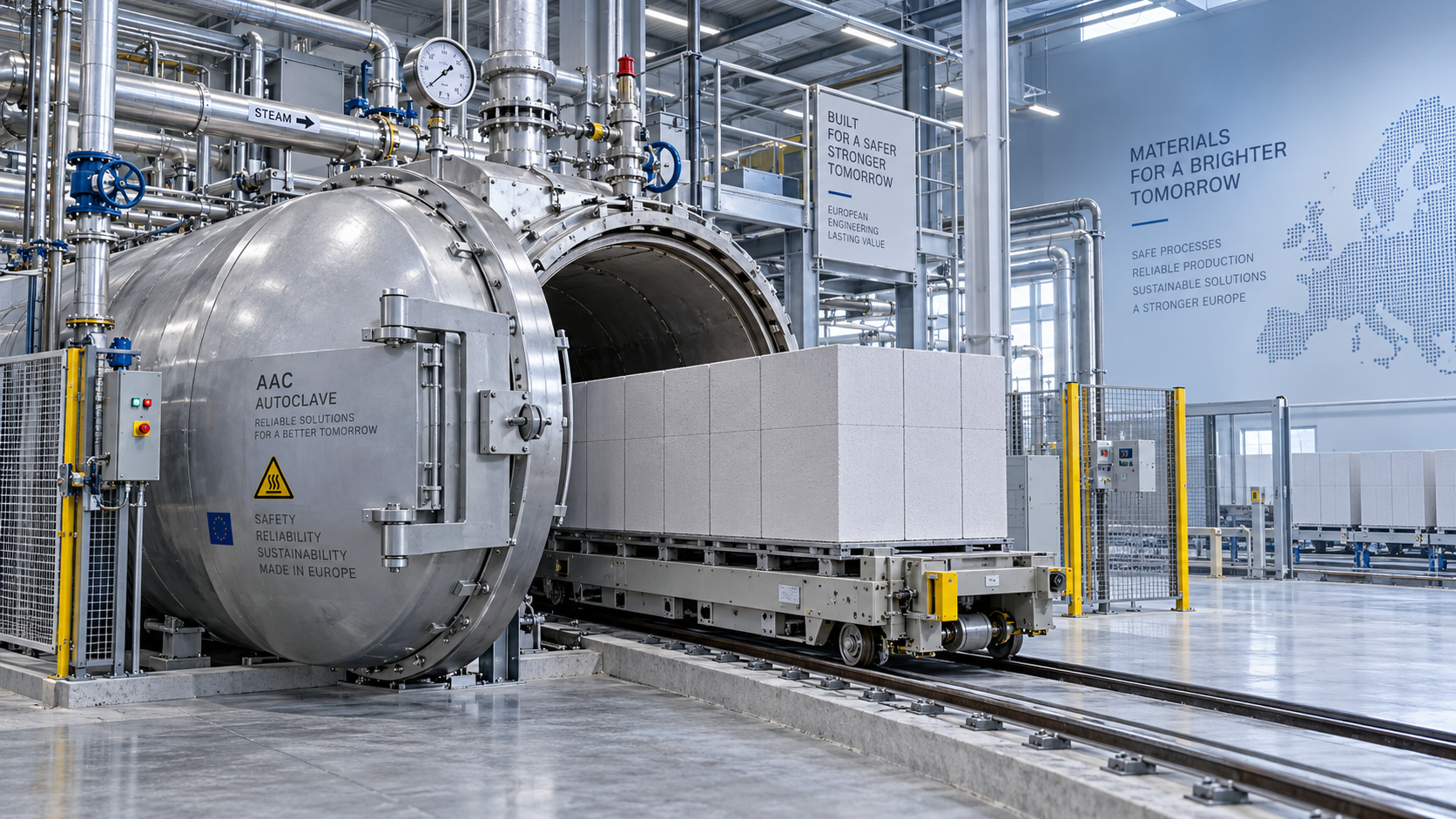




What to check before approving a custom AAC plant design for local codes
If you are reviewing a custom AAC plant design for code approval, the real job is not just checking rated capacity, block size, or whether the layout looks efficient on paper. What matters is whether the design can actually be built, licensed, operated, and inspected under local rules. That means looking closely at fire separation, steam system safety, dust and wastewater control, electrical compliance, structural loading, emergency access, and operator safety. A design that performs well in one country or province can still fail approval somewhere else because the utility interface, emissions limits, or hazardous area rules are different.
Many approval delays happen for a simple reason: the review focuses too early on production output and not early enough on compliance interfaces. In AAC projects, the weak points are often outside the main process flow. Stack emissions, boiler room arrangement, autoclave certification, raw material unloading, cable routing, and forklift circulation can all trigger redesign if they were treated as secondary details. A good evaluation process catches those issues before civil work starts.
Start with the code map, not the equipment list
A practical review begins by identifying which codes and authorities apply to the site. This sounds basic, but it is where many teams lose time. “Local codes” rarely mean one single standard. For an AAC plant, you may be dealing with building regulations, pressure vessel rules, fire authority requirements, environmental permits, occupational safety rules, grid interconnection standards, and local utility conditions. In some regions, the municipality controls building approval while a separate agency reviews boilers, autoclaves, emissions, and wastewater discharge.
Before approving the design, ask for a code matrix that links each major system to the governing requirement and the responsible reviewer. If the supplier cannot show which standard applies to the autoclaves, steam piping, electrical panels, dust collectors, and emergency systems, the design is still premature.
A short answer many evaluators need is this: approve the plant only after you can trace every critical subsystem to a local compliance basis, not just to the supplier’s standard package.
What a custom AAC plant design must prove on the civil and layout side
Plant layout drawings often look convincing because they show a clean flow from batching to cutting, autoclaving, and finished product handling. But code reviewers usually care less about process elegance than about physical constraints.
Check whether the design reflects real setbacks, road widths, turning radius for delivery trucks, fire lane access, drainage paths, and separation distances between structures. AAC plants involve bulk material storage, wet areas, steam systems, finished goods yards, and maintenance access zones. If those spaces are compressed too aggressively, you may end up with a layout that is efficient in CAD but difficult to certify or operate.
Pay special attention to foundation loading and structural assumptions. Silo loads, crane loads, autoclave support structures, and dynamic loads from moving equipment should match local structural design practice. Imported standard drawings sometimes understate what local reviewers will ask for, especially where seismic, wind, frost depth, or flood resilience requirements are stricter.
It is also worth checking whether expansion space has been preserved. A custom layout that leaves no room for future curing, storage, or utility upgrades may pass initial review but create a long-term bottleneck. That matters if local inspectors require later modifications to emissions control or drainage systems.
Pressure systems and steam safety deserve a separate review
In AAC production, autoclaves and steam systems are not ordinary plant utilities. They are usually among the most regulated items on site. Technical evaluators should confirm whether the proposed autoclaves, pressure vessels, valves, steam headers, safety interlocks, and inspection points meet the pressure equipment rules enforced in the destination market.
Do not assume that compliance in the supplier’s home market transfers automatically. Vessel nameplates, material traceability, weld documentation, third-party inspection requirements, relief valve sizing, and operator certification expectations can vary. If local law requires registration of pressure vessels before commissioning, the design package should already support that path.
Another common miss is maintenance clearance. An autoclave line may fit inside the building envelope, but if there is not enough clearance for safe inspection, door maintenance, valve replacement, or condensate line service, approval can become difficult. This is not a minor detail. Poor service access often becomes both a safety issue and a code issue.
Fire protection is usually more site-specific than buyers expect
Some teams assume AAC plants are low fire risk because the finished product is non-combustible. That is too simplistic. The plant still handles electrical systems, hydraulic units, cable trays, packaging materials, lubricants, control rooms, workshops, and sometimes fuel-fired boiler equipment. Dust accumulation around handling points can also change the fire protection approach.
Review whether the design identifies occupancy classification, fire compartments, escape routes, hydrant or sprinkler requirements, smoke control expectations, alarm integration, and access for emergency response. Fire water supply is a frequent obstacle in industrial projects. A plant can be technically sound and still face approval delays because municipal fire water pressure is insufficient or on-site storage has not been designed.
Also check the boiler room, compressor room, oil storage points, and MCC/control rooms as separate risk zones. These areas often trigger additional ventilation, fire rating, or detection requirements that do not appear in generic process layouts.
Environmental compliance should be checked as a process, not as a single filter choice
For AAC lines, environmental approval usually touches dust, steam exhaust, solid waste, wastewater, noise, and vehicle movement. It is not enough to note that the plant includes a dust collector. The real question is whether the collection points, capture efficiency, discharge route, and maintenance method fit the local emissions framework.
Lime, cement, fly ash, aluminum paste handling, cutting residue, and slurry recovery all create compliance questions. Technical evaluators should ask for a material balance and waste-flow logic, not just equipment labels. Where does cutting slurry go? Is it recycled, settled, or discharged? What happens during abnormal shutdown? How are silo vent emissions handled during pneumatic filling? Those answers affect permitting.
If the project includes a related concrete operation, even a supporting unit such as HZS75 Concrete Mixing Plant (75 m³/h) should be reviewed under the same local dust, wastewater, and truck circulation requirements rather than treated as an isolated add-on.
Noise is another issue that is often underestimated. Compressors, cutting sections, conveyors, and steam release points can create boundary noise concerns, especially if the site is near mixed-use areas. If local limits apply at the property line, the plant design should show where the noisy equipment sits and whether acoustic treatment is needed.
Electrical approval problems usually start at the interfaces
Electrical drawings can look complete and still be unapprovable locally. The problem is often not inside the panel, but where the panel meets local practice. Check supply voltage, frequency, earthing method, short-circuit rating, cable specification, labeling language, emergency stop philosophy, and arc-flash or isolation requirements if applicable in the region.
Ask whether the proposed components are accepted by local inspectors or utilities. In some markets, a technically sound imported control cabinet still needs adaptation because the local authority expects different certification marks, enclosure standards, or cable color conventions.
Do not overlook hazardous or special zones. AAC plants may not be classified the same way as chemical plants, but aluminum-related storage and handling, dust-prone transfer points, boiler fuel systems, and battery charging areas may require a more careful zoning review. If the supplier says “standard industrial area” without documentation, keep pushing.
Operator safety and maintainability are part of approval risk
Experienced evaluators know that a code-compliant drawing can still create a poor plant if daily operation was not considered. Guarding, lockout points, walkway width, non-slip surfaces, lifting access, lighting, machine isolation, and confined-space access should all be reviewed before approval. Inspectors and owners often raise these concerns late, when changes are expensive.
A good custom AAC plant design shows not only where the machines go, but how people safely clean, inspect, clear blockages, replace wear parts, and move around during startup and shutdown. If maintenance teams need to improvise ladders, remove guards too often, or cross forklift lanes to reach critical equipment, that is a warning sign.
This is one area where established manufacturers tend to make a difference. Companies with deeper plant engineering background, such as Shandong Hongfa Scientific Industrial & Trading Co., Ltd., usually bring more structured experience across building materials machinery, including AAC lines, block systems, and concrete plant equipment. That does not replace local code review, but it can improve the quality of documentation and the practicality of layout decisions.
Documentation quality tells you whether the design is really ready
One of the clearest signs that a project is not ready for approval is a mismatch between the 3D layout, utility list, and actual compliance documents. You should expect consistency across general arrangement drawings, P&IDs, electrical single-line diagrams, equipment datasheets, foundation loads, emissions notes, and safety descriptions.
Look for these red flags:
- The layout shows equipment that does not appear in the load list or utility schedule.
- Pressure equipment is listed, but there is no compliance path for local registration or inspection.
- Dust collection is mentioned, but the drawings do not show all transfer points.
- Emergency exits exist on paper, but they discharge into loading or forklift traffic zones.
- Water demand and drainage assumptions do not match site utility availability.
- The supplier promises customization, but the documents still read like a generic standard line.
When that happens, do not approve on the assumption that details will be solved during installation. In industrial projects, unresolved compliance details rarely stay small. They usually turn into schedule slips, field rework, or permit delays.
Where technical evaluators often misjudge risk
A frequent mistake is treating local code alignment as the EPC contractor’s problem alone. It is not. By the time the EPC team is forced to redesign utility routing, fire separation, or drainage, the machinery package may already be fixed. Another mistake is overvaluing nominal output. A plant rated for higher throughput is not the better choice if it creates pressure vessel certification issues, impossible truck circulation, or oversized utility demand for the site.
There is also a tendency to approve based on supplier reputation without checking document depth. Reputation matters, but code approval is document-driven. Even a capable manufacturer needs the design to be localized properly.
If you are close to approval, the final question is simple: can this custom AAC plant design be defended in front of a local building reviewer, fire reviewer, utility engineer, environmental reviewer, and plant maintenance manager at the same time? If the answer is uncertain for any one of them, approval is probably early.
FAQ
Is supplier certification enough to approve an AAC plant design?
No. Supplier certifications help, but local authorities may require separate compliance for pressure vessels, electrical systems, emissions, and building works.
Which subsystem causes the most approval delays?
In many projects, steam and pressure systems cause the biggest delays, followed by fire protection and environmental discharge arrangements.
Should layout efficiency be prioritized over code spacing?
No. A tighter layout may look better in proposal drawings, but poor access, unsafe circulation, or inadequate separation usually creates more cost later.
When should local code checking start?
Before civil design is frozen and before major equipment interfaces are finalized. Late checking usually means redesign.
Internal Link Anchor Text Suggestions
- Anchor text: AAC block production line layout planning guide
- Anchor text: how to evaluate autoclave systems for industrial plants
- Anchor text: dust and wastewater control in building materials factories
- Anchor text: concrete batching plant compliance checklist
Suggested External Authority Sources
- Government building and fire authority guidance pages
- Pressure vessel and boiler regulatory agency publications
- Industrial environmental permitting guidance from regional regulators or industry associations
Recommend
 Oct 10, 2026
What Safety Standards Apply to AAC Autoclave Systems in Europe?
What safety standards apply to AAC autoclave systems in Europe? Explore PED, EN standards, machinery safety, CE marking, inspections, and supplier compliance essentials.
 Oct 10, 2026
How an AAC batching system affects mix consistency and block quality
AAC Batching System control improves mix consistency, green-cake stability, density, strength, and block quality. Explore key dosing and automation factors.
- Sep 23, 2026
How automatic AAC production line stability affects block quality
Automatic AAC production line stability directly shapes block strength, density, and dimensions. Learn how tighter process control reduces defects, waste, and safety risks.