



How to Plan an AAC Factory for 100,000 m³ Annual Capacity
How to Plan an AAC Factory for 100,000 m³ Annual Capacity
AAC factory planning for 100000 cubic meters per year requires more than selecting equipment. Investors must align market demand, plant capacity, raw materials, utilities, process design, and operating capability before construction begins.
For most investors, the central question is whether a 100,000 m³ annual AAC facility can deliver stable quality, controlled production costs, and an acceptable return under local market conditions.
The answer depends on planning accuracy. A well-designed line can support reliable block production and future expansion, while an undersized utility system or poor material assessment can create lasting operational constraints.
Start With Market Demand, Product Mix, and Real Capacity
A nominal annual capacity of 100,000 m³ should be translated into daily output, shift arrangements, product dimensions, sales territory, and realistic operating days before any equipment specification is finalized.
If the factory operates 300 days annually, the target average output is approximately 333 m³ per day. The actual design output should include reasonable allowance for maintenance, curing cycles, and commissioning periods.
Investors should avoid designing solely around maximum theoretical output. AAC production lines perform best when capacity, logistics, warehouse turnover, and customer demand remain balanced throughout the operating year.
Local demand analysis should identify major users of AAC blocks, including residential developers, commercial contractors, precast distributors, municipal projects, and regional building-material retailers.
It is also necessary to study competing wall materials. Clay bricks, concrete blocks, lightweight panels, and other alternatives affect pricing, product positioning, dealer margins, and the expected market adoption rate.
A practical sales forecast should separate contracted demand from estimated demand. New AAC factories often face a gradual market-development period, especially where builders have limited experience using autoclaved aerated concrete.
Product mix is equally important. Standard blocks may provide the largest volume, while insulated blocks, partition blocks, lintels, or customized dimensions can improve margins when supported by local specifications.
Before choosing a production configuration, confirm which block sizes are commonly used in the target market. Mold dimensions, cutting systems, packaging methods, and storage layouts should support those requirements.
A factory designed for 100,000 m³ annually should usually retain some flexibility. Changing market demand can require different thicknesses, densities, or packaging formats without rebuilding the complete production system.
Evaluate Raw Materials Before Defining the Process Route
Raw-material suitability has a direct effect on AAC density, compressive strength, cutting quality, steam consumption, and long-term manufacturing cost. Equipment selection should follow material testing, not precede it.
Common AAC raw materials include fly ash, sand, cement, lime, gypsum, aluminum powder or paste, water, and sometimes recycled slurry from internal production processes.
Fly ash-based AAC is often attractive where stable supplies are available from nearby power plants. However, ash chemistry, fineness, moisture content, and seasonal supply consistency must be verified.
Sand-based AAC may offer stronger control over feedstock composition, but it requires crushing or wet grinding. This can increase electrical consumption, water demand, and grinding equipment investment.
A laboratory analysis should review silica content, particle size, loss on ignition, calcium availability, impurities, and reaction behavior. These results influence the formulation and required grinding fineness.
Lime quality deserves particular attention because it affects slurry temperature, gas generation, expansion stability, and strength development. Variable lime quality can cause density fluctuation and product cracking.
Aluminum powder or paste must be selected according to the intended process and local storage conditions. Its gas-generation performance should remain stable across different batches and ambient temperatures.
Reliable material supply is not only a purchasing issue. Transport distance, unloading infrastructure, dust control, silo capacity, and backup suppliers should be included in the factory planning model.
Where raw materials vary significantly, the plant should include suitable storage segregation, batching accuracy, and quality-control procedures. A lower-cost material is not economical if it causes persistent production instability.
Design the Production Process Around Stable Quality
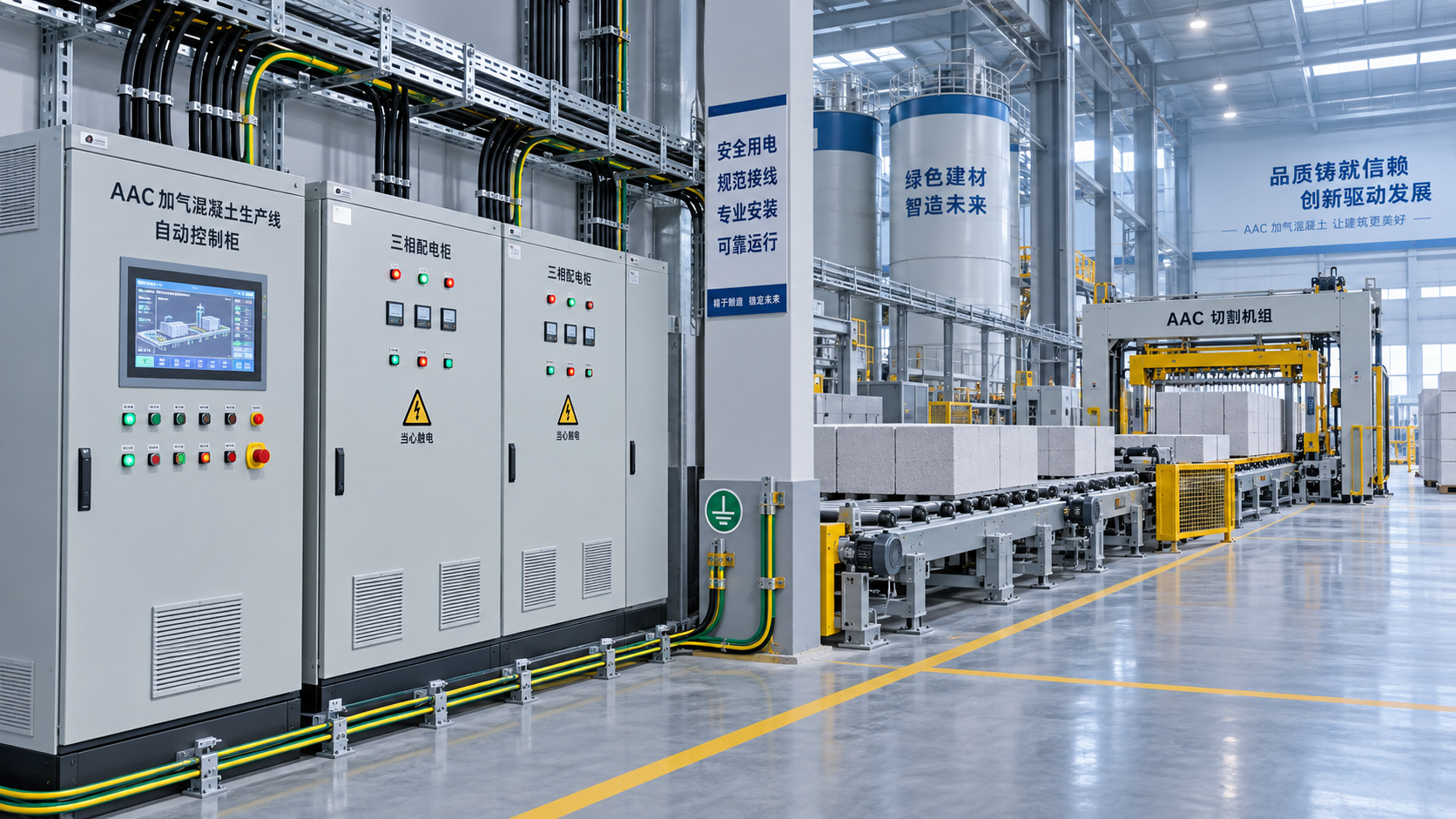
An AAC production line typically includes raw-material preparation, batching, mixing, pouring, pre-curing, cutting, autoclave curing, product separation, packaging, and finished-product storage.
Each stage affects the next. A weakness in slurry preparation, for example, may appear later as poor cake strength, wire cutting defects, uneven density, or increased autoclave rejects.
For AAC factory planning for 100000 cubic meters per year, production scheduling should match mold circulation, pre-curing duration, cutting throughput, and autoclave loading capacity.
The line should not be designed as isolated machines. It must operate as an integrated system in which mold movement, slurry timing, cutting speed, and steam curing cycles remain synchronized.
Mixing and pouring systems need accurate weighing and consistent slurry control. Automated batching helps reduce variation in water-to-solid ratio, aluminum dosage, and material proportions.
Pre-curing is one of the most sensitive stages. Temperature, rising time, holding time, and cake strength must be controlled so the green cake can be cut cleanly.
The cutting section should be selected according to required product accuracy, production rhythm, and maintenance capability. Wire tension, alignment, cleaning, and replacement procedures affect finished block dimensions.
Autoclaves are major capital and energy assets. Their diameter, length, loading method, steam cycle, insulation, and pressure-control reliability should suit the designed daily output and future utilization level.
Production planning should also account for product separation and packing. Finished AAC blocks must be handled carefully to reduce edge damage, maintain stack stability, and support efficient outbound transport.
Size Utilities and Infrastructure for Continuous Operation
Many AAC projects face avoidable delays because utility planning begins too late. Electricity, water, steam, compressed air, drainage, roads, and material handling must be designed with the production line.
Electrical demand includes grinding equipment, pumps, mixers, conveyors, cutting machines, cranes, packing systems, lighting, offices, and auxiliary equipment. The local power connection must support peak demand safely.
Steam supply is especially critical because autoclaving determines production rhythm. Investors should compare self-generated steam, external steam purchase, and combined energy solutions based on local conditions.
A boiler system should be assessed for fuel availability, operating permits, emissions requirements, redundancy, water treatment, and maintenance support. Low steam reliability can stop the entire factory.
Water planning should include production water, boiler feedwater, cleaning water, domestic use, recycling loops, and wastewater management. Water quality can also influence slurry behavior and equipment reliability.
Compressed air supports valves, instrumentation, and some automation functions. The air system needs adequate pressure stability, moisture control, and maintenance access to avoid intermittent production disruptions.
Site layout should minimize unnecessary material movement. Raw-material storage, grinding, batching, pouring, cutting, autoclaves, packaging, and finished-goods areas should follow a logical production flow.
Enough space should be reserved for truck movement, loading areas, maintenance access, safety separation, expansion, and stock turnover. Congested layouts increase handling cost and raise damage risk.
The land requirement depends on product range, storage duration, raw-material logistics, utility facilities, and future expansion. A compact layout may reduce initial investment but limit later productivity improvements.
Choose Equipment Based on Lifecycle Value, Not Purchase Price
Equipment quotations should be compared by process capability, automation scope, durability, energy performance, commissioning support, spare-parts access, and supplier experience with comparable AAC projects.
The lowest initial quotation may omit essential components such as slurry recycling, dust collection, automatic packing, mold handling devices, instrumentation, or sufficient electrical-control integration.
Investors should request a clear scope list showing what is included in the supply. Interfaces between the main line, boiler plant, civil works, installation team, and local contractors need defined responsibility.
Critical equipment should be evaluated using actual operating references. Ask suppliers about line availability, typical maintenance requirements, cutting precision, energy consumption, and production results under similar material conditions.
Automation can improve consistency, labor efficiency, and traceability. However, the level of automation should match the factory team’s ability to operate, maintain, and troubleshoot control systems.
A practical factory does not need unnecessary complexity. It needs reliable sensors, clear operating logic, accessible electrical cabinets, documented procedures, and remote or local technical support when issues occur.
Spare-parts planning should cover wear items and critical components from the start. Cutting wires, bearings, seals, valves, sensors, and electrical parts can create lengthy downtime if unavailable locally.
Established manufacturers can add value through formulation guidance, line integration, installation supervision, staff training, and after-sales service. These capabilities matter because AAC production depends on coordinated process knowledge.
Build a Realistic Investment and Operating Cost Model
A complete project budget should include more than machinery. Investors need to account for land, buildings, foundations, utilities, installation, transport, permits, laboratory equipment, working capital, and startup losses.
Civil construction can be a substantial portion of project expenditure. Foundations for autoclaves, cranes, silos, and heavy equipment require proper engineering, soil assessment, and alignment with equipment drawings.
Operating cost analysis should calculate raw materials, fuel or steam, electricity, labor, packaging, maintenance, transport, financing, quality testing, and expected product loss during normal production.
Energy cost should be modeled carefully because grinding and steam curing are significant cost drivers. A small difference in fuel price or steam efficiency can materially affect unit production cost.
Labor planning should consider operators, maintenance technicians, laboratory personnel, warehouse staff, forklift drivers, production supervisors, sales support, administration, and safety management.
Do not assume that high automation eliminates staffing needs. Automation changes labor roles, but skilled operators and maintenance teams remain essential for sustained equipment availability and consistent product quality.
Working capital is often underestimated. The factory must purchase raw materials, pay utilities, hold finished inventory, support dealer credit, and cover payroll before sales collections stabilize.
Financial projections should use conservative utilization assumptions. A phased ramp-up model is more credible than calculating returns from full production immediately after commissioning.
Investors should test several scenarios, including lower selling prices, delayed market entry, higher fuel costs, raw-material shortages, and maintenance downtime. The project should remain manageable under realistic pressure.
Plan Quality Control, Compliance, and Plant Management Early
AAC product quality should be verified through routine testing of density, compressive strength, drying shrinkage, dimensional accuracy, moisture content, and appearance according to applicable local standards.
A properly equipped laboratory allows the team to adjust formulations before quality issues reach customers. Testing should cover incoming materials, fresh slurry, green cakes, and finished products.
Quality control is not limited to laboratory work. Operators need clear process targets for batching, mixing, pouring temperature, pre-curing, cutting, autoclaving, and packaging.
Environmental and safety planning should address dust collection, noise control, wastewater handling, steam safety, pressure-vessel compliance, lifting operations, chemical storage, and emergency response procedures.
Autoclaves and boilers may require inspection, licensing, and trained operators depending on local regulations. These approvals should be integrated into the project schedule from the earliest planning stage.
Factory management should use daily production data to identify causes of waste, downtime, density variation, damaged blocks, and excessive energy consumption. Measurement supports improvement more effectively than assumptions.
Preventive maintenance should be scheduled around the production plan. Waiting for failure can affect mold circulation, cutting accuracy, steam cycles, and customer deliveries across the entire supply chain.
Use a Phased Project Plan to Reduce Startup Risk
A structured project plan usually begins with market research, raw-material testing, site selection, utility confirmation, preliminary layout, equipment specification, and a realistic financial feasibility study.
The next phase includes detailed engineering, civil design, procurement, permitting, construction, equipment delivery, installation, utility connection, and control-system integration. Dependencies should be managed carefully.
Commissioning should include dry runs, individual equipment checks, water testing, trial batching, green-cake evaluation, cutting tests, autoclave trials, finished-product testing, and operator training.
Early production should focus on stable quality rather than maximum output. Increasing volume before formulation, curing conditions, and equipment timing are stabilized can create unnecessary waste and customer complaints.
A supplier with engineering and commissioning experience can help shorten the learning curve. Technical support is particularly valuable when local raw materials require formulation adjustment or process refinement.
For a 100,000 m³ annual project, planning for future expansion is sensible when demand growth is likely. Reserve land, utility capacity, and layout access where expansion can occur economically.
Conclusion: Make Capacity Planning a Business Decision
AAC factory planning for 100000 cubic meters per year should begin with evidence, not equipment brochures. Demand, material quality, utility reliability, process integration, and operating capability determine project success.
The strongest projects connect commercial planning with technical design. They select capacity based on realistic sales, build around available raw materials, and budget for reliable utilities, quality systems, and startup support.
When these factors are assessed early, investors can reduce avoidable delays, control operating costs, and create a production facility capable of delivering consistent AAC blocks to the market.
A qualified AAC equipment partner should provide more than machinery. Detailed process design, equipment integration, testing support, installation guidance, training, and long-term service are essential for dependable factory performance.
Previous:No more content
Next:No more content
Recommend
 Sep 30, 2026
When does an automated building material production line pay off?
Automated building material production line ROI explained: assess capacity, quality, labor, waste, and total costs to make a profitable investment.
- Oct 01, 2026
How a green building material production line reduces material waste
Discover how a green building material production line cuts waste through precise batching, controlled forming, stable curing, and smart material recovery.
- Oct 02, 2026
What to confirm before finalizing AAC factory planning
AAC factory planning: confirm product mix, raw materials, capacity, utilities, layout, automation, and supplier scope before investing in a reliable, efficient AAC plant.