

What to confirm before finalizing AAC factory planning
Before approving an AAC plant investment, a project manager is usually asked one deceptively simple question: “Will this factory run as planned after handover?” The answer is rarely determined by one machine or one drawing. It depends on whether the full chain—from raw-material supply and slurry preparation to autoclaving, cutting, packing, and utility recovery—has been examined as one operating system.
That is why AAC factory planning should not end with selecting a nominal production capacity or comparing equipment quotations. Aerated autoclaved concrete production involves material chemistry, pressure-vessel operations, thermal energy use, civil construction, logistics, automation, and maintenance planning. A decision that looks economical during procurement can create daily losses if it leads to unstable raw materials, an undersized steam system, poor layout flow, or difficult access for maintenance.
For engineering leaders preparing to finalize a new AAC block or panel plant, the following confirmations provide a practical framework for moving from an attractive proposal to a buildable, operable factory.
Begin with the product mix, not the equipment list
AAC plants are often discussed in terms of annual output, but output alone does not define the production solution. The planned market determines the product mix, and the product mix affects almost every major design choice.
Confirm whether the factory will produce standard AAC blocks, partition blocks, high-strength units, insulated wall blocks, reinforced panels, or a combination of products. Block-only facilities and panel-capable facilities do not have identical requirements. Reinforced products introduce steel preparation, anti-corrosion treatment, cage handling, positioning accuracy, and additional quality-control considerations. Even within block production, target dimensions, density grades, compressive-strength requirements, and packing formats should be established before the line configuration is frozen.
It is also worth asking how much flexibility the market truly needs. A plant designed for frequent mold changes and multiple product sizes may require a different handling arrangement from a facility focused on a narrow range of high-volume blocks. Flexibility has value, but it also adds complexity. The most suitable configuration is usually the one that matches realistic sales demand rather than every possible future product.
A useful planning document should state:
- Target product types and dimensions;
- Design density and strength ranges;
- Planned annual capacity and expected operating days;
- Shift pattern during ramp-up and mature operation;
- Expected proportion of blocks, panels, and special products;
- Packaging, palletizing, and delivery requirements.
These decisions become the design basis for batching accuracy, mold quantity, cutting technology, autoclave capacity, finished-product storage, and dispatch flow.
Validate raw materials with testing, not assumptions
In AAC manufacturing, raw materials are not simply purchased inputs; they are part of the process design. Fly ash, sand, lime, cement, gypsum, aluminum powder or paste, and water must work together consistently. A line can be mechanically sound and still struggle with cracking, poor cutting performance, density variation, or insufficient strength when material characteristics change unexpectedly.
For fly ash-based production, confirm long-term availability, particle size, chemical composition, moisture, loss on ignition, and seasonal variation. If sand is the principal siliceous material, examine its hardness, silica content, gradation, grinding behavior, and distance from the plant. A nearby source is not automatically the better source if it causes high grinding energy consumption or unstable slurry properties.
Lime deserves particular attention. Its reactivity, available calcium oxide content, storage condition, and consistency affect gas generation and strength development. Aluminum powder or paste must be evaluated not only for purchase price but for gas-generation behavior under the intended process conditions. Small changes in dosing performance can affect pore structure across an entire batch.
Before finalizing AAC factory planning, arrange representative laboratory or pilot testing with the actual materials expected for production. The goal is to develop a workable formulation and identify the allowable range for each critical input. A competent equipment supplier can use these results to refine the process route, slurry preparation system, dosing controls, and curing parameters.
Supply resilience matters as much as material quality. Project teams should map alternative suppliers, transport routes, required stock levels, covered storage needs, and the consequences of a delayed shipment. Low-cost raw materials become expensive when production stops because the factory was designed without adequate storage capacity.
Check whether the stated capacity is physically achievable
Capacity figures can be misleading when they are not tied to operating assumptions. A proposal may refer to annual output, daily output, or output per shift, but each figure depends on mold cycle time, autoclave loading, maintenance allowance, product dimensions, and the number of working days.
Ask the supplier to show the capacity calculation in a transparent form. It should explain the number and volume of molds, pre-curing cycle, cutting cycle, autoclave cycle, autoclave loading pattern, unloading sequence, and expected yield. The calculation should also distinguish between theoretical capacity and practical commercial output.
Autoclaves are commonly the pacing point of an AAC line. Their diameter, length, quantity, loading arrangement, steam supply, and cycle schedule must align with the upstream casting and cutting sections. If casting creates green cakes faster than the autoclaves can process them, work-in-process accumulates. If autoclave capacity is oversized while batching or cutting is constrained, capital is tied up in underused equipment.
Rather than accepting a single headline number, request answers to several practical questions:
- What operating hours and number of shifts are assumed?
- How much planned downtime is included for cleaning and maintenance?
- What yield rate is assumed after cutting and quality sorting?
- Can the line maintain capacity across the intended product range?
- Which section becomes the bottleneck if demand increases?
- What expansion path is possible without rebuilding the entire plant?
A realistic capacity model helps management plan staffing, sales commitments, working capital, and ramp-up expectations with fewer surprises.
Make the site layout serve production flow
On paper, an AAC plant can look compact. On site, the distance between material storage, grinding, casting, autoclaving, packing, and truck loading affects labor intensity, internal transport, safety, and future maintenance. The layout must accommodate not only production equipment, but also movement around it.
Raw-material yards need suitable access for trucks, protected storage where needed, drainage, dust-control measures, and enough buffer inventory for supply interruptions. Heavy equipment foundations, especially for mills, autoclaves, cranes, and cutting systems, require early coordination with civil engineers. Late revisions to foundation loads or embedded parts can delay construction and increase costs.
Pay close attention to the path of the green cake. It should move smoothly from mold preparation through pre-curing, demolding, cutting, grouping, autoclave loading, and finished-product handling. Reversals, tight turns, conflicting crane movements, or shared paths between forklifts and personnel may seem minor during layout review, but they often become recurring operational frustrations.
The finished-product area is equally important. AAC blocks must be protected from unnecessary handling damage while waiting for shipment. Confirm the storage area, pallet flow, loading lanes, drainage, traffic circulation, and truck turnaround radius. If delivery vehicles queue on the same road used for raw materials, a busy day can disrupt the entire operation.
Confirm steam, power, water, and recovery systems early
AAC production is energy-intensive, particularly in grinding and autoclaving. Utility planning should therefore be treated as a core process decision rather than a supporting detail.
The steam system must be sized according to the autoclave cycle, pressure requirement, number of vessels, expected simultaneous demand, heat losses, and reasonable reserve capacity. Confirm the boiler or steam-source arrangement, fuel availability, water-treatment requirements, condensate return design, piping insulation, pressure-control strategy, and relevant local safety approvals for pressure equipment.
Where available, waste heat and condensate recovery can materially improve operating economics. The practical value depends on the local utility price structure and the plant’s operating pattern, so it should be evaluated with an energy balance rather than added as a generic feature. Recovery systems need sound controls and maintenance discipline to deliver their intended benefit.
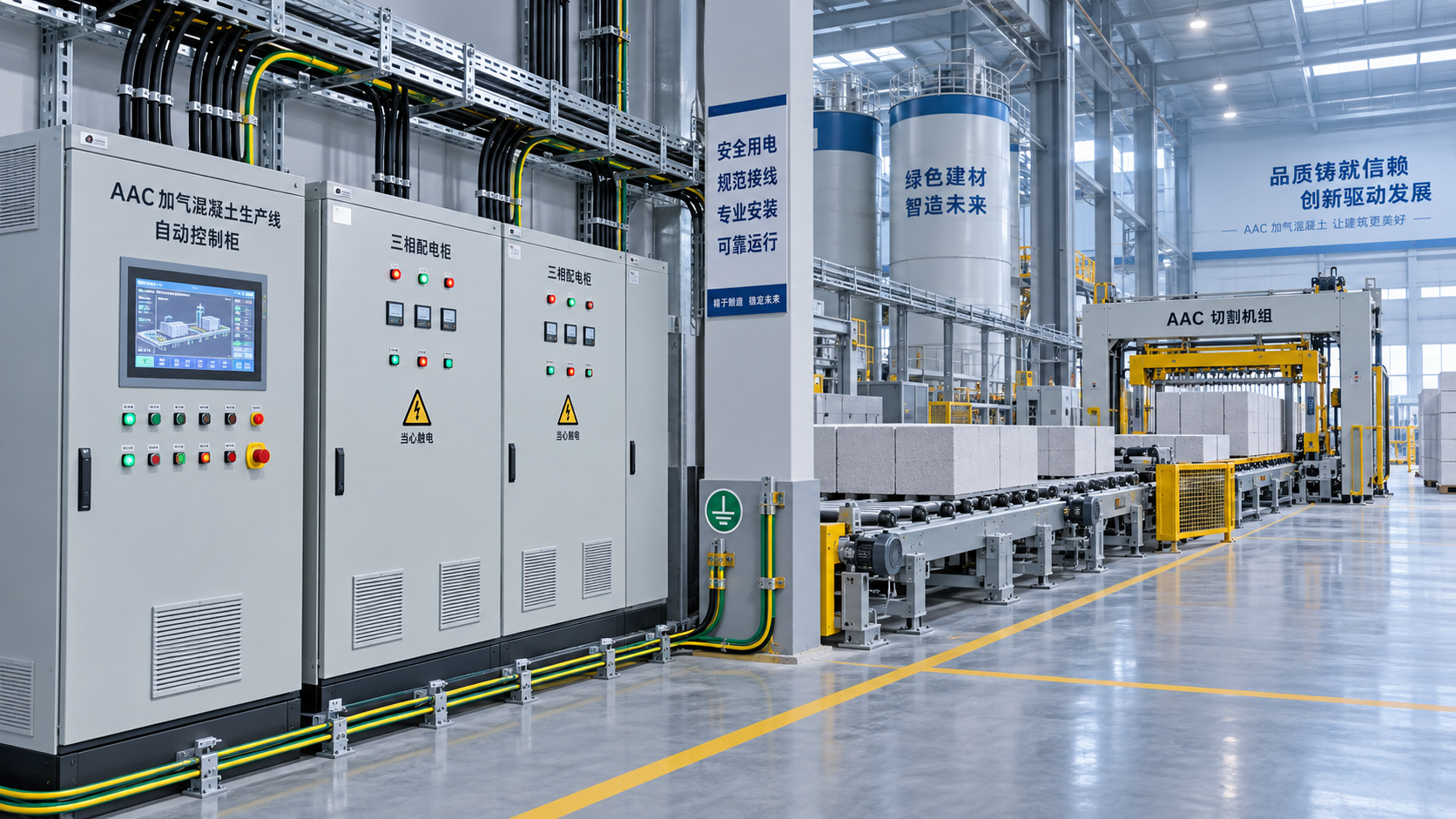
Electrical planning should cover installed load, peak demand, transformer capacity, backup strategy for critical controls, cable routing, grounding, and allowance for future expansion. Water quality and availability also require verification. Process water, boiler feedwater, equipment cleaning, and domestic use may have different treatment requirements. In areas with water restrictions, recycling and wastewater management should be incorporated at the design stage.
Decide the automation boundary based on operating reality
Automation is not an all-or-nothing decision. The right level depends on labor availability, operator skill, production scale, local service capability, and the management team’s ability to maintain control systems.
For a modern AAC line, batching accuracy, slurry control, mold handling, cutting synchronization, autoclave transfer, and production data collection are all areas where automation can reduce variation and improve traceability. Yet automation only supports performance when sensors are calibrated, operators understand process alarms, spare parts are available, and control logic is documented.
When reviewing a proposed control system, confirm who owns the source documentation, what languages are available in the human-machine interface, how historical data can be accessed, and whether remote troubleshooting is possible under local network conditions. Ask for a clear division between automatic functions, manual override procedures, and emergency operating modes.
For project managers, the central question is not “How automated is the line?” It is “Can our team run, troubleshoot, and improve this line after commissioning?”
Look beyond purchase cost to operating cost and maintainability
A lower initial quotation can conceal higher lifetime cost. During equipment comparison, examine consumables, wear parts, lubrication points, cutting-wire replacement, mold maintenance, mill wear, crane components, electrical spares, and the practical availability of replacement parts.
Maintenance access should be reviewed directly on layout drawings and, where possible, during visits to operating references. Can personnel safely inspect drives, change wires, clean slurry equipment, service pumps, access valves, and maintain autoclave door systems? Is there room to remove a motor or gearbox without dismantling adjacent equipment? These details influence the plant’s availability far more than a brochure specification.
Energy consumption should be discussed by process section: raw-material preparation, mixing, handling, steam generation, curing, compressed air, and packing. A credible proposal explains the conditions behind its estimates. Project teams should avoid comparing energy figures from different product densities, material recipes, or operating schedules as if they were directly equivalent.
Build quality control into the process, not only the laboratory
A finished-block test is necessary, but it is too late to correct a poor batch. Strong AAC quality management starts with incoming-material inspection and continues through slurry density, viscosity, temperature, mold filling, rising behavior, pre-curing condition, green-cake strength, cutting accuracy, autoclave cycle, and final inspection.
Define the testing plan before procurement is complete. This includes required laboratory equipment, sampling points, testing frequency, acceptance criteria, data records, and responsibilities. The project team should also align production targets with applicable building-material standards in the destination market.
Many quality issues are traceable to small deviations that went unnoticed: inconsistent lime activity, inaccurate aluminum dosing, delayed casting, uneven pre-curing temperature, or a poorly controlled autoclave cycle. Process data and disciplined operator routines make those deviations visible before they become rejected inventory.
Clarify supplier scope, interfaces, and commissioning responsibilities
Complex industrial projects often encounter difficulties at the boundaries between suppliers. One party provides the main AAC equipment, another designs the boiler system, another builds civil works, and a local contractor handles electrical installation. Unless responsibilities are clearly defined, critical interfaces can be left unresolved.
The equipment contract and technical agreement should identify supply boundaries for foundations, embedded parts, structural steel, piping, cabling, insulation, instrumentation, installation tools, lifting equipment, commissioning materials, operator training, and acceptance testing. Site conditions and local codes should be reviewed before fabrication rather than during installation.
Commissioning should include more than an equipment start-up. It should cover dry testing, interlock verification, material trial runs, recipe adjustment, production stabilization, operator training, maintenance instruction, and documented acceptance criteria. A realistic ramp-up plan recognizes that process tuning takes time, particularly when local materials are being used for the first time.
Manufacturers with broad building-material machinery experience can add value during this stage by connecting equipment design with process support. For example, Hongfa has developed AAC block production lines alongside concrete machinery and other building-material equipment, supported by multiple manufacturing bases, engineering personnel, and an internal focus on equipment research and quality tracking. For buyers, the important point is to assess how that experience translates into engineering support, spare-parts planning, and responsiveness throughout the project—not simply the size of the supplier’s product catalog.
A final decision gate for AAC factory planning
Before issuing the final order, gather engineering, operations, procurement, finance, and site-construction stakeholders for one structured review. The project should be ready to proceed only when the product plan is defined, raw materials have been validated, capacity calculations are understood, utilities are secured, the layout is workable, and supplier interfaces are documented.
The strongest AAC factory planning decisions are rarely the fastest ones. They are the decisions that recognize where the plant will be vulnerable six months after commissioning: a changing fly ash source, a constrained steam supply, insufficient spare parts, limited yard space, or operators asked to manage a system they were never trained to control.
When those questions are addressed before contracts are finalized, the production line becomes more than a collection of machines. It becomes a factory designed to produce stable AAC products, manage operating cost, and adapt to the realities of the market it is intended to serve.
Recommend
 Sep 30, 2026
When does an automated building material production line pay off?
Automated building material production line ROI explained: assess capacity, quality, labor, waste, and total costs to make a profitable investment.
- Oct 01, 2026
How a green building material production line reduces material waste
Discover how a green building material production line cuts waste through precise batching, controlled forming, stable curing, and smart material recovery.
- Oct 02, 2026
What to confirm before finalizing AAC factory planning
AAC factory planning: confirm product mix, raw materials, capacity, utilities, layout, automation, and supplier scope before investing in a reliable, efficient AAC plant.